AITECH ($AITECH) Review
AITECH Review: AITECH powers a decentralized AI economy with GPU marketplaces, green data centers, virtualization, and autonomous AI agents.


Author: Akshat Thakur
Introduction
AITECH is the flagship project of Solidus AI Tech, a company that evolved from Ethereum mining into a leader in high-performance computing (HPC) and AI infrastructure. Its mission is to establish a decentralized, agent-driven AI economy where individuals, enterprises, and institutions can seamlessly access compute resources, AI applications, and autonomous agents. By combining cutting-edge AI data centers, decentralized compute marketplaces, and a modular AI application ecosystem, AITECH is addressing the urgent global demand for scalable AI infrastructure.
The project is positioned at the convergence of AI, blockchain, and DePIN (Decentralized Physical Infrastructure Networks), sectors that are expected to drive technological transformation in the next decade. As AI becomes central to decision-making, creativity, and business processes, centralized models controlled by large corporations raise concerns about accessibility, trust, and systemic bias. AITECH’s ecosystem is designed to counter these issues by enabling democratized AI access, verifiable governance, and regulatory compliance.
Its infrastructure emphasizes eco-friendly AI data centers, GPU virtualization, and tokenized incentives that allow enterprises, SMEs, and individuals to participate in the AI economy. By also introducing retail-facing AI products such as AvaChat and AVA agents, AITECH creates a user-first experience that broadens engagement beyond enterprise-level adoption. This dual focus on institutional trust and retail accessibility makes AITECH one of the most ambitious and versatile projects in the decentralized AI landscape.
Problem Statement
- Dominance of Centralized AI Providers: The AI industry is dominated by a handful of large corporations with exclusive control over GPU infrastructure and vast datasets. This centralization stifles competition, creates systemic bias, and concentrates power.
- High Barriers to Compute Access: Advanced GPU and TPU resources needed for AI training and inference are expensive and scarce. SMEs and individuals struggle to access compute power, while enterprises face cost inefficiencies and bottlenecks.
- Compliance and Trust Gaps: Regulated industries, governments, and institutions require AI solutions that meet compliance and transparency standards. Many decentralized AI initiatives fail to satisfy these criteria, preventing large-scale institutional adoption.
- Underutilization of GPU Clusters: GPU clusters often operate below full capacity due to lack of fractionalization and inefficient allocation. This wastes resources and inflates costs across the ecosystem.
- Complex AI App Deployment: Developers face technical and financial barriers in deploying scalable AI applications. Limited tools and unified marketplaces hinder innovation and adoption.
- Minimal Retail Participation in AI: The benefits of AI adoption are concentrated in enterprises. Retail users lack access to AI agents, governance participation, and token-based rewards that could empower them in the ecosystem.
Solutions Provided by AITECH
- Enterprise-Ready AI Data Centers: To counter centralization, AITECH operates eco-friendly, enterprise-grade HPC data centers designed for AI workloads. These facilities provide secure, scalable, and reliable infrastructure accessible to enterprises and governments while diversifying away from Big Tech monopolies.
- Decentralized Compute Marketplace: To lower barriers to access, AITECH introduces a DePIN-powered compute marketplace where enterprises, SMEs, and individuals can rent GPU and AI compute resources. This ensures fair distribution of global demand and reduces costs.
- Compliance-Driven Infrastructure: To address regulatory and trust gaps, AITECH embeds compliance and transparency into its infrastructure. By meeting international standards, it becomes a viable choice for governments, financial institutions, and large enterprises seeking reliable AI services.
- GPU Virtualization and Fractional Access: To solve underutilization, AITECH implements GPU partitioning that enables fractional access. This maximizes GPU utilization, reduces wasted capacity, and allows smaller participants to harness powerful compute at affordable costs.
- Multi-Layer AI Marketplace: To simplify app deployment, AITECH provides a modular marketplace that includes Foundational Models, Middleware, App Store, Datamart, and Agent Forge. Developers can build, deploy, and monetize AI applications in one ecosystem.
- Retail-Facing AI Agents and Incentives: To broaden retail participation, AITECH introduces consumer AI products like AvaChat and AVA agents, alongside $AITECH staking, DAO governance, and deflationary tokenomics. These features engage mainstream users while ensuring community involvement.
Problem–Solution Overview
Technology and Architecture
- AI Data Centers: HPC infrastructure optimized for GPU clusters with green energy integration.
- Compute Marketplace: On-chain platform for compute leasing via tokenized incentives.
- GPU Virtualization: Fractional GPU allocation powered by open-source frameworks.
- AI Marketplace: Layers include Foundational Models, Middleware, App Store, Datamart, and Agent Forge.
- AI Agents: AvaChat and AVA agents provide multi-platform interaction.
- Blockchain Integration: $AITECH token supports staking, governance, and payments across services.
Technology & Architecture
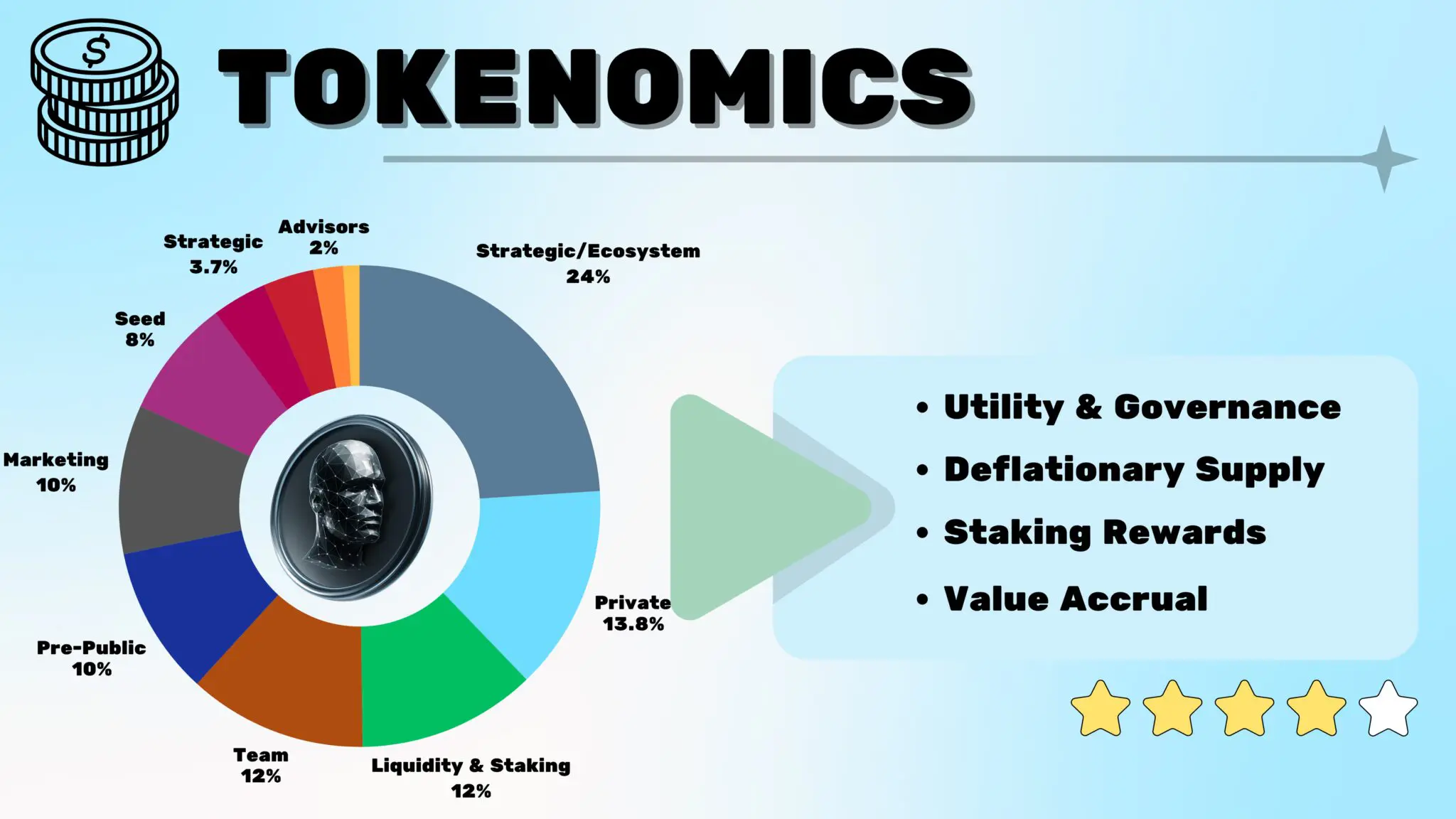
Tokenomics
- Token Utility:
- Payment for compute services and AI marketplace tools
- Staking for governance and rewards
- Yield through hybrid and compound staking pools
- Deflationary mechanism with token burns
- Supply Model:
- Deflationary with periodic burns
- DAO-governed emission adjustments
- Designed for long-term scarcity and value accrual
- Staking Pools:
- Hybrid Pools: Flexible staking with governance rights
- Compound Pools: Auto-compounding rewards
- Governance tiers increase voting influence
Distribution:
- Strategic/Ecosystem: 24%
- Private: 13.8%
- Liquidity & Staking: 12%
- Team: 12%
- Pre-Public: 10%
- Marketing: 10%
- Seed: 8%
- Strategic: 3.7%
- Public: 3.4%
- Advisors: 2%
- Kol: 1.1%
Market Performance
📊 Market Performance
Team
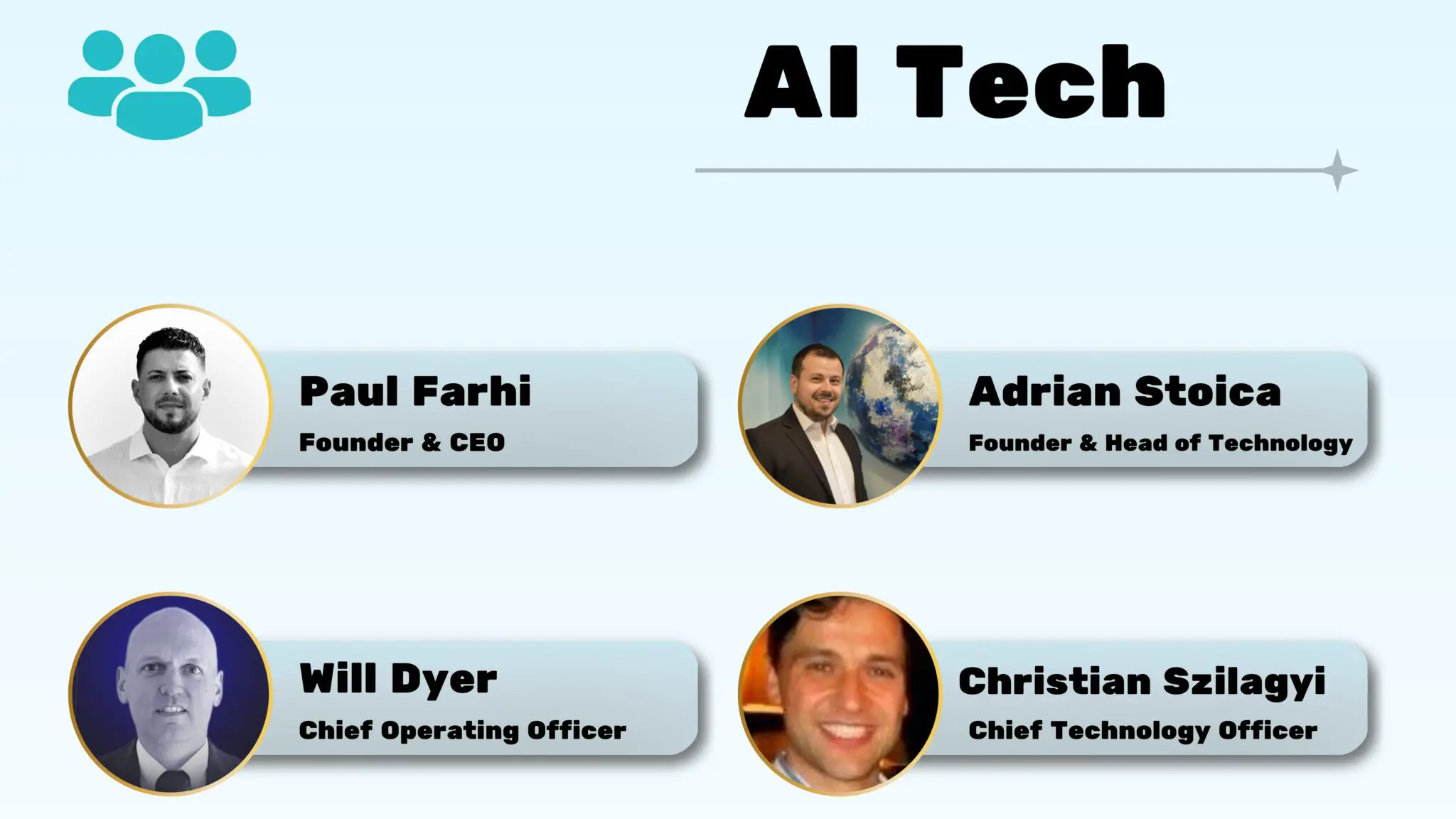
The project is led by Solidus AI Tech, transitioning from Ethereum mining to enterprise-grade HPC and AI solutions. The team emphasizes regulatory compliance, eco-friendly infrastructure, and integration with both Web2 and Web3 ecosystems. Its mix of blockchain developers, AI researchers, and enterprise experts strengthens execution potential.
- Paul Farhi: Founder & CEO.
- Adrian Stoica: Founder & Head of Technology & Development.
- Will Dyer: Chief Operating Officer.
- Christian Szilagyi: Chief Technology Officer.
Project Analysis
Comparative Overview
- Vs. Render Network (RNDR): RNDR focuses on GPU rendering, while AITECH emphasizes compliance-driven AI compute and marketplaces.
- Vs. Akash Network: Akash provides decentralized compute but lacks AI-specific marketplaces and autonomous agent integration.
- Vs. Bittensor: Bittensor creates an incentive layer for AI models, while AITECH builds a holistic AI economy with compute, data centers, and apps.
Strengths
- Enterprise and government compliance positioning
- Modular AI marketplace with multiple layers
- GPU virtualization for accessibility
- Deflationary tokenomics with DAO governance
- Retail engagement via AvaChat and AVA agents
Challenges
- High competition in AI + DePIN sector
- Need for strong partnerships to drive adoption
- Technical complexity of GPU partitioning at scale
- Early-stage ecosystem maturity
Solidus AI Tech (AITECH) vs Decentralized AI / Compute Protocols
TAO) –> Akash Network –>| Project | Core Focus & Innovation | Compliance / Identity | Performance & Notes |
|---|---|---|---|
 Solidus AI Tech (AITECH)
| Hybrid AI + HPC infrastructure with government-grade data centers and blockchain-based access. | Fully KYC/AML-compliant; EU-regulated. | Enterprise-grade compute; semi-centralized for security and reliability. |
 0G (Zero Gravity)
| Decentralized AI OS with modular storage, DA, and compute. | Permissionless. | Full-stack AI infra; early-stage, highly scalable. |
 Ritual
| On-chain AI inference for dApps and smart contracts. | Permissionless (curated infra). | Optimized for devs; lacks native compute/storage. |
|
| Decentralized AI marketplace of subnets. | Permissionless. | Largest active ecosystem; no compliance layer. |
|
| Decentralized ML training marketplace. | Permissionless. | Focused on training verification; not full-stack. |
|
| Decentralized GPU/cloud marketplace. | Permissionless. | Cost-efficient compute; no AI verification/compliance. |
|
| GPU DePIN network for AI workloads. | Permissionless. | Rapid GPU growth; compute-focused only. |
Conclusion
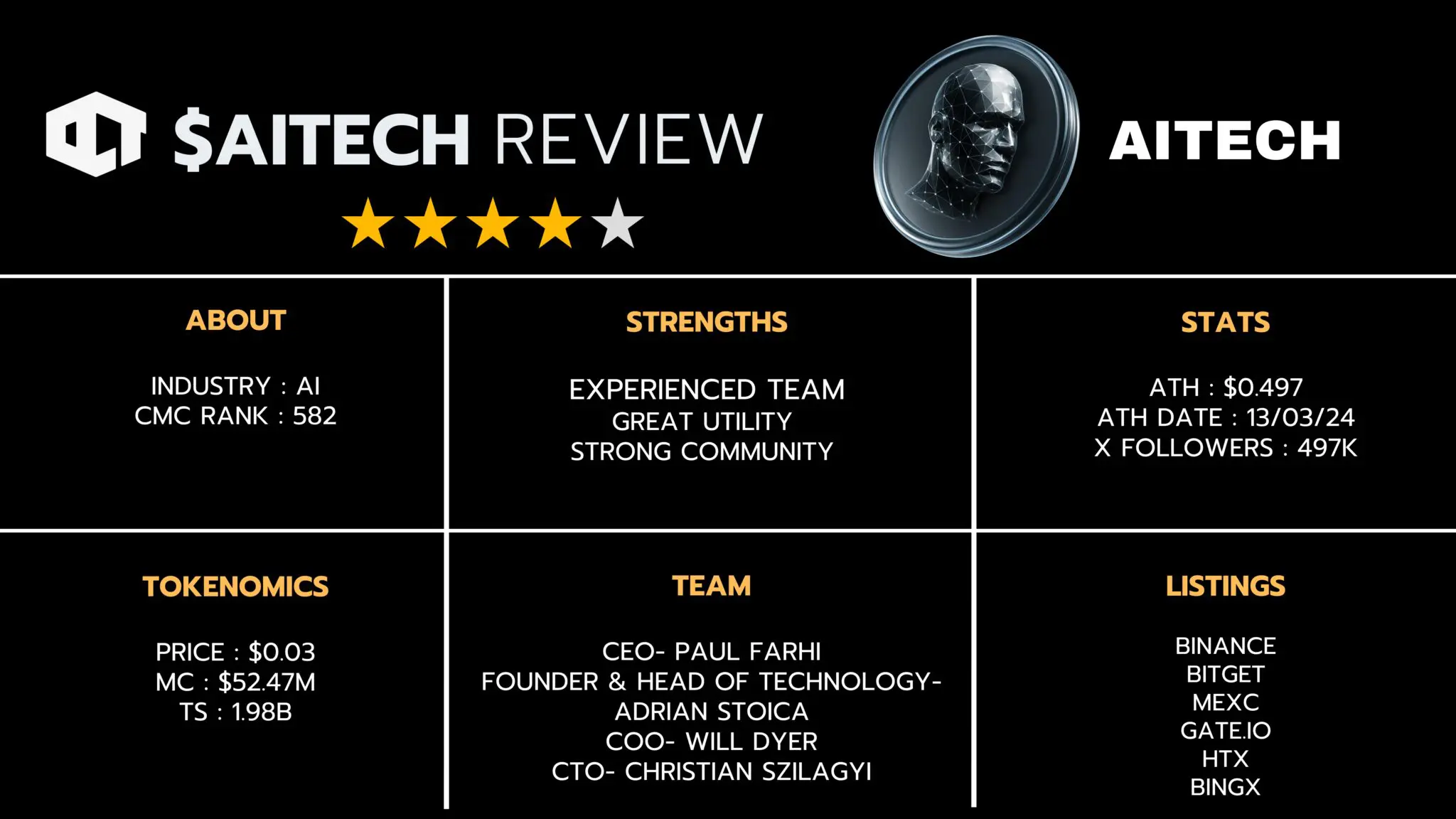
AITECH represents a bold vision to decentralize and democratize access to AI through compliant infrastructure, compute marketplaces, and autonomous agents. By leveraging HPC data centers, GPU virtualization, and a multi-layer AI marketplace, it addresses the inefficiencies of centralized AI while inviting both institutional and retail participation.
What makes AITECH especially compelling is its dual focus: delivering enterprise-ready, regulation-compliant infrastructure for governments and large corporations while simultaneously offering accessible AI agents, staking, and governance tools for everyday users. This balance is rare in the industry and demonstrates the project’s ambition to be more than just another DePIN or AI marketplace it aims to create a fully functional agentic AI economy.
Its strengths lie in compliance readiness, retail engagement, and a deflationary token economy, though challenges remain in competition and adoption speed. Success will depend on execution, ecosystem partnerships, and the ability to attract developers to its AI marketplace. If AITECH achieves these goals, it could evolve into a foundational layer of decentralized AI infrastructure, enabling everything from enterprise-scale deployments to consumer-facing applications.
Ultimately, AITECH has the potential to redefine how people interact with artificial intelligence. By making AI accessible, verifiable, and decentralized, it aspires to create a system that empowers individuals and institutions alike. If it fulfills its roadmap, AITECH could become one of the most important projects bridging the gap between centralized AI monopolies and a fair, inclusive AI-powered future.
Explore More Reviews to Level Up Your DYOR Game.
Frequently Asked Questions
What is AITECH’s main goal?
How does AITECH differ from other AI blockchain projects?
What role does the $AITECH token play?
What is unique about AITECH’s AI marketplace?
How does GPU virtualization benefit users?
Who is behind AITECH?
How does AITECH address compliance?
What are AvaChat and AVA agents?
What makes AITECH deflationary?
What is AITECH’s long-term vision?
In this article
Technology & Architecture 📊 Market PerformanceSolidus AI Tech (AITECH) vs Decentralized AI / Compute Protocols