Learn how NUVA brings institutional assets onchain through RWA vaults, private credit, yield opportunities, and its upcoming token launch.

Author: Akshat Thakur
NUVA is an Ethereum-based marketplace for permissionless real-world asset (RWA) vaults. Users deposit USDC into vaults, receive composable nvAsset tokens, and earn yield from underlying assets such as US residential credit and Figure’s YLDS product. Meanwhile, a points program offers a potential path toward a future NUVA token.
The idea addresses a gap between institutional finance and DeFi. Private credit and regulated yield products often come with high minimum investments, accreditation requirements, and fragmented access. NUVA aims to package these assets into ERC-20 tokens that users can hold and potentially reuse across DeFi.
The model follows a straightforward loop: issuers provide underlying assets, NUVA makes them available through Ethereum vaults, and yield accrues to the value of the vault tokens. Animoca Brands and Nuva Labs, formerly Provenance Blockchain Labs, co-incubated the project.
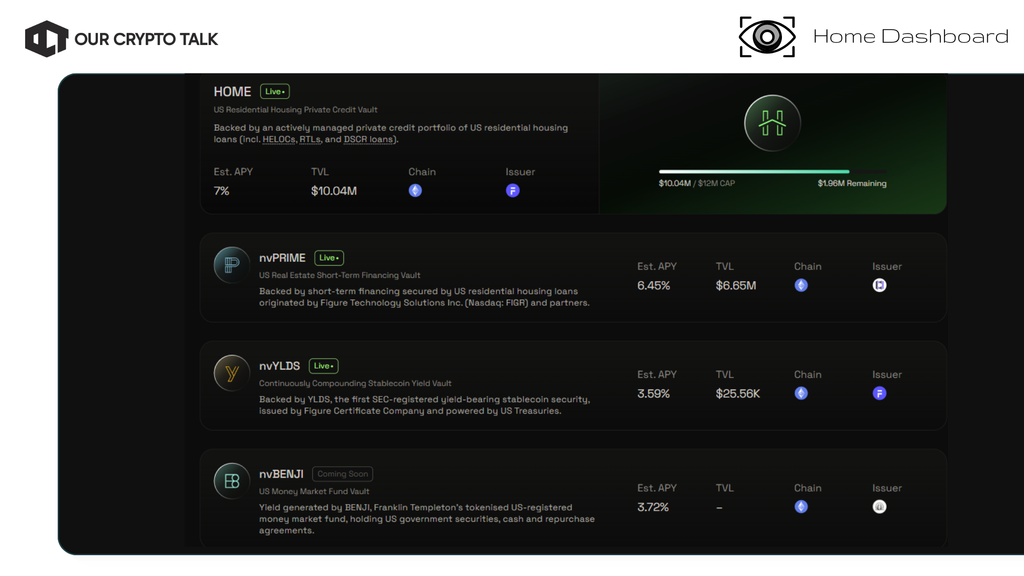
As of October 2026, the platform lists three live vaults. HOME holds approximately $10 million in TVL, offers an estimated 7.25% APY, and has a $12 million cap. It provides exposure to Figure-originated US residential credit. nvPRIME holds around $6.6 million in TVL with an estimated 6.34% APY, while nvYLDS holds roughly $25.56K with an estimated 3.59% APY through an SEC-registered YLDS product.
Combined TVL sits around ~$17 million. NUVA also points to potential integrations with Franklin Templeton, including nvBENJI for non-US access to an onchain money-market fund product.
Timing matters because institutional RWA adoption continues to attract attention, and NUVA already has live vaults backed by identifiable issuers. However, the NUVA token has not launched. The points program and anticipated 2026 listing remain speculative, separate from the yield products already accepting deposits.
NUVA enters a crowded market with competitors that have stronger distribution, larger asset bases, or longer operating histories.
Ondo, BlackRock’s BUIDL, Franklin Templeton’s onchain funds, and Superstate target tokenized Treasuries and investment funds. Centrifuge, Maple, Goldfinch, and Clearpool focus on private credit and structured lending. Figure and Provenance-native products already operate closer to the underlying credit inventory that NUVA wants to distribute.
Other vault aggregators can also package yield-bearing assets into onchain products. That makes NUVA’s positioning important, but it also means competitors could offer similar exposure if issuers permit it.
NUVA’s strongest differentiator is its combination of curated vaults, permissionless access, and composable ERC-20 nvAssets. Its live products provide exposure to Figure-linked housing credit and regulated yield, while its roadmap includes assets from additional issuers such as Franklin Templeton. The team has also discussed revenue sharing or buybacks for staked NUVA tokens.
The live vaults matter more than broad marketplace claims. HOME provides a concrete example of NUVA packaging residential credit into an Ethereum vault, with published TVL, APY, and capacity. That gives the project more substance than an RWA platform that only advertises future integrations.
Still, NUVA has not established a defensible technical moat. Its advantage depends largely on issuer relationships, distribution, and the ability to retain deposits. Animoca Brands, Nuva Labs, Provenance connections, and CEO Anthony Moro’s traditional finance network may help secure that position, but competitors can pursue similar partnerships.
The key metrics to watch are vault retention, growth in deposits, diversification across issuers, and the delivery of announced integrations. Franklin Templeton assets would strengthen the multi-issuer thesis if they launch and attract meaningful capital. Until then, NUVA remains a smaller marketplace operating alongside much larger RWA platforms.
NUVA has an identifiable, institutionally oriented leadership profile, which matters for a platform handling private credit and securities-related products.
Anthony Moro serves as CEO. His background includes executive work at BNY Mellon and experience in American depositary receipts and capital markets. Public interviews and launch coverage have also helped establish his profile within the digital asset and traditional finance sectors.
Nuva Labs, previously known as Provenance Blockchain Labs, brings experience connected to the Provenance ecosystem and its real-world asset infrastructure. That background aligns with NUVA’s focus on bringing institutional credit and yield products into onchain markets.
Animoca Brands co-incubated NUVA and contributes a potential strategic and distribution connection. Yat Siu, Animoca’s co-founder and executive chairman, has also appeared in the project’s broader advisory and funding context. Mike Cagney, Figure’s founder, has featured in round-related commentary as another name connected to the project’s institutional network.
For NUVA, the team’s value ultimately depends on its ability to secure assets from issuers and turn those relationships into deposits. Traditional finance experience can help with institutional access, but titles and connections alone do not guarantee adoption.
The strongest evidence so far comes from the products themselves. NUVA has launched Ethereum vaults, integrated Figure-linked assets, and built a platform with approximately $17 million in combined TVL. HOME’s October 2026 launch adds another operational milestone.
The next test is whether the team can expand its issuer network, retain capital, and deliver additional products without relying solely on incentives or expectations around the future NUVA token.
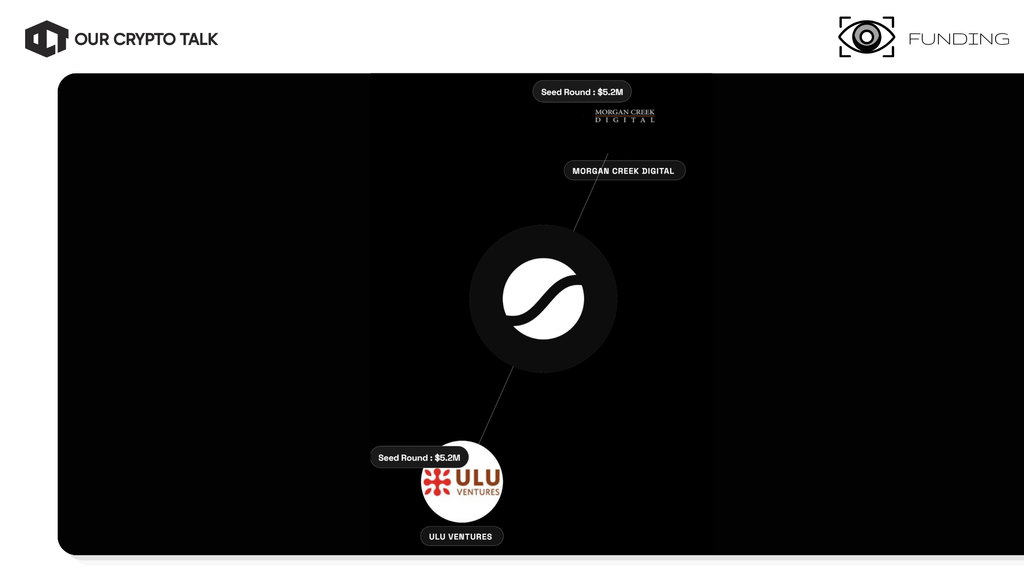
NUVA raised a reported $5.2 million seed round in April 2026, led by Morgan Creek Digital, with Ulu Ventures among the major participants. The round represented the project’s first disclosed external funding tranche.
Animoca Brands and Nuva Labs also co-incubated the project, providing strategic backing beyond the seed round. The wider institutional network includes Figure, whose products underpin some of NUVA’s vault offerings, and a collaboration with Franklin Templeton around additional tokenized assets.
The investor and partner lineup fits NUVA’s strategy. Morgan Creek Digital has a focus on digital assets, Animoca brings experience across blockchain ecosystems, and Figure and Franklin Templeton offer connections to real-world financial products. These relationships could help NUVA access assets that would otherwise remain difficult for DeFi users to reach.
However, the funding remains modest compared with the resources available to major RWA platforms. A $5.2 million seed round can support product development and early growth, and NUVA has already launched vaults with roughly $17 million in combined TVL. It does not provide the same financial runway as a much larger institutional operation.
Long-term sustainability will depend on recurring vault fees, continued deposits, and the ability to expand the product range. A future token launch could provide another funding or ecosystem-development mechanism, but NUVA has not launched its token yet, and that possibility should not be treated as guaranteed financing.
The strongest bullish signal is therefore not the seed headline. It is the combination of live vaults, identifiable underlying assets, and relationships that could unlock further issuer inventory. The next milestone is proving that these advantages can attract and retain substantially more capital.
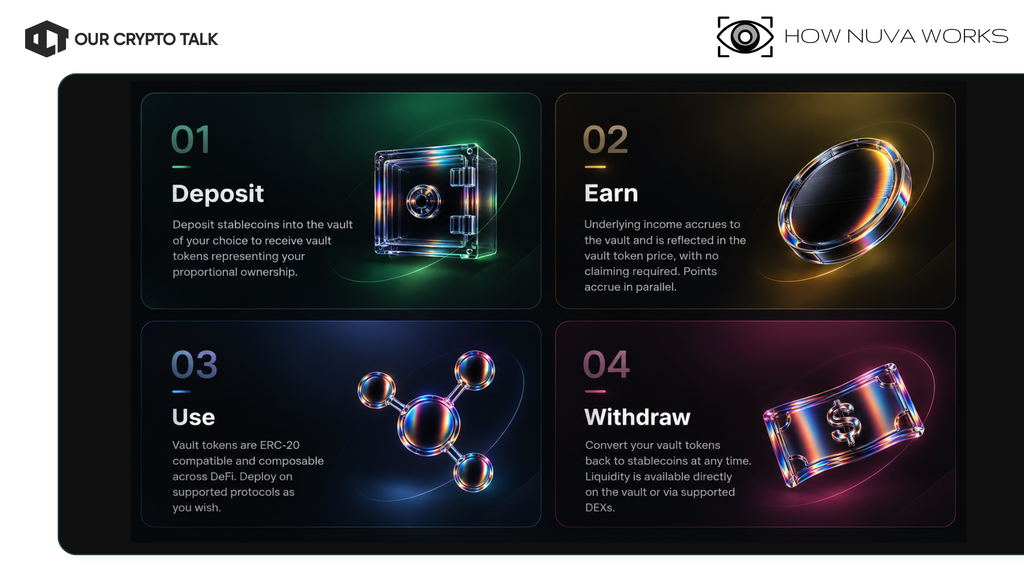
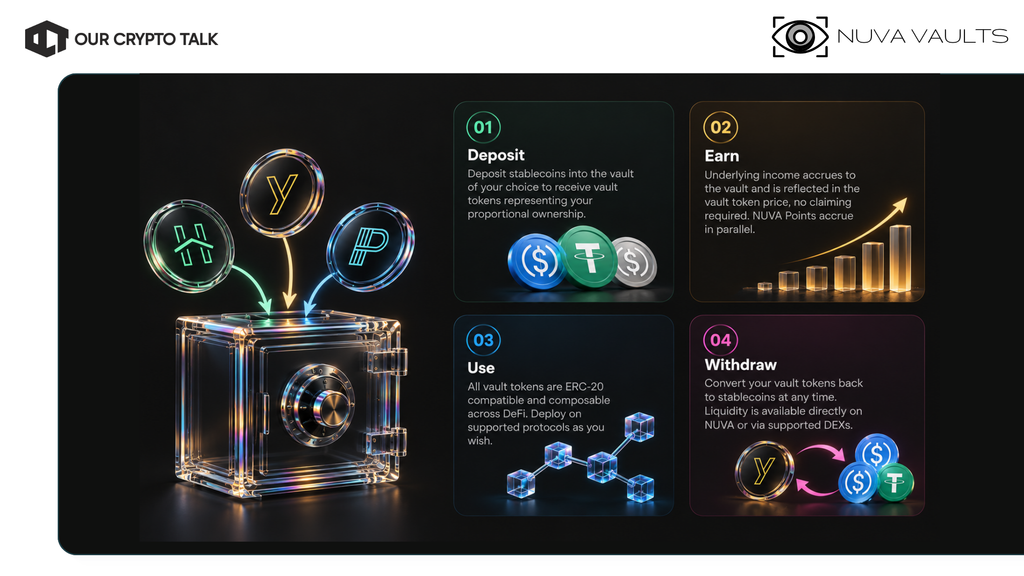
NUVA has a live Ethereum product. Since its May 2026 launch, users have been able to deposit USDC into real-world asset vaults and receive ERC-20 nvAsset tokens that represent their vault shares. Yield accrues through token price appreciation, while withdrawals remain subject to settlement windows, AML checks, and geographic restrictions.
The platform focuses on distributing institutional assets through DeFi rather than building a new blockchain. Users can access vaults through app.nuva.finance, with some nvAssets also designed for use in other DeFi protocols. Project materials, for example, cite nvPRIME’s integration with Morpho.
As of October 2026, NUVA lists three live vaults. HOME (nvHOME) holds approximately $10 million against a $12 million cap and offers an estimated 7.0% to 7.25% APY. It provides exposure to Figure-originated US residential credit, including HELOCs, residential transition loans, and DSCR loans. The structure includes a first-loss buffer of around 5%.
nvPRIME holds approximately $6.6 million and offers an estimated 6.4% APY through short-term financing backed by Figure housing loans. nvYLDS holds around $26,000 and offers an estimated 3.6% APY through a yield-bearing structure linked to YLDS and Treasury exposure. Combined live vault TVL stands near $17 million.
NUVA also lists nvBENJI as a future product, targeting exposure to Franklin Templeton’s onchain money-market fund. The vault remains marked as coming soon, so investors should not count it as live inventory.
The project publishes Ethereum contract addresses, deposit-flow documentation, a 48-hour upgrade timelock, audit information, and an Immunefi bug bounty. Its security setup also references multisig controls, AML screening, and emergency pause mechanisms.
The main product gap is scale and issuer diversification, not product availability. NUVA already distributes real assets through live vaults, but its longer-term marketplace thesis depends on attracting more capital and delivering additional issuer integrations.
NUVA’s strongest traction signal is the amount of capital users have deposited into its vaults. HOME holds around $10 million, close to its $12 million capacity, while nvPRIME holds approximately $6.6 million. A smaller nvYLDS allocation brings combined platform TVL to roughly $17 million.
These deposits carry more weight than social engagement because users commit real USDC and accept the risks associated with the underlying assets. HOME’s near-capacity position also suggests demand for that specific vault, although it does not establish lasting demand across NUVA’s entire marketplace.
The project has also secured $5.2 million in seed funding led by Morgan Creek Digital. That capital provides an additional signal of investor commitment beyond free sign-ups or social campaigns.
NUVA’s underlying asset relationships offer another source of potential growth. Figure-originated housing credit and YLDS provide inventory for existing vaults, while Provenance-related updates cite much larger RWA figures at the issuer or chain level. Those figures describe the wider ecosystem, not NUVA’s own assets under management.
Operational constraints also distinguish NUVA from a typical points farm. HOME withdrawals can take around three US business days, and users face AML screening and geographic restrictions. These requirements reflect the realities of distributing real-world financial assets through onchain products.
The points program adds another layer. Season 0 ended on October 1, 2026, with deposits, holding duration, and referrals contributing to points. However, social campaigns and Genesis Pass-style promotions do not necessarily demonstrate capital commitment or recurring product usage.
X followers, points screenshots, and headlines citing billions in RWA inventory deserve less weight than actual vault deposits. NUVA’s approximately $17 million TVL represents early operating traction, but it remains small compared with leading tokenized Treasury and credit platforms.
The next test is whether NUVA can retain deposits, expand beyond its existing issuer relationships, and grow TVL without relying primarily on points incentives.
NUVA has not launched its token. Project documentation targets a 2026 listing, but investors cannot yet assess its market valuation or circulating supply.
The published design sets total supply at 1 billion NUVA tokens, with six decimals. The project describes a majority-community distribution, but the available information does not provide a complete allocation table with precise percentages, vesting schedules, and unlock dates.
The proposed sNUVA staking model includes revenue sharing, boosted vault yields, fee discounts, and governance. The project also describes a value-accrual mechanism in which protocol revenue supports staking rewards and buybacks. These features could give the token a stronger economic link to platform activity than a token that relies entirely on inflationary rewards.
However, these mechanisms remain a design thesis until the token launches and generates verifiable economic activity. With approximately $17 million in current vault TVL, the scale of future fee revenue will determine how much value the protocol can distribute to stakers or use for buybacks.
The project also outlines progressive governance through a NUVA Foundation and a Cayman-based structure, with early governance remaining more foundation-led. Points may determine eligibility for an airdrop or possible ICO participation, but the project has not published a definitive allocation size, conversion rate, or TGE date.
This uncertainty makes FDV and circulating supply impossible to assess today. A strong RWA narrative can still produce an expensive launch valuation, particularly if the initial float is small. Without the full allocation and vesting tables, investors cannot quantify potential insider selling or future dilution.
Points also reset between seasons, making farming episodic rather than permanent. The tokenomics concept is coherent, but the entry structure remains unproven.
NUVA’s vaults can be used without owning the future token. Until the team publishes initial circulating supply, allocations, vesting schedules, and launch valuation, the token should remain a speculative possibility rather than the primary reason to deposit USDC.
NUVA’s early-access strategy revolves around vault deposits and points rather than a confirmed public token presale.
Users can deposit USDC into HOME, nvPRIME, or nvYLDS through app.nuva.finance. When a points season operates, deposits, holding duration, and vault-specific weighting can contribute to points accrual. Referrals may also earn a share of referred users’ points, subject to seasonal limits.
Season 0 ended on October 1, 2026. Based on the information available in the supplied October coverage, Season 1 had not yet started. Users should therefore check the official app and announcements before committing capital specifically to farm points.
The documentation also identifies potential future rewards for liquidity provision on approved DEX pairs, DeFi use of nvAssets, and social activity. Several of these routes remain unavailable or marked as coming soon, so they should not be treated as active reward opportunities.
NUVA’s FAQ links points to potential airdrop eligibility and possible ICO participation. However, the project has not confirmed the airdrop pool, points conversion rate, or final token allocation. Earning points does not guarantee a meaningful token distribution.
The more immediate decision is whether the vault itself makes sense. Current estimated yields range from around 3% to 7%, depending on the product. Those returns come with real risks, including underlying credit exposure, settlement delays, smart-contract vulnerabilities, and geographic or AML restrictions. HOME’s approximately 5% first-loss buffer also does not eliminate credit losses.
If Season 1 remains inactive, depositing USDC is primarily a real-world asset yield decision, with potential token eligibility as an additional possibility. When points return, users will still need to weigh the value of the expected rewards against the risks of locking capital into the vaults.
NUVA may suit users who already want exposure to these underlying assets and accept the associated restrictions. It is much harder to justify deposits, leverage, or oversized positions purely for an unconfirmed airdrop.
NUVA presents two separate opportunities: earning yield from its live RWA vaults and farming points ahead of a potential token launch. The risk and expected return differ considerably between them.
Season 0 ended on October 1, 2026, and NUVA has not launched a tradable token. With Season 1 still offline, the immediate expected value of farming points is close to zero.
When the next season opens, rewards will depend on factors such as deposit size, holding duration, and vault weighting. That makes NUVA a capital-intensive farm rather than a campaign where users can earn meaningful allocations through a few hours of social tasks. The airdrop pool, conversion rate, and eventual fully diluted valuation remain unknown.
Depositing USDC for yield is a different decision. NUVA’s live vaults offer estimated APYs of roughly 3% to 7%, depending on the product. Those returns come with exposure to underlying credit, settlement delays, geographic restrictions, and the structure of each vault. HOME’s first-loss buffer of around 5% offers some protection, but it does not eliminate the risk of losses.
The future token presents another uncertainty. NUVA has raised $5.2 million and built a live platform with approximately $17 million in TVL, but neither figure determines whether the token will launch cheaply or at an inflated valuation. Without published allocation details, initial circulating supply, and vesting schedules, investors cannot properly assess dilution or insider selling pressure.
The expected-value picture is straightforward:
NUVA is worth considering as a small, informed RWA allocation if the underlying assets suit your risk tolerance. The points program should remain a bonus, not the main reason to deposit capital. As a token investment, the expected value remains undefined until the team publishes its launch terms.
NUVA’s biggest risks concern credit quality, regulation, and distribution. A working vault interface cannot protect the business from losses in its underlying assets or prevent competitors from securing the same issuer relationships.
Competition is already intense. Ondo, BlackRock’s BUIDL, Franklin Templeton’s own distribution channels, Maple, Centrifuge, and Figure’s direct channels compete for institutional assets and investor attention. NUVA could struggle if issuers prefer distributing products themselves or working with larger platforms. Its curated vault interface is replicable, and the team has not established exclusive access to its underlying inventory.
Market conditions create another vulnerability. Falling interest rates could compress Treasury yields, while private-credit losses could weaken demand for onchain credit products. HOME approaching its $12 million cap signals demand for one vault, not proof that NUVA can sustain diversified assets under management through a full market cycle.
Points incentives also create the risk of mercenary capital. Users may deposit USDC to earn rewards and withdraw when a season ends or the token launches. Referral caps and seasonal resets may limit some behavior, but neither guarantees sticky TVL.
Regulation poses a more serious challenge. Tokenized securities, money-market fund exposure, and private-credit products can attract scrutiny over securities rules and investment-company requirements. US residential lending also brings servicing, disclosure, and credit risks. AML screening and geographic restrictions support compliance but limit market access and can complicate withdrawals. Any attempt to distribute US-registered products internationally, including the planned nvBENJI offering, requires careful attention to jurisdictional rules.
The token’s proposed revenue sharing, boosted yields, and airdrop incentives could also invite scrutiny depending on how NUVA markets and structures the eventual launch.
There is a structural risk as well. nvAssets may look like straightforward DeFi yield tokens, but their underlying assets include private credit and regulated financial products. HOME withdrawals can take around three US business days, and its first-loss buffer sits near 5%. These features make liquidity and credit risk central to the investment case. Holders who treat a 7% estimated APY as risk-free yield may underestimate the possibility of losses or delayed redemptions.
Execution remains another concern. NUVA has raised a modest $5.2 million seed round, its TVL remains small relative to category leaders, Franklin’s vault is still pending, Season 1 has not restarted, and the full token allocation remains unpublished.
NUVA is not a technical copy of a single famous AMM. It follows a familiar RWA distribution model: institutional assets, Ethereum vaults, points, and a planned governance token. Its long-term position will depend on issuer access, trust, and sustained deposits rather than architectural novelty alone.
NUVA’s next major catalysts concern token launch details, points incentives, and the expansion of its underlying asset inventory.
The first is the restart of Season 1. A new points season would reopen the farming opportunity, but users need clear reward rules before estimating whether the potential allocation justifies the capital commitment.
The second is publication of the tokenomics and TGE terms. The initial circulating supply, fully diluted valuation, allocation breakdown, and vesting schedules will determine whether the launch offers a reasonable entry or exposes buyers to excessive dilution.
Third, the launch of nvBENJI would provide evidence that NUVA can expand beyond Figure-linked products. Additional Franklin Templeton capacity could strengthen the multi-issuer thesis, provided the vault attracts meaningful deposits.
Fourth, sustained TVL growth matters more than temporary points-driven inflows. Higher vault caps and deposits that remain after reward seasons would help demonstrate durable demand. Investors should also monitor whether the platform generates meaningful fees and whether the proposed sNUVA revenue-sharing and buyback mechanisms become operational after TGE.
Act now or wait three months?
Consider NUVA now only if you want exposure to its underlying RWA vaults and accept the associated credit and liquidity risks. For a token investment, waiting for the points restart and full TGE terms offers a clearer basis for evaluating the opportunity.
The main catalysts are already identifiable: Season 1, Franklin’s delivery, sustained multi-vault TVL, and the token’s initial valuation and supply structure.
NUVA has live Ethereum vaults, identifiable institutional underlyings, published yield estimates, security documentation, and approximately $17 million in combined TVL. It has moved beyond the concept stage, but it has not yet established the scale or token economics needed to justify a high-conviction token allocation.
The immediate limitations are clear. Season 0 has ended, Season 1 remains inactive, the full token allocation is unpublished, and NUVA’s TVL remains small compared with established RWA platforms. Credit exposure, redemption delays, regulatory restrictions, and reliance on issuer relationships add risks that a polished DeFi interface cannot remove.
This is not a compelling points farm while rewards remain paused. The underlying vaults may still suit users who want their particular yield exposures, but that decision should stand on its own without assuming a future airdrop will compensate for the risks.
The milestone that would change the rating is publication of the full token allocation, initial circulating supply, and TGE FDV, alongside a live Season 1 and sustained growth across multiple vaults. Meaningful deposits into Franklin or other non-Figure products would strengthen the case further.
On the downside, a credit loss, redemption problem, or regulatory action that undermines the platform’s yield proposition could materially weaken the thesis.
Until those questions have answers, NUVA belongs on the watchlist. The product is real, but the token’s investment case still needs evidence.
All the opinions in this article are that of the author and in no way are financial advice. Our Crypto Talk and the author always suggest you do your own research in crypto and to never take anything as financial advice that you read on the internet. Check our Terms and conditions for more info.


RWA Needs Better Access. Can NUVA Deliver?
Tokenization of RWA yields onchain might be the biggest opportunity that no one has noticed
Cold Wallet Safety 2026: Are Hardware Wallets Still Safe?
One Token, Multiple Products. Can Zylo Deliver?
RWA Needs Better Access. Can NUVA Deliver?
Tokenization of RWA yields onchain might be the biggest opportunity that no one has noticed
Cold Wallet Safety 2026: Are Hardware Wallets Still Safe?
One Token, Multiple Products. Can Zylo Deliver?

Aave