Kaspa ($KAS) Review 2026: Is It Worth Investing In?
An honest review of Kaspa’s BlockDAG covering Crescendo, smart contract plans, tokenomics, mining, risks, & whether $KAS is a solid 2026 bet.


Author: Akshat Thakur
What Is Kaspa? (How BlockDAG Works)
When people ask what is kaspa, they’re usually trying to understand why it’s getting attention in 2026. The answer comes down to how it handles blocks.
Kaspa is a proof-of-work network, but it doesn’t follow the standard one-block-at-a-time model. Instead of a linear chain, it uses a BlockDAG. That allows multiple blocks to be created and confirmed at the same time.
In a typical blockchain, miners compete for a single block. One gets accepted, the rest are thrown away as orphan blocks. That limits speed and wastes work. Kaspa removes that constraint. Blocks are produced in parallel and included rather than discarded.
This is made possible by the GHOSTDAG protocol. Instead of selecting a single longest chain, it evaluates how blocks connect across the network and orders them based on honest activity. That’s how Kaspa keeps consensus without slowing down block production.
In practice, this design makes the network feel fast. Transactions confirm quickly, and throughput is much higher than traditional proof-of-work systems. At the same time, it doesn’t rely on staking or Layer 2 scaling. It stays true to PoW.
From a 2026 perspective, this is where most of the value sits. The architecture is strong and clearly solves a real limitation in older blockchains.
But there’s a gap.
Kaspa still lacks a mature application layer. The tech is ahead, but adoption is still catching up. That’s the part this kaspa review 2026 can’t ignore. If usage doesn’t follow, the advantage stays theoretical.
So if you’re trying to understand what is kaspa, don’t think of it as just a faster chain. It’s a different structure entirely. The idea works. Now it needs to prove it can support real demand.
Kaspa Technology Explained (GHOSTDAG, 10 BPS, Sub-second Confirmations)
Kaspa’s tech story in 2026 is simple. It shipped. The Kaspa network is now running at 10 blocks per second after the Crescendo upgrade. This isn’t a testnet claim or a roadmap promise. It’s live on mainnet, and it changes how the network behaves under real usage.
The reason this works comes back to the GHOSTDAG protocol. Instead of forcing blocks into a single chain, it allows them to exist in parallel and then orders them based on how well they connect to honest activity. That removes the usual bottleneck where only one block can win at a time.
In practice, this means blocks are not competing to survive. They are contributing to throughput. That alone separates Kaspa from most proof-of-work systems.
The numbers back it up. During a public stress test in 2025, the network handled 5,584 transactions per second. That’s not theoretical scaling. That’s under pressure. At the same time, transactions land almost instantly and get their first confirmation in about a second.
This is where the evaluation becomes clear. Kaspa is not chasing speed through shortcuts. There’s no staking layer, no sharding complexity, and no dependence on rollups. It scales the base layer directly. That’s rare.
But there is still execution risk. Running at 10 BPS is one thing. Sustaining higher rates like 25 or 100 BPS will depend on node performance and network conditions. If that doesn’t scale cleanly, the advantage narrows.
Still, compared to most competitors, Kaspa is already operating where others are still experimenting. That puts it ahead on the only metric that matters here. What’s live.
Kaspa Tokenomics & Supply
If you look at kaspa tokenomics supply, the structure is aggressive by design.
There is a fixed maximum supply of 28.7 billion KAS. No foundation. Zero VC backing. No insider allocation. Everything entered circulation through mining. That part is straightforward and aligns closely with early proof-of-work principles.
The difference is in how fast the supply was distributed. Kaspa uses a chromatic emission model. Instead of large halving events every few years, rewards decrease gradually every month. The curve is smooth, but the impact is the same. Supply gets cut in half roughly every year.
This leads to a front-loaded distribution. A large portion of the supply was mined early when participation was low. That created selling pressure at the time, and it showed in price performance.
But that phase is mostly done. By 2026, over 90 percent of the supply is already mined. That changes the dynamic completely. New issuance is no longer a major source of pressure. The asset moves closer to a scarcity-driven model much earlier than something like Bitcoin.
This is where Kaspa stands out.
Bitcoin spreads its emission over more than a century. Many altcoins keep inflating through staking rewards. Kaspa compresses distribution into a much shorter window and then slows down sharply.
That creates a cleaner long-term structure, but it comes with trade-offs. Early volatility was high. Miners and early holders had a large share, and that supply needed to be absorbed. The market had to digest it. That’s the cost of fast distribution.
My view is simple. The difficult phase is behind it. What’s left is a network with minimal new supply entering circulation and no hidden inflation mechanics.
If demand doesn’t show up, then even strong tokenomics won’t matter. That’s the real position Kaspa is in right now. Strong structure. But it still needs to prove it can pull in sustained demand.
Kaspa Mining in 2026
Kaspa mining in 2026 is no longer in its early phase. The easy entry window is gone.
Kaspa runs on the kHeavyHash algorithm. It was designed to favor efficiency over brute force, with a strong focus on core computation instead of memory-heavy workloads. Early on, that gave GPUs a fair shot.
That phase didn’t last.
ASICs now dominate the network. Machines from Bitmain and Iceriver are far ahead in hash rate and power efficiency. GPUs still work, but they are not competitive if you are paying for electricity. At best, they make sense for hobby setups or situations where power is cheap or already sunk.
Mining today is mostly done through pools. Solo mining exists, but it is unrealistic unless you control serious hash power. Pools smooth out rewards and reduce variance, which is necessary at current difficulty levels.
At 10 blocks per second, the network produces a block roughly every 100 milliseconds. The reward sits around 5.5 KAS per block and keeps decreasing under the chromatic emission model. That means rewards are consistent in frequency but gradually shrinking in size.
If you are searching how to mine kaspa 2026, the process itself is not complicated. You need a wallet, mining software, and access to a pool. The real barrier is hardware efficiency. Without ASICs, profitability is limited.
My view is straightforward. Kaspa mining has already followed the same path as Bitcoin. It moved from accessible to specialized. That raises concerns around hardware concentration, especially with a few manufacturers controlling supply. But the network itself remains open. Anyone can still participate, just not on equal footing.
Kaspa Roadmap & 2026 Developments
Kaspa’s roadmap is one of the few that actually moved forward.
The Crescendo hardfork already delivered 10 blocks per second on mainnet. That set the base layer for everything else. The Rusty Kaspa upgrade improved node performance and reduced sync times, which matters more than most people think. If nodes can’t keep up, higher throughput becomes meaningless.
Now the focus shifts to the kaspa toccata hardfork.
Toccata is expected to introduce native assets and covenants through SilverScript. This is the first real step toward programmability on Kaspa without turning it into a heavy smart contract platform. The design stays closer to Bitcoin-style scripting but expands what can be built on top.
Then comes the kaspa dagknight upgrade.
DAGKnight is not just another feature. It changes how the network handles block ordering under real-world conditions. Instead of relying on fixed assumptions, it adapts to network latency. That is key if Kaspa wants to move beyond 10 BPS without breaking consensus reliability.
vProgs sits further out. It aims to bring verifiable computation directly on-chain. If it works as intended, it could open the door to more complex applications without sacrificing performance. But this is still early and not something to price in yet.
Here’s the honest take.
Kaspa has executed better than most projects so far. Crescendo and Rusty are already live and working. Toccata is the next real test because it moves Kaspa from pure infrastructure to actual usability. DAGKnight is even more critical. If it succeeds, Kaspa can push throughput further while staying stable.
But there is still risk. Delays are happening. Some features are still in development. And until Toccata is live, the ecosystem remains limited.
The direction is strong. The execution has been solid. Now it needs to translate into real usage.
Team & Ecosystem
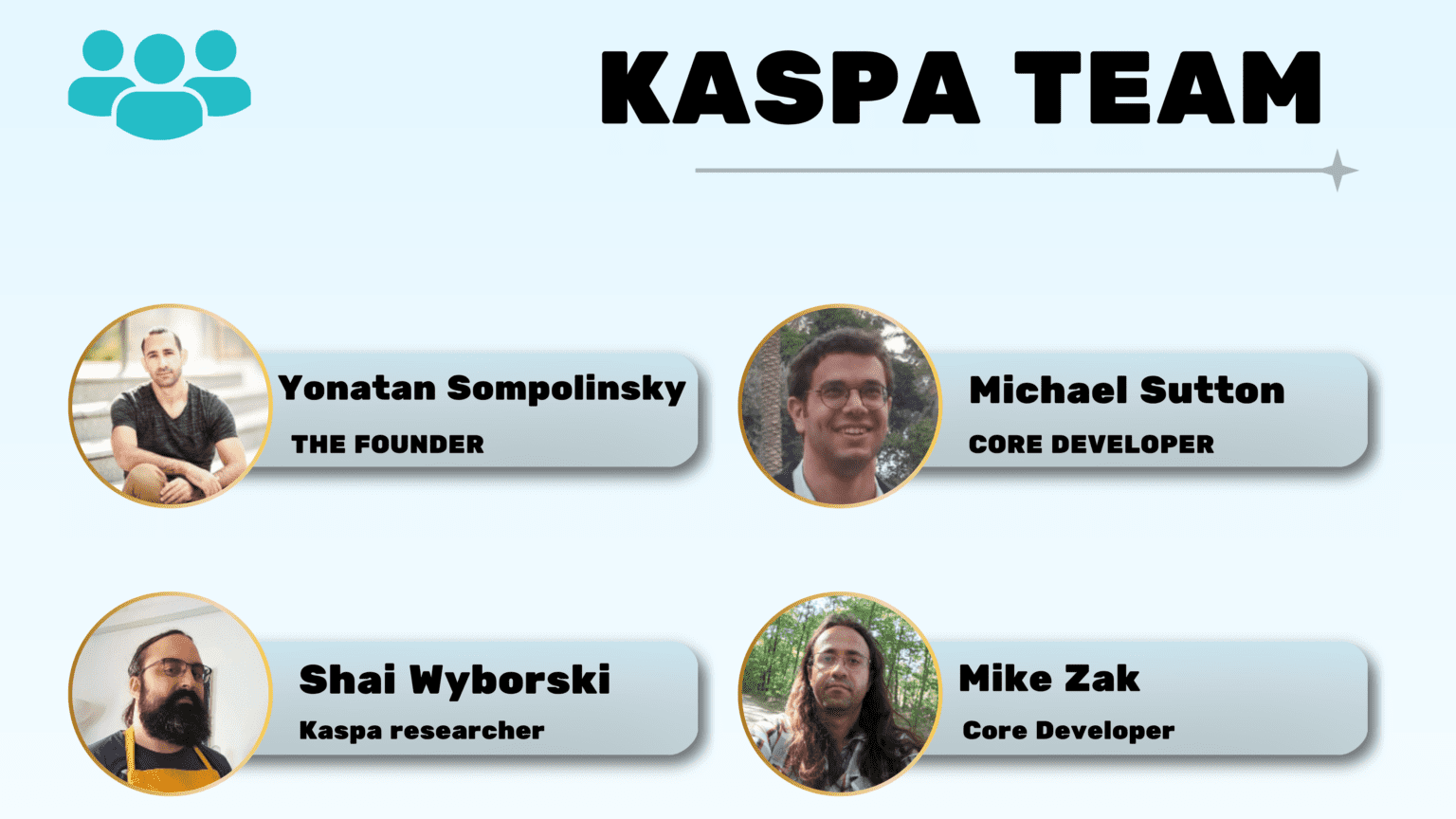
Kaspa didn’t follow the usual playbook. No foundation. Zero VC backing. No insider allocation.
Kaspa runs as a community-driven network. Development is open. Decisions are visible. Funding comes from contributors and community-managed pools, not a centralized treasury controlled by a few players.
The core direction still traces back to Yonatan Sompolinsky. His research laid the groundwork, but the project itself is no longer dependent on a single figure. A small group of developers continues to push upgrades, while most of the ecosystem growth comes from independent teams building on top.
That model has trade-offs.
On one side, alignment is strong. There is no pressure to inflate the token or chase hype cycles. No one is sitting on a massive allocation waiting to exit. That gives Kaspa a cleaner foundation than most projects.
On the other side, growth has been slower. Without aggressive funding, expansion relies on organic traction. That’s harder, especially in a market driven by narratives.
This structure is a long-term advantage, but only if usage follows. A strong community can build momentum, but it won’t replace real adoption. Kaspa is moving in the right direction, just not at the pace of heavily funded ecosystems.
Kaspa vs Bitcoin vs Solana
If you’re searching kaspa vs bitcoin, you’re not looking for theory. You want a clear comparison of how these systems actually perform.
Here’s the breakdown.
Architecture
Consensus
Speed
Now the real context behind the table.
On architecture, Kaspa is the only one trying to scale proof-of-work at the base layer. It removes the single-chain bottleneck by allowing parallel block production. Bitcoin stays deliberately simple and slow. That design has held up for over a decade. Solana pushes performance through a more complex system that depends on high-performance validators.
On speed, the gap is obvious. Bitcoin is not competing here. It trades speed for reliability. Solana is fast, but that speed has come with instability at times. Kaspa is the only one delivering high throughput with proof-of-work, and it is already live at 10 blocks per second. That matters more than theoretical numbers.
On ecosystem, Bitcoin leads in trust and capital. Solana leads in usage and applications. Kaspa is still catching up. It has momentum, but it is not yet in the same league in terms of real activity.
Here’s the straight take. Bitcoin is the safest asset. Solana is the most active network. Kaspa has the strongest design for scaling decentralized money.
But design alone doesn’t win.
If Kaspa converts its technical edge into real adoption, it becomes a serious competitor. If it doesn’t, then the comparison stays theoretical. Right now, it is somewhere in between, and that’s the honest position.
Is Kaspa a Good Investment in 2026?
If you’re asking is kaspa a good investment or is kaspa worth buying, you need a clear stance, not hype.
Bull case: Kaspa already proved its core claim. It scales proof-of-work at the base layer. 10 blocks per second is live. Confirmations are fast. That alone puts it ahead of most PoW competitors.
Supply is also working in its favor. Over 90 percent is already mined. Emission is dropping every month. That reduces constant sell pressure, which has been a problem for many altcoins.
The next trigger is adoption. If upgrades like Toccata bring real usage, the combination of strong tech and tight supply can move price quickly. That’s the upside people are betting on.
Bear case: Right now, usage does not match the tech. The ecosystem is still small. That’s the biggest gap. Price action reflects this. After the earlier run, momentum slowed. That shows demand is not strong enough yet to sustain growth.
There is also execution risk. Delays in key upgrades hurt confidence. If timelines keep slipping, the narrative weakens. Liquidity is another issue. Without top-tier exchange access, growth is slower and more fragile.
Balanced verdict: Kaspa is not a safe investment. It is a bet on future adoption. My view is simple. The fundamentals are stronger than most altcoins, but they are not fully priced in because usage is still developing. If adoption follows, upside is real. If it doesn’t, the market won’t reward it. This makes Kaspa worth buying only for investors who understand the risk and are willing to wait. It should be a calculated position.
Disclaimer: This is not financial advice. Crypto markets are volatile. Always do your own research and manage risk.
Risks & Concerns
Kaspa has already shown it can drop hard after hype fades. That matters because current price action is still driven more by narrative than consistent usage. If demand doesn’t show up after key upgrades, there is no strong support level holding it up. In a weak market, it can drift lower for longer than most expect.
The ecosystem is still thin. Compared to networks like Solana, there is a clear gap in real applications, liquidity, and developer depth. Early traction exists, but it’s not enough to create a strong network effect yet. If builders don’t commit in the next phase, the tech advantage won’t matter.
Mining has already shifted toward ASIC dominance. That naturally concentrates power among larger players and pools. The network stays open, but control becomes less distributed over time. This is a known path for proof-of-work, but it still raises long-term decentralization concerns.
Programmability is still not fully live. Delays in key upgrades slow down everything that depends on them. Each delay gives competing ecosystems more time to strengthen their position. If this continues, Kaspa risks losing its timing advantage even if the tech is solid.
Access is another limitation. Kaspa is still missing from major exchanges like Binance and Coinbase. That restricts liquidity, reduces visibility, and slows new capital from entering the market. Without broader access, growth stays constrained.
All of these risks connect to one point. Kaspa has solved a technical problem, but it hasn’t yet proven sustained demand. If that demand doesn’t arrive, the upside case weakens quickly.
Verdict: Should You Buy KAS?
Consider if: You are betting on infrastructure before it becomes obvious. Kaspa already proved it can scale proof-of-work in production. If that matters to you, this is one of the few real options.
You are comfortable buying before adoption fully arrives. The upside depends on usage catching up with the tech, not the other way around.
You understand supply dynamics. With most of the supply already mined, new issuance is no longer a major drag. That setup can move fast if demand shows up. You can hold through volatility. This will not move in a straight line. It hasn’t so far, and it won’t going forward.
Avoid if: You need a mature ecosystem today. Kaspa is still early. If you want deep DeFi, active users, and strong liquidity, this is not there yet. You rely on hype cycles or short-term catalysts. Kaspa doesn’t have the same narrative momentum as larger chains right now.
You are not comfortable with execution risk. Key upgrades still need to land cleanly. Delays can impact both sentiment and adoption. You prefer safer assets. This is not a defensive hold. It’s a speculative position with clear upside and clear downside.
My position is direct. KAS is worth buying, but only under the right expectations. The tech is already ahead of most of the market. The problem is not capability, it’s adoption.
If adoption follows, KAS is undervalued. If it doesn’t, the market will keep ignoring it.
That’s the bet.
Frequently Asked Questions
How does Kaspa’s GHOSTDAG protocol work?
What is Kaspa’s token supply model?
Is Kaspa a good investment in 2026?
What is the Kaspa Toccata hardfork?
How do you mine Kaspa in 2026?
Is Kaspa better than Solana?
Is Kaspa safe? Is it a scam?
Where can you buy Kaspa (KAS) in 2026?
In this article
What Is Kaspa? (How BlockDAG Works)Kaspa Technology Explained (GHOSTDAG, 10 BPS, Sub-second Confirmations)Kaspa Tokenomics & SupplyKaspa Mining in 2026Kaspa Roadmap & 2026 DevelopmentsTeam & EcosystemKaspa vs Bitcoin vs SolanaIs Kaspa a Good Investment in 2026?Risks & ConcernsVerdict: Should You Buy KAS?