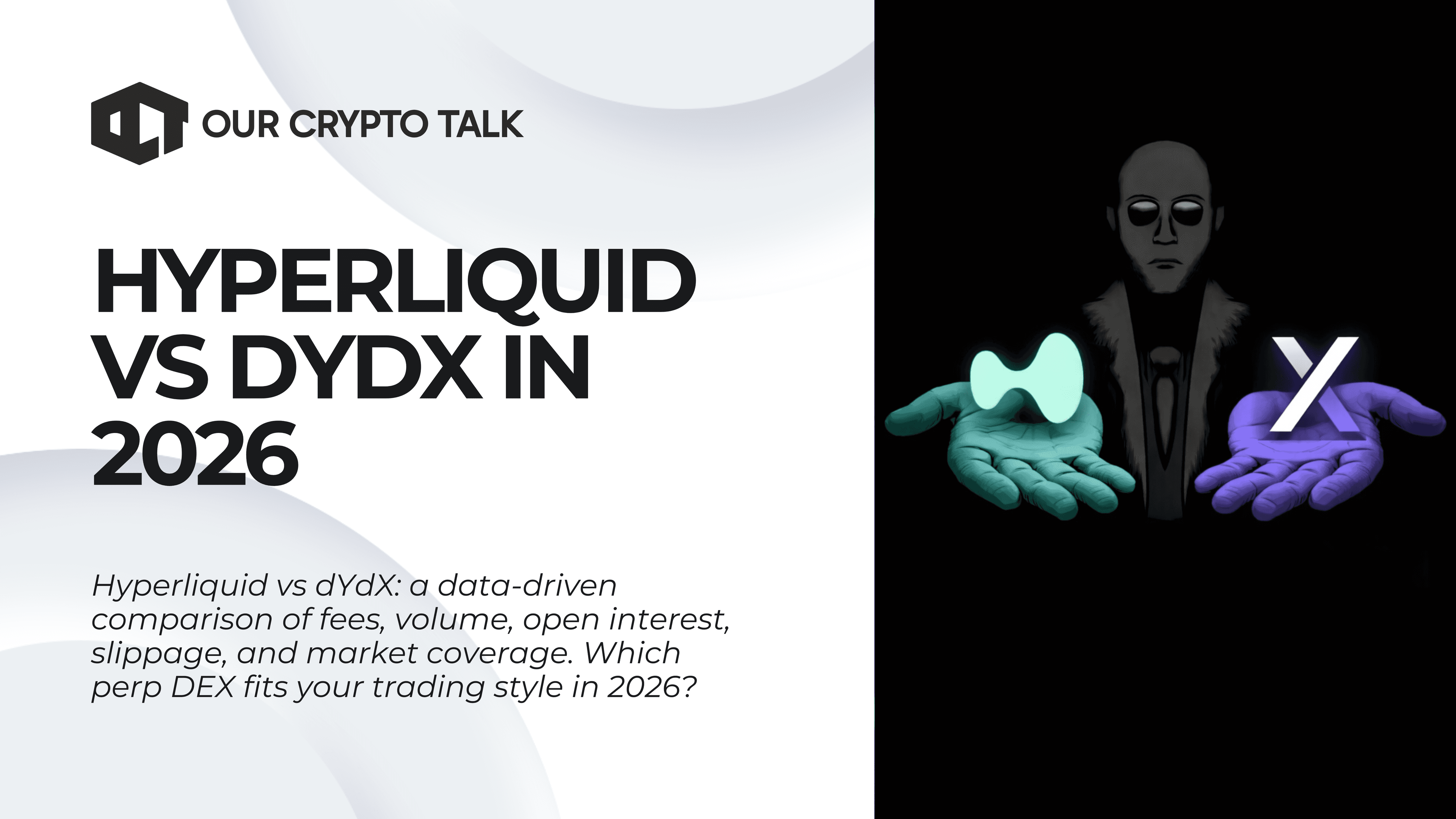
Hyperliquid vs dYdX: data-driven comparison of fees, volume, open interest, slippage, & markets. Which DEX fits your trading style in 2026?

Author: Akshat Thakur
Hyperliquid vs dYdX v4 both aim to deliver CEX-like performance on-chain. The difference shows up the moment you trade. Hyperliquid runs on a custom-built Layer 1 with its own HyperBFT consensus. The order book is fully on-chain.
Every order, fill, and cancellation is recorded directly at the protocol level. This creates a tightly integrated system where matching, execution, and settlement all live in the same environment.
This design creates a fast and consistent trading flow. The network confirms transactions almost instantly, and latency stays low. Traders pay no gas fees on orders, which removes friction when adjusting positions. The platform feels like a single high-performance engine because everything runs within one controlled system.
dYdX v4 takes a different approach. It runs as a Cosmos-based appchain where validators maintain an in-memory order book and handle matching before submitting results on-chain. The platform evolved from Ethereum to StarkEx and then to its own chain. Token holders govern the system through the DYDX token.
This structure creates a more distributed trading experience. Validators coordinate execution, so the system behaves like a network rather than a single engine. Execution remains fast, but it depends on multiple participants. Hyperliquid focuses on control and performance through vertical integration, while dYdX focuses on decentralization and sovereignty.
Both approaches reflect different tradeoffs and set the context for how liquidity, slippage, and volume behave in the data that follows. In this dYdX vs Hyperliquid design comparison, Hyperliquid emphasizes vertical integration and performance, while dYdX prioritizes decentralization and modularity. These tradeoffs shape everything from execution speed to liquidity distribution.
A $10K market trade costs $9 round trip on Hyperliquid and $10 on dYdX. That gap looks small, but it compounds with frequency. If you trade often with taker orders, Hyperliquid reduces friction slightly on every position. Maker fees widen the gap further. Hyperliquid charges 0.015% while dYdX charges 0.020%, so limit orders save more on Hyperliquid at the same tier.
The dYdX vs Hyperliquid fee gap narrows at higher volumes. Volume changes the equation. dYdX lowers fees more aggressively once traders cross higher 30-day volume brackets. Taker fees can drop into the 0.035% to 0.040% range, and maker fees approach zero or turn into rebates. Hyperliquid also reduces fees with volume, but it uses a 14-day window. That lets active traders reach discounts faster, even if the top-end structure looks similar.
The fee picture shifts at higher volume tiers. dYdX distributes monthly rewards in DYDX based on fees paid, which can reduce effective costs for consistent traders. Hyperliquid offers fee discounts through HYPE staking instead. Data shows a clear split. Lower base fees favor smaller or casual traders on Hyperliquid. Incentives and deeper tiers make dYdX competitive for high-volume users.
Notes: Data pulled live from DeFiLlama on April 5, 2026. Total perp DEX market volume sat at roughly $8.41 billion that day. BTC and ETH account for the largest share of activity on both platforms, though exact per-asset breakdowns are not published publicly.
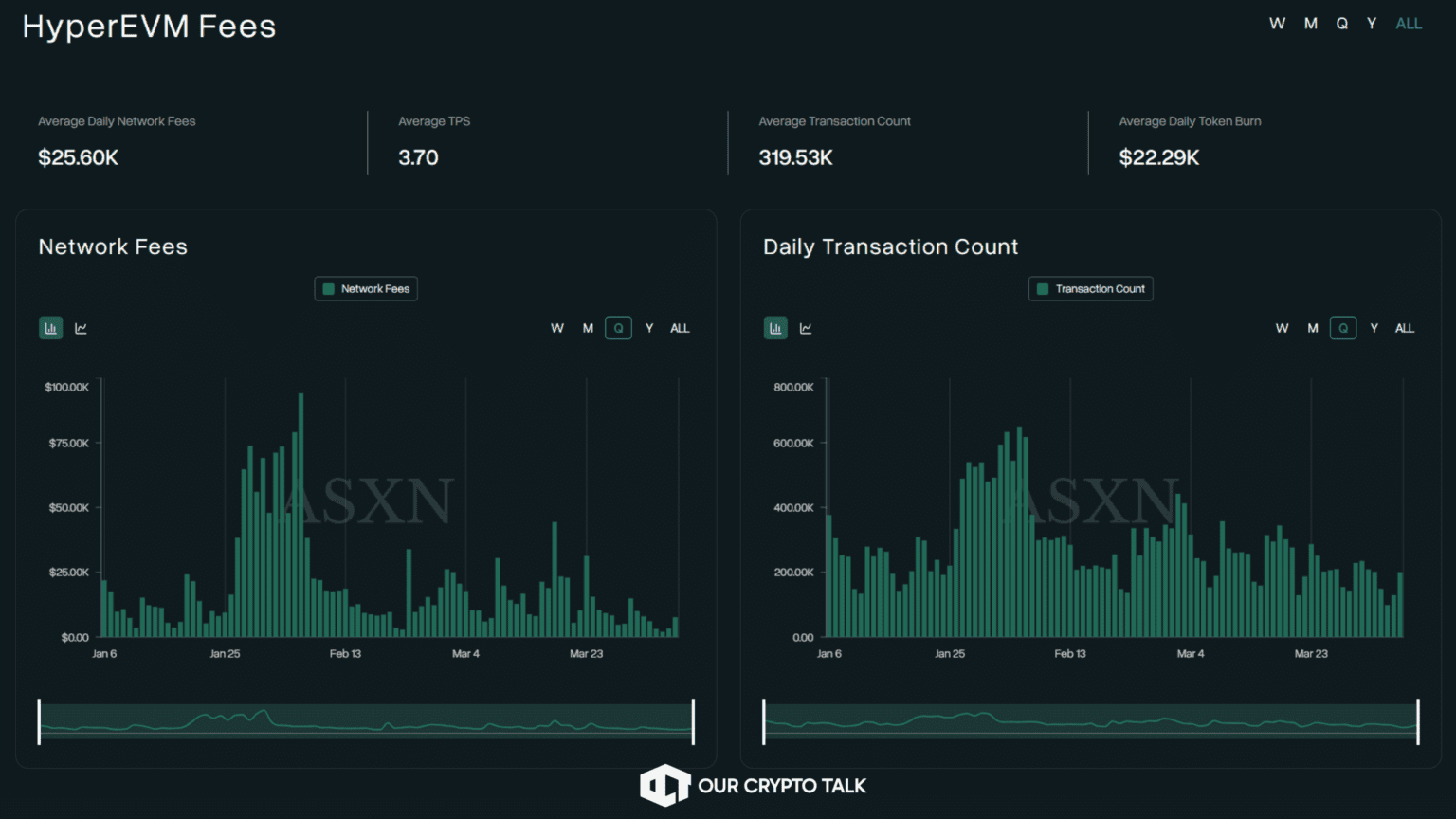
Data shows a large gap in activity. Hyperliquid processes about 30 times more daily volume and holds over 100 times more open interest. That means more orders sit in the book and more capital stays deployed. Volume shows where traders execute. Open interest shows where they keep positions open. In the dydx vs hyperliquid liquidity comparison, both metrics point to stronger participation on Hyperliquid.
Execution reflects that difference. A $100K BTC market order on Hyperliquid moves roughly 2 basis points on average. Deep books absorb size with minimal price impact. dYdX handles the same order size, but the thinner book increases slippage once you move beyond top-of-book liquidity. On BTC and ETH, depth remains usable for most traders, but it does not match the same consistency across sizes.
This split matters more as size increases. Smaller trades see little difference on both platforms. Larger orders expose the gap faster. Data shows Hyperliquid leads on depth and market share, which attracts high-frequency and size-heavy traders. dYdX still delivers solid execution on major pairs, especially for moderate size.
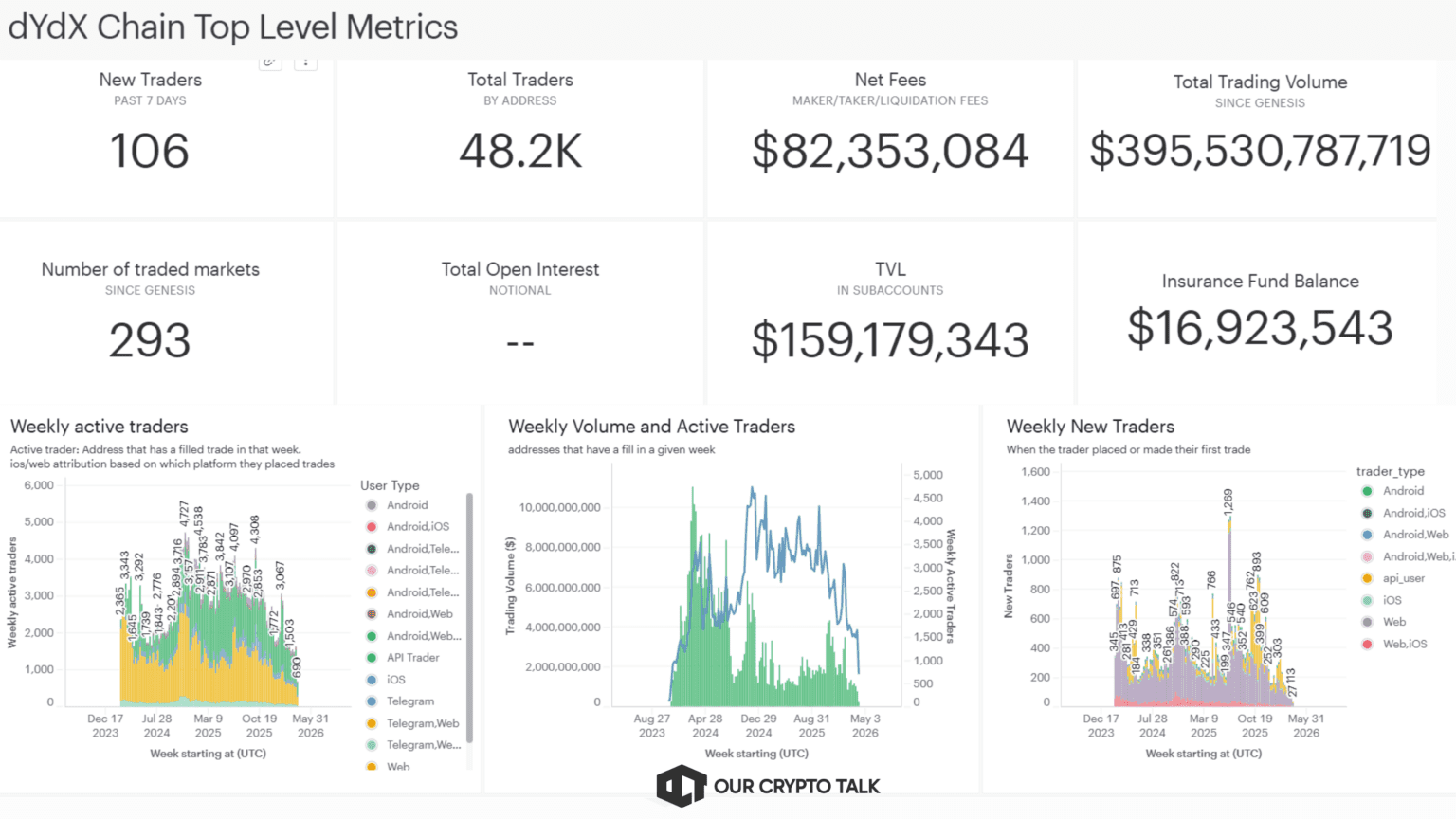
The numbers come straight from DeFiLlama dashboards on April 5, 2026. Hyperliquid posts 67 times the daily volume and 112 times the open interest of dYdX. That gap turns into deeper books and lower slippage the second you move beyond small retail size. dYdX keeps a leaner footprint but still delivers solid execution on its core crypto pairs.Both chains run zero gas trading, so the real split shows in architecture and reach.
Hyperliquid stacks perps, spot, and HyperEVM DeFi inside one high-speed L1. dYdX spreads across the Cosmos ecosystem through IBC with full governance via DYDX. The data shows neither model wins every category. Hyperliquid leads on concentrated liquidity and raw throughput. dYdX leads on modular interchain access and mature token utility.
Pick the row that matches how you actually trade. High-frequency or large-size traders see the volume and OI edge immediately on Hyperliquid. Cosmos-native users or governance-focused traders get more from dYdX’s IBC rails and DYDX voting power. The table makes the tradeoffs clear so you can match the platform to your style instead of chasing the biggest headline number.
Hyperliquid lists over 300 perpetual markets, while dYdX v4 offers around 200–250 depending on active listings. The gap shows up in breadth. Hyperliquid expands beyond crypto through HIP-3 and HIP-4, introducing synthetic exposure to assets like equities, commodities, and indices. Traders can access markets such as gold or oil alongside BTC and ETH in the same interface. dYdX stays focused on crypto-native perpetuals, covering major pairs and a wide range of altcoins but avoiding non-crypto assets.
Leverage also differs by design. Hyperliquid offers up to 50x on major pairs, while dYdX generally caps leverage closer to 20x depending on the market. Hyperliquid also includes a spot market, which allows direct asset trading alongside perps without moving funds across platforms. dYdX remains a perps-only exchange, so all activity centers around derivatives.
Data shows the difference comes down to scope. Hyperliquid provides a broader trading surface with more markets and asset types in one place. dYdX keeps a tighter focus on crypto perps with simpler structure. If you trade only crypto, both platforms cover the essentials. If you want exposure to commodities or equities alongside crypto, Hyperliquid extends that range inside a single account.
For a broader view of how these design choices fit into the wider competition between perp DEXs, you can explore Perp DEX Wars analysis, which highlights how different platforms compete on liquidity, performance, and ecosystem design.
Hyperliquid runs HyperEVM on the same chain as its perp and spot markets. Developers deploy Solidity contracts that interact directly with the order book. Lending protocols can read positions and liquidate against live liquidity. Vaults rebalance using real-time prices.
Traders can move from a perp trade into a DeFi strategy without bridging. Data shows over $1B in TVL on Hyperliquid, with a growing share tied to apps that reuse exchange liquidity. This setup keeps capital in one place and reduces friction between trading and DeFi.
dYdX v4 runs as a Cosmos appchain and connects to other chains through IBC. Traders move assets like USDC from Noble or swap on Osmosis without relying on wrapped tokens. Validators secure the network, and DYDX holders manage governance through staking and proposals.
The system already executes upgrades on-chain. Data shows strong staking participation, which supports decentralization and network security. The design keeps trading separate but expands access across multiple ecosystems.
The roadmap split is clear. Hyperliquid builds vertically by expanding HyperEVM access and deeper integrations with its order book. dYdX builds horizontally by improving IBC connectivity and extending into more Cosmos-linked use cases. Data shows two working models with different strengths. One concentrates liquidity and apps in one system. The other spreads access across chains.
For the full picture of how both platforms sit inside the broader perp DEX landscape, check OCT’s Perp DEX Wars article.
The data ties directly to usage. Hyperliquid leads in volume and open interest, which improves execution for frequent and size-heavy traders. Orders fill faster and with less impact. dYdX shows lower aggregate liquidity, but it maintains reliable depth on BTC and ETH and adds stronger governance and ecosystem access through Cosmos.
Funding stays comparable on both platforms. Both settle hourly and react to positioning on each pair. Differences show up when you scale frequency or size. Fees, depth, and incentives start to matter more than small variations in funding.
This is where the best perp dex 2026 discussion becomes practical. Data shows different strengths, not a single winner. Hyperliquid fits traders who want speed, depth, and an integrated on-chain stack. dYdX fits traders who value governance, Cosmos interoperability, and a focused perp environment.
There is no single winner. There is a better fit for how you trade. Pick the platform that matches your frequency, position size, and ecosystem preference. For our full Hyperliquid analysis, see our in-depth Hyperliquid review.
Disclaimer: This content is for informational purposes only and not financial advice. Trading on platforms like Hyperliquid and dYdX involves risk. Always do your own research and assess your risk tolerance before trading.
All the opinions in this article are that of the author and in no way are financial advice. Our Crypto Talk and the author always suggest you do your own research in crypto and to never take anything as financial advice that you read on the internet. Check our Terms and conditions for more info.


GEODNET Price Prediction: The $1B Thesis for GEOD
RWA Needs Better Access. Can NUVA Deliver?
Tokenization of RWA yields onchain might be the biggest opportunity that no one has noticed
Solana Ecosystem Projects: Top 10 to Watch in 2026
GEODNET Price Prediction: The $1B Thesis for GEOD
RWA Needs Better Access. Can NUVA Deliver?
Tokenization of RWA yields onchain might be the biggest opportunity that no one has noticed
Solana Ecosystem Projects: Top 10 to Watch in 2026