Hyperliquid ($HYPE) deep dive: $1B+ revenue, aggressive buybacks, HIP-3 growth, and key risks shaping its long-term investment outlook.
For foundational context on Hyperliquid’s architecture and HIP-3 market microstructure, I recommend reading Blockworks Research’s comprehensive piece: HIP-3 Silver Microstructure: Hyperliquid vs. CME
This memo focuses on the investment case, current market dynamics, and the catalysts shaping HYPE’s future.
Hyperliquid is not just another DEX. It is the first on-chain exchange that has genuinely threatened the dominance of centralized exchanges, and the market is only beginning to price in what that means. While every other DeFi protocol chases incremental improvements on existing infrastructure, Hyperliquid built its own Layer 1 blockchain from scratch, optimized for one thing: trading at CEX speed with DEX transparency. That isn’t a feature. That’s the entire thesis.
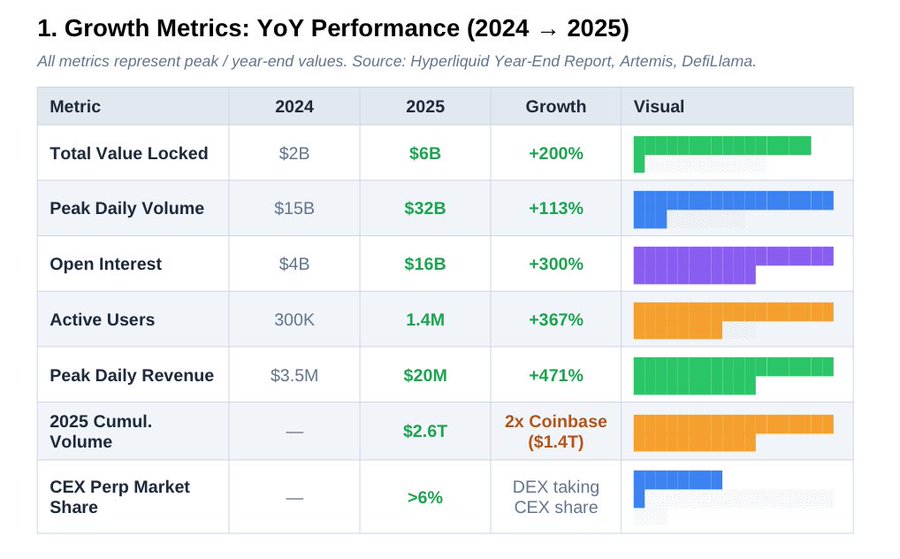
To start, the numbers speak for themselves. In 2025, for example, Hyperliquid processed $2.6 trillion in notional trading volume. By comparison, Coinbase, one of the largest and most regulated exchanges, processed $1.4 trillion. As a result, a fully on-chain exchange nearly doubled the volume of a Nasdaq-listed giant. So, let that sink in. In other words, this isn’t aspirational. It has already happened.
But what separates Hyperliquid from the pack isn’t just volume. It’s the flywheel. Every trade on Hyperliquid generates fees. 97% of those fees flow into the Assistance Fund, which automatically buys back HYPE tokens on the open market and burns them permanently. This creates a direct, programmatic link between platform usage and token value. More trading means more buybacks. More buybacks mean less supply. Less supply, with growing demand, means price appreciation. It’s the most aggressive value accrual mechanism in all of DeFi, and it’s running 24/7 without human intervention.
The platform now handles over 6% of total CEX perpetual volumes. It commands 73% of all decentralized derivatives market share. Its user base has grown from roughly 300,000 to over 1.4 million in a single year, driven almost entirely by word of mouth and product quality rather than paid marketing. When a protocol grows this fast on merit alone, you pay attention.
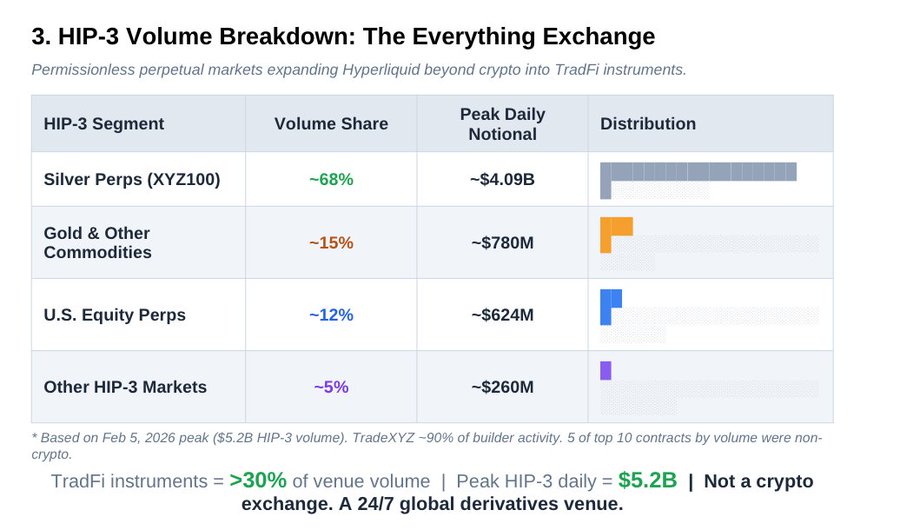
Hyperliquid’s ambition extends far beyond crypto perpetuals. The HIP-3 upgrade, launched in October 2025, transformed the platform from a closed trading venue into permissionless infrastructure. Anyone can now deploy perpetual markets on Hyperliquid by staking capital, and the results have been immediate and dramatic.
Real-world assets like silver, gold, and U.S. equities now account for over 30% of Hyperliquid’s total trading volume. On February 5, 2026, HIP-3 daily trading volume hit $5.2 billion, a new all-time high. Five of the top ten contracts by volume on that day were non-crypto assets. This is not a crypto exchange anymore. This is a 24/7 global derivatives venue that happens to run on-chain.
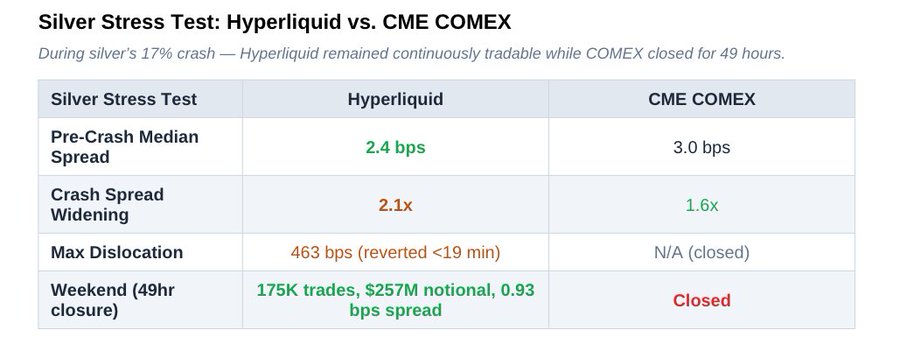
The silver stress test is instructive. During the most violent silver repricing in decades (a 17% peak-to-trough crash in a single session), Hyperliquid remained continuously tradable while delivering competitive execution for the retail and mid-sized clips that dominate its flow. Pre-crash median spreads were 2.4 basis points versus 3 basis points on COMEX. Yes, depth was thinner and tails were heavier during the crash, but the platform never halted, and the brief 463 basis point dislocation mean-reverted in under 19 minutes. For a venue without designated market makers operating entirely on-chain, that’s remarkably resilient.
More importantly, the weekend regime exposed Hyperliquid’s true strategic edge. While COMEX was closed for 49 hours, Hyperliquid processed 175,000 trades and $257 million in notional volume in silver alone. Weekend median spreads actually tightened to 0.93 basis points. When COMEX reopened on Sunday, Hyperliquid’s last internal price was closer to Monday’s opening print than Friday’s close. The platform is creating a tradable reference price that exists nowhere else.
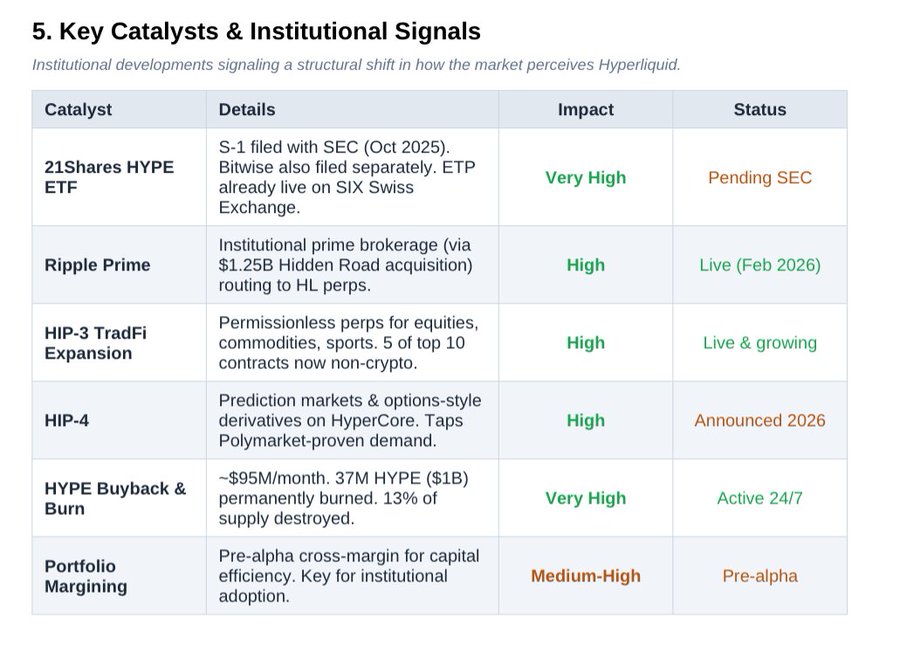
HIP-4, announced in early 2026, takes this further by introducing prediction markets and options-style derivatives on HyperCore. This isn’t incremental. It’s a new product vertical that taps into a market Polymarket proved has massive demand, but built on institutional-grade infrastructure with deep liquidity. Sam Ruskin at Messari has speculated that HIP-4 could enhance pre-IPO trading by eliminating the oracle problem and reducing liquidation risks. Each successful upgrade directly links to increased platform usage, fee generation, and buyback pressure on HYPE.
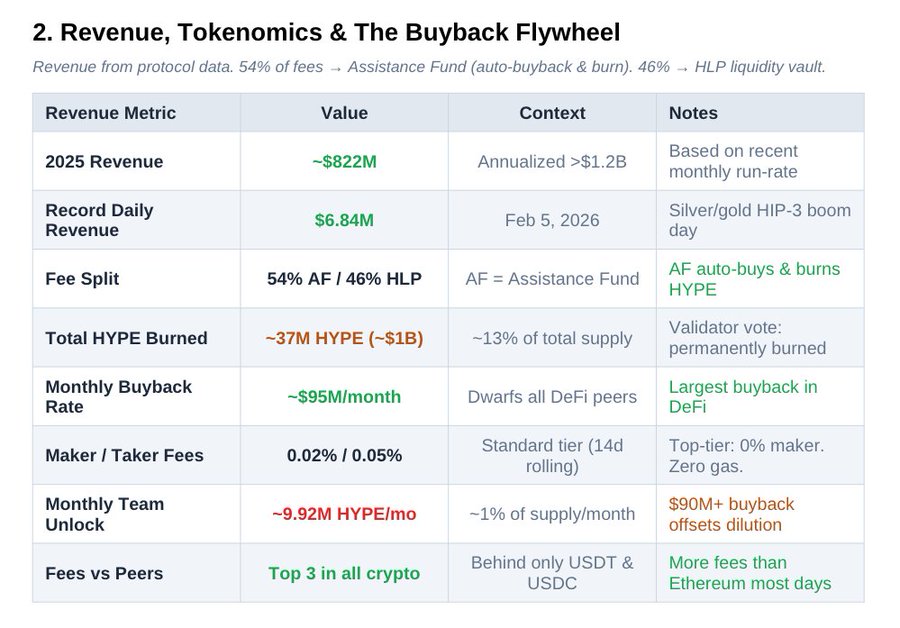
Hyperliquid’s revenue engine is one of the most compelling in crypto. That view comes from five years of evaluating DeFi protocols.
The platform generated about $822 million in revenue in 2025. Its annualized run rate now exceeds $1.2 billion based on recent months. On February 5, 2026, it recorded $6.84 million in daily revenue. Hyperliquid generates more fees than Ethereum on most days. It also ranks among the top three fee-generating protocols, behind Tether and Circle.
The fee structure rewards activity and aligns incentives. Maker and taker fees are tiered using a 14-day rolling volume. Rates start around 0.02% maker and 0.05% taker for standard users. Fees decline to zero for top-tier participants. There are no gas fees on the native L1. This makes Hyperliquid cheaper than most centralized exchanges for active traders.
Here is where the tokenomics stand out. About 46% of fees go to HLP, the Hyperliquidity Provider vault. The remaining 54% flows to the Assistance Fund for HYPE buybacks. The system converts fees into HYPE automatically during execution. Those tokens are then permanently burned. By January 2026, the fund had accumulated over 37 million HYPE. Its value exceeded $1 billion. Monthly buybacks reached roughly $95 million, far above peers.
In December 2025, validators formally recognized 37 million HYPE as permanently burned. These tokens were held in the inaccessible Assistance Fund. They were removed from both circulating and total supply. Validators also agreed never to upgrade access to that address. As a result, about 13% of total supply has been destroyed. The burn rate continues to rise with volume.
HYPE has a fixed maximum supply of 1 billion tokens. The distribution is heavily community-focused. About 31% went to users through a record airdrop. Recipients averaged $45,000 to $50,000 across 94,000 users. Another 38.888% is reserved for future emissions and rewards. There was no VC participation. No private sale. No insider allocation beyond the team. This removes typical sell pressure from early investors.
Monthly team unlocks began in late 2025. Around 9.92 million HYPE enters circulation each month. That equals roughly 1% of total supply. This creates steady sell pressure. However, buybacks of $90 million or more per month offset much of it. The key question is whether buybacks outpace dilution. At current revenue levels, the balance remains favorable.
Several institutional developments have materialised in recent months that signal a structural shift in how the market perceives Hyperliquid.
21Shares filed an S-1 with the U.S. SEC for a Hyperliquid ETF in October 2025, which would become one of the first institutional-grade products offering direct HYPE exposure through U.S. exchanges. Bitwise filed a separate HYPE ETF proposal around the same time. A 21Shares Hyperliquid ETP already trades on the SIX Swiss Exchange in Europe, giving regulated access to institutional investors in Switzerland and the EU. While U.S. approval timelines remain uncertain (the SEC has over 90 crypto ETF applications pending), the mere existence of these filings signals that serious asset managers view HYPE as an investable asset class.
Ripple Prime, the institutional prime brokerage platform built on Ripple’s $1.25 billion acquisition of Hidden Road, announced integration with Hyperliquid in early February 2026. This gives institutional traders direct access to Hyperliquid’s perpetuals through a regulated brokerage layer, which is a meaningful step toward capturing TradFi flow. When institutional prime brokers are routing to your platform, you’ve moved beyond the “degen DEX” narrative into something fundamentally different.
Paradigm, one of crypto’s most respected venture firms, reportedly holds $581 million in HYPE. On-chain analysts identified Multicoin Capital wallets accumulating over $40 million in HYPE in late January 2026. This became particularly notable when co-founder Kyle Samani left the firm days later and publicly criticized Hyperliquid, more on that below. When firms that define smart money in crypto build positions, that’s a signal worth tracking.
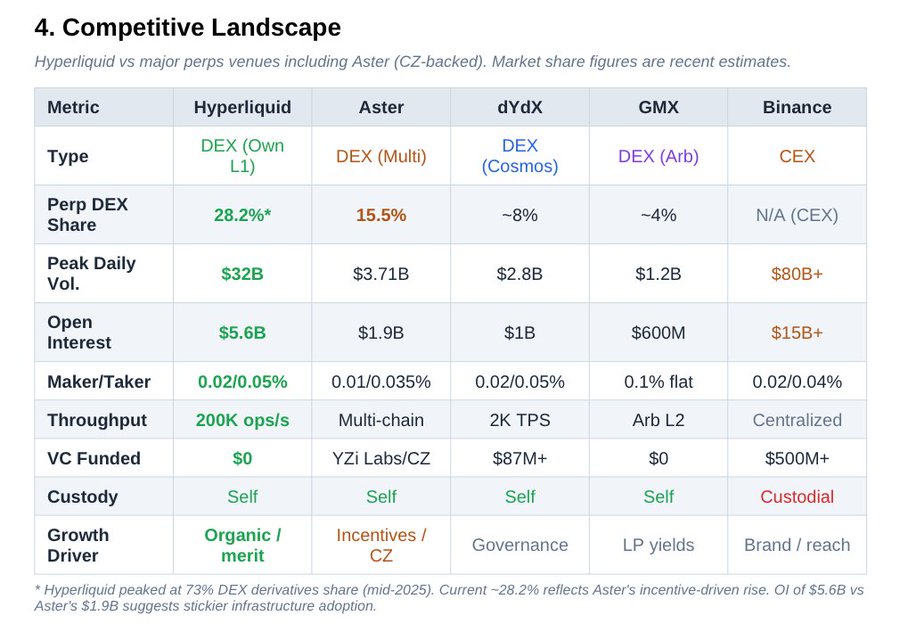
No investment memo is complete without an honest assessment of the competitive landscape, and Hyperliquid faces real challengers.
Aster (formerly the merger of APX Finance and Astherus) is the most aggressive competitor, backed by YZi Labs and publicly endorsed by CZ. When CZ shills a chart, the crypto world pays attention. The last time he did that was BNB below $50. Aster launched in September 2025 with explosive metrics: $3.71 billion in first-day trading volume, over 2 million users onboarded within weeks, and open interest that surged 33,500% in under a week. It offers 1001x leverage, hidden orders, stock perpetuals, and multi-chain support across BNB Chain, Ethereum, Solana, and Arbitrum.
Aster currently holds roughly 15.5% of the perp DEX market compared to Hyperliquid’s 28.2%. On peak days, Aster has temporarily surpassed Hyperliquid in 24-hour volume. CZ’s backing provides formidable distribution through Binance’s ecosystem, CoinMarketCap promotion, and direct financial support.
However, I view Aster’s rise with the same skepticism I apply to any incentive-driven growth story. Aster’s volume surge is fueled by trading competitions, aggressive airdrops, and reward programs. When Lighter (another competitor) saw its weekly volume plummet threefold after ending its airdrop, it illustrated the fragility of incentive-driven models. Hyperliquid’s ability to retain traders and maintain $5.6 billion in open interest versus Aster’s $1.9 billion suggests that infrastructure-centric approaches build more durable network effects.
Lighter, backed by Peter Thiel’s Founders Fund and Ribbit Capital after a $68 million raise, represents the institutional play in this space. It briefly topped the perps leaderboard on DefiLlama in November 2025. Its zk-rollup architecture and zero retail fees make it a legitimate contender for smart money flow, though it’s still finding product-market fit.
My take: competition validates the category. When CZ deploys resources to attack your market share, it means your market share is worth attacking. Hyperliquid’s moat isn’t a single feature. It’s the combination of a purpose-built L1 with sub-second finality, 73% market share creating deep liquidity, the most aggressive buyback mechanism in DeFi, and 1.4 million organic users who chose the platform on merit. Aster can buy attention. Lighter can attract institutions. But building a full-stack exchange that processes more volume than Coinbase without ever raising venture capital is something that cannot be easily replicated.
Regulatory Risk
This is the existential threat. Hyperliquid operates from Singapore without KYC, offering leveraged derivatives to a global user base. The U.S. Department of Justice remains the most significant regulatory risk. As one market watcher noted: “HYPE’s biggest risk is regulatory. They need to get much more embedded with the tradfi elites as regulators will eventually get involved.” If U.S. enforcement actions target the platform or its team, the consequences could be severe and immediate.
The Ripple Prime integration and ETF filings are positive signals on the institutional legitimacy front, but they don’t immunize the protocol from regulatory action. Founder Jeff Yan’s relocation from the U.S. to Singapore has been criticized by Kyle Samani and others as regulatory evasion. Whether that characterization is fair or not, it adds to the perception of vulnerability.
Centralization Concerns and the JELLY Precedent
The JELLY exploit in March 2025 exposed a fundamental tension at the heart of Hyperliquid’s design. A trader manipulated the price of the illiquid JELLY token through a $7.17 million coordinated attack across three accounts, forcing $13.5 million in unrealized losses onto the HLP vault. When the situation threatened the vault’s $290 million in assets, validators convened and voted within two minutes to delist JELLY and settle all positions at $0.0095, the attacker’s short entry, instead of the $0.50 market price.
This saved the platform but destroyed the narrative. Bitget CEO Gracy Chen called the response “immature, unethical, and unprofessional” and compared Hyperliquid to “FTX 2.0.” TVL in the HLP vault subsequently plummeted from $540 million to $150 million. Arthur Hayes put it bluntly: “Let’s stop pretending Hyperliquid is decentralized.”
Hyperliquid has since upgraded its infrastructure to include fully on-chain validator voting for asset delisting, and the vault has recovered significantly. But the precedent remains. A “decentralized” exchange that can override market prices through a two-minute validator vote is functionally centralized in moments of crisis. Investors need to understand this risk clearly.
The Kyle Samani Critique
Kyle Samani, former co-founder of Multicoin Capital, publicly called Hyperliquid “everything wrong with crypto” on February 8, 2026, three days after departing the firm. He cited closed-source code, permissioned validators, and alleged facilitation of illicit activity. The timing was notable: on-chain analysts had flagged Multicoin-linked wallets accumulating over $40 million in HYPE just days before Samani left.
The community response was overwhelmingly critical of Samani. Anthony Sassano accused him of being bitter about missing an allocation. Cobie called it “clownish behavior.” Arthur Hayes challenged him to a public $100,000 bet that HYPE would outperform any coin above $1 billion market cap between February 10 and July 31, 2026. Samani subsequently deleted the post.
My take: the criticism contains kernels of truth wrapped in clear bias. Hyperliquid’s closed-source codebase is a legitimate concern for a protocol marketed as decentralized. The permissioned validator set (with Hyperliquid controlling 81% of staked HYPE) is worth monitoring. But the timing, the deleted post, and the apparent contradiction with Multicoin’s own accumulation suggest this was more about personal positioning than objective analysis. The market agreed. HYPE rose 6% in the days following the critique.
Token Unlock Pressure
Beginning in late November 2025, Hyperliquid initiated linear unlocking of 237.8 million HYPE tokens over 24 months for core contributors. At current prices, this represents roughly $500 million in nominal value entering the market each month. The monthly unlocks of approximately 9.92 million HYPE create consistent sell-side pressure that the buyback mechanism must absorb.
At current revenue levels ($90 million+ monthly in buybacks), the protocol can offset a meaningful portion of this dilution. But if trading volume declines materially during a bear market while unlocks continue, this dynamic becomes unfavorable. The Tornado Cash developer and Continue Fund finished dumping millions of HYPE in late January 2026, removing one overhang, but the structural unlock schedule persists.
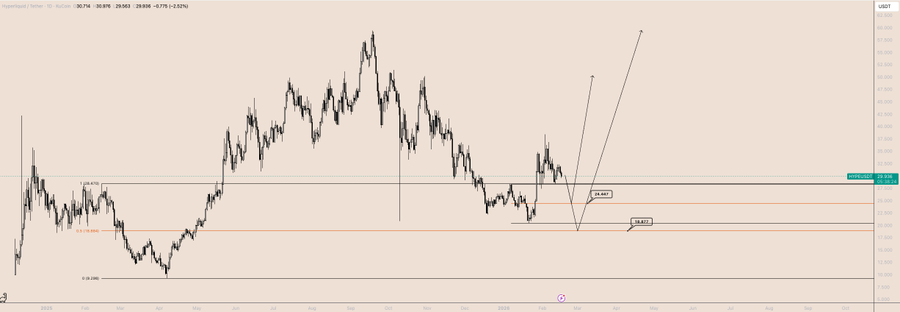
HYPE is currently trading around $29, down roughly 51% from its all-time high of $59.37 reached in September 2025. The correction has been brutal but constructive.
The token found strong support during the January 2026 drawdown around the $20 to $22 zone, forming what appears to be a higher low relative to the December 2025 cycle low. The subsequent rally from $20 to $35 represented a 75% recovery before the current pullback. This pattern mirrors the falling wedge breakout that characterized the Q4 2025 chart structure.
Key support sits at $24, which aligns with the horizontal demand area established during the January consolidation and the 200 EMA on the daily timeframe. Below that, $19 to $20 represents the deeper support zone where the January low was printed and where any secondary test would offer exceptional risk-reward.
Resistance is layered: $33 to $35 is the immediate hurdle that has capped recent rallies. A clean break above this zone opens the path to $38 to $42, the significant pivot area from late 2025. Beyond that, $48 to $50 has been a major rejection zone for months, with sellers consistently defending that level.
The RSI has cooled off from overbought territory, and the MACD is in a healthy reset after the January surge. Volume patterns suggest accumulation rather than distribution, with whale activity picking up notably (a wallet deposited 12.88 million USDC into Hyperliquid on February 10 to open a leveraged long).
I’m approaching this with a layered entry strategy because buying drawdowns in high-conviction assets requires discipline, not emotion.
First Entry: $24
This is the reactive level. If HYPE pulls back to $24, which aligns with the 200 EMA, horizontal support, and the upper bound of the January accumulation zone, I’m starting a position. This level represents a roughly 60% discount from the all-time high and prices in significant pessimism about the unlock schedule and macro conditions. I’ll deploy a moderate allocation here, enough to have skin in the game but not so much that a deeper correction creates anxiety.
Second Entry: $19
This is the high-conviction, heavy accumulation level. A move to $19 would represent a 68% drawdown from the all-time high and would test the January 2026 low. At $19, you’re buying Hyperliquid at roughly a $19 billion fully diluted valuation for a protocol generating over $1.2 billion in annualized revenue, commanding 73% of the DEX derivatives market, processing 2x more volume than Coinbase, and running the most aggressive buyback program in DeFi. The risk-reward at that level is asymmetric. The heavier portion of my capital is reserved for this zone.
If $19 never comes, that’s fine. I’d rather miss the absolute bottom than chase a position in a protocol where conviction and patience are the edge.
I’ve spent five years in DeFi’s trenches. During that time, I’ve used over 100 protocols, survived the OHM fork implosions, DCA’d ETH from $3,000 to $900, and watched the Solana memecoin casino cycle play out in real time. I’ve also seen what separates protocols that endure from those that fade. The difference is always the same: real revenue, real users, and a product people choose to use even when there are no incentive programs bribing them to stay.
Hyperliquid has all three.
This is a protocol that processes nearly twice the notional volume of Coinbase without ever raising a dollar of venture capital. Moreover, it generates over $1 billion in annualized revenue and channels 97% of fees into buying and burning its own token. At the same time, its user base has grown to 1.4 million organically. Meanwhile, institutional prime brokers are already routing flow to it. In parallel, ETF issuers are filing with the SEC for HYPE products. Even more notably, it is achieving all of this while the token trades at half its all-time high, in a market where the Fear and Greed Index signals extreme fear.
That said, the risks remain real. First, regulatory action could have a material impact. Second, the centralization exposed by the JELLY incident remains unresolved. Additionally, monthly token unlocks create persistent sell pressure. Finally, competition from Aster and Lighter will continue to intensify.
But the bull case is simple and powerful: Hyperliquid is building the exchange of the future, and the future of trading is on-chain. Every data point, from HIP-3’s TradFi volume explosion to the Coinbase volume flip to institutional integrations, confirms that the thesis is playing out faster than even the most optimistic projections suggested.
I’m not buying HYPE because it’s safe. I’m buying it because this is what it looks like when a category-defining protocol is being repriced by the market during a fear-driven correction, while the fundamentals are screaming that the structural story has never been stronger.
At $24, I’m starting. At $19, I’m loading. The future of trading is being built on Hyperliquid, and the market hasn’t fully priced it in yet.

5 years in DeFi 🐍 | 100+ protocols tested | Finance background | Seeking VC/analyst roles 💼 | Research: https://t.co/qCa3AE5QpC
https://t.co/MnHWZuGS44


GEODNET Price Prediction: The $1B Thesis for GEOD
RWA Needs Better Access. Can NUVA Deliver?
Tokenization of RWA yields onchain might be the biggest opportunity that no one has noticed
Solana Ecosystem Projects: Top 10 to Watch in 2026
GEODNET Price Prediction: The $1B Thesis for GEOD
RWA Needs Better Access. Can NUVA Deliver?
Tokenization of RWA yields onchain might be the biggest opportunity that no one has noticed
Solana Ecosystem Projects: Top 10 to Watch in 2026