GHO Beyond Borrowing is expanding Aave’s stablecoin ecosystem through cross-chain sGHO, Stable Vaults, and retail-focused products.
GHO started out as a fairly simple stablecoin minted through borrowing on Aave.
By mid-2026, however, it had grown into one of the most important pillars of the broader Aave ecosystem.
Beyond giving users access to stablecoin liquidity, GHO is now generating real revenue, expanding across multiple chains, and preparing to reach mainstream users through embedded financial products.
Here are the most important recent updates.
GHO’s core function remains its role as a debt token.
Users borrow GHO by depositing crypto assets as collateral, and the interest they pay flows directly to the Aave DAO.
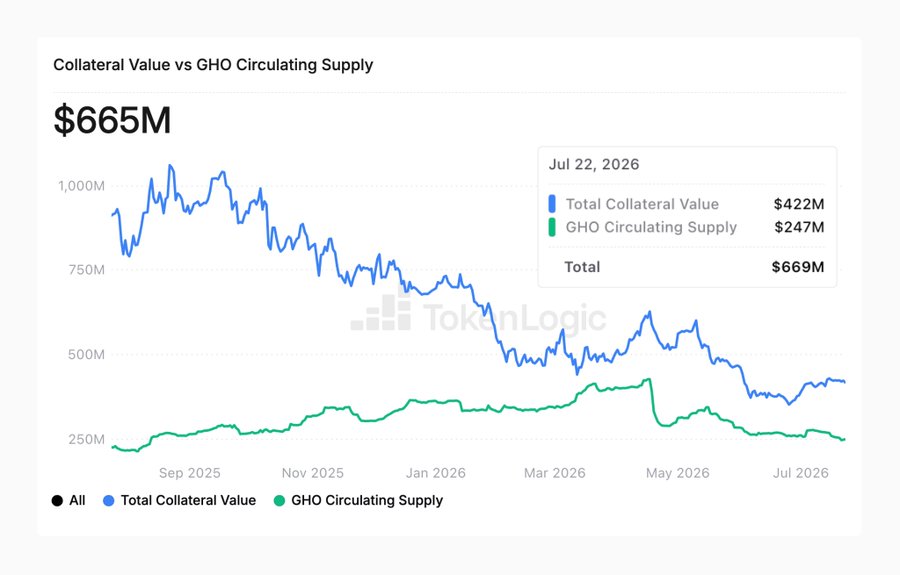
GHO’s circulating supply stands at roughly $600M . Of that, around $426M has been minted through collateral-backed borrowing positions.
Most of GHO’s revenue still comes from Aave V3. In Q2 2026, GHO generated approximately $3.15M in earnings for the DAO.
Aave V4 launched around the end of Q1 2026 with its Hub-and-Spoke architecture, so GHO activity there is still in an early growth phase.
GHO liquidity across V4 Hubs remains relatively small compared with V3, generally ranging from a few hundred thousand dollars to several million dollars depending on the Hub.
Still, V4 represents the longer-term direction. Its architecture allows GHO liquidity to be allocated more flexibly through Credit Lines while giving Aave tighter control over risk.
The revenue flywheel is becoming increasingly visible.
GHO currently generates roughly $12.6M in annualized revenue, making it one of Aave’s most stable and predictable revenue streams.
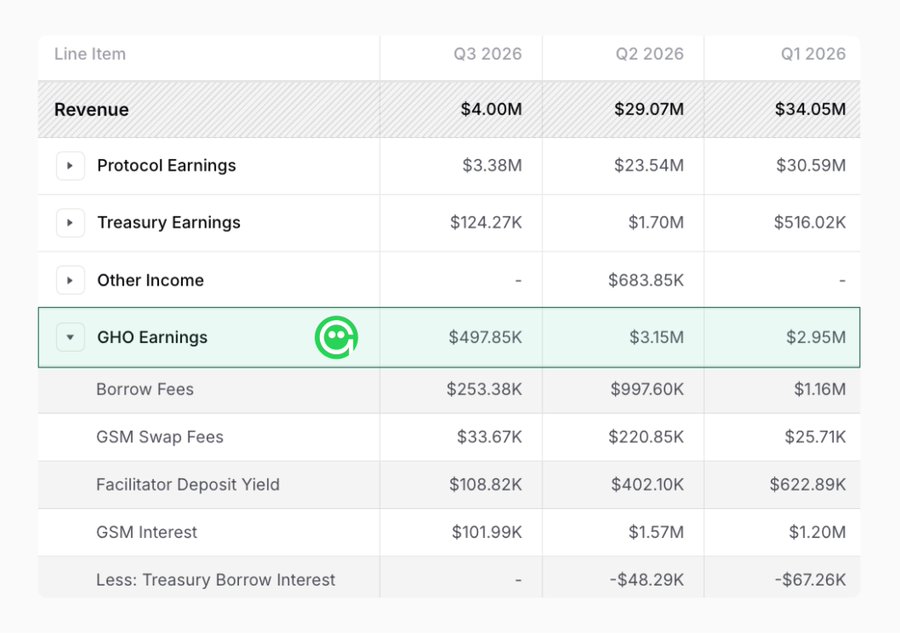
What makes GHO especially valuable is its revenue efficiency compared with ordinary borrowed assets:
Each $1 of GHO minted and borrowed is estimated to generate roughly the same protocol revenue as $8-$10 of conventional borrowing on Aave, because 100% of the interest paid on GHO flows to the DAO rather than being shared with suppliers.
That means GHO can contribute meaningfully to protocol revenue even with a supply of around $600M . The revenue strengthens the DAO treasury, with a portion ultimately supporting the $AAVE buyback program.
More GHO borrowing -> more revenue for the DAO -> stronger indirect value accrual for AAVE.
The Cross-Chain sGHO solution proposed by Token Logic
sGHO is the savings version of GHO. Users deposit GHO into the main Ethereum vault and receive sGHO, which accrues the Aave Savings Rate.
Token Logic’s proposal aims to extend this experience to Layer 2 networks while keeping all sGHO managed through a single shared vault, rather than deploying separate vaults on every chain.
The mechanism is divided into two routes:
Suppose you hold GHO on Arbitrum and want to convert it into sGHO. If the Fast Path has enough sGHO liquidity available on Arbitrum, the system will:
Users receive sGHO almost instantly, with an experience similar to a regular swap. The Fast Path is designed for smaller deposits and everyday usage.
For larger transactions, or when the sGHO liquidity available on the L2 has been depleted, the system switches to the Slow Path:
This process takes longer because it involves multiple cross-chain transactions, but it can handle larger amounts and always settles directly through the main vault.
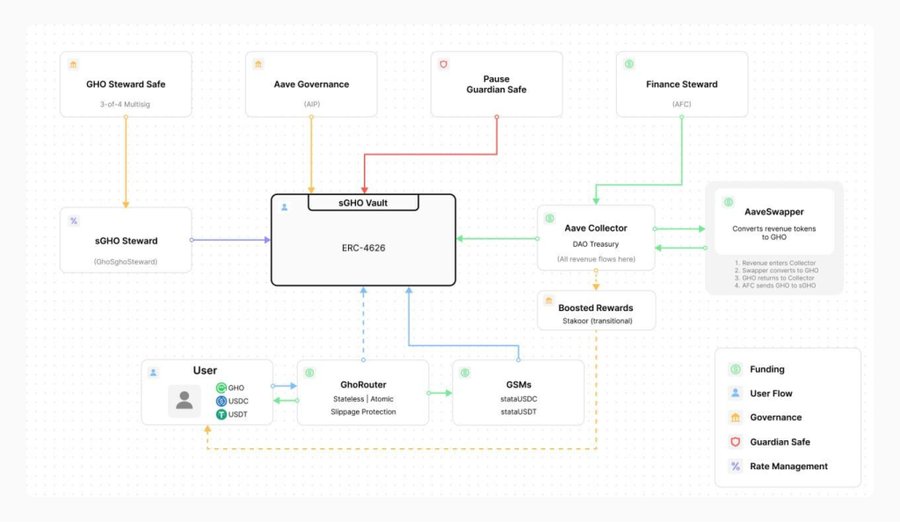
The design gives L2 users a fast experience while keeping all sGHO backed by the same vault on Ethereum.
As a result, the yield rate, exchange rate, and liquidity-management mechanism remain consistent across the entire system.
The broader goal of the proposal is to make GHO a core yield-bearing liquidity asset across ecosystems such as Arbitrum and Monad, while also tapping into the distribution channels of CEX-linked networks such as Mantle – Bybit, and X Layer – OKX.
The proposal has now advanced to the AIP stage, the final on-chain voting round in Aave Governance. If the current level of support holds, it is likely to pass soon.
The infrastructure buildout is already visible in GHO’s cross-chain flows.
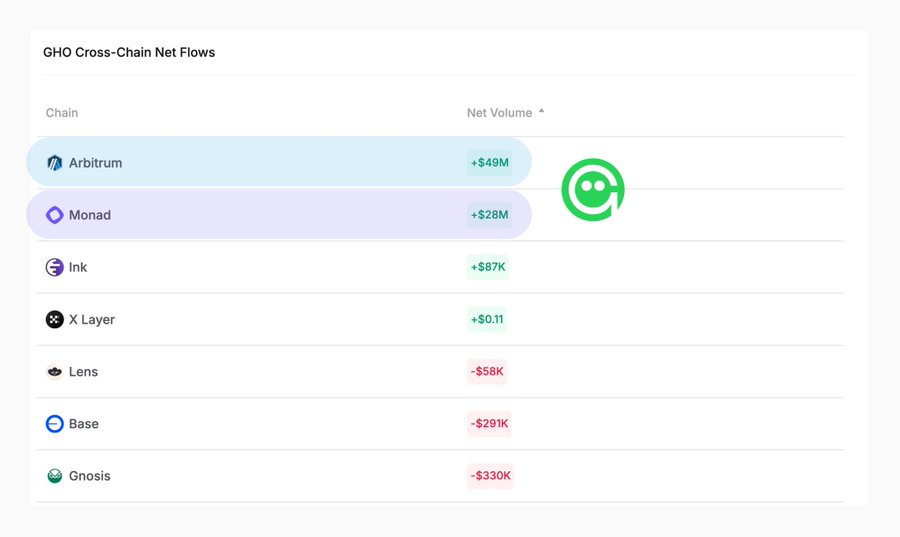
The $50M net inflow into Arbitrum primarily reflects a DAO-led liquidity deployment for the planned remoteGSM, rather than $50M in organic user demand. The goal is to seed native GHO liquidity, support the peg, and lay the groundwork for cross-chain sGHO.
Monad has also recorded more than $28M in net GHO inflows. Of that, 10M GHO came from the Monad Foundation’s commitment and 500K GHO from incentives, while the remainder appears to reflect other cross-chain transfers and operational activity.
Aave App is the consumer-facing distribution layer, while Stable Vault provides the allocation infrastructure underneath it. The same vault infrastructure can also be integrated by fintechs and other partners through Aave Kit.
At launch, the proposed target allocation places 90% of Stable Vault capital into sGHO, making GHO’s savings layer the core yield engine behind the product.
Aave App serves as the direct distribution layer for retail users.
Users only need to deposit stablecoins through a simple interface. Behind the scenes, Aave App can automatically allocate their funds into sGHO or other suitable yield sources.
Stable Vaults serve as the distribution layer through partners.
Fintech companies, wallets, and CEXs can integrate Aave’s vaults to offer yield-bearing stablecoin products directly inside their own applications.
Aave handles the underlying infrastructure, yield strategies, and liquidity management, while its partners provide the interface and user distribution.
GHO and sGHO are expected to sit at the center of this model:
GHO provides liquidity -> sGHO generates yield -> Stable Vaults package the product -> fintechs, wallets, and CEXs distribute it to users.
Within this structure, cross-chain sGHO acts as a critical connection layer.
It allows Aave App and Stable Vaults to serve users directly across ecosystems such as Arbitrum, Monad, and other networks, while the underlying yield remains managed through the main vault on Ethereum.
GHO’s next phase is less about minting more supply and more about making that supply useful, yield-bearing, and easy to access.
V3 provides the revenue engine, V4 improves liquidity allocation, cross-chain sGHO expands utility, while Aave App and Stable Vaults bring distribution.
Together, these pieces position GHO as the link between Aave’s credit infrastructure, DAO revenue, and its path toward millions of users.

On-chain research & DeFi analyst | ex-@Deloitte Consultant | @Crediblefin Advisor | @GREEND0TS fren
https://t.co/sQvUmkF705


Tokenization of RWA yields onchain might be the biggest opportunity that no one has noticed
Cold Wallet Safety 2026: Are Hardware Wallets Still Safe?
One Token, Multiple Products. Can Zylo Deliver?
The Rise of NEAR Protocol 2026: Inside the 530% Rally and the ETF
Tokenization of RWA yields onchain might be the biggest opportunity that no one has noticed
Cold Wallet Safety 2026: Are Hardware Wallets Still Safe?
One Token, Multiple Products. Can Zylo Deliver?
The Rise of NEAR Protocol 2026: Inside the 530% Rally and the ETF