GEODNET price prediction: how $9.5M in real DePIN revenue, an 80% buyback-and-burn, and a $3.7B target market could push GEOD toward a $1 billion valuation.

Author: Kritika Gupta
GEODNET sells centimeter-level positioning data to enterprise customers and directs most of that revenue into GEOD token buybacks and permanent burns. This GEODNET price prediction examines how network adoption and token economics could shape GEOD’s valuation.
The supplied figures place annualized revenue at roughly $9.5–10.6 million, with more than 22,000 community-operated base stations across 174–175 countries. Meanwhile, GEODNET targets a positioning services market worth several billion dollars. Together, these metrics support a potential billion-dollar valuation thesis, although enterprise growth, token dilution, and market conditions will determine the outcome.
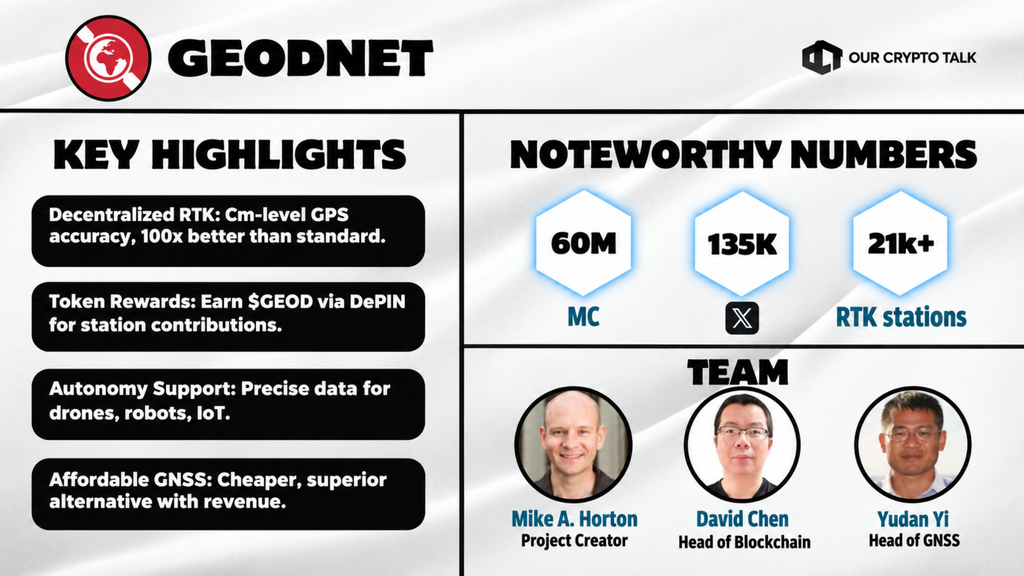
Standard GPS typically provides accuracy within a few meters. Real-time kinematic, or RTK, corrections can improve positioning to roughly ±1 centimeter under suitable conditions. Fixed base stations compare satellite signals and broadcast corrections that compatible receivers use to reduce positioning errors.
GEODNET operates a decentralized RTK network. Community members deploy triple-band global navigation satellite system, or GNSS, base stations, with hardware typically costing $600–800. These stations contribute observation data, while the protocol validates their location and data quality. GEODNET then sells correction streams to customers.
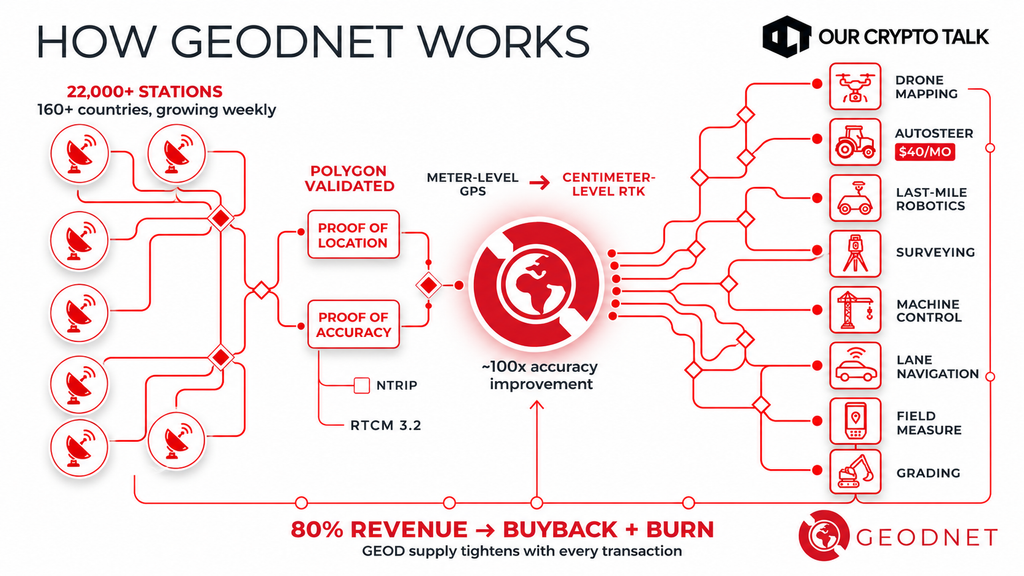
In return, station operators earn GEOD tokens. Meanwhile, customers typically pay fiat subscriptions of around $40 per month or $400 per year per device.
This economic model underpins the GEODNET price prediction: operators fund hardware deployment, customers pay for positioning services, and the network allocates 80% of revenue to open-market GEOD purchases and permanent burns. Consequently, commercial demand creates token buying activity. However, holders must compare those burns with mining emissions and other supply entering circulation.
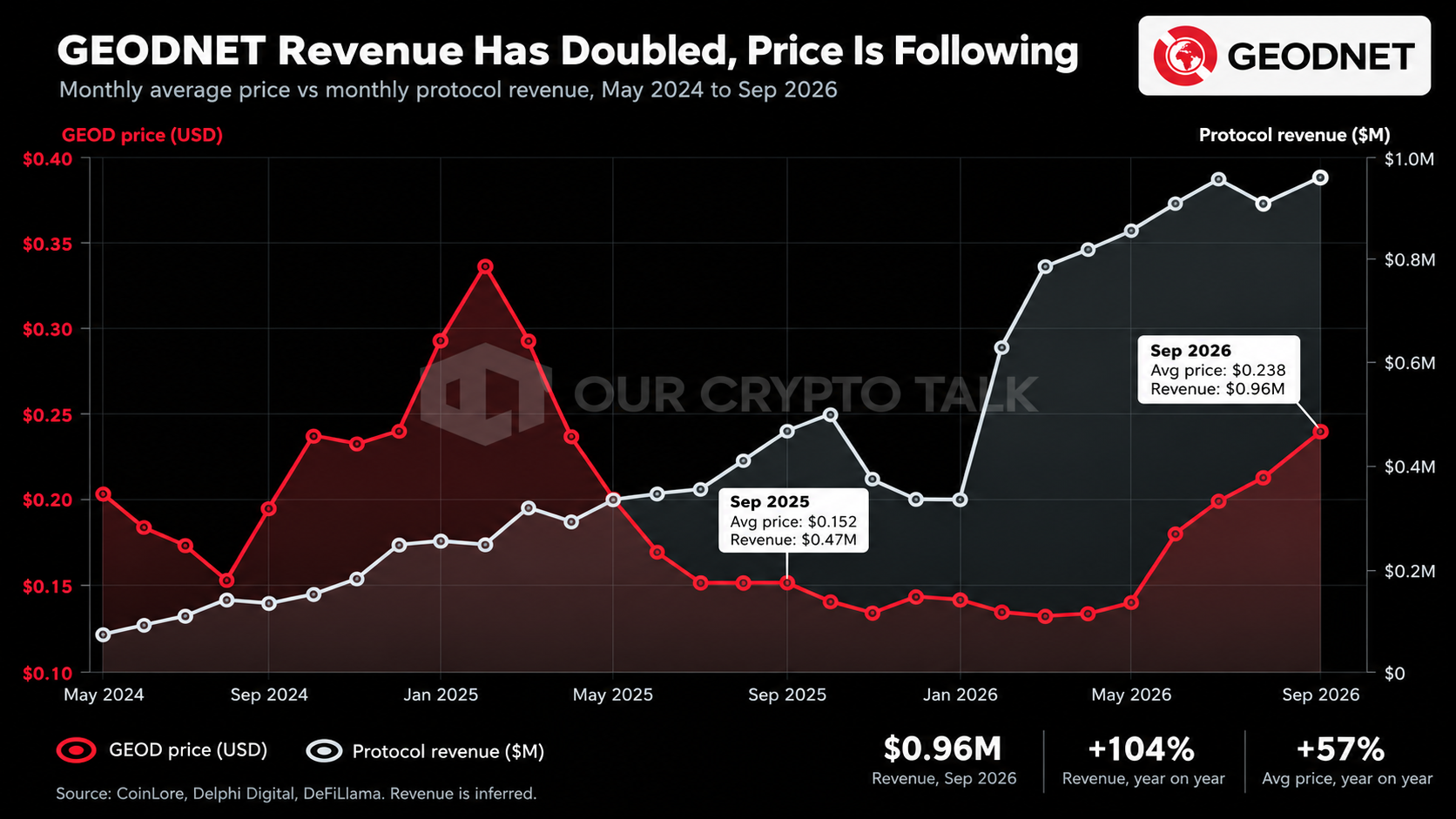
The supplied DefiLlama figures show that GEODNET has increased quarterly protocol revenue from the low hundreds of thousands of dollars into the millions. Annualized revenue sits near $9.5 million, while recent monthly figures exceed $900,000. Separately, project communications cite approximately $10.6 million in annualized revenue.
These figures may reflect different reporting dates or calculation methods. Nevertheless, they indicate substantial growth from earlier quarters, when revenue remained in the mid-to-high six figures, to recent quarters near $2.8 million.
Network expansion supports that growth. The supplied data lists more than 22,000 base stations across 174–175 countries, with historical additions of 100–200 stations per week. It also cites more than 150 enterprise accounts and reports total RTK users in the hundreds of thousands.
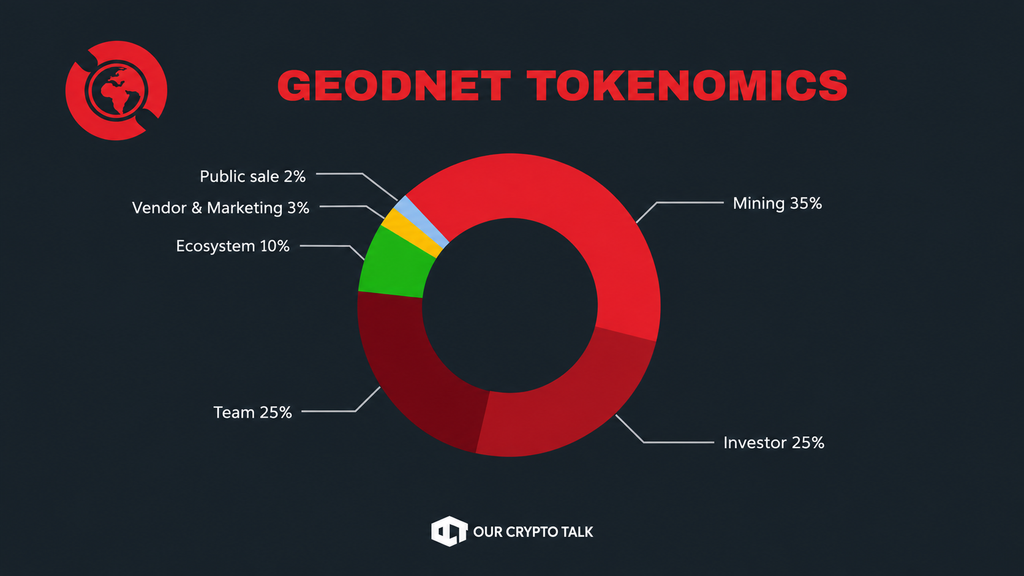
Meanwhile, the draft places GEOD’s circulating market capitalization near $117–120 million, with roughly 462–463 million tokens in circulation against an original maximum supply of 1 billion.
For crypto readers, the central question concerns conversion: can GEODNET turn broader coverage into recurring customer revenue while managing the cost of token incentives?
The GNSS correction services market and GEODNET’s position
Precision agriculture represents a major source of demand. Autonomous tractors, targeted spraying systems, and drone mapping applications rely on accurate positioning. Additionally, construction, surveying, mining, and outdoor robotics create further opportunities.
Legacy providers already serve these customers through established hardware, software, and correction services. Therefore, GEODNET must compete on reliability, integration, customer support, and price.
Its small revenue share suggests room for expansion. However, market size alone does not establish how much demand GEODNET can capture. The network must build sufficient coverage where customers operate and convert that coverage into paying subscriptions.
GEODNET compared with Trimble and Hexagon
GEODNET’s model shifts station hardware and deployment costs to community operators. In exchange, the network distributes token rewards. This structure allows the protocol to expand without directly funding every installation, although token emissions still create an economic cost for holders.
Using the draft’s subscription figures, GEODNET offers roughly 60–80% lower pricing than services charging $1,000–2,000 annually. However, customers must compare equivalent service packages, geographic coverage, hardware requirements, and support.
The draft also cites field comparisons between GEODNET’s GEO-MEASURE hardware and Trimble receivers using the same network. Those comparisons suggest comparable centimeter-level results under the tested conditions. They do not establish identical performance across every deployment or location.
Ultimately, this GEODNET price prediction depends partly on whether lower deployment costs translate into reliable service, sustained customer adoption, and stronger revenue growth.
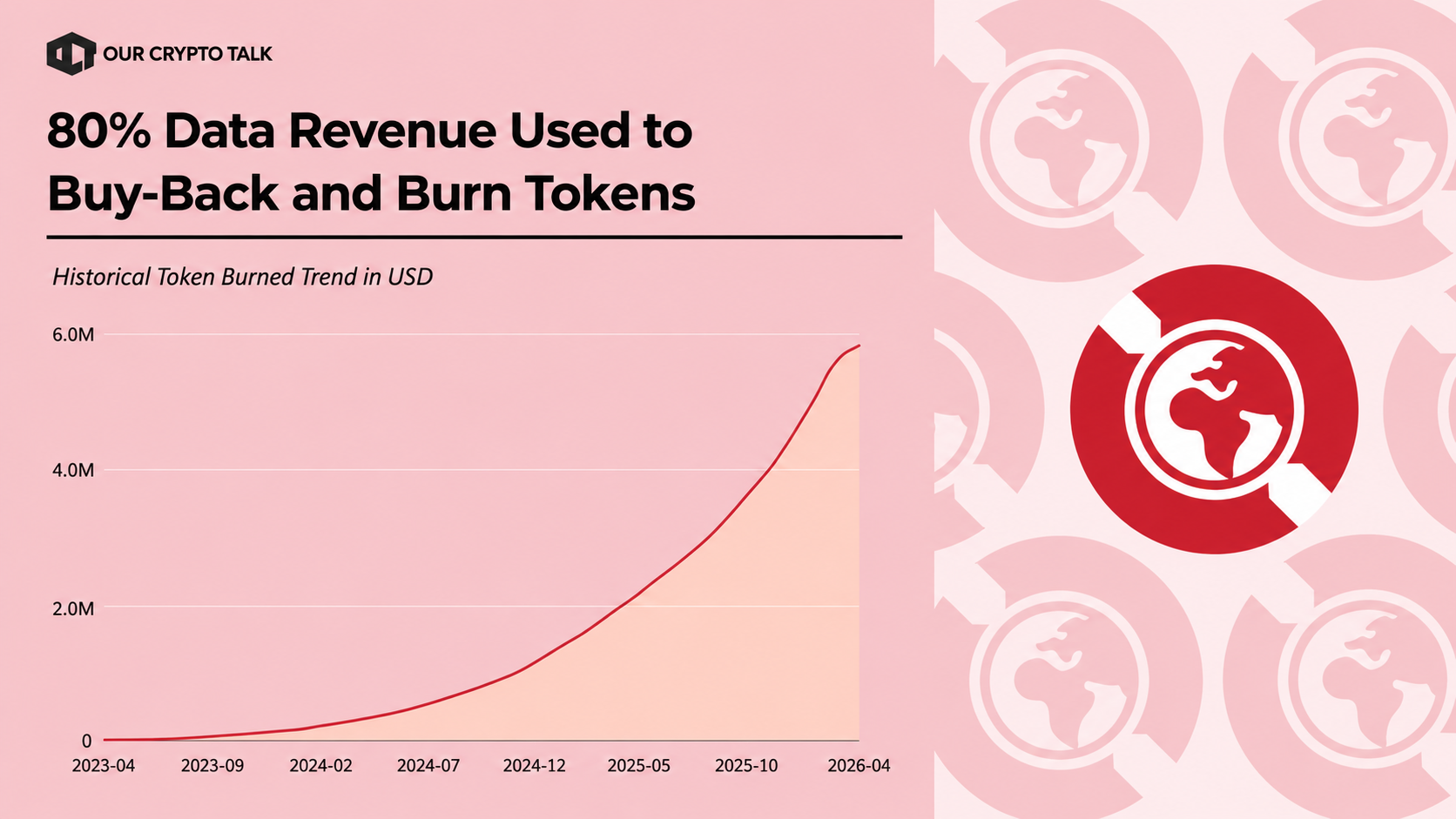
GEOD supply, revenue allocation, and buyback mechanics
GEODNET allocates 80% of data revenue to open-market GEOD purchases and sends the purchased tokens to a burn address. At a $9.5 million annualized revenue rate, that allocation implies approximately $7.6 million in annual purchases if revenue and the allocation remain constant.
Similarly, $50 million in annual revenue would support approximately $40 million in annual buybacks under the same policy. However, the token price determines how many GEOD those purchases remove from circulation.
Meanwhile, the protocol halves base mining rewards every June 30, according to the draft. Following the 2026 halving, the draft places the maximum base reward for eligible stations at 6 GEOD per day.
Rising revenue and declining mining rewards could help burns overtake emissions. Nevertheless, readers should distinguish lower mining emissions from lower total circulating supply. Unlocks and other distributions can increase the tradable supply even as the protocol burns tokens.
Buybacks create a connection between customer spending and token demand, but they do not guarantee price appreciation or give holders a direct claim on revenue.
GEODNET use cases, relationships, and market opportunities
The draft identifies relationships across GNSS hardware, surveying, drones, and robotics. For example, it describes Quectel integrations for IoT and robotics applications, Propeller Aero’s use of the network for mapping, and Bad Elf’s RTK subscription offerings.
Additionally, bynav targets automotive applications, while Sensori Robotics and Unmanned Life address robotic lawnmowers and drone operations.
These relationships show potential distribution channels and practical applications. However, a hardware integration, partnership, and paying customer represent different levels of commercial adoption. Readers should assess the revenue contribution behind each relationship when the project discloses it.
Outdoor automation could expand demand for precise positioning. Consequently, this GEODNET price prediction considers whether these relationships can generate additional usage and recurring revenue, strengthening the project’s investment case.
The following scenarios illustrate how different revenue assumptions and valuation multiples affect the outcome. They do not predict future token prices.
For consistency, the table treats the implied valuations as circulating market capitalizations. Future supply changes would affect the corresponding token price.
GEODNET valuation scenarios based on revenue assumptions and multiples
Under the bull case in this GEODNET price prediction, $50 million in annual revenue and a 20x revenue multiple produce a $1 billion valuation. However, that outcome requires revenue to grow approximately 5.3 times from the $9.5 million reference level. It also requires investors to assign a higher multiple than the reference valuation implies.
The $50 million revenue assumption represents approximately 1.35% of the cited $3.7 billion market. That share may appear modest, but capturing it still requires substantial enterprise sales, customer retention, and reliable service.
Moreover, a token market capitalization-to-revenue multiple differs from an equity valuation multiple. GEOD holders do not automatically receive ownership rights or a direct share of protocol earnings. Therefore, the buyback policy, supply schedule, and market demand all influence the usefulness of this framework.
Key risks affecting GEODNET’s growth and token valuation
Large-holder concentration, enterprise execution, and competition can materially affect this GEODNET price prediction. Meanwhile, emissions and unlocks influence how much additional demand GEOD needs to absorb new supply.
Service reliability also matters. A growing station count only creates commercial value when customers can access dependable corrections where they need them.
Consequently, readers should track recurring revenue, customer retention, usable coverage, buyback execution, and net supply changes alongside headline network growth.
GEODNET combines an operating positioning network, paying customers, and a revenue-funded token buyback mechanism. The supplied figures place annualized revenue near $9.5–10.6 million and network deployment above 22,000 stations across 174–175 countries.
Those metrics support a case for further growth. Additionally, community-funded infrastructure can help the network expand, while buybacks connect commercial activity to GEOD demand.
However, this GEODNET price prediction treats a $1 billion circulating market cap as a bull-case outcome. Reaching that level under the illustrated framework requires approximately $50 million in annual revenue, a 20x valuation multiple, and continued investor demand.
GEODNET’s progress will depend on its ability to win and retain enterprise customers, maintain reliable coverage, and grow buybacks relative to new supply. Those measures will determine whether commercial adoption supports a larger token valuation.
This is not financial advice. Do your own research.


GEODNET Price Prediction: The $1B Thesis for GEOD
RWA Needs Better Access. Can NUVA Deliver?
Tokenization of RWA yields onchain might be the biggest opportunity that no one has noticed
Cold Wallet Safety 2026: Are Hardware Wallets Still Safe?
GEODNET Price Prediction: The $1B Thesis for GEOD
RWA Needs Better Access. Can NUVA Deliver?
Tokenization of RWA yields onchain might be the biggest opportunity that no one has noticed
Cold Wallet Safety 2026: Are Hardware Wallets Still Safe?