The FOMO app went from zero to 625K users and $4B in volume in a year. See how its social trading feed, Apple Pay onboarding, and $1 trades actually work.

Author: Kritika Gupta
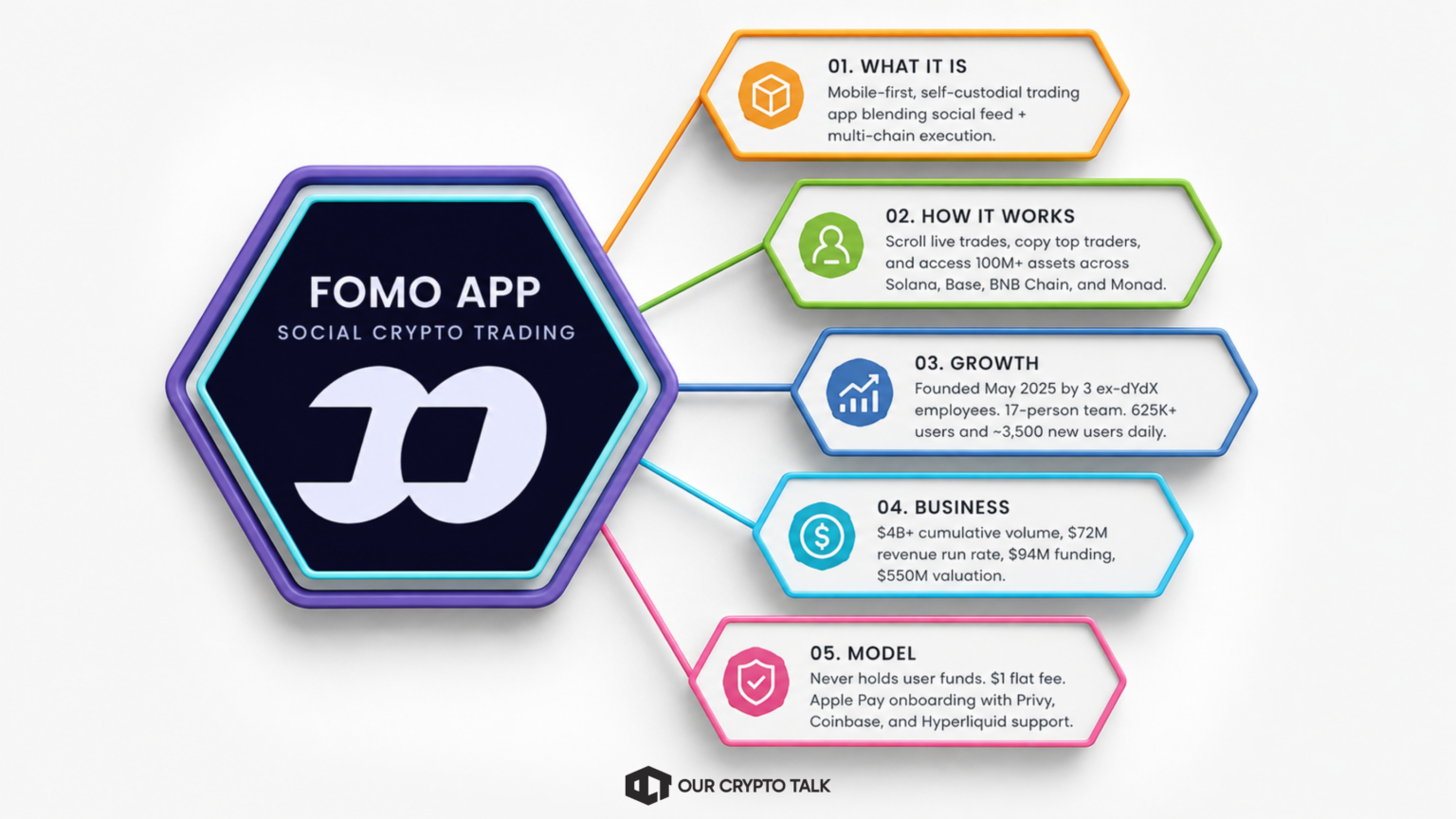
FOMO is a mobile-first, self-custodial crypto trading app that combines a social media feed with multi-chain trading. In practice, think of it as the TikTok of crypto trading: you scroll a feed of what real traders are buying and selling in real time, tap to copy their trades, and access 100 million+ on-chain assets across Solana, Base, BNB Chain, and Monad, all from a single screen with no wallet setup, no bridges, and no gas management. As a result, FOMO packages on-chain trading into a consumer-style interface instead of asking users to manage wallets, networks, and transaction mechanics themselves.
Three former dYdX employees, Paul Erlanger, Se Yong Park, and Prashan Dharmasena, founded FOMO in May 2025. Since then, the platform has scaled quickly despite operating with a team of just 17 people. It adds roughly 3,500 users per day and has grown to more than 625,000 users. At the same time, cumulative trading volume has crossed $4 billion, while the company reports a $72 million annual revenue run rate. Moreover, FOMO has raised $94 million at a $550 million valuation, with backing from Index Ventures, which previously invested in companies such as Figma and Robinhood, as well as Union Square Ventures and Benchmark.
FOMO also takes a self-custodial approach, meaning the platform never holds user funds. Importantly, March 2026 guidance from the SEC and CFTC clarified the regulatory treatment of this architecture and gave the model more room to operate outside traditional broker-dealer requirements. Meanwhile, FOMO charges a flat $1 fee per trade and relies on infrastructure partners for key services. For example, Privy provides embedded wallets, Coinbase handles fiat rails, and Hyperliquid powers perpetual futures. Consequently, this setup allows the company to focus heavily on its interface, execution flow, and social layer.
That consumer-first approach sits at the center of FOMO’s product strategy. Paul Erlanger described the problem directly: “Onchain trading is just impossible. We want FOMO to not read as a crypto app at all.” To support that vision, users can sign up with Apple ID or email, fund their account through Apple Pay, and begin trading without handling seed phrases or bridges. Ultimately, FOMO aims to make on-chain trading feel closer to using a mainstream social or fintech app than a traditional crypto interface.
For active traders who already use DEXs or CEXs, FOMO’s main advantage comes from combining social alpha with fast execution. Instead of showing what influencers claim to like, the feed shows what top traders are actually buying and selling. Public P&L and win rates add accountability, so users can evaluate a trader’s track record before deciding whether to copy them. FOMO also uses Solana-native execution to deliver sub-second trades, while its multi-chain setup removes the need to bridge assets or jump between different apps. From one interface, traders can move between Solana meme coins, Base DeFi tokens, and BNB Chain assets.
FOMO expanded that experience in June 2026 by adding perpetual futures through Hyperliquid. The app integrates perps directly into the social feed, allowing users to see when traders they follow open leveraged positions and react in real time. Pricing also works in FOMO’s favor for larger trades. The platform charges a flat $1 per transaction, compared with Coinbase’s typical 40 to 60 basis points and Phantom’s roughly 85 basis points on swaps. However, the fee becomes expensive on very small orders. A $5 trade, for example, carries an effective 20% fee, while trades above $100 make the flat-fee model much more competitive.
The main caveat is that FOMO does not operate as a full-stack exchange. It relies on Privy for wallets, Coinbase for fiat infrastructure, and Hyperliquid for perpetuals. In practice, FOMO acts more like an aggregation and interface layer that connects several external services. That keeps the user experience simple, but it also means execution quality, uptime, and some parts of the trading experience depend on third-party partners.
For investors evaluating FOMO as a product or broader market thesis, the company’s operating efficiency stands out first. FOMO generates a $72 million annual revenue run rate with a team of just 17 people, which works out to roughly $4.2 million in revenue per employee. That level of productivity puts it in the efficiency range of some of the strongest SaaS businesses. At the same time, DefiLlama protocol data places gross margin at roughly 96.7%, giving FOMO an unusually high-margin revenue profile. The investor base adds another signal. Index Ventures, which has backed companies such as Figma and Scale AI, and Union Square Ventures are generalist firms rather than crypto-native VCs. Index partner Julia Andre summarized the thesis directly: “We’re not doing Fomo because it’s a crypto business.” In that context, participation from generalist venture capital suggests a structural bet on the product category rather than short-term crypto narrative speculation.
FOMO is also expanding the addressable market instead of competing only for existing crypto traders. The platform has onboarded 68,000 first-time crypto buyers, giving it a user-acquisition channel that many crypto-native trading apps struggle to build. However, the bigger investment thesis centers on the social graph. FOMO needs to prove that it can turn trading activity into a durable financial social network. If market activity slows, will users continue opening the app for discovery, trader tracking, and interaction? More than 110 million social interactions suggest that engagement already extends beyond pure trade execution.
Still, investors should treat the headline user numbers carefully. FOMO’s reported user count may include registrations rather than only funded or active accounts. The clearest disclosed funnel metric remains the 29% trader-to-user ratio reported in November 2025. Therefore, the key question is not whether FOMO can attract attention during periods of strong trading activity, but whether its social layer can retain enough users to remain valuable when volume and speculation cool.
For people who already own some crypto but do not actively trade, FOMO removes much of the usual friction. Users can deposit through Apple Pay and start browsing the feed in under 30 seconds without setting up a separate crypto wallet or opening an exchange account first. The feed then handles discovery by surfacing trending tokens, top traders, and market movements in real time. Instead of researching through reports, charts, or X threads, users can learn what is moving by scrolling. That is where the “TikTok for trading” comparison fits. Just as TikTok surfaces content users did not know they wanted, FOMO surfaces trades and tokens they may not have known existed. Discovery becomes social rather than search-driven.
FOMO also keeps the experience self-custodial without exposing users to much of the usual wallet complexity. Users retain control of their keys, but the interface removes seed-phrase management, MetaMask pop-ups, bridge steps, and manual gas calculations from the experience. However, a simpler interface does not make the underlying assets safer. Meme coins can lose 90% of their value within hours, and copy trading can reproduce losses just as quickly as gains. So while FOMO makes crypto trading easier to access, casual users still take on the same volatility and market risk that comes with trading speculative on-chain assets.
Bitcoin dropped roughly 23% in Q1 2026, and many crypto apps saw engagement weaken as trading activity cooled. FOMO moved in the opposite direction. The key difference was that FOMO did not rely entirely on rising prices to keep users engaged. Bear markets often make conventional trading feel slow, but a live social feed of traders placing real bets creates its own form of entertainment. Users can watch positions open, profits and losses update, and new tokens gain attention in real time. That turns FOMO into more than a trading interface. It also functions as gambling-style entertainment, where the activity itself can keep users scrolling even when the broader market goes sideways.
FOMO also benefited from Solana’s meme coin economy, which does not depend on Bitcoin being in a bull market. Platforms such as Pump.fun already created an attention-driven ecosystem where new tokens, narratives, and traders rotate quickly. FOMO plugged directly into that existing behavior. Instead of asking users to search for the next token manually, the social feed surfaced what other traders were already buying. In other words, FOMO monetized attention cycles rather than relying on a sustained rise in BTC or the broader crypto market.
Regulatory timing and FOMO’s revenue model strengthened that advantage. March 2026 SEC and CFTC guidance gave non-custodial wallet models more regulatory breathing room just as FOMO was scaling. At the same time, the company earns a flat $1 every time a user trades, regardless of whether that trade makes money. As a result, FOMO does not need asset prices to rise for revenue to grow. It needs activity. Social dynamics can generate that activity in either market direction because users still copy trades, rotate into meme coins, and react to what they see in the feed.
The network effect then compounds the model. Every new trader adds more activity to the feed. More activity creates more content, which improves discovery and gives other users more reasons to return. More discovery can then produce more trades and attract more users. That flywheel can keep working even during weak markets. The revenue numbers show how powerful it became: FOMO increased weekly revenue from roughly $150,000 in late 2025 to $1.39 million by July 2026, representing about 9x growth. Crucially, that expansion happened during the same broader bear market that reduced engagement across much of the crypto sector.
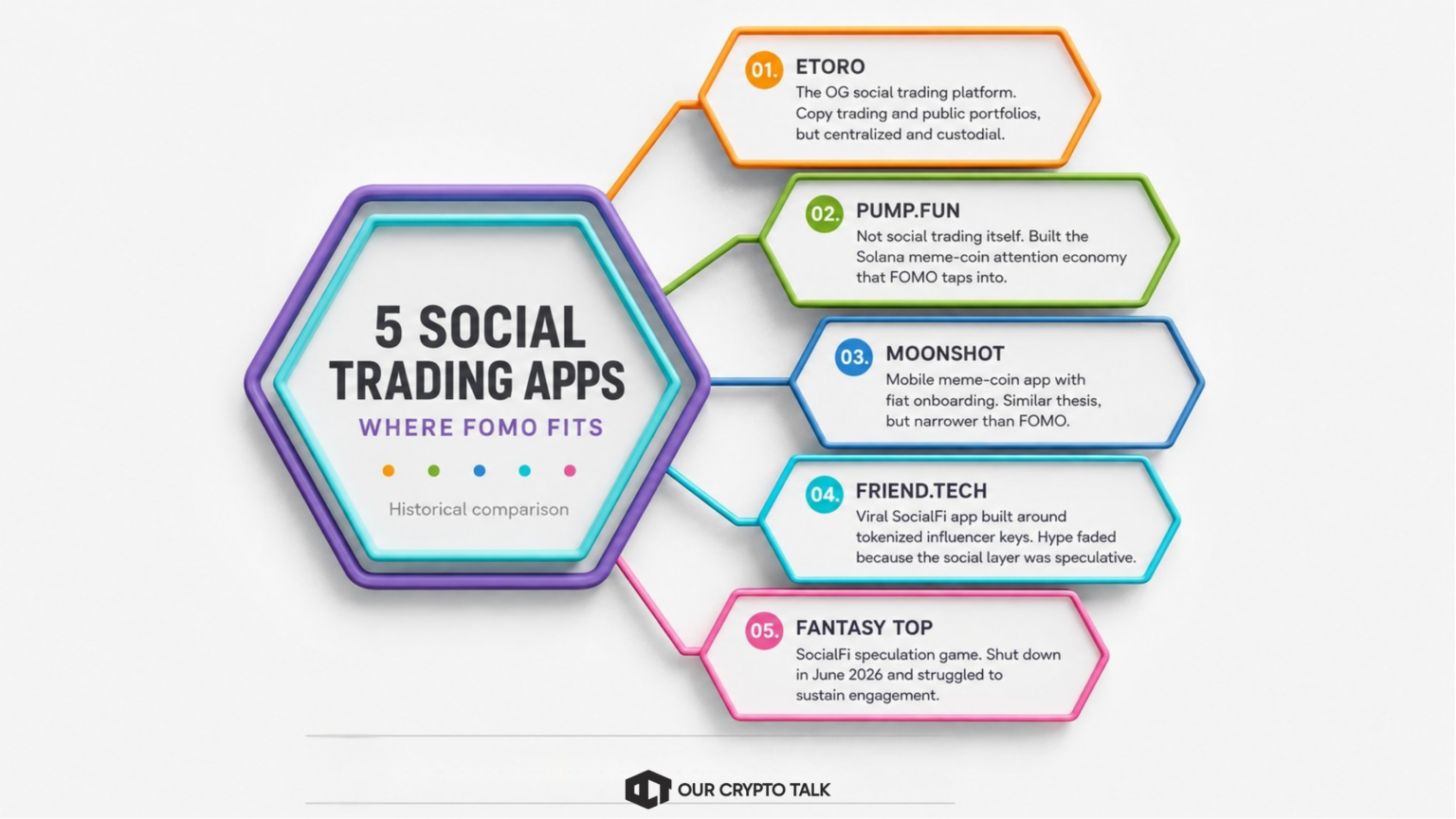
FOMO is not the first company to combine trading with social mechanics. eToro has done it since 2007 through copy trading, public portfolios, and trader performance profiles. The difference is infrastructure. eToro built its model around a centralized, custodial platform, while FOMO approaches social trading as an on-chain product. In that sense, FOMO looks like what eToro might have become if developers had built it natively around crypto rails. Pump.fun represents a different part of the stack. It is not a social trading app, but it created much of the Solana meme coin attention economy that FOMO now taps into. Pump.fun creates the tokens and initial speculation, while FOMO helps distribute the resulting trades through its social feed.
Moonshot followed a thesis closer to FOMO’s. The mobile app combined meme coin trading with a fiat onramp and simplified the onboarding process for retail users. However, Moonshot focused much more narrowly on meme coins. FOMO expanded that concept across a broader universe of on-chain assets while adding trader feeds, copy trading, public performance data, and multi-chain execution. That wider product scope gives FOMO more potential use cases beyond a single token category or market cycle.
The more cautionary comparisons come from friend.tech and Fantasy Top. friend.tech went viral by allowing users to trade tokenized influencer keys on Base, but the social layer itself became the speculative asset. Once interest in trading those keys faded, the product had little functional activity left to sustain engagement. Fantasy Top followed a similar SocialFi pattern, building speculation around personalities and eventually shutting down in June 2026. FOMO uses a different retention mechanism. Its social layer sits on top of actual token trading, meaning users can continue following positions, discovering assets, and executing trades even when speculation around individual creators disappears.
That distinction may determine whether FOMO lasts. Social crypto products built primarily around speculation on people, such as friend.tech and Fantasy Top, have struggled to maintain engagement after the initial hype cycle. Platforms built around recurring trading activity, with eToro as the clearest long-term example, have shown a stronger path toward durability. FOMO fits closer to that second category, but it still faces one major test: whether its social graph remains valuable after the current meme coin cycle fades.
FOMO’s next phase will likely focus on expanding both its product and market reach. The app remains mobile-only, so a desktop version would give active traders more room for charts, position management, and deeper analysis. More chain integrations also look like a logical step. Monad already sits alongside Solana, Base, and BNB Chain, while Ethereum mainnet, Arbitrum, and other Layer 2 networks could broaden the asset universe further. FOMO has not announced a token, but speculation will likely continue given its $94 million in funding, more than 625,000 users, and growing social graph. A governance or utility token would fit the broader crypto playbook, although users should treat any launch expectations as speculation until the company confirms one.
Perpetual futures offer another growth path. FOMO launched non-US perps through Hyperliquid on June 11, 2026, but bringing similar products to U.S. users would require greater regulatory clarity. Still, the larger opportunity lies in the social graph. If FOMO can turn trader activity, discovery, and interactions into a durable financial social network, it stops being just a trading app with a feed and starts becoming a platform. That is the deeper thesis behind investors such as Index Ventures. However, the window is narrowing as Coinbase, Phantom, and Jupiter add more social and discovery features of their own. FOMO needs to establish strong network effects before larger incumbents close the gap.
FOMO has the growth, the revenue, and the investors. The question is whether it has the retention. Social trading apps live and die by whether users come back after the hype cycle. History says most don’t. FOMO’s bet is that this time, the product is good enough to change that pattern.
This article is for informational purposes and is not financial advice. Crypto trading carries significant risk of loss.


Tokenization of RWA yields onchain might be the biggest opportunity that no one has noticed
Cold Wallet Safety 2026: Are Hardware Wallets Still Safe?
One Token, Multiple Products. Can Zylo Deliver?
The Rise of NEAR Protocol 2026: Inside the 530% Rally and the ETF
Tokenization of RWA yields onchain might be the biggest opportunity that no one has noticed
Cold Wallet Safety 2026: Are Hardware Wallets Still Safe?
One Token, Multiple Products. Can Zylo Deliver?
The Rise of NEAR Protocol 2026: Inside the 530% Rally and the ETF