

Author: Chirag Sharma
The Coinbase vs Clarity Act battle is no longer just about policy. It has become a defining moment for the future of crypto in the United States. In July 2025, lawmakers passed the Digital Asset Market Clarity Act with strong bipartisan support. The goal was simple but ambitious: end regulatory uncertainty and provide a clear framework for how crypto should operate in the U.S. Yet nearly nine months later, the bill remains stuck.
The reason is not a lack of interest. It is conflict. At the center of that conflict is Coinbase, the largest crypto exchange in the U.S., which has now withdrawn support from the Senate’s latest draft for the second time in 2026. The issue is narrow but powerful: restrictions on stablecoin rewards and yields.
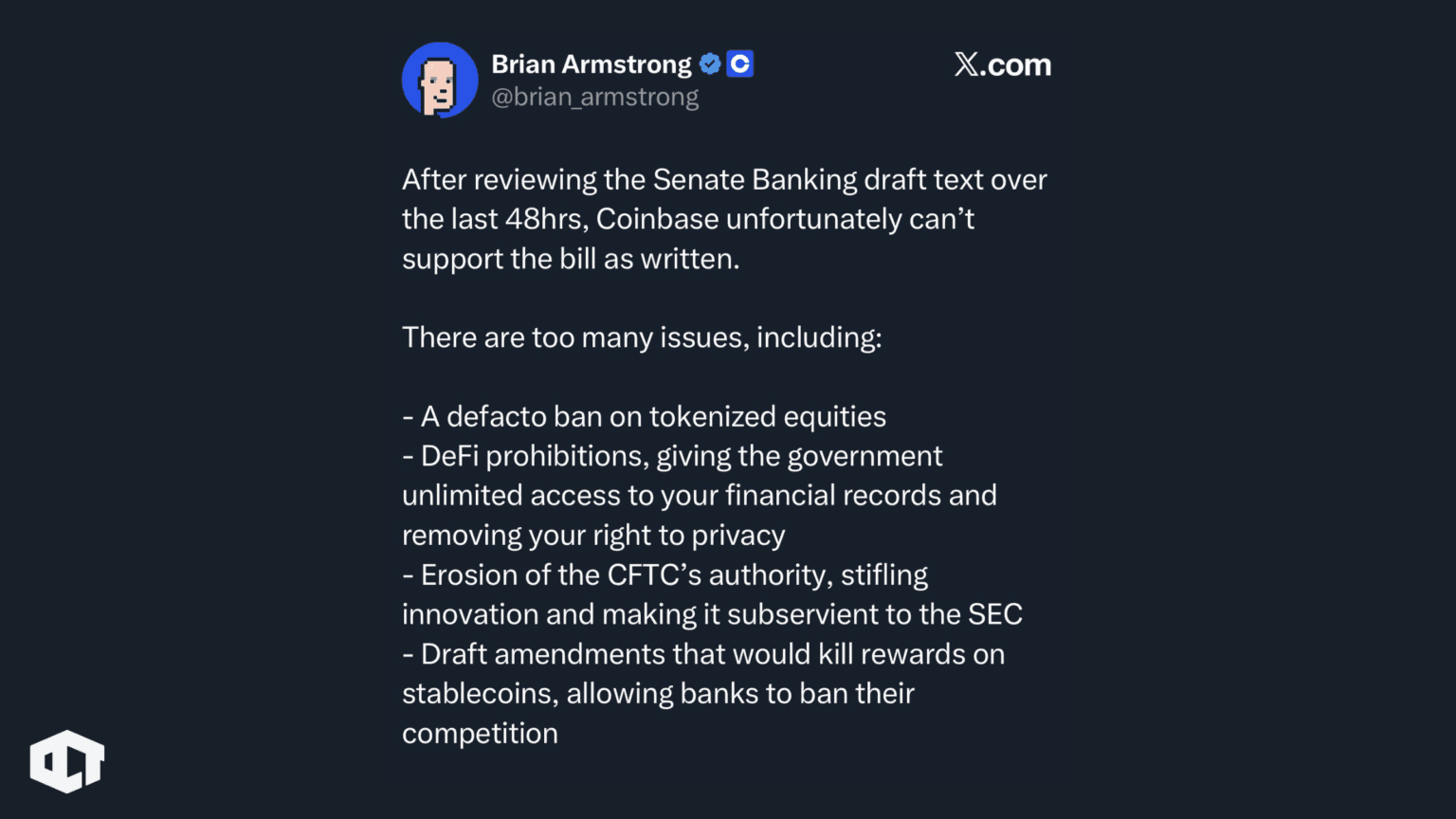
This is not just a disagreement over one clause. It is a clash between two financial systems. On one side is crypto, pushing for open, programmable money. On the other are traditional institutions, trying to preserve their role in the economy. The outcome of the Coinbase Clarity Act debate could shape how crypto evolves over the next decade.
To understand the Coinbase Clarity Act conflict, you first need to understand what the Clarity Act actually does. The legislation attempts to solve one of crypto’s biggest problems: regulatory ambiguity. For years, U.S. regulators and especially the U.S. Securities and Exchange Commission have relied on enforcement rather than clear rules. This approach created uncertainty for companies, developers, and investors.
The Clarity Act changes that. It introduces a structured framework that defines how digital assets should be classified and regulated. The most important feature is the division of authority between two regulators:
This distinction is critical. It determines how tokens are issued, traded, and regulated. Beyond classification, the Clarity Act introduces several key reforms:
The House version of the bill was widely praised for its balanced approach. It aimed to position the U.S. as a global leader in crypto innovation while maintaining oversight. But the Senate version introduced a new variable which is Stablecoins.
The Coinbase Clarity Act conflict is centered around one specific issue: stablecoin yield restrictions. The Senate draft includes language that prohibits crypto platforms from offering:
This directly impacts Coinbase’s business model. Coinbase co-issues the USDC stablecoin alongside Circle. One of its key offerings is a rewards program where users earn yield on their USDC holdings. These rewards are funded by interest generated from the underlying reserves.
This is not a small feature. It is a major revenue stream. In 2025 alone, Coinbase generated approximately $1.35 billion from stablecoin-related activity, representing nearly 20 percent of its total revenue. If the Senate language passes unchanged, that revenue stream could disappear.

CEO Brian Armstrong has been vocal about this. He has argued that the restrictions are not about consumer protection but about limiting competition. From his perspective, this is regulatory capture. Traditional banks offer low-interest savings accounts. Stablecoins, on the other hand, enable higher yields through on-chain mechanisms. Limiting those yields reduces the competitive advantage of crypto.
This is why Coinbase has taken a strong stance. It is not opposing regulation. It is opposing this version of regulation.
The Coinbase Clarity Act debate is not theoretical. It has real economic implications. Stablecoins are one of the fastest-growing sectors in crypto. They serve as the backbone of trading, DeFi, and cross-border payments. More importantly, they represent a direct challenge to traditional banking.
Here is why stablecoins matter:
Yield-bearing stablecoins take this a step further. They allow users to earn returns without relying on traditional banks. This is where the tension arises. Banks rely on deposits to generate revenue. Stablecoins, especially those offering yields, compete directly for those deposits. The Senate’s proposed restrictions effectively limit this competition. From Coinbase’s perspective, this creates an uneven playing field. From the banking sector’s perspective, it preserves financial stability. The Coinbase Clarity Act is therefore not just about crypto regulation. It is about the future structure of finance.
Despite the controversy, most of the crypto industry still supports the broader goals of the Clarity Act. That is an important point. The bill addresses several long-standing issues that have slowed innovation in the U.S. First, it provides regulatory clarity. This alone is a major breakthrough. Companies can operate with confidence instead of navigating uncertain enforcement actions. Second, it introduces market structure rules tailored to crypto. Exchanges, custodians, and brokers gain defined responsibilities and compliance pathways. Third, it legitimizes stablecoins through reserve requirements and transparency standards. This builds trust and encourages adoption.
Fourth, it enhances U.S. competitiveness. Other regions, including Europe and parts of Asia, have already implemented clear crypto frameworks. Without similar policies, the U.S. risks falling behind.
Even Coinbase agrees with these aspects. Its opposition is not to the entire bill. It is specifically focused on the stablecoin provisions. This nuance is critical in understanding the Coinbase Clarity Act debate.
At a deeper level, the Coinbase Clarity Act represents a broader philosophical conflict. Should crypto be allowed to compete freely with traditional finance? Or should it be integrated within existing financial structures?
On one side, crypto advocates argue for open systems that enable innovation. They see stablecoins as a tool for financial inclusion, efficiency, and global access. On the other side, regulators and banks emphasize stability, risk management, and consumer protection.
Both perspectives have merit. Unregulated innovation can lead to risks. Over-regulation can stifle growth. The challenge is finding balance. The current Senate draft may have tilted too far in one direction.
If the Clarity Act passes with the current stablecoin restrictions, several outcomes are likely.
First, Coinbase and similar platforms may need to redesign their products. Yield-based offerings could disappear or move offshore.
Second, users may shift toward decentralized platforms that are harder to regulate. This could reduce transparency rather than improve it.
Third, traditional financial institutions may retain a stronger position in the market.
Fourth, innovation could slow within the U.S., with developers choosing to build in more favorable jurisdictions.
In short, the bill could achieve clarity but at the cost of competitiveness.
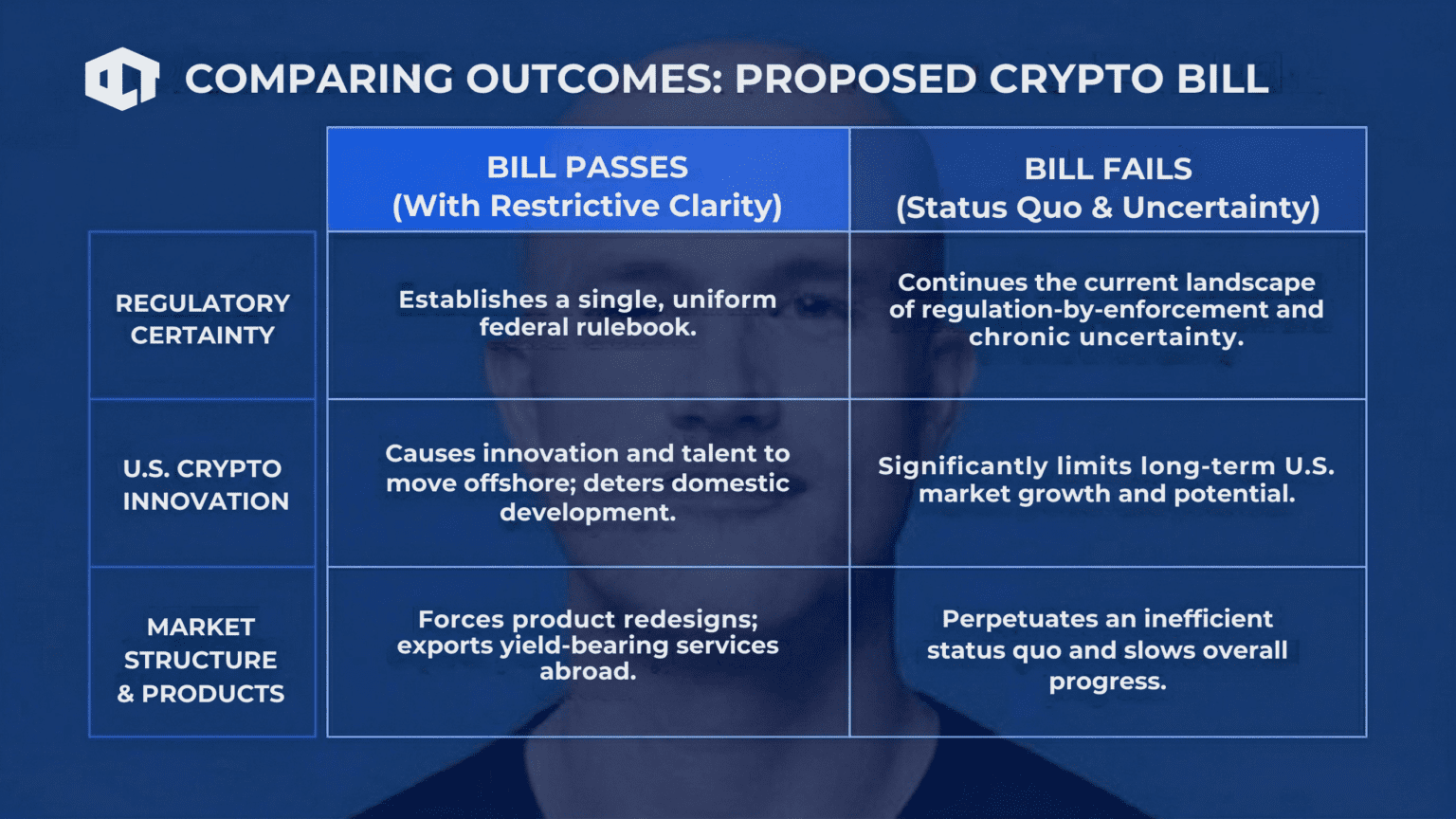
If the Coinbase Clarity Act conflict leads to a complete failure of the bill, the consequences are different but equally significant. The current regulatory environment would remain in place.
This means:
While imperfect, the status quo has allowed some growth. However, it lacks the structure needed for long-term expansion. This is why many in the industry still want the bill to pass, even with compromises.
The Coinbase Clarity Act debate comes at a crucial time. Crypto is transitioning from a niche technology to mainstream infrastructure. Institutional adoption is increasing. Use cases are expanding. Governments are paying closer attention.
This is the moment when rules are being written. The decisions made now will shape:
The stakes are high. This is not just another policy discussion. It is a structural turning point.
The Coinbase Clarity Act conflict highlights the growing tension between innovation and regulation in the crypto industry. On one hand, the Clarity Act represents a major step forward. It provides long-awaited regulatory clarity and establishes a framework for growth.
On the other hand, specific provisions—particularly around stablecoin yields—risk limiting the very innovation the bill aims to support. Coinbase’s opposition is not about rejecting regulation. It is about shaping it. The coming months will determine whether lawmakers can find a balance that supports both innovation and stability.
If they succeed, the U.S. could lead the next phase of crypto development. If they fail, the industry may look elsewhere.
All the opinions in this article are that of the author and in no way are financial advice. Our Crypto Talk and the author always suggest you do your own research in crypto and to never take anything as financial advice that you read on the internet. Check our Terms and conditions for more info.