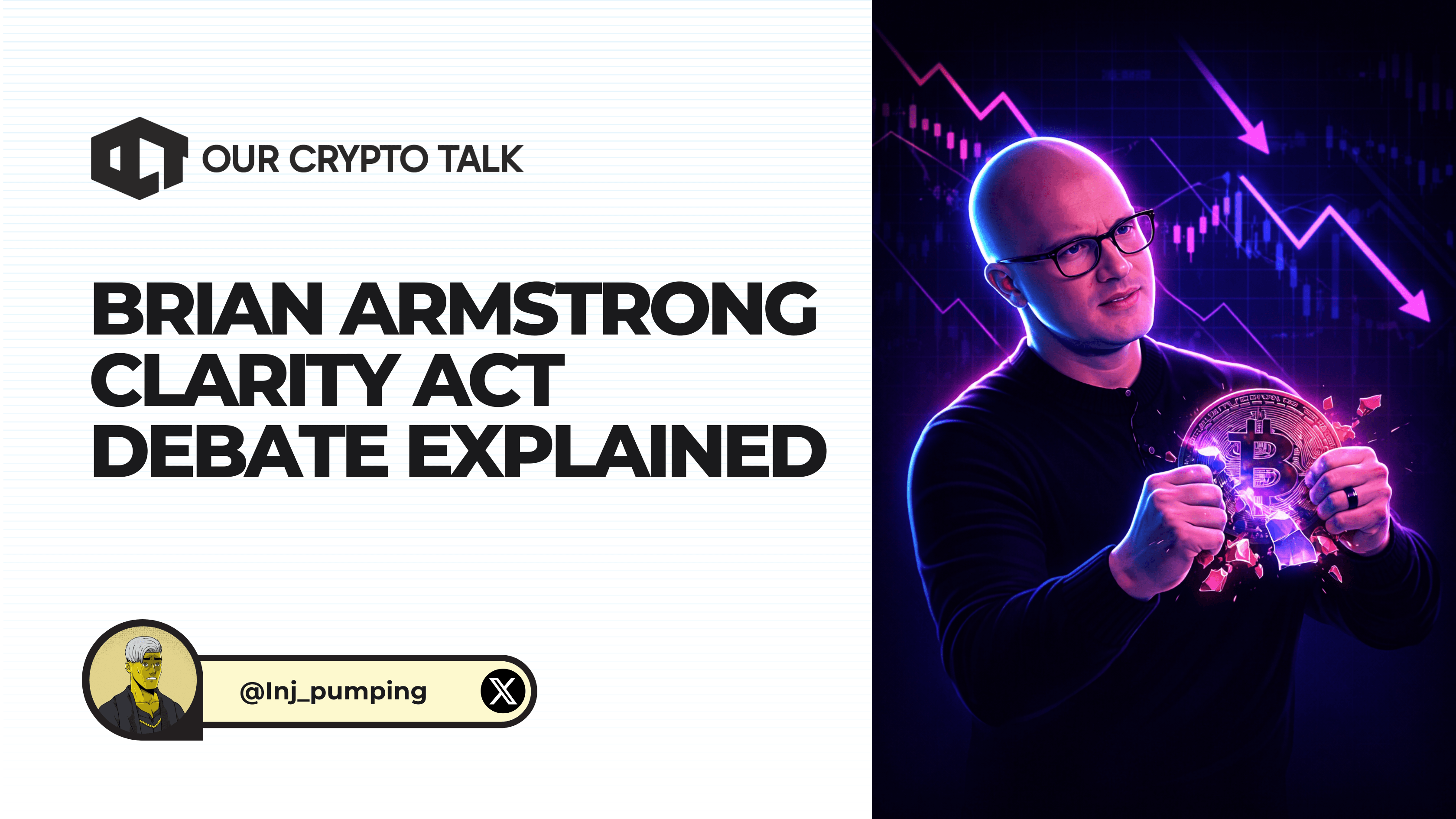
Brian Armstrong CLARITY Act stance sparks debate over Coinbase’s role in crypto regulation and its impact on industry clarity.
The Coinbase CEO is quietly sabotaging the one bill that could save the industry. The Brian Armstrong CLARITY Act debate reveals how, while you hold the bag, he’s protecting his. This is the story the crypto press won’t tell you.
Let’s start with a number: $11 billion.
That’s roughly Brian Armstrong’s net worth. It’s also, conveniently, the amount of personal financial firepower insulating him from every single regulatory outcome that keeps you up at night.
Now let’s talk about a different number: zero.
That’s how many times Brian Armstrong has stood up in front of Congress, the press, or his own community and said the words “I fully support the CLARITY Act, and Coinbase will spend every dollar of its political capital to make it law.”
One man. Eleven billion dollars. The biggest megaphone in crypto. And somehow, the industry’s most important piece of legislation in a decade is limping through Washington without its most obvious champion.
This isn’t an accident. This is a strategy.
Before we get into Armstrong’s game, you need to understand what’s actually at stake because the mainstream crypto press has done a remarkable job of covering the CLARITY Act without explaining why certain powerful people have every incentive to see it watered down or dead.
The CLARITY Act, in its most essential form, does three things:
First – , it draws a hard legal line between digital assets that are securities and those that are commodities. Right now, that line doesn’t exist. The SEC has spent years arguing everything is a security when it wants to make an example of someone, and nothing is a security when it doesn’t. This ambiguity has been weaponized against projects, founders, and retail holders alike. The CLARITY Act kills that weapon permanently.
Second – , it establishes a real regulatory pathway for token projects to achieve compliance without having to register as a traditional security which is functionally impossible for most decentralized protocols. This means builders in the U.S. can actually *build* in the U.S. again. Developers who fled to Dubai, Singapore, and Zug can come home. The brain drain reverses.
Third – and this is the part nobody talks about it significantly reduces the compliance advantage of large, established, centralized exchanges over smaller competitors and decentralized alternatives. If the rules are clear, anyone can follow them. If the rules are deliberately murky, only the biggest players with the most lawyers and the most cozy relationships with regulators can survive.
Guess who benefits from murky rules?
Coinbase didn’t become the dominant U.S. crypto exchange because it had the best product. Ask any serious crypto user whether they prefer Coinbase’s UX, fees, and asset selection to alternatives, and you’ll get a laugh.
Coinbase became dominant because it was compliant, or at least compliant enough. The company played the regulatory game better than anyone, hiring the right people from key agencies and cooperating with major investigations. It also testified at critical hearings and, over time, built the perception of being the “safe” choice in an otherwise unsafe industry.
That perception is worth billions. Not because it’s necessarily true, but because in a world without regulatory clarity, perception of safety is the product.
Think about it from a retail investor’s perspective. A newcomer to crypto is often cautious, shaped by headlines about hacks, rug pulls, and SEC lawsuits. So where does the money go? Typically, to the exchange that appears to have its act together one that’s publicly traded, uses a .com instead of a .io, and has been featured on CNBC.
That’s Coinbase. And that advantage exists almost entirely because the regulatory environment is confusing enough to scare retail into the arms of the biggest, most established player.
The CLARITY Act doesn’t just help the industry. It demolishes Coinbase’s single most valuable competitive advantage: being the only place regular people feel safe parking their money.
Here’s where it gets instructive. Brian Armstrong is very, very good at sounding like a crypto advocate.
He tweets about financial freedom and posts long-form pieces on the importance of decentralization. At conferences, he speaks about Coinbase’s mission “to increase economic freedom in the world.” Over time, he has positioned himself as the industry’s statesman, the adult in the room who can engage senators without making them reach for their gavels.
But there is a difference between *performing* advocacy and *doing* advocacy. And when you look at where Coinbase’s actual lobbying dollars go, and which provisions in which bills Coinbase’s government affairs team has quietly pushed to modify, weaken, or remove you start to see a gap between the brand and the behavior.
Coinbase has not thrown its full institutional weight behind the CLARITY Act the way it threw its weight, for example, behind fighting the IRS broker reporting rules that threatened its business model directly. When Coinbase’s fees are on the line, the lobbying machine activates hard and fast. When the industry’s structural clarity is on the line, the machine runs at a much more… deliberate pace.
There’s a technical term for this in political science. It’s called prioritization. And Coinbase’s priorities reveal its interests far more clearly than any mission statement ever could.
If you’ve followed Coinbase’s communications around any piece of crypto legislation, you’ve heard some version of this phrase: *”We’re working constructively with lawmakers to ensure any legislation protects consumers and fosters innovation.”*
Write that sentence down. Memorize it. Because it is the single most effective piece of legislative delay technology ever deployed in Washington.
“Working constructively” means nothing. In practice, it’s a holding pattern disguised as engagement. This approach signals to the press that you’re involved and reasonable, to legislators that you’re at the table, and to the public that you care while committing to absolutely nothing.
This is how you kill a bill without ever opposing it. Instead of fighting unwanted legislation, the strategy is to improve it, suggest amendments, and raise concerns. Meetings get scheduled, more time is requested for review, and the bill’s provisions are framed as needing clarification. Six months later, the legislative window has closed, Congress has moved on, and the CLARITY Act is dead, with no one able to point to Brian Armstrong as the reason because he was always “working constructively.”
This is not a conspiracy theory. This is how Washington works. And no one in the crypto industry has more resources, more access, and more motivation to play this game than Coinbase.
Let’s say something uncomfortable.
In the aftermath of FTX’s collapse, the crypto industry spent enormous energy pointing at Sam Bankman-Fried as a cautionary tale a charismatic, publicly beloved figure who was privately undermining the very industry he claimed to champion, all while protecting his own financial interests.
The specifics are obviously different. Armstrong isn’t running a fraud. Coinbase isn’t FTX. Nobody is suggesting criminal behavior.
But the structural pattern a powerful industry figure using their platform to *perform* advocacy while their actual interests point in a different direction should at least give the community pause. Because the community learned, too late with SBF, that public enthusiasm for crypto doesn’t equal alignment with crypto’s actual users.
The question worth asking is: whose interests does Brian Armstrong actually serve when the pressure is on?
Look at where Coinbase fought hardest: against the IRS broker rules, against certain DeFi regulations that would have required decentralized protocols to comply with KYC requirements (which would have made Coinbase’s compliance infrastructure even more valuable by comparison), and in favor of its own Base chain ecosystem. All legitimate fights. All, notably, fights where Coinbase’s own business interests were directly and immediately at stake.
Now look at the CLARITY Act a bill that helps every builder, every retail investor, every DeFi protocol, and every competitor equally. A bill where Coinbase’s specific advantage doesn’t improve and may actually diminish. A bill where Armstrong’s incentive to fight hard is structurally weakest.
Notice the difference?
Brian Armstrong’s compensation package and asset holdings are public record. He owns approximately 19% of Coinbase’s outstanding shares, plus additional crypto holdings reported across various filings. His diversification and liquidity means that even a catastrophic regulatory outcome say, a sweeping SEC crackdown that cripples the U.S. crypto market would hurt him, but it would not ruin him.
He has options, backed by lawyers, an offshore contingency plan, a board, and a full PR team.
You have a Ledger and a prayer.
The retail holder sitting on $40,000 in altcoins that could be deemed unregistered securities has no exit ramp. The solo developer who spent two years building a protocol that the SEC could classify as an investment contract tomorrow has no legal war chest. The DAO contributor who didn’t realize their governance tokens might make them a “promoter” under securities law has no Washington lobbyist.
Those people need the CLARITY Act to survive in this market. Armstrong needs the status quo to keep his moat intact.
This is not a small distinction. This is the entire story.
Here’s a chapter the crypto press has almost entirely ignored: the Base chain play.
Coinbase launched Base, its own Ethereum Layer 2 network, and has been aggressively building it into a major ecosystem. On the surface, this looks like Coinbase embracing decentralization a centralized exchange building public blockchain infrastructure. Bullish for the industry, right?
Look closer.
Base’s success is actually enhanced by regulatory ambiguity at the application layer. When it’s unclear whether certain DeFi protocols are legal to operate in the U.S., developers and users migrate toward infrastructure with institutional backing infrastructure like Base, which has Coinbase’s implicit regulatory credibility behind it.
A fully clarified regulatory environment, where any developer can build anything with confidence about their legal status, means Base competes on pure merit technology, fees, ecosystem quality. An ambiguous regulatory environment means Base gets a trust premium just for having Coinbase’s name on it.
Armstrong isn’t just protecting Coinbase the exchange. He’s positioning Coinbase as the infrastructure layer of whatever regulated crypto future eventually emerges. The longer the uncertainty persists, the more developers and users cluster around the safe harbor of Coinbase-affiliated products.
The CLARITY Act would open the floodgates for independent builders. Armstrong’s strategy depends on those floodgates staying mostly closed.
One more thing worth examining: the people moving between Coinbase’s policy and legal teams and the regulatory agencies they’re supposed to be navigating.
Coinbase has, over the years, recruited from the SEC, the CFTC, the Treasury Department, and Congress’s own staff. This is completely legal and extremely common in Washington. It’s also how you build relationships that allow you to “work constructively with lawmakers” in ways that smaller players simply cannot.
The revolving door isn’t corruption. It’s access. And access is leverage. And leverage gets deployed in the direction of whoever is paying the salary which, in this case, is an entity whose business model benefits from the rules staying complicated.
Every time a former SEC staffer joins Coinbase’s legal team, that’s a person who knows exactly which senators are moveable on which provisions, which committee chairs care about which talking points, and how to slow-walk a piece of legislation while maintaining the appearance of good faith participation.
This is the infrastructure of regulatory capture. It’s boring. It’s invisible. And it is extraordinarily effective.
Brian Armstrong is a billionaire because millions of retail crypto users decided Coinbase was trustworthy enough to hold their money. Early adopters who wanted a simple on-ramp. Bitcoin maximalists who needed fiat rails. Altcoin degens who wanted a regulated venue. They all chose Coinbase. They made Armstrong one of the wealthiest people in the technology industry.
Those same users are the ones most exposed to the regulatory chaos that the CLARITY Act would resolve. Many hold assets with uncertain legal status. Others rely on platforms that could face enforcement action. At the same time, builders are creating projects without knowing whether they’re operating legally.
They made Armstrong. And Armstrong by virtue of inaction, strategic ambiguity, and the quiet protection of his own competitive position is leaving them exposed.
There is a word for a leader who builds their wealth and power on the backs of a community and then fails to use that wealth and power to protect that community when it matters most.
We’ll let you fill in the blank.
To be fair, let’s be specific about what we’re actually asking for because “support the CLARITY Act” is easy to say and hard to define.
Full-throated support from Brian Armstrong and Coinbase would look like this:
Coinbase’s government affairs team should make the CLARITY Act its top lobbying priority. Not one of many priorities, but the priority, backed by real headcount and funding.
Armstrong personally calling out, by name, the legislators blocking or diluting the bill not vague statements about “bad actors in Washington,” but specific, public accountability for specific people making specific decisions.
Coinbase spending a portion of its political action resources on advertising in the home districts of key committee members, making it politically costly to kill or weaken the bill.
Armstrong using his platform his Twitter, his podcast appearances, his conference keynotes to explain in plain language exactly what the CLARITY Act does and why every retail crypto holder should care whether it passes.
Coinbase pledging publicly that it will support the passage of the Act even in a form that is not maximally favorable to Coinbase’s business interests.
That last one is the tell. That’s the commitment that would cost Armstrong something real. And that’s exactly the commitment we’re not hearing.
Brian Armstrong is not the villain of some James Bond movie. He’s not twirling a mustache in a back room, explicitly plotting to kill crypto legislation for personal gain.
What he is, arguably, is something more mundane and more common: a powerful person whose institutional incentives point in one direction while his public persona points in another, and who has chosen whether consciously or through the quiet drift of self-interest to let those institutional incentives win.
The CLARITY Act doesn’t need Armstrong to *oppose* it to die. It just needs him to not fight for it with everything he has. It just needs him to be busy. To be measured. To be *constructive*.
And Brian Armstrong is very, very good at being constructive.
The crypto community has a choice. It can keep treating Armstrong as the industry’s statesman the respectable face of legitimate crypto, the adult who gets to negotiate on everyone’s behalf. Or it can start demanding that the most powerful, best-resourced, most connected man in U.S. crypto actually use that power, those resources, and those connections for the community that built him.
Not when it’s convenient. Not when it’s already in his interest. Now. On this bill. This cycle.
Because if the CLARITY Act dies in committee while Armstrong is out there giving keynotes about financial freedom, the community will know exactly what kind of advocate it actually has.
And it won’t be able to say nobody warned it.
The CLARITY Act may be the industry’s last real shot at a legislative lifeline this cycle. If it fails, remember who had the platform, the money, the lobbying infrastructure, and the access to push it over the finish line and chose to stay comfortable instead.

The bull run will start when SBF gets pardoned. Parody account, Triple check the news from this account.
https://t.co/JQ5SSeWji4


RWA Needs Better Access. Can NUVA Deliver?
Tokenization of RWA yields onchain might be the biggest opportunity that no one has noticed
Cold Wallet Safety 2026: Are Hardware Wallets Still Safe?
One Token, Multiple Products. Can Zylo Deliver?
RWA Needs Better Access. Can NUVA Deliver?
Tokenization of RWA yields onchain might be the biggest opportunity that no one has noticed
Cold Wallet Safety 2026: Are Hardware Wallets Still Safe?
One Token, Multiple Products. Can Zylo Deliver?