
Bitcoin halving schedule from 2012–2024 with dates, rewards, prices, plus the 2028 outlook, miner impact, and monetary policy insights.

Author: Arushi Garg
The Bitcoin network passed the halfway point of its current halving cycle in April 2026. The next halving is roughly two years away. That timing matters. We now have hindsight on the April 2024 halving, plus enough distance t o look ahead to 2028 with clarity. This guide explains the bitcoin halving schedule from first principles. You’ll see every halving from 2012 to 2024, what changed after each one, and what the 2028 halving is likely to mean. It also answers a bigger question most articles miss: why halving is Bitcoin’s monetary policy, not just a trading narrative.
If you want the full context on supply limits, read the pillar on Bitcoin’s 21M cap. This article stands on its own, but fits into that broader framework.
Bitcoin halving is a built-in rule that reduces how quickly new bitcoin enters circulation.
Every 210,000 blocks, or roughly every four years, the block reward paid to miners is cut in half.
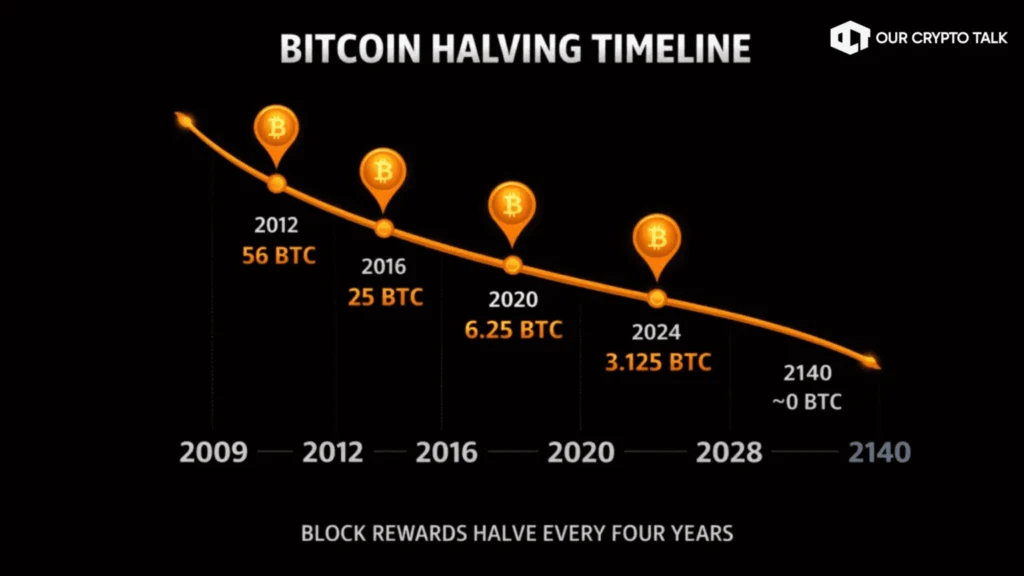
Today, miners receive 3.125 BTC per block, which equals about 450 BTC per day.
A simple way to picture it:
The network is like a bus that drops off new coins every 10 minutes. In the early days, it dropped off 50 passengers each time. Now it drops off just 3.125. This process continues until around 2140, when the maximum supply of 21 million BTC is reached. Halving is not optional. It is coded into Bitcoin’s protocol. No one votes on it. No one can change it.
Below is the definitive halving table. This is the core reference for understanding how Bitcoin’s supply has evolved.
*Bitcoin later reached an all-time high near $126,000 in October 2025 before correcting. As of April 2026, it trades around $75,000–$85,000.
2012 Halving
Bitcoin was still experimental. Infrastructure was minimal. Exchanges were fragile. The massive 8,858% return reflects a tiny starting base and early discovery phase.
Takeaway: Early cycles behave differently. Growth starts from near zero.
2016 Halving
This cycle introduced broader retail awareness. The ICO boom followed. Market structure improved, but volatility remained extreme.
Takeaway: Demand expansion drove price more than supply reduction alone.
2020 Halving
This cycle coincided with global monetary stimulus during COVID. Institutional interest accelerated. Companies began adding BTC to balance sheets.
Takeaway: Macro conditions can amplify halving effects.
2024 Halving
This is the first cycle with spot Bitcoin ETFs, large-scale institutional custody, and deep liquidity.
Takeaway: The diminishing returns pattern is clear:
Past performance does not guarantee future results. But the pattern suggests a shift from explosive cycles to more stable growth.
Here’s what the next decades look like. These are estimates based on a 10-minute block time.
Two important points:
The final phase stretches over a century. The last fractions of Bitcoin are mined extremely slowly.
For a full breakdown of the 2140 timeline, see the guide on how long until all Bitcoin is mined.
The next Bitcoin halving is expected around March–April 2028, when the network reaches block height 1,050,000. At that point, the block reward will drop from 3.125 BTC to 1.5625 BTC, cutting daily issuance from roughly 450 BTC to about 225 BTC. That reduction represents a meaningful supply shock, but the broader context today is very different from earlier cycles.
Institutional demand has become structural. Spot Bitcoin ETFs now collectively hold more than 1.3 million BTC, creating a steady and persistent source of demand that did not exist in earlier halvings. Alongside that, corporate accumulation has scaled significantly. Companies like MicroStrategy (now operating as Strategy) hold hundreds of thousands of BTC, often absorbing supply at a pace that rivals or exceeds what miners produce.
At the same time, the market itself has matured. Bitcoin dominance has increased since the 2024 halving, signaling a consolidation of capital into larger, more established assets. This shift tends to reduce volatility compared to earlier cycles, where capital rotated more aggressively into smaller tokens.
Another important trend is diminishing returns. Each halving has historically produced smaller percentage gains than the one before it. While Bitcoin has still appreciated over time, the explosive moves seen in earlier cycles have moderated. This suggests the next cycle may be less dramatic but more sustained, driven increasingly by macroeconomic conditions rather than purely cyclical supply shocks.
Taken together, these factors point to a different kind of cycle. It is likely to be less explosive, more gradual, and more dependent on sustained demand. Rather than predicting price, it is more useful to understand these structural forces and how they interact.
Halving has an immediate and direct impact on miners. Their revenue is cut in half overnight, while operational costs such as electricity, hardware, and cooling remain unchanged. This creates instant pressure across the mining ecosystem.

The adjustment process tends to follow a familiar pattern. Less efficient miners, especially those with higher energy costs or older equipment, are forced to shut down. As these participants exit, the network’s hash rate can drop temporarily, leading to a downward adjustment in mining difficulty. This rebalancing makes it easier for the remaining miners to compete, improving their relative profitability.
Over time, the miners who remain are typically more efficient and better capitalized. They operate with optimized infrastructure and lower costs, which allows them to survive in a lower-reward environment. This cycle of pressure and adaptation has repeated after every halving.
Despite the short-term disruption, long-term trends in mining remain strong. Bitcoin’s hash rate reached the milestone of 1 zettahash in April 2026, reflecting continued investment in infrastructure and growing industrialization of the sector. At the same time, the hash price, or revenue earned per unit of computational power, has been trending downward, forcing miners to constantly improve efficiency.
To remain competitive, miners focus on securing cheaper energy sources, upgrading to more efficient hardware, and optimizing operations at scale. Looking further ahead, transaction fees are expected to play a larger role in miner revenue as block rewards continue to decline. This transition is gradual and built into Bitcoin’s long-term design.
Bitcoin halving is often discussed as a market event, but its deeper significance is that it functions as a form of monetary policy. Unlike traditional systems, where policy decisions are made by central authorities, Bitcoin’s monetary framework is predefined and enforced by code.
In traditional financial systems, central banks adjust interest rates, expand or contract the money supply, and respond to economic conditions as they evolve. These decisions are shaped by policy goals, economic data, and sometimes political pressure. As a result, monetary policy can change frequently and is not always predictable.
Bitcoin operates differently. Its supply schedule is fixed, and halvings occur automatically at predetermined intervals. There is no central authority making adjustments, and the entire system is fully transparent. Anyone can verify how many coins exist and how many will be created in the future.
This structure gives Bitcoin three defining characteristics: it is predictable, because the issuance schedule is known decades in advance; transparent, because all transactions and supply changes can be verified on-chain; and immutable, because no individual or group can alter the rules without broad network consensus. Together, these properties make Bitcoin fundamentally different from fiat-based systems.
As a result of halvings, Bitcoin’s inflation rate has steadily declined and is now below 1% annually. In contrast, fiat supply can expand in response to economic conditions, often in ways that are difficult to anticipate. There is also an additional layer of scarcity. Not all Bitcoin is accessible, as a portion has been permanently lost over time. This reduces the effective circulating supply, making Bitcoin even scarcer than the headline 21 million cap suggests.
The outcome is a monetary system with an unusual level of clarity. Bitcoin is unique in that its supply trajectory is not only finite but also precisely known. For the next century and beyond, its issuance is fully mapped out, making it one of the most transparent monetary systems ever created.
The bitcoin halving schedule explained is not just a timeline. It is the backbone of Bitcoin’s economic design. Four halvings have already reshaped supply. The next one in 2028 will push Bitcoin deeper into its scarcity phase.
The key shift is perspective:
All three views matter. But the last one explains why Bitcoin works. Not financial advice. This article is for educational purposes only.