Learn how a bitcoin dollar cost averaging strategy removes timing stress, with real historical returns, platform setup steps, and the stacking sats mindset.

Author: Kritika Gupta
There is a moment almost every Bitcoin beginner experiences. You finally decide you want to buy. You open the chart but see a huge rally that already happened, or a sharp drop that might continue. Suddenly the excitement turns into hesitation. “What if I buy at the top?” This single question has probably delayed more Bitcoin purchases than any bear market ever has. If that sounds familiar, a Bitcoin dollar cost averaging strategy can offer a simple and practical way to start investing without the pressure of perfect timing.
At first, timing the perfect entry feels like the most important decision in the world. You imagine buying today and watching the price fall tomorrow. You imagine missing a dip and regretting it for years. So you start reading opinions. You watch charts. You wait for confirmation. Days turn into weeks. Weeks turn into months. In many cases, people never buy at all.
A bitcoin dollar cost averaging strategy exists to solve exactly this fear. It is not a trading system. It is not a complex financial framework. Instead, it is a simple process that removes timing pressure and replaces it with routine.
Rather than guessing when Bitcoin is cheap or expensive, you invest a fixed amount on a schedule. You buy when the market is euphoric, when sentiment is terrible and during headlines that feel bullish and during moments that feel uncomfortable. Over time, your average entry price smooths out. The decision becomes automatic rather than emotional.
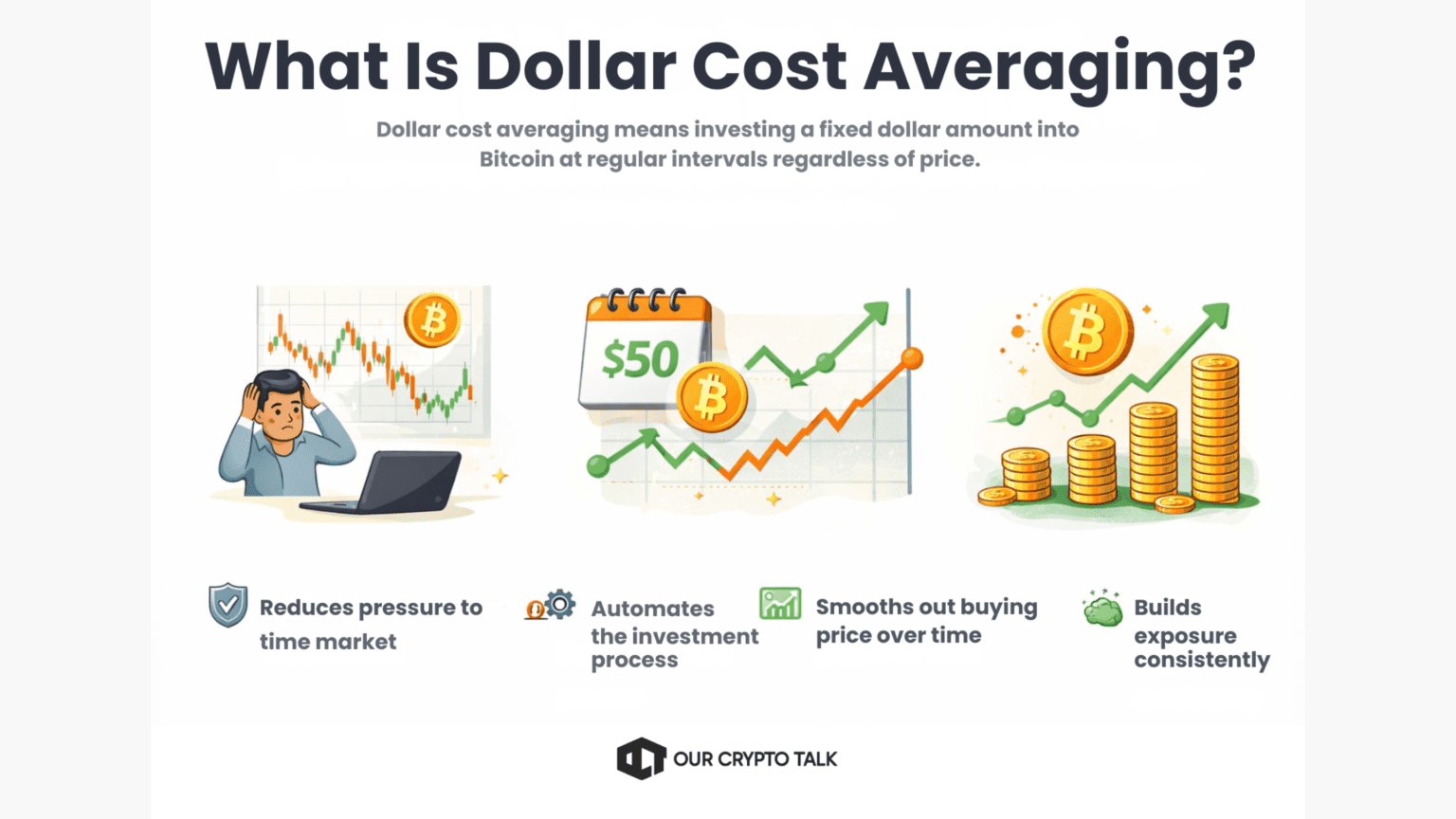
Dollar cost averaging means investing a fixed dollar amount into Bitcoin at regular intervals regardless of price.
If you have ever stared at a Bitcoin chart and thought, “What if I buy at the top?” you are not alone. This fear stops many beginners from taking their first step. Dollar cost averaging exists to remove that pressure. Instead of trying to predict the perfect entry point, you simply commit to buying Bitcoin on a schedule. You buy when prices are rising. You buy when prices are falling. Over time, these regular purchases smooth out your overall entry price.
This is exactly why the strategy feels so powerful for new investors. You do not need to learn complex trading indicators or constantly monitor market movements. The decision is made once when you set up your plan. After that, the process becomes automatic. Rather than reacting emotionally to every price swing, you focus on building exposure gradually. In this way, Bitcoin’s volatility becomes something you can use to your advantage instead of something that keeps you on the sidelines.
To see how Bitcoin Dollar Cost Averaging Strategy explained works in real life, imagine investing fifty dollars into Bitcoin every Monday. Some weeks the price will be high, so your fifty dollars buys a smaller amount. Other weeks the price will be lower, so the same fifty dollars buys more Bitcoin.
The real strength of a bitcoin dollar cost averaging strategy becomes clearer when you look at actual outcomes. Bitcoin has gone through multiple bull markets, deep crashes, and long recovery phases. That volatility makes it a useful test case for consistent investing.
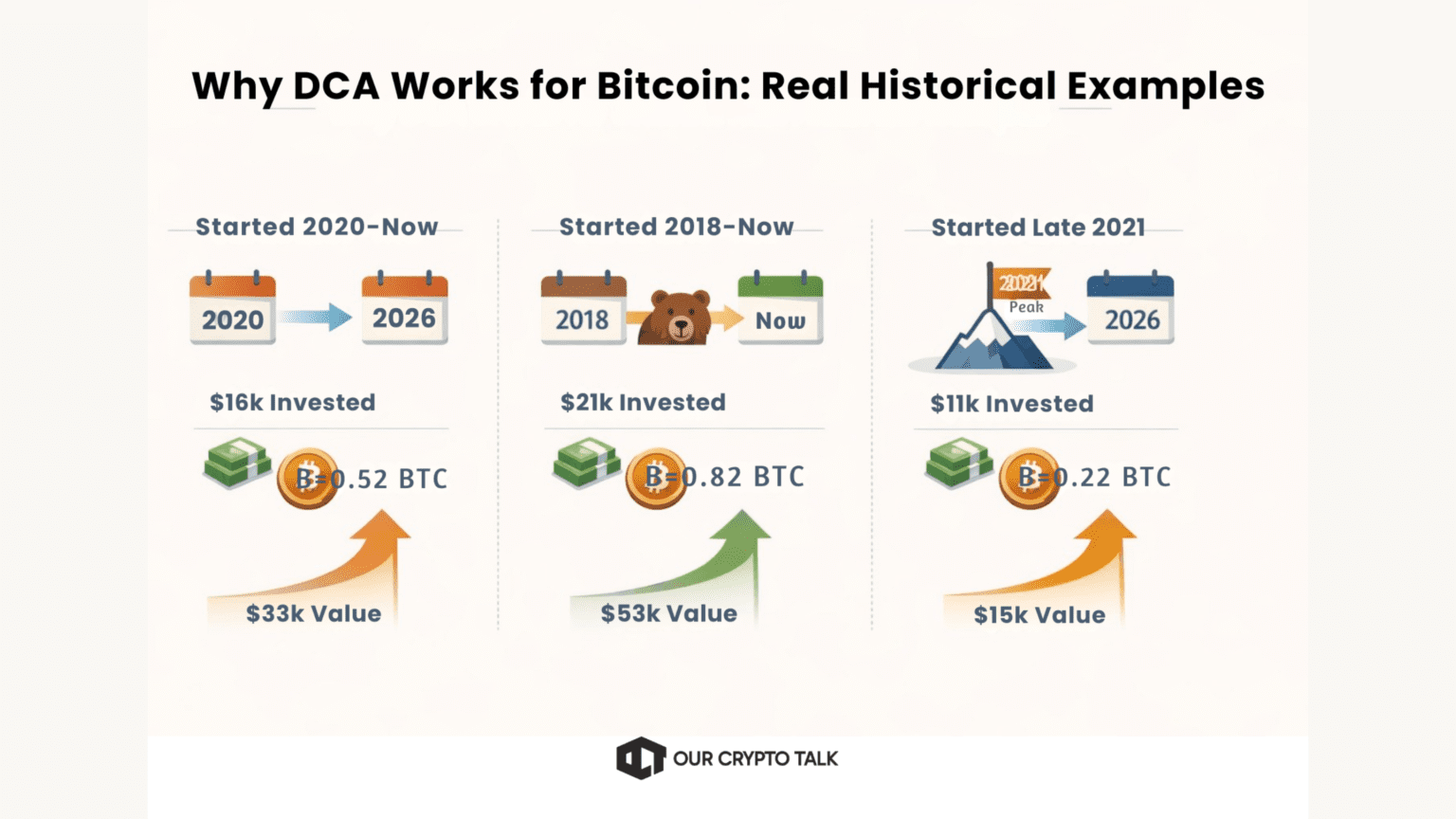
Consider the centerpiece scenario. Investing fifty dollars per week starting January 2020 through March 2026 would mean contributing roughly sixteen thousand dollars in total. Over that period, such a strategy could accumulate Bitcoin. With Bitcoin near sixty-five thousand dollars in early 2026, that holding would be worth close to forty thousand dollars. In simple terms, your steady weekly buys could have more than doubled.
Starting earlier shows the smoothing effect even more clearly. An investor who began the same weekly strategy in January 2018 would have invested around twenty-one thousand dollars. By continuing to buy through a brutal bear market, they could accumulate about 1.392 Bitcoin. Today, that would be worth roughly ninety five thousand dollars.
Even starting at the peak still tells an interesting story. Someone who began buying weekly in November 2021 might invest around eleven thousand dollars. That consistent approach could build roughly 0.28 Bitcoin. At current prices, that would still mean being modestly in profit.
Historical Bitcoin DCA scenarios showing how consistent buying performed across very different entry points
Data as of March 23, 2026.BTC price: $68,443.
Understanding the idea of Bitcoin Dollar Cost Averaging Strategy is helpful. However, actually putting it into motion is where most beginners pause. The good news is that setting up a bitcoin recurring buy today is simple on most major platforms. Once you activate it, the strategy starts working in the background. Here is a practical walkthrough of how to DCA Bitcoin using widely used services.
Coinbase is often the first stop for new investors because the interface feels familiar and easy to navigate. After logging in, go to the Bitcoin asset page and select Buy. From there, switch from a one-time purchase to a recurring buy. You can then choose a frequency such as daily, weekly, biweekly, or monthly. Enter the amount you want to invest and confirm your payment method.
Fees generally range between 1 percent and 3 percent, depending on whether you use a bank transfer, debit card, or another option. The minimum purchase is usually around $10, which makes it practical for small DCA plans. Coinbase does not automatically move Bitcoin to your personal wallet, so you will need to transfer funds manually once your balance grows. For many beginners, though, the simplicity of setup makes this a comfortable place to start. Your next step here is clear. Open the app and schedule your first recurring purchase.
Strike has built a strong reputation among Bitcoin users who care about keeping fees low. After installing the app and linking a bank account, you can configure an automatic DCA schedule directly from the Bitcoin purchase screen. The process takes only a few taps. You select the amount, choose how often you want to buy, and let the system handle the rest.
Minimum purchase sizes are very small, which helps if you want to build exposure gradually. In some regions, Strike also makes it easier to withdraw Bitcoin to your own wallet, which supports long-term self-custody habits. Because frequent small buys can add up in fees on other platforms, Strike appeals to investors focused on efficiency. If reducing costs is important to you, this is a strong option to explore next.
Cash App is one of the fastest ways to begin a recurring Bitcoin strategy. Inside the app, tap the Bitcoin tab, choose Buy, and then select the recurring purchase feature. You can set a fixed amount and choose a schedule such as weekly or biweekly. The process is designed to feel intuitive, even for someone buying Bitcoin for the first time.
Fees usually include a service charge of around 1 percent to 2 percent plus a price spread, so the total cost varies slightly depending on market conditions. The minimum purchase can be as low as $1, which lowers the psychological barrier to getting started. Withdrawals to a personal wallet must be done manually, but they are straightforward. If your goal is simply to start stacking small amounts without friction, setting up your first buy on Cash App can be a practical next move.
Bitcoin-only platforms such as Swan or River are built specifically for long-term accumulation strategies. After completing account verification and connecting a bank account, you can automate purchases on a weekly or monthly basis. These services typically offer lower recurring buy fees compared with general crypto exchanges.
Minimum purchase levels are often around $10, and one of the biggest advantages is support for automatic withdrawal to self-custody wallets once your balance reaches a chosen threshold. This reduces the need to remember manual transfers and aligns with Bitcoin’s ownership principles. For investors who already know they want to commit to a multi-year DCA plan, choosing a platform focused entirely on Bitcoin can make the process feel more intentional.
The truth is that most major platforms today allow you to run a basic DCA strategy effectively. What matters more than optimization is consistency. A recurring purchase that is active today is more valuable than a perfectly optimized plan that never begins.
This is where a simple rule helps. Pick a platform. Set $25 per week. Done. You can always refine your setup later and can move to a lower-fee service. You can enable self-custody once your balance grows and can adjust frequency or contribution size as your confidence increases.
Bitcoin DCA platform comparison based on fees, minimums, frequency options, wallet automation, and ideal use case
Eventually, every thoughtful beginner asks the same question. If Bitcoin trends upward over time, would investing a large amount immediately produce better returns?
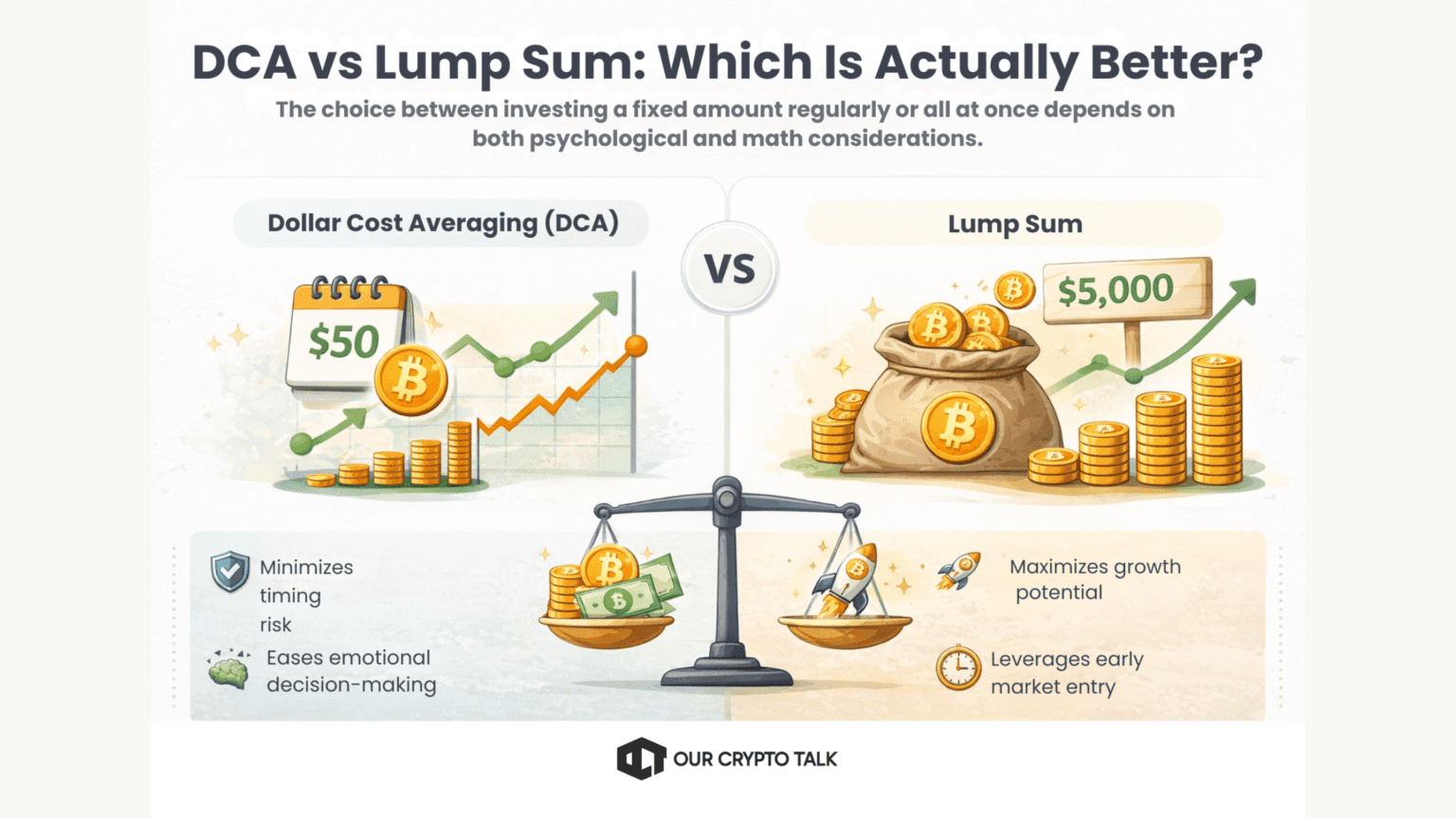
Mathematically, this is often true. Studies such as those from Vanguard show lump sum investing outperforms DCA about two-thirds of the time in traditional markets. The reason is straightforward. Capital invested earlier has more time to grow.
If you have five thousand dollars ready to deploy and strong conviction in Bitcoin’s long-term future, investing it all today can increase your statistical chance of higher returns. However, investing decisions are not purely mathematical. Emotional responses matter.
Lump sum investing requires conviction that many new buyers do not yet have. If Bitcoin drops thirty percent shortly after a large purchase, panic selling becomes a real risk. Dollar cost averaging reduces that emotional shock by spreading entry points.
There is also the reality of income patterns. Most people earn and save gradually. A recurring buy aligns naturally with this flow. Automation also removes the daily internal debate about whether today is the right time.
The balanced conclusion is this. Lump sum investing is often mathematically optimal. Dollar cost averaging is psychologically optimal. For beginners, psychology usually decides success.
At some point in your Bitcoin journey, you will hear the phrase “stacking sats.” On the surface, it sounds like slang for dollar cost averaging. In reality, it represents a deeper mindset and a shared culture among long-term Bitcoin believers.
One of the most common reactions beginners have is shock at Bitcoin’s price. Seeing a single coin worth tens of thousands of dollars can make investing feel out of reach. It is easy to assume that meaningful participation requires buying an entire Bitcoin, which can feel unrealistic for most people.
This is where the stacking sats mindset becomes powerful.
You are not trying to buy 1 BTC. You are stacking satoshis, the smallest unit of Bitcoin. One Bitcoin is made up of 100,000,000 sats. That means even a small recurring purchase can steadily build ownership. Instead of thinking in terms of buying a whole coin, you start thinking about accumulating thousands or even millions of sats over time.
This shift changes the emotional experience. A weekly purchase of fifty dollars might only buy a fraction of Bitcoin, but it can still add tens of thousands of sats to your holdings. Progress becomes visible and motivating. You are no longer focused on an intimidating price tag. You are focused on consistent accumulation.
Beyond the mechanics of accumulation, stacking sats has evolved into a visible community ritual. On platforms like X, the hashtag #StackingSats is widely used by Bitcoin investors who share screenshots of their recurring purchases or milestone achievements. These posts are rarely about short-term price gains. Instead, they signal discipline, patience, and long-term conviction. Seeing others follow the same routine helps beginners feel less isolated in their strategy. It turns what could be a quiet personal habit into something socially reinforced.
Over time, this shared behavior has created a culture around consistent accumulation. Many participants treat stacking sats almost like a long-term challenge. Weekly buys, monthly updates, and progress tracking become part of a broader movement focused on gradual ownership rather than speculation. This community identity matters because investing can feel emotionally difficult during market downturns.
The long-term effectiveness of any strategy depends on the asset. Bitcoin’s history includes explosive growth, severe drawdowns, and ongoing debates about its role in global finance.
If volatility continues alongside gradual adoption, structured accumulation strategies will likely remain relevant. Dollar cost averaging does not require certainty about the future. It simply requires belief that long-term exposure makes sense.
For beginners, this reduces decision pressure. You do not need to predict market cycles. You only need consistency. A recurring buy turns uncertainty into habit.
A bitcoin dollar cost averaging strategy is not about perfect timing. It is about building exposure in a sustainable and emotionally manageable way. Many beginners assume their biggest challenge is understanding Bitcoin. In reality, hesitation is the real barrier. Fear of volatility and fear of immediate losses often delay action indefinitely.
Dollar cost averaging offers a practical path forward. By investing fixed amounts on a schedule, you replace timing pressure with consistency. Historical scenarios show that disciplined accumulation has worked across crashes, peaks, and recovery phases. Risk still exists, but timing mistakes matter less.
While lump sum investing can produce stronger returns in rising markets, many investors struggle to hold through sharp drawdowns. Dollar cost averaging aligns better with real income patterns and human behavior. Over time, small recurring purchases turn into meaningful holdings.
If you are ready to begin, the next step is clear. Choose an amount you can sustain. Set up an automatic recurring buy. Then give the strategy time to work.
Note: This article is for educational purposes only and is not financial advice. Bitcoin is volatile and past performance does not guarantee future results. Never invest more than you can afford to lose.


RWA Needs Better Access. Can NUVA Deliver?
Tokenization of RWA yields onchain might be the biggest opportunity that no one has noticed
Cold Wallet Safety 2026: Are Hardware Wallets Still Safe?
One Token, Multiple Products. Can Zylo Deliver?
RWA Needs Better Access. Can NUVA Deliver?
Tokenization of RWA yields onchain might be the biggest opportunity that no one has noticed
Cold Wallet Safety 2026: Are Hardware Wallets Still Safe?
One Token, Multiple Products. Can Zylo Deliver?