Top 7 biggest Bitcoin ETF holders in 2026, how much BTC they control, and what it means for supply, institutional demand, and price trends.

Author: Arushi Garg
As of March 2026, US spot Bitcoin ETFs collectively hold an estimated ~1.45–1.55 million BTC. That is roughly 7% of all Bitcoin ever mined and closer to 8.5%–9% of the effective circulating supply once lost coins are excluded. This is one of the fastest supply consolidations in Bitcoin’s history.
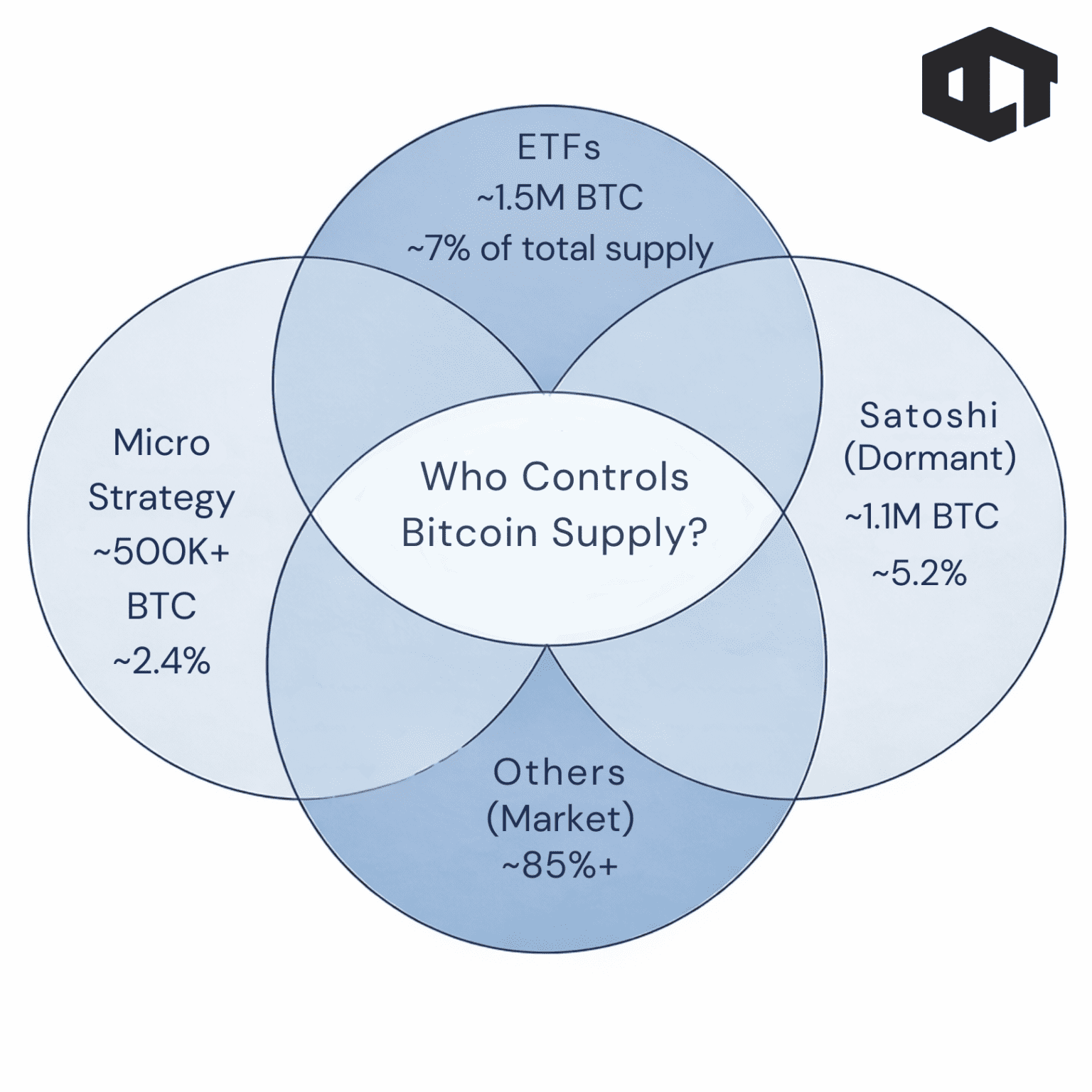
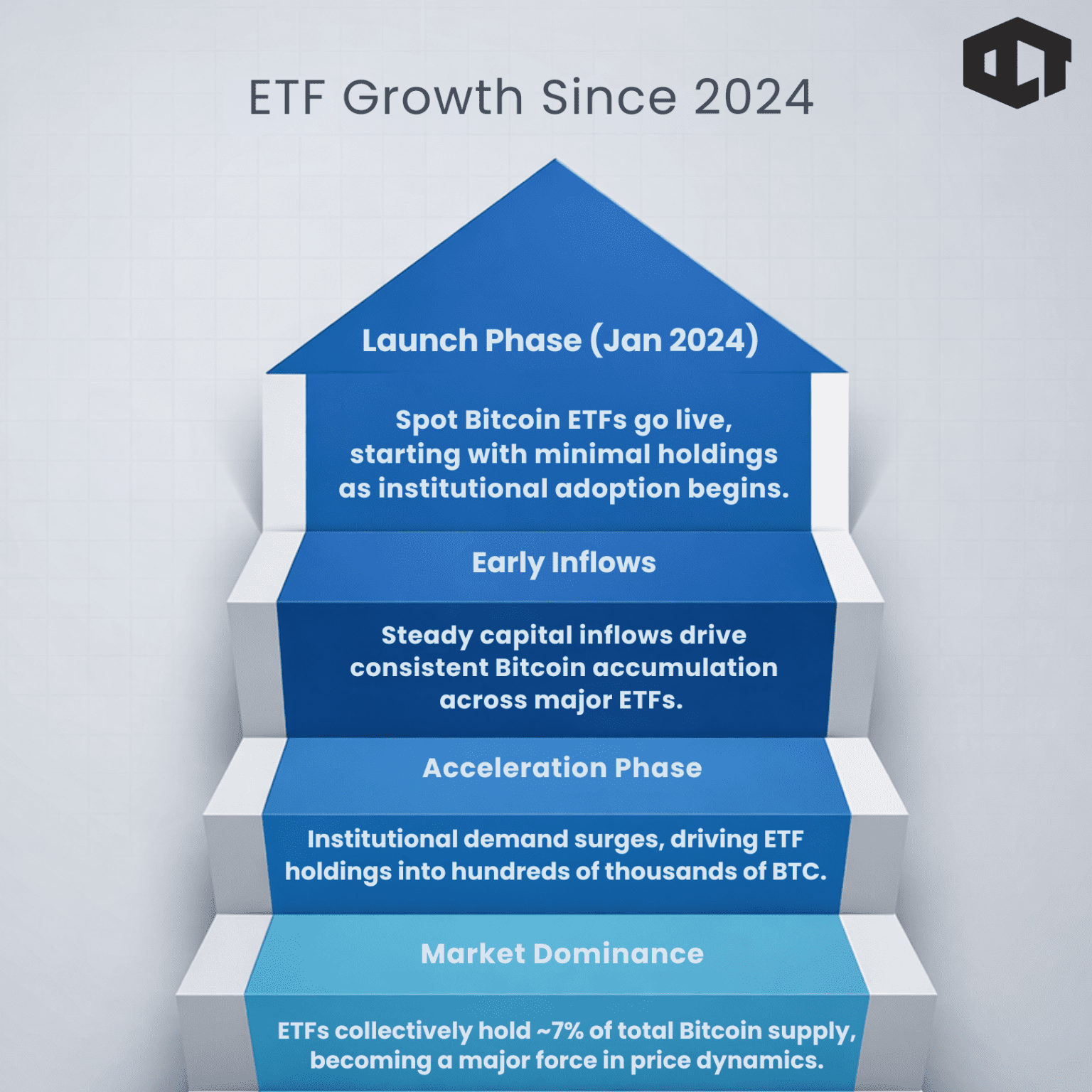
Since launching in January 2024, spot ETFs have absorbed Bitcoin at a pace unmatched by any other category of buyer. Within just two years, a handful of Wall Street firms now control a meaningful share of the world’s hardest monetary asset.
The key takeaway is not just the number. It is the concentration. A relatively small group of asset managers now controls close to 1 in every 11 actively circulating Bitcoin.
That raises an important question: What happens when these entities keep buying or eventually start selling?
Holdings as of March 2026. Figures are approximate and change daily based on inflows and outflows.
Total (Top 7): ~1.2M–1.3M BTC
Note: Grayscale’s GBTC, once dominant, has seen sustained outflows and may fall outside the top 7 depending on the latest data snapshot.
~769,000 BTC
BlackRock’s IBIT is in a league of its own. It holds more Bitcoin than all other US ETFs combined in many periods. This level of dominance is rare even in traditional ETF markets. The fund launched in January 2024 and quickly became the default choice for institutional allocators. The reasons are straightforward: BlackRock’s distribution network, brand trust, and deep liquidity. IBIT’s 0.25% fee is not the lowest in the market, but it rarely matters. The ETF consistently offers tight bid-ask spreads and deep liquidity, making it more efficient for large trades. For institutions moving hundreds of millions, this outweighs marginal fee differences.
Flow trend: Strong net accumulation since launch, with consistent inflows even during volatile periods.
Custodian: Coinbase Custody.
~190K–200K BTC
Fidelity’s FBTC is the clear number two. While far behind IBIT, it has built a strong position thanks to Fidelity’s existing brokerage ecosystem. A key differentiator is custody. Unlike most ETFs, FBTC uses Fidelity Digital Assets, its in-house custody solution. This appeals to investors who prefer vertical integration over reliance on third-party custodians. The fee matches IBIT at 0.25%, but FBTC occasionally competes on promotional pricing and platform integration advantages.
Flow trend: Steady inflows, though at a slower pace than IBIT.
~75K–85K BTC
ARKB positioned itself early as a low-fee challenger. With an expense ratio of 0.21%, it undercuts IBIT and FBTC while still maintaining strong liquidity. The fund benefits from ARK Invest’s strong retail following and 21Shares’ crypto-native expertise. It became a popular option for investors seeking a balance between cost and credibility.
Flow trend: Moderate accumulation, with periods of strong inflows during bullish sentiment.
~60K–70K BTC
Bitwise built its reputation as a crypto-native asset manager long before ETFs launched. BITB reflects that positioning. At 0.20%, it is one of the cheapest ETFs among major players. Bitwise also differentiates through transparency and investor education, often publishing detailed reports on Bitcoin markets. Despite lower AUM than IBIT or FBTC, BITB attracts fee-sensitive investors and crypto-focused allocators.
Flow trend: Gradual accumulation, often tied to broader market cycles.
~30K–40K BTC
BTCO combines traditional finance (Invesco) with crypto-native expertise (Galaxy Digital). However, its 0.39% fee is higher than competitors, which has limited its growth. The ETF has struggled to keep pace with lower-cost alternatives, especially IBIT and BITB.
Flow trend: Mixed, with periods of inflows offset by stagnation.
~25K–30K BTC
VanEck was an early advocate for Bitcoin ETFs, filing proposals years before approval. Its product reflects that long-term commitment. The fee sits around 0.25%, making it competitive but not leading. HODL has carved out a niche among investors who value VanEck’s history in commodity ETFs.
Flow trend: Stable but slower growth.
~15K–25K BTC
Franklin Templeton entered the market with one of the lowest fees at 0.19%, aiming to compete aggressively on cost. Despite this, it has struggled to gain significant market share. Brand strength alone has not been enough against IBIT’s liquidity dominance.
Flow trend: Relatively modest inflows.
Fees have compressed rapidly since launch.
However, the lowest fee does not automatically mean the best ETF.
Liquidity matters. IBIT often delivers tighter spreads and lower trading friction, especially for large orders. For active traders or institutions, that can outweigh a 5–10 basis point fee difference.
This is the most important risk, and the least discussed. If IBIT alone holds ~769K BTC, that represents ~3.5%–4% of total Bitcoin supply in a single fund. If significant outflows occur, that Bitcoin must be sold.
Spot Bitcoin ETFs operate through creation and redemption mechanisms that directly impact the underlying market. When investors exit an ETF, shares are redeemed and the fund must reduce its Bitcoin holdings to meet those redemptions. In practice, this means Bitcoin is sold into the open market. Unlike derivatives or synthetic exposure, this process creates real selling pressure because actual BTC is being liquidated, not just reallocated on paper.
A clear example of this dynamic played out during the Grayscale GBTC conversion. When GBTC transitioned into an ETF, it experienced billions of dollars in outflows as investors rotated into lower-fee alternatives. That wave of selling was largely absorbed because newer ETFs like IBIT were simultaneously seeing strong inflows and buying Bitcoin at scale. The net effect was balanced, but it highlighted how ETF flows can directly translate into market pressure.
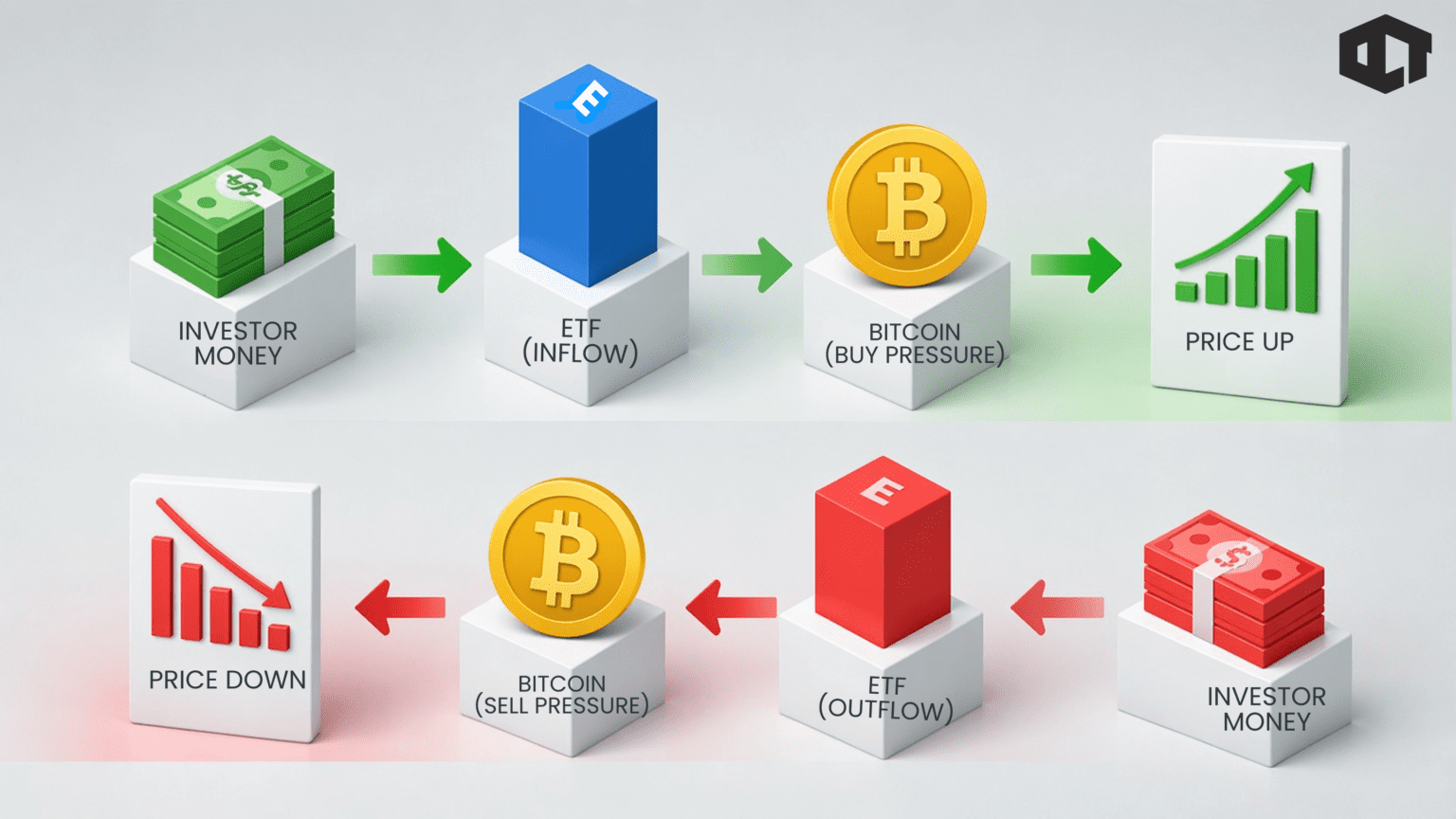
The more important question is what happens if the largest funds begin to see sustained outflows. If a dominant player like IBIT were to reverse from accumulation to distribution, the scale of potential selling would be significant relative to daily market liquidity.
With ETFs holding over 1.4M BTC, ownership is becoming increasingly concentrated. A small number of institutions now influence a meaningful portion of liquid supply. This creates a structural risk where coordinated or simultaneous outflows could overwhelm natural market demand.
Several macro and market-specific triggers could drive such a shift. A broader economic downturn or liquidity crunch could force institutional investors to de-risk. Regulatory pressure on crypto markets could also reduce demand. Competitive dynamics matter as well, since a new ETF with materially lower fees or better structure could pull capital away. Finally, a prolonged Bitcoin bear market could naturally lead to redemptions as sentiment weakens.
In that scenario, large ETF outflows could accelerate downside volatility, amplify price swings, and further entrench institutional flows as a dominant force in price discovery. The structure that currently supports upward momentum through inflows could work in reverse during periods of stress.
It is also important to consider the opposite scenario. ETFs have introduced a persistent bid into the market. Retirement accounts, RIAs, and institutional portfolios are still under-allocated to Bitcoin. Even during corrections, long-term allocators may continue buying, absorbing sell pressure.
That said, the current trend remains firmly in accumulation. ETF flows have been overwhelmingly positive, with an estimated $15B to $20B in net inflows in early 2026 alone. For now, ETFs are acting as a persistent source of demand rather than supply. This is not a prediction of imminent selling, but a structural risk that becomes increasingly important as ETF-held Bitcoin continues to grow.
ETF flows have become one of the strongest short-term drivers of Bitcoin price. Unlike retail speculation, these flows represent large, consistent capital allocations that directly impact supply-demand dynamics.
If you follow Bitcoin seriously, ETF flows are now one of the most important indicators.
Here are the best tools:
Practical advice: Check ETF flows daily. They are one of the clearest signals of institutional demand.
This article ranks Bitcoin ETFs by on-chain holdings as of March 2026. Holdings change daily based on inflows and outflows. This content is for informational purposes only and does not constitute investment advice.
Bitcoin ETFs are no longer a niche product. They are a core structural force in the market.
A handful of firms now control a meaningful share of global Bitcoin supply. That concentration introduces both:
Understanding who holds the Bitcoin is no longer optional. It is essential.