A guide to prediction market types, from binary and scalar markets to event contracts, forecasting markets, and emerging formats.
A guide to prediction market types starts with understanding where people trade on real-world outcomes. Most people will name @Polymarket or @Kalshi, or perhaps @trylimitless or @opinionlabsxyz if they’re active in the space.
But the PM ecosystem is a lot more diverse than just those 2 platforms.
A platform called PM Atlas (built by the team behind @Dekantfi) has indexed a total of 120 PMs into 12 different categories.
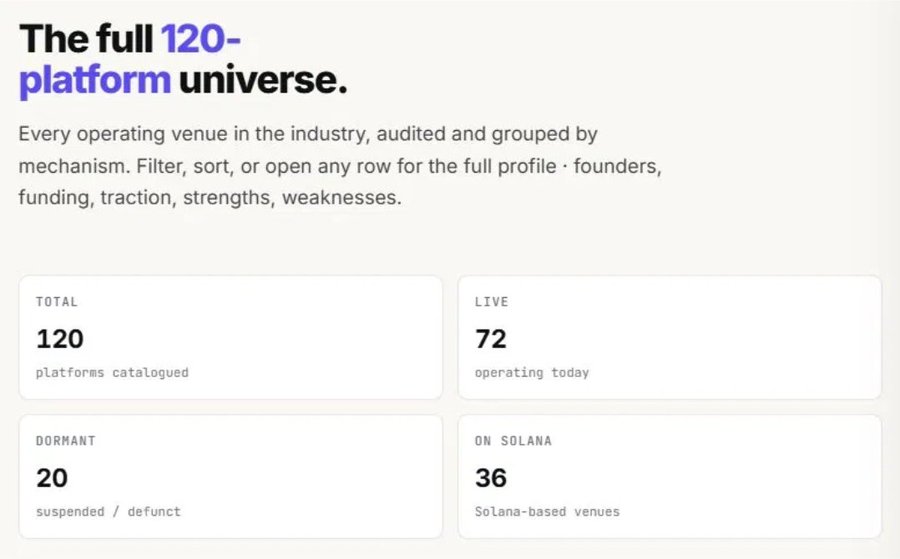
It’s important to note that not all of these are platforms where you can trade outcomes, unlike the ones I mentioned.
30/120 are infrastructure tools to keep the rest of the markets running properly.
I’ll walk you through the entire ecosystem map, specifically:
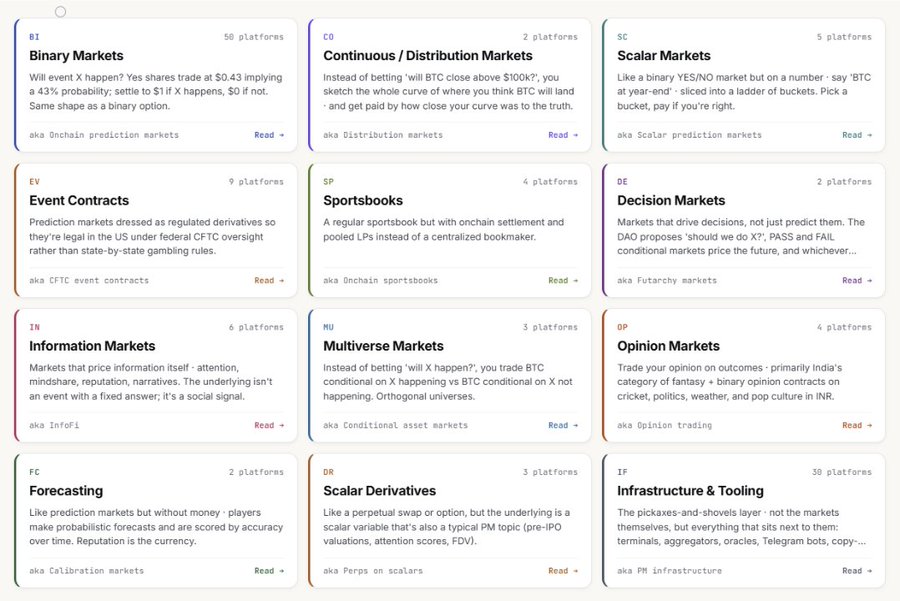
Binary markets dominate because they’re simple: yes or no. But prediction markets are bigger than that, with 10 other formats built for outcomes that need more nuance:
1. Binary markets (50): You bet yes or no on an outcome, and the price reflects the odds, so a market at 72 cents = 72% chance.
Examples: @Polymarket, @trylimitless, @HyperliquidX HIP-4, @ManifoldMarkets, @predictdotfun, @MyriadMarkets, @Outcomexyz, @PRDT_Finance, @PredictBase, @wormwtf
2. Event contracts (9): The same yes/no bet, but registered as a US-regulated contract so it can be offered legally in the States.
Examples: @Kalshi, @RobinhoodApp, @DraftKings, @FanDuelPredicts, @PredictIt, @OG_com, @fanaticsmarkets
3. Scalar markets (5): Instead of yes or no, you bet on where a number will land inside a range, like CPI between 2% and 5%.
Examples: @opinionlabsxyz, @futuurHQ, @UnhedgedHQ, @PolyquestSOL
4. Scalar derivatives (3): Event bets built like perpetuals, so you can hold and roll a position instead of waiting for it to resolve.
Examples: @ventuals, @premarket_xyz
5. Continuous / Distribution markets (2): You bet on the full spread of where a number could land rather than a single point, and you’re paid on how close you were.
6. Decision markets (2): Markets that exist to answer a decision, like whether shipping a feature will grow revenue, with the price serving as the answer.
Example: @MetaDAOProject
7. Multiverse markets (3): Conditional bets that only pay out if a specific other event happens first, such as “if X wins, then Y.”
Examples: @lightconexyz, @ProofMarkets, @ifmarkets
8. Sportsbooks (4): Sports betting settled onchain, where bets are backed by a shared pool of money instead of a house setting the odds.
Examples: @azuroprotocol, @smarkets, @BetDEXLabs
9. Information markets (6): Markets built to surface what a crowd collectively knows rather than to gamble, where the price itself is the useful output.
Examples: @noise_xyz, @benchdotmarkets
10. Forecasting markets (2): You submit probabilities and get scored on your accuracy over time, usually competing for points rather than money.
Examples: @metaculus, @GJ_Open
11. Opinion markets (4): Bets on subjective or cultural questions that are often settled by a vote, though every platform in this type is now dead or dormant.
Example: N/A (all platforms are permanently shut down)
12. Infrastructure platforms (30): Not markets themselves, but the underlying tooling that the other platforms are built on, like oracles and settlement engines.
Examples: @gnosis_ CTF, @Vistadex, @fireplacegg, @tradefoxai, @betmoardotfun, @liquidtrading, @functionspaceHQ, @predikt_gg
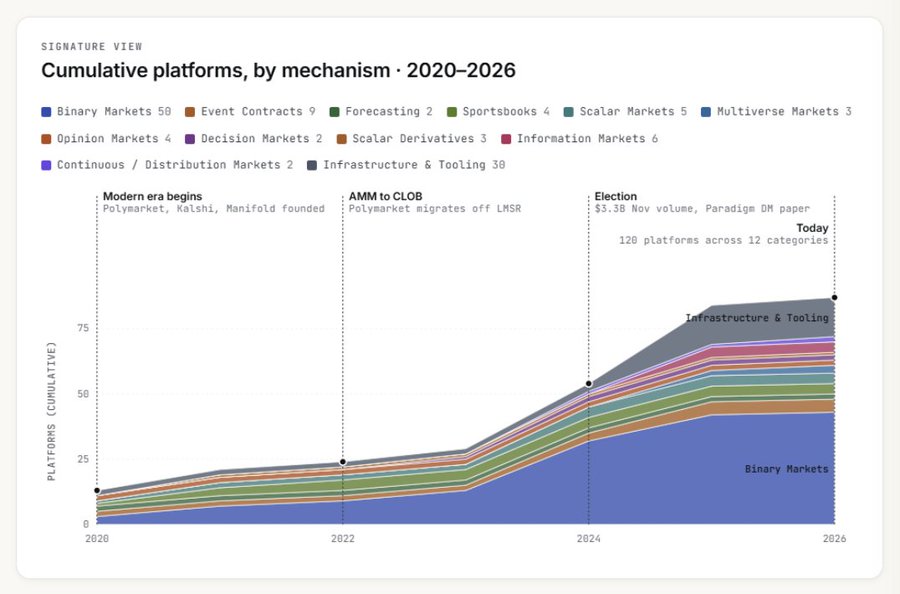
Binary markets dominate by count, with more platforms than every other market type combined.
I’ll break down why this format keeps getting used more than any other.
There are three reasons why binary markets are the most widely built PMs, one for each side of a market:
Easy to understand
For example, 72 cents means a 72% chance, and everyone easily gets it. In a scalar or distribution market, reading the price takes real effort, and most people either can’t do it on the spot or simply won’t bother.
Easy to use
If you’re making a market on a yes/no question, you only need a view on one probability, and the worst-case scenario is that you lose a known, capped amount. In the more complex formats, the risk starts to behave like options trading, which needs far better tools and scares off most market makers.
Easy to settle
A binary market resolves to a simple yes/no, with most resolutions being decentralized, with almost instant resolutions. A scalar market needs an exact number from a trusted source, and a distribution market needs to check which range the result landed in. Every market besides binary makes settlement harder and disputes more likely.
So binary is the simplest and easiest PM format to use. That’s why builders prefer it over the other market formats.
PM Atlas breaks platforms down by chain, and the distribution varies a lot. A few chains dominate most of the prediction market activity.
Solana is far ahead, with 36 platforms, including:
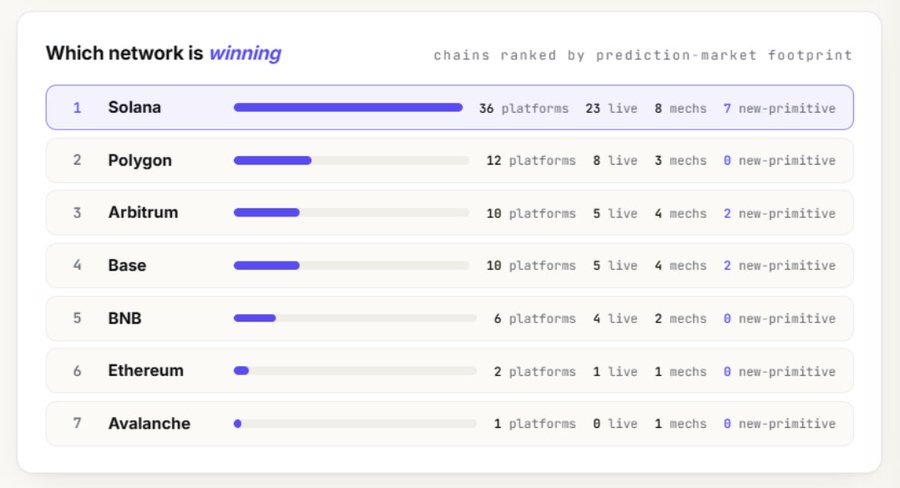
Polygon comes in 2nd with 12 platforms, and Arbitrum and Base are tied for 3rd at 10 each. But almost all of them are Polymarket clones rather than new formats.
Solana acts as an experimental chain, while most other chains host proven formats like Polymarket copies. There are three reasons for this:
1. Small fees
Transactions cost a fraction of a cent, so small and short-lived markets are affordable to run
2. Onchain order books
Most chains can’t match trades onchain affordably, so Polymarket does it off-chain, while Solana handles it directly onchain, which newer formats need
3. A ready-made user base
Years of memecoin trading left Solana full of people comfortable trading fast, risky, short-term things, exactly what an experimental format needs to start moving
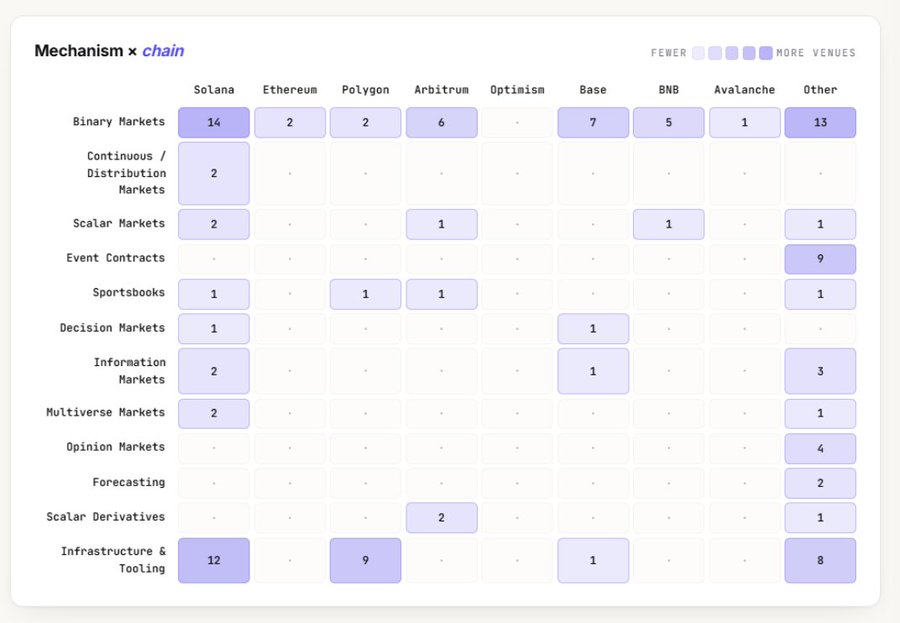
The last two years brought in more platforms than any period before, and the new arrivals fall into three groups.
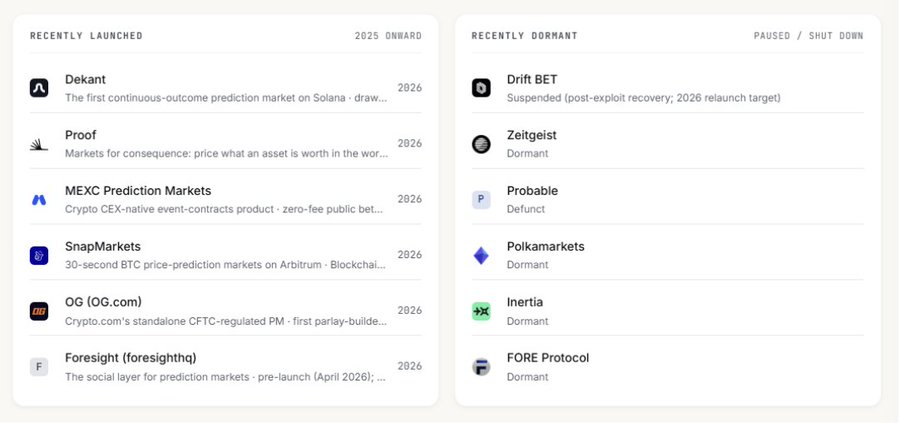
The first is big consumer brands. @RobinhoodApp, @FanDuel, @cryptocom, and @MEXC all added prediction markets. None of them built a new format. They put the standard yes/no markets in front of audiences they already had, and Robinhood alone came in with more than 25 million users.
The second is Kalshi moving up a level. It went from a prediction market to a full derivatives exchange and launched the first US-regulated perpetual futures in May 2026, which puts it head-to-head with Binance and Bybit, except on regulated ground.
The third is the crypto-native experiments, where the actual new formats are coming from. Dekant launched the first onchain distribution market on Solana, Limitless built fast short-duration markets on Base, and Jupiter and Kalshi brought regulated contracts into DeFi as tradeable tokens.
A few of the platforms didn’t really make it:
The pattern is pretty clear. The regulated brands are consolidating, the crypto teams are running the experiments, and the platforms stuck in a legal gray area are the ones dying off.
This tab on PM Atlas is super interesting to analyze. It’s a list of market types that are designed on paper but haven’t shipped yet as a working product.
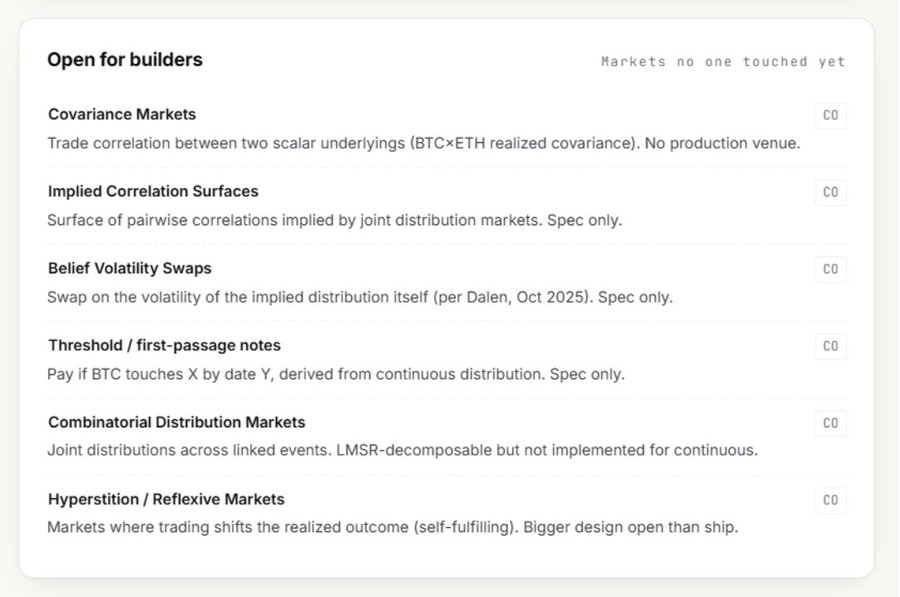
Let’s analyze why they’re unlikely to exist.
Covariance markets
You’re essentially betting on whether two things happen together.
Example: “Will BTC and ETH both go up, or will they split?”
Nobody’s built one because it needs two events to settle at the same time, and very few people want to trade correlations in the first place.
Combinatorial markets
You bet on a bunch of events all at once, in every possible combination.
The problem is that the math gets too complicated. Just 20 events create over a million possible outcomes, so the bets get spread too thin to work.
Someone already built one for a research study, and barely anyone used it.
Belief volatility
You’re not betting on the outcome, but on how much the odds will bounce around before it resolves.
Example: “This election market will swing wildly” vs “it’ll stay flat at 50/50.”
It’s hard to build because tracking all that movement onchain is expensive, and there’s no obvious person to take the other side of your bet.
First-passage notes
You bet on whether a price will hit a certain level, and you win more the faster it gets there.
Example: “Bet on BTC touching $150K”
If BTC reaches $150K sooner rather than later, the win is bigger.
Nobody’s built it because you’d need an oracle watching the price every second, and the exact moment it crosses is really easy to manipulate.
Hyperstition markets
A hyperstition market is one where the bet causes the outcome.
Say there’s a market asking, “Will this token hit $1?” People can buy “yes,” then buy the token itself to make that outcome more likely.
At that point, the market is no longer just predicting the result. It’s actually pushing it towards settlement.
Nobody builds these on purpose because a market that forces its own outcome isn’t really predicting anything and looks like manipulation.
This problem exists in binary markets too, especially when traders can influence the outcome themselves. If a market asks whether a token hits $1, a “Yes” buyer can also buy the token and help push the outcome toward their own bet.
For all the variety on PM Atlas, the space is more lopsided than it looks.
Almost all the volume sits in one format and on two apps.
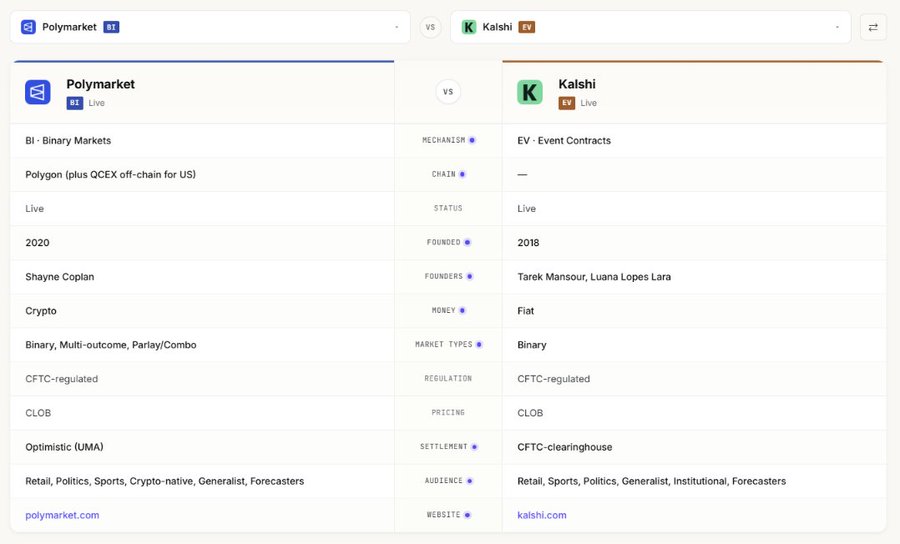
Everything other than the yes/no format is not getting any attention, and the pattern is consistent enough that PM Atlas gave it a name:
The comprehension cliff.
Every step away from binary roughly cuts the number of people who can use the market by a factor of ten, because each step makes it harder to understand, make a market in, and settle.
Still, it’s good to see teams test new market formats.
Maybe the future isn’t one prediction market design. Perhaps it will be a mix of binary markets, perps-style markets, and user-created markets, depending on what people are actually trying to bet on.

Tiering everything in crypto 5k MMR in research 15k MMR based tier list enjoyer Contributor https://t.co/1tdubpI1GT KOL fren @GREEND0TS Advisor @DinariGlobal
https://t.co/mchbz7gGYA