ZKsync Airbender Prime claims real-time Ethereum proving on one GPU. Vitalik urges zkEVM teams to prioritize security.

Author: Kritika Gupta
15th October 2026 – Ethereum co-founder Vitalik Buterin says the zkEVM speed race is now won. He credited the team behind ZKsync Airbender Prime in a post on X.
High Signal Summary For A Quick Glance

skxrx
@0xskxrx

@VitalikButerin @zksync speed won, security next - the most reliable roadmap in crypto. the interesting bit is the equivalence proof: the guest program and the circuit have to agree on what "correct execution" means, and that gap is where the zk bugs live.
Big congratulations to the @zksync airbender team for this milestone. At this point, I consider the battle for speed to be definitively won, and the top priority for zkEVMs should shift fully to security. To me that means formally verifying (i) equivalence of the
05:09 AM·Oct 15, 2026

DexSwap
@DexSwapy
@VitalikButerin @zksync Declaring the speed battle 'definitively won' just swaps the stopwatch for a spec sheet — now 'faster' has to mean 'provably correct'. Sharp pivot, but: equivalence against WHICH EVM spec? Do we converge on one formalization, or get a dozen competing ones arguing about what
Big congratulations to the @zksync airbender team for this milestone. At this point, I consider the battle for speed to be definitively won, and the top priority for zkEVMs should shift fully to security. To me that means formally verifying (i) equivalence of the
04:36 AM·Oct 15, 2026

Antonio Gomes
@onchainantonio
@VitalikButerin @zksync Fair point, but speed and security were never sequential. They competed for the same engineering hours. Now that formal verification becomes the bottleneck, the real test is whether proof systems built for speed can be verified without rebuilding half the stack.
Big congratulations to the @zksync airbender team for this milestone. At this point, I consider the battle for speed to be definitively won, and the top priority for zkEVMs should shift fully to security. To me that means formally verifying (i) equivalence of the
04:25 AM·Oct 15, 2026
High attention and emotional sentiment detected.
Buterin posted the message on Wednesday, two days after ZKsync unveiled the milestone. He then urged every zkEVM team to treat security as the new top priority. His comment reframes a field that has chased raw speed for years.
<<-tweet-2110576209658548683
ZKsync announced Airbender Prime on 13 October. The team calls it the first Ethereum prover to show real-time proving on a single GPU.
According to the ZKsync blog, the test ran on one NVIDIA RTX PRO 6000 Blackwell GPU. It proved 99% of 7,200 consecutive Ethereum mainnet blocks in under 10 seconds each. Every block finished in under 12 seconds, which is roughly Ethereum’s block time.
That marks a sharp jump from earlier work. Prior Airbender builds reported about 35 seconds per block on a single H100 GPU, at roughly 21.8 MHz throughput. ZKsync also says the system now leads the ETHproofs public leaderboard on average proving time, GPU efficiency, and cost. Live 2-GPU and 4-GPU configurations appear on the board too.
Buterin framed the result as a turning point. In his view, provers are now fast enough for the use cases that matter, so speed is no longer the bottleneck.
Matter Labs CEO Alex Gluchowski echoed the point. “Real-time proving on a single GPU is here,” he wrote in a follow-up post. He tied the milestone to a ZK-centric Ethereum roadmap and to independent verifiability for global finance.
Still, the numbers come from ZKsync’s own evaluation. Independent teams have not yet replicated the exact 7,200-block benchmark. For now, the figures remain self-reported, and several reports stressed that caveat alongside the praise.
Buterin spelled out three security goals for the field. First, teams should formally verify that the prover’s arithmetization matches the Ethereum spec. In plain terms, the circuit must prove exactly the rules Ethereum actually runs.
Second, he wants a hard maximum bound on prover cost relative to the gas in a block. That cap would block economic attacks that make proving suddenly expensive.
Third, he wants the proof system itself formally verified for soundness. Because a fast but subtly broken prover could accept invalid state, correctness now matters more than raw throughput. Formal verification uses math, often checked by tools like Lean, to prove a circuit is correct rather than just well tested.
The Ethereum Foundation flagged a similar path last year. Its zkEVM security post argued that soundness is the harder problem once speed improves.
ZKsync’s prover evolution and the shift toward security
ZKsync introduces its STARK-based proof system, improving proving efficiency.
The RISC-V prover reports Ethereum block proofs in roughly 35 seconds on one H100 GPU.
ZKsync reports proving 99% of 7,200 consecutive Ethereum blocks in under 10 seconds each on one NVIDIA RTX PRO 6000 Blackwell GPU, including witness preparation. Every block finished in under 12 seconds.
Buterin declares the speed battle won and calls for formal verification of Ethereum-spec equivalence, maximum proving-cost bounds relative to gas, and proof-system security.
The open question is when all three security requirements will receive complete, independently reviewable verification. The supplied research establishes no completion date.
Buterin’s own 2022 taxonomy still shapes this debate. His zkEVM types post ranked designs from Type 1, fully Ethereum-equivalent, to Type 4, highly optimized but less strictly equivalent.
ZKsync historically sat toward the efficient end of that scale. Airbender is a RISC-V zkVM built alongside ZKsync OS, so it proves execution through a general-purpose virtual machine rather than a bespoke EVM circuit.
Ethereum proving speed, hardware requirements, and formal-verification status
Airbender’s figures are self-reported. The supplied research does not establish a numerical ranking across competitors. Missing verification evidence does not mean no verification work exists.
The hardware claim carries real weight. Earlier provers often needed large GPU clusters, so only well-funded operators could run them.
A single consumer-class GPU lowers that barrier sharply. As a result, more independent provers could join, which supports decentralization and faster finality. Several replies to Buterin’s post made exactly this point.
Airbender is open source and built on that RISC-V design. Its public repository ships under MIT and Apache-2.0 licenses, so other teams can inspect and reuse the work. Matter Labs also runs a separate prover service repo for production setups.
The technical news did not move markets much. The ZK token traded roughly between $0.014 and $0.018 near the announcement. It gained about 11.5% on 13 October, then gave back ground on mixed days.
On-chain activity also stayed flat. ZKsync Era holds about $14.5 million in total value locked, according to DefiLlama data. No large spike followed the Airbender Prime reveal.
So the market impact looks limited for now, even as the technical claim draws praise. This article is not financial advice.
The next test is independent verification. Outside researchers still need to reproduce the single-GPU results under their own conditions and hardware.
Beyond that, the formal verification work Buterin described could take years. No major zkEVM has yet proven full arithmetization equivalence, cost bounds, and proof-system soundness together. The speed milestone is real, but the security race for ZKsync Airbender Prime and its rivals is just starting.
Our Crypto Talk is committed to unbiased, transparent, and true reporting to the best of our knowledge. This news article aims to provide accurate information in a timely manner. However, we advise the readers to verify facts independently and consult a professional before making any decisions based on the content since our sources could be wrong too. Check our Terms and conditions for more info.


Starknet Weighs Leaving Ethereum to Become Post-Quantum L1
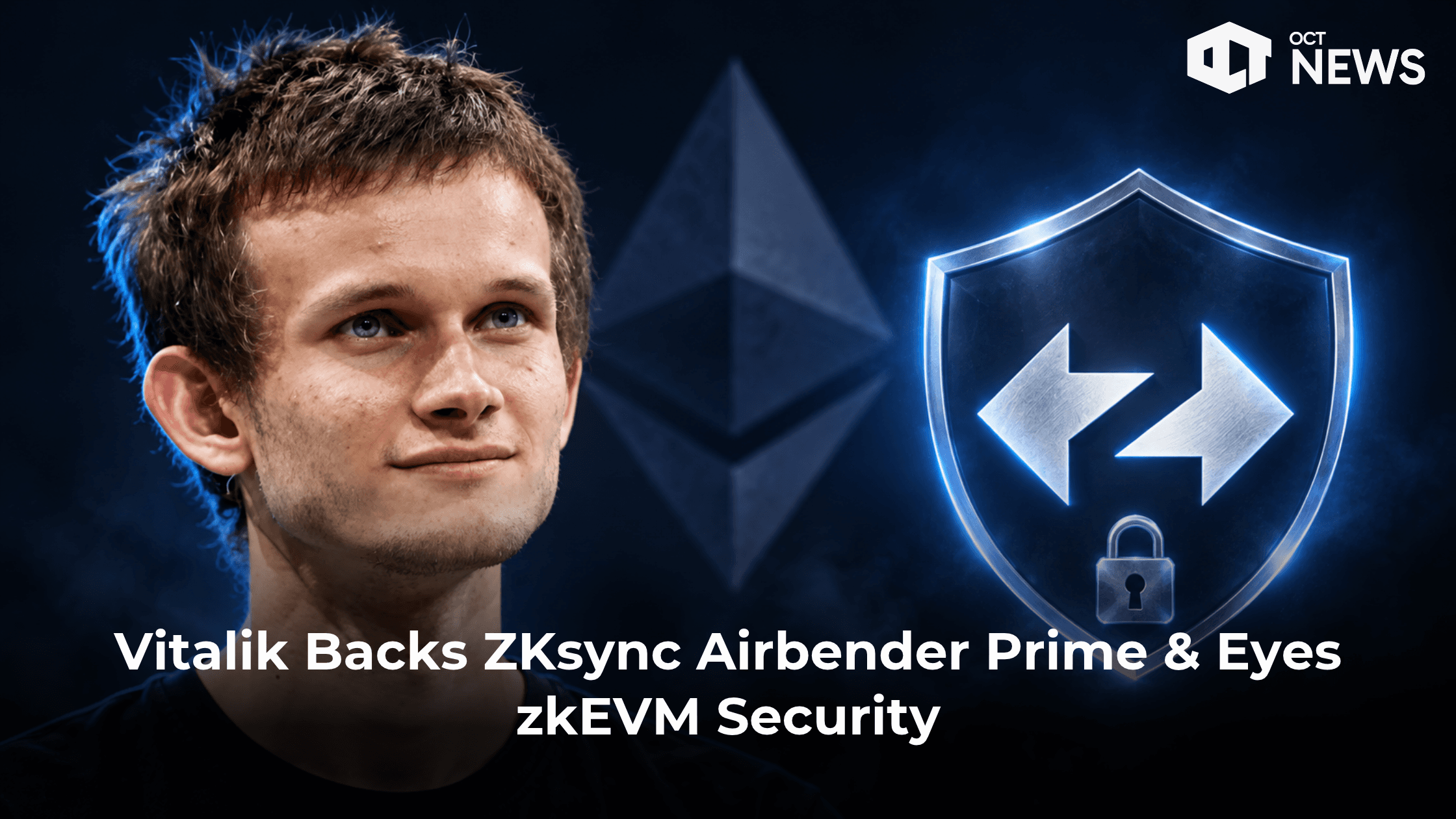
Vitalik Backs ZKsync Airbender Prime & Eyes zkEVM Security
StandX Cancels Token Launch and Winds Down Perps
Creo Engine Unites Gaming AI & $CREO in Website Launch
Starknet Weighs Leaving Ethereum to Become Post-Quantum L1
Vitalik Backs ZKsync Airbender Prime & Eyes zkEVM Security
StandX Cancels Token Launch and Winds Down Perps
Creo Engine Unites Gaming AI & $CREO in Website Launch

ZKsync