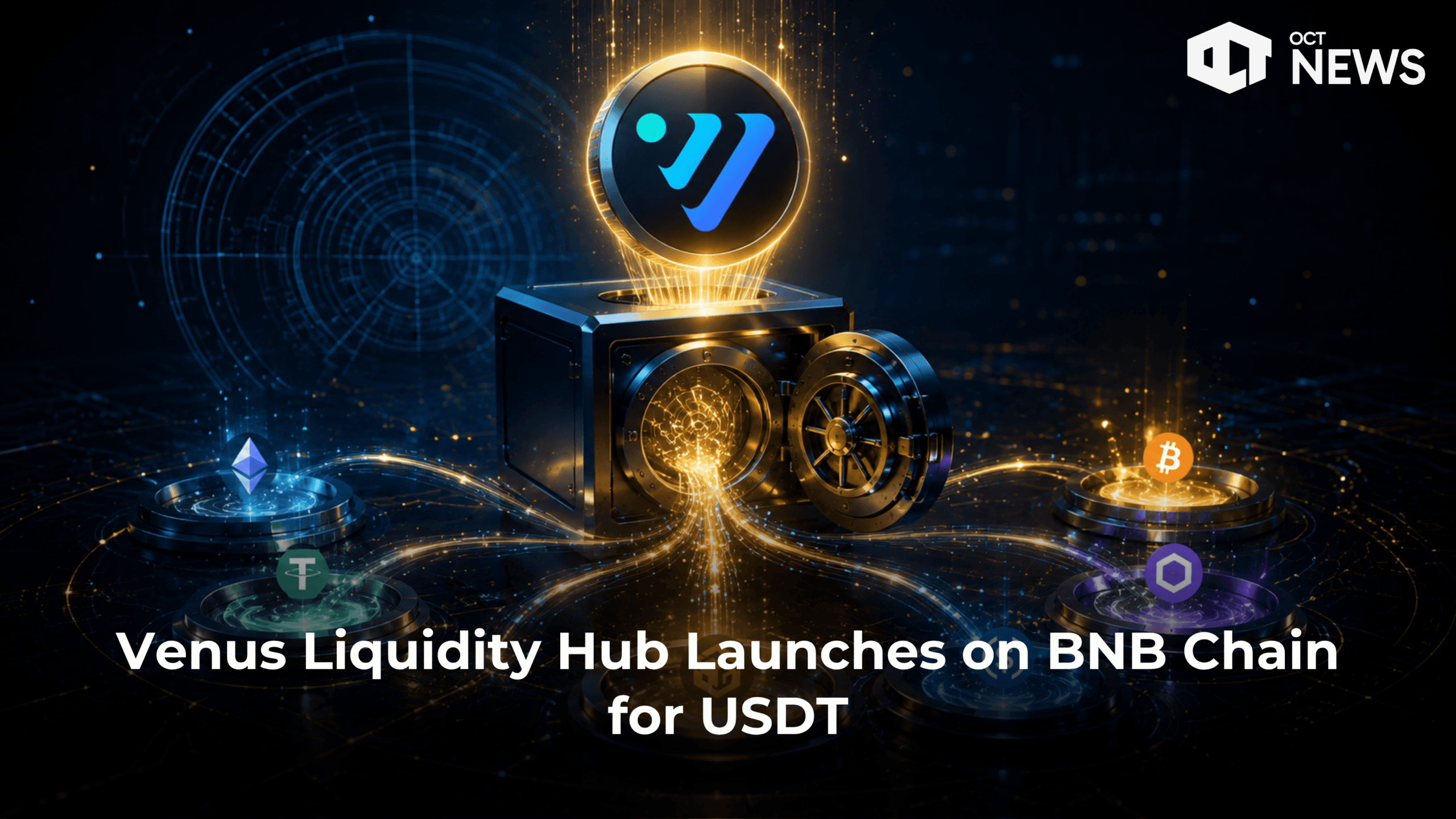
Venus Liquidity Hub is live on BNB Chain, enabling one-asset deposits and automatic capital routing across Venus markets.

Author: Akshay
High attention and emotional sentiment detected.
31st August 2026 – Venus Protocol has taken its Venus Liquidity Hub live on BNB Chain. Lenders can now deposit one asset and auto-route it across Venus markets.
High Signal Summary For A Quick Glance

Rewards Bunny
@rewardsbunny

@VenusProtocol @BNBCHAIN One deposit, fewer tabs, fewer ways to lose track of your yield.
🚀 Introducing Liquidity Hub. One asset. One Hub Token. Access the entire Venus ecosystem. Deposit once, and Liquidity Hub automatically allocates your capital across supported Venus markets according to governance-defined strategies. Built on ERC-4626. Live now on @BNBChain. https://t.co/W8spJzY0Ae
07:44 AM·Aug 31, 2026
The team posted the official launch thread at 07:41 GMT on Monday. It confirmed three separate Hubs at launch, for USDT, USDC, and U. Each one runs on the ERC-4626 vault standard.
A lender deposits a single asset and receives a yield-bearing share called a VH Token, such as vhUSDT. The Hub then spreads that capital across existing Venus yield sources.
According to the official docs, the Hub “shifts the lender experience from pick a vault per product to one-click deposit per asset.” So the goal is convenience, not a new market.
Importantly, the Hub is only a routing layer. The docs state it “does not modify the parameters or governance of the underlying Core, Flux or FRV products.” In other words, it sits on top of what already exists.
Monday’s post is the marketing launch, not the first on-chain step. The activation timeline actually started earlier in August.
The forum proposal went up on 3 August. Then, according to Messari, the DAO approved VIP-650 and VIP-651 on 5 August to onboard the three Hubs. The work was split across two proposals because one transaction would breach BNB Chain’s gas limit.
After that, ChainCatcher reported Liquidity Hub v1 live on BNB Chain on 12 August. So the code has been running for weeks. Monday simply made it official.
At launch the Venus Liquidity Hub routes across two live sources, with a third waiting in reserve. Governance sets the queues and the caps.
On deposit, the Hub fills Venus Core Pool first, then Venus Flux. Core carries an absolute cap of 2 billion tokens and no percentage limit. Flux is capped at 7 million tokens, or 20% of Hub assets, whichever is stricter.
On withdrawal, the order flips. The Hub drains Flux first, then Core, then Fixed Rate Vaults. As a result, Core stays as the deeper reserve while Flux clears early.
The third source, Institutional Fixed Rate Vaults, is registered but unfunded for these assets. Its cap sits at 5 million tokens, or 30%. For now, no live FRV exists for USDT, USDC or U.
The proposal gives a plain example. A 10 million USDT Hub can place at most 2 million in Flux, because of the 20% ceiling. Adapters then mint the underlying vTokens and fTokens behind the scenes.
One deposit surface, three different allocation models.
At launch, management, performance, and redeem fees all sit at 0%. Governance can enable them later, capped at 50% for management and performance, and 5% for redemptions.
Notably, any future redeem fee is not protocol revenue. According to the docs, it stays in the vault and spreads to remaining lenders. Fee changes require a governance vote.
The VH Token does not rebase. Instead, yield accrues through a rising exchange rate, so each share redeems for more underlying over time. There is no separate claim step.
The three Hub contracts are live on BNB Chain. The vhUSDT Hub sits at 0x18AfDACF30F8671021dec4b78297E39d2FE87226, with vhUSDC and vhU deployed alongside it. A HubRegistry and dedicated adapters route to each source.
Here the marketing and the mechanics diverge slightly. Secondary coverage from ChainCatcher framed the Hub as a tool that finds “optimal APY combinations” on its own.
However, the official docs and the Venus Team forum reply describe something more constrained. The DAO sets allocation limits, and the Hub rebalances within that fixed policy. So it is a policy-driven allocator, not a free-form yield optimizer.
An Operator multisig can reallocate within the caps and pause the system. A Guardian multisig can also pause instantly, but it cannot unpause. Only governance can unpause, add a source, or change fees.
The Hub adds a new layer, and every layer adds surface area. A USDT depositor now inherits Core credit risk plus Flux contract risk. The docs note capital in Flux touches Fluid Lending contracts, not just Venus.
There is also governance and operator risk. A mis-set cap or a compromised Operator key is a real concern, distinct from a plain Core deposit. Meanwhile, withdrawals are atomic and capped per transaction.
Venus also carries a long incident history. The protocol logged a roughly $2.15 million bad-debt event in March 2026, and XVS fell 9% afterward, CoinDesk reported. The Hub does not fix that past; it aggregates exposure across products.
On adoption, the picture is thin so far. DefiLlama lists Venus at $1.252 billion in total value locked. But it does not yet break out the Hub as its own line item. A community ambassador claimed liquidity above $3 million shortly after launch, though that figure is not verified.
Venus says more assets will follow once the first three Hubs prove themselves in production. A future proposal could also activate the Fixed Rate Vault route that currently sits idle.
For now, the Venus Liquidity Hub is a live BNB Chain product with 0% fees and a clear governance policy. Watch the on-chain TVL and any fresh VIP for signs of how fast it scales. None of this is financial advice, so verify the contracts and caps before depositing.
Our Crypto Talk is committed to unbiased, transparent, and true reporting to the best of our knowledge. This news article aims to provide accurate information in a timely manner. However, we advise the readers to verify facts independently and consult a professional before making any decisions based on the content since our sources could be wrong too. Check our Terms and conditions for more info.


Venus