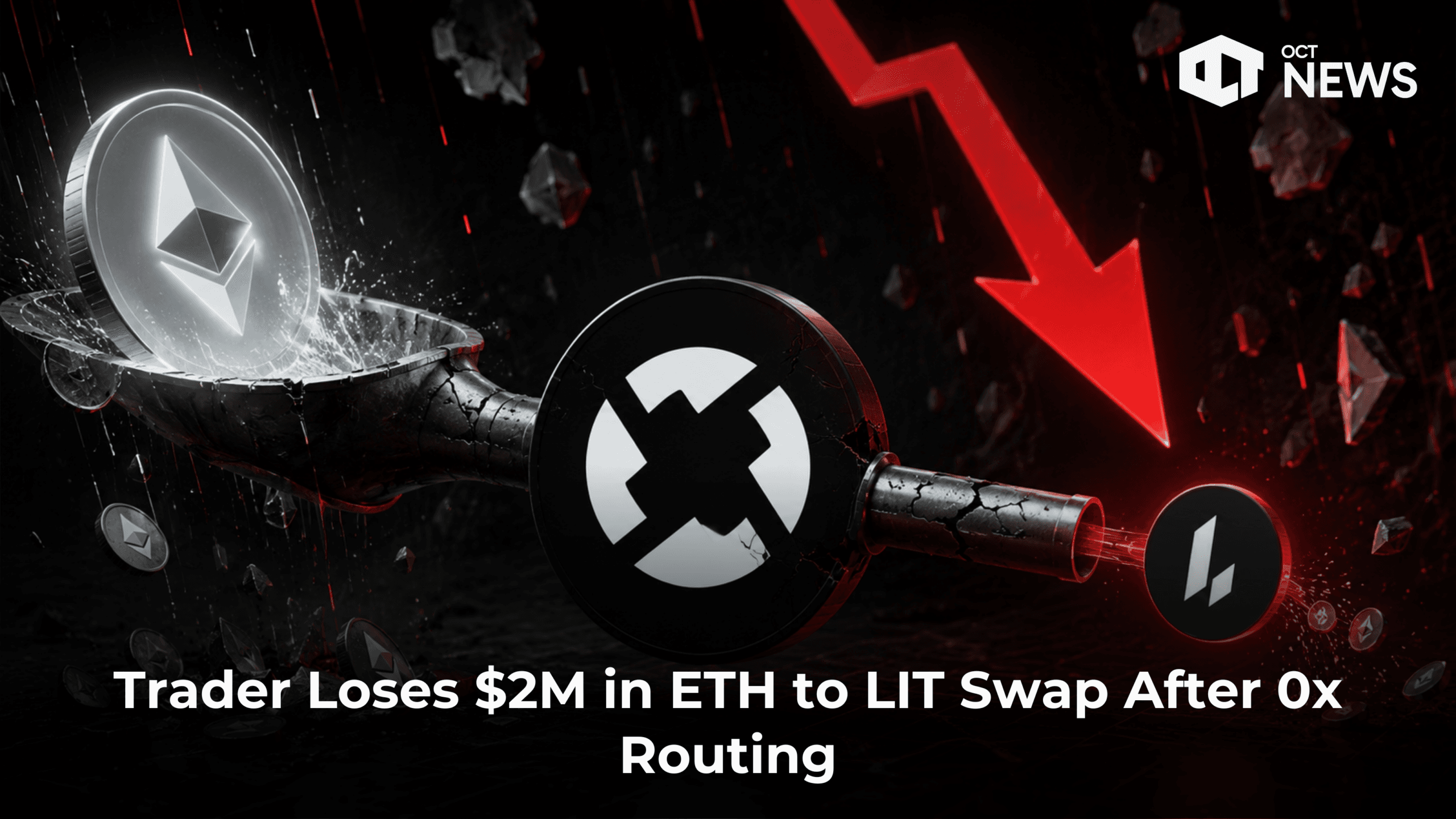
Trader Loses $2M after an ETH to LIT swap was routed through a thin AVAIL liquidity pool by the 0x router, resulting in a 99% loss.

Author: Akshay
6th July 2026 – Trader Loses $2M after an ETH to LIT swap routed through a thin liquidity pool on Ethereum, leaving the wallet with only about $14.2K worth of LIT. According to Arkham Intelligence, wallet 0xfF8 suffered a loss of nearly 99% in a single transaction.
High Signal Summary For A Quick Glance

Eterna Hybrid Exchange
@Eterna_Hybrid

@arkham This is why you always check liquidity depth before large swaps. $2M through a shallow pool was bound to have massive slippage. Basic DeFi hygiene.
HE SWAPPED $2 MILLION OF ETH FOR LIT - AND LOST IT ALL Trader 0xfF8 withdrew $2M of ETH from Binance, then swapped his entire stack to LIT. He received $14.1K of LIT. He lost 99% of his funds because the 0x router sent his order through a low liquidity AVAIL pool. Titan https://t.co/OQEkrnuaap
04:16 PM·Jul 6, 2026
High attention and emotional sentiment detected.
The trader first withdrew about 1,126.44 ETH from Binance on July 5, 2026, near 15:55 UTC. Then, shortly after, they swapped the full stack into LIT. Because the order was far too large for the available liquidity, the execution price collapsed. Arkham later flagged the wallet in a public alert on July 6.
The main withdrawal moved 1,121.441 ETH from a Binance hot wallet, worth roughly $2.01 million at the time. A smaller transfer of about 5 ETH followed. In total, the trader controlled around $2 million before the trade.
Next, the trader swapped everything for Lighter (LIT), the token behind the Lighter perpetuals exchange. According to DeBank data, they received about 5,776 LIT. At roughly $2.46 per token, that came to just $14,200.
For clarity, this LIT is Lighter, not Litentry, an older token that shares the ticker. The Lighter token contract confirms the address. Meanwhile, the full swap transaction sits on Etherscan for anyone to verify.
As a result, the position fell from about $2.01 million to $14.2K. That works out to a loss near 99% in a single transaction.
The damage came from the routing path, not a hack. DEX aggregators like the 0x router sample liquidity across many venues. Then they build what looks like the cheapest path for an order.
Here, the aggregator sent the order through an AVAIL pool as an intermediate hop. The path ran ETH to WETH, then into AVAIL through a shallow Uniswap V3 pool, then to USDC, and finally to LIT on Uniswap V4.
Because that AVAIL pool held very little liquidity, the large buy moved the price hard. According to GoPlus Security, the trade effectively bought AVAIL at roughly 120 times its fair price. In short, the first leg destroyed most of the value before the order even reached LIT.
AVAIL is the token of the Avail data availability layer, bridged to Ethereum as an ERC-20. Its pools on Ethereum stayed extremely thin before the incident. As a result, they offered almost no cushion for a multi-million-dollar order.
Timeline: How a $2 million ETH swap routed through a low-liquidity pool resulted in catastrophic slippage and an MEV extraction within minutes
Wallet 0xfF89...981e receives 1,121.441 ETH from a Binance hot wallet, preparing what appears to be a large on-chain token purchase.
Just 3 minutes and 36 seconds later, the wallet swaps roughly 1,126.44 ETH for LIT through the 0x router. The transaction is routed via a thin WETH/AVAIL Uniswap V3 pool, causing extreme slippage. The trade succeeds because the received amount remains above the user’s minimum output threshold, ultimately returning only 5,775.66 LIT worth about $14,208 instead of roughly $2.01 million.
Titan Builder’s MEV bot backruns the distorted AVAIL liquidity pool, arbitraging the mispricing created by the swap and extracting an estimated $2 million in profit.
Arkham posts an analysis on X, highlighting the wallet, the low-liquidity routing path, and the MEV backrun that transformed the failed execution into a multi-million-dollar arbitrage opportunity.
Arkham immediately follows up with a direct link to the wallet’s on-chain profile, allowing the community to inspect the transaction history and affected addresses.
On-chain analysts and security researchers publish transaction breakdowns confirming the routing path through the low-liquidity AVAIL pool and the subsequent MEV extraction. Debate centers on router behavior, slippage settings, and the ethics of MEV.
As of July 6, 2026, neither the 0x Protocol nor Matcha has issued a public statement regarding the incident. The event continues to circulate across crypto news outlets and social media while the community awaits further clarification.
Trader Loses $2M after the distorted pool created an easy target for MEV bots. Soon after the ETH to LIT swap, a Titan Builder MEV bot backran the trade and profited around $2 million. GoPlus estimates the backrunner drained roughly 1,072 WETH from the imbalance, cementing the incident in which the Trader Loses $2M in a single transaction.
Notably, this was a backrun, not a classic sandwich. In a sandwich, one actor trades both before and after the victim. Here, the bot simply arbitraged the mispriced pool right after the trader created the gap.
Because MEV profits are rarely returned, the funds are unlikely to be recovered. For now, the loss stands on-chain.
Many readers blame slippage settings for why the Trader Loses $2M, yet the deeper issue was price impact. Slippage tolerance controls how far execution can drift from the quoted price. Price impact, by contrast, reflects how a large order moves a thin market against itself. In this case, the Trader Loses $2M because the oversized order overwhelmed a shallow liquidity pool long before the swap reached LIT.
In this case, the quoted path already reflected massive price impact before execution. So even a careful slippage setting would not have saved the trade. Instead, the order size and the shallow AVAIL pool did the damage.
Neither Arkham nor GoPlus has confirmed whether the trader accepted a default aggregator quote or set a high tolerance manually. That detail stays open for now.
This is not an isolated event. In March 2026, another trader lost about $50 million swapping USDT for AAVE through a frontend that routed into shallow liquidity. As OCT reported at the time, the quote already showed near total price impact.
The pattern is becoming familiar. Aggregators can route large orders through obscure intermediate tokens when direct liquidity looks fragmented. Meanwhile, MEV bots stand ready to profit from any resulting imbalance.
Ultimately, a $2 million ETH to LIT swap shows how thin pools and automated routing can combine into a near total loss.
For large orders, traders can split the trade, use limit orders, or move to venues with deeper liquidity. Above all, check the quoted output before signing. If the number looks wrong, it usually is.
Analysts also suggest reviewing the full routing path on aggregators for low-cap tokens. A single thin hop can quietly wreck an otherwise simple swap. In addition, testing a small amount first can expose a bad route before the full order goes through. As DeFi grows, better guardrails for oversized orders may follow.
This article is not financial advice. Always do your own research before trading or moving large sums on-chain.
Our Crypto Talk is committed to unbiased, transparent, and true reporting to the best of our knowledge. This news article aims to provide accurate information in a timely manner. However, we advise the readers to verify facts independently and consult a professional before making any decisions based on the content since our sources could be wrong too. Check our Terms and conditions for more info.


PROPS Token Set to Launch on Robinhood Chain
ASTRA 2.0 Migration: Snapshot Nov 7, Trading Nov 10
Starknet Weighs Leaving Ethereum to Become Post-Quantum L1
Vitalik Backs ZKsync Airbender Prime & Eyes zkEVM Security
PROPS Token Set to Launch on Robinhood Chain
ASTRA 2.0 Migration: Snapshot Nov 7, Trading Nov 10
Starknet Weighs Leaving Ethereum to Become Post-Quantum L1
Vitalik Backs ZKsync Airbender Prime & Eyes zkEVM Security