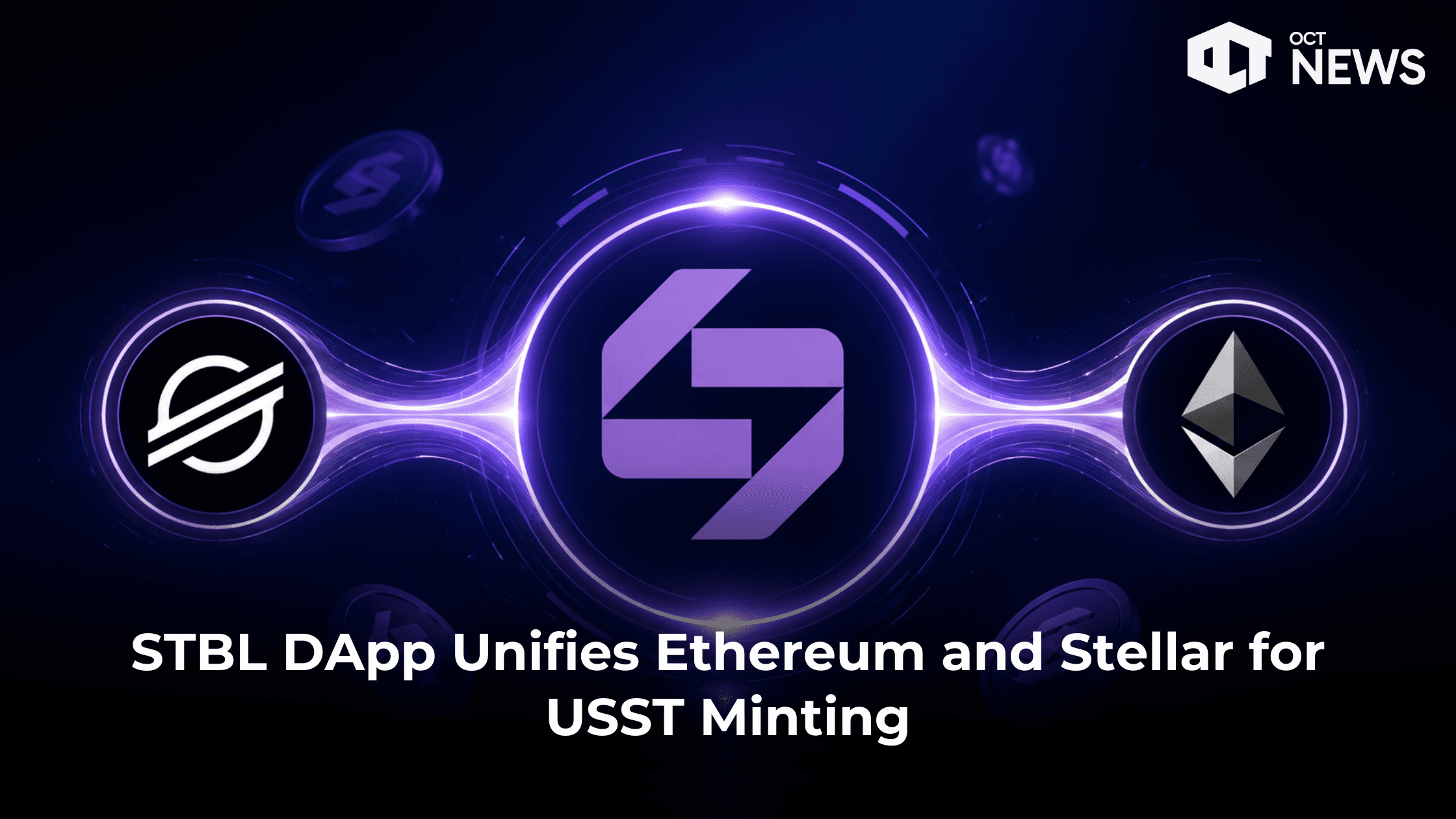
STBL USST expands to Ethereum and Stellar, letting users mint RWA-backed USST with USDY and OUSG through one consolidated DApp.

Author: Kritika Gupta
7th July 2026 – STBL has launched a consolidated DApp that brings Ethereum and Stellar together in one interface for minting the USST stablecoin.
High Signal Summary For A Quick Glance

andre4s._.
@qukljXKA2WnJznl

@stbl_official Now I can mint stablecoins and feel like I’m juggling two blockchains at once, all from one sleek portal. Nice upgrade!
The STBL Dapp now delivers a consolidated portal for accessing both the Ethereum and Stellar networks through a single, intuitive interface. Users can efficiently mint USST utilizing real-world asset collateral, including USDY and OUSG, while maintaining complete on-chain https://t.co/FL1MHQyUL4
08:11 AM·Jul 7, 2026

val_
@PalisYohann
@stbl_official So now I can hop between galaxies without changing browsers, guess my coffee just got a blockchain upgrade.
The STBL Dapp now delivers a consolidated portal for accessing both the Ethereum and Stellar networks through a single, intuitive interface. Users can efficiently mint USST utilizing real-world asset collateral, including USDY and OUSG, while maintaining complete on-chain https://t.co/FL1MHQyUL4
08:09 AM·Jul 7, 2026
Steady attention without excessive speculation.
The STBL DApp went live at dapp.stbl.com on or around July 7, 2026. Users can now mint USST against tokenized real-world assets without switching between separate apps for each chain.
According to STBL, the portal delivers access to both networks through a single, intuitive interface. So a user can deposit collateral, mint USST, and track a portfolio in one place.
The STBL DApp accepts tokenized real-world assets as collateral. To start, it supports Ondo Finance’s USDY and OUSG.
USDY is a yield-bearing tokenized note. OUSG represents tokenized short-term US Treasuries.
The interface handles wallet connections, deposits, and minting for each network. So an Ethereum user and a Stellar user both reach USST from the same front end.
A user deposits collateral, and the protocol then mints USST at roughly a 1:1 peg to the US dollar. According to STBL, a haircut of about 10 basis points applies at mint.
Redemption works in reverse. The user burns USST to retrieve the collateral, minus fees.
STBL calls its model “Stablecoin 2.0.” The design splits a stablecoin into two separate parts.
USST holds the principal and the dollar peg. A second token called YLD then captures the yield that the collateral produces.
So when a user mints, they receive USST plus YLD. The YLD carries the yield rights, while USST stays stable for spending or transfers.
This split lets minters keep the yield instead of passing it to the issuer. STBL says the process stays fully on-chain and transparent.
The two tokens can also move separately. So one holder can keep USST for stability while another holds YLD purely for the yield.
RWA-backed stablecoins let holders unlock liquidity without selling the underlying asset. So a USDY holder can mint USST, spend or trade it, and still keep exposure to the original note.
The yield then keeps flowing through YLD rather than disappearing. That design turns an idle Treasury position into working, on-chain capital.
Tokenized Treasuries have grown into one of the largest RWA categories this cycle. STBL is now trying to plug that collateral directly into a spendable stablecoin.
The collateral matters because it decides where the yield comes from. Both assets trace back to US Treasuries and short-term instruments.
USDY passes through yield from its underlying note. OUSG, by contrast, offers more direct Treasury exposure and liquidity.
Because the collateral is tokenized, the backing stays visible on-chain. So anyone can check reserves on a block explorer rather than trust a private custodian.
STBL and Ondo first linked up around October 2025. Coverage at the time cited a $50 million quota for USDY collateral.
USST launched on Stellar around July 1, 2026. STBL reported roughly $3 million minted shortly after, starting with USDY as the first accepted collateral.
On Ethereum, USST trades as an ERC-20 token, and its contract sits public on Etherscan. So users can verify the token and its collateral on-chain before they mint.
The team also pointed to a Hashlock audit for the Stellar deployment. Still, the numbers remain small for now, so the traction looks early rather than proven at scale.
Before Stellar, STBL used Wormhole NTT to reach Ethereum and BNB Chain. The latest announcement highlights Ethereum and Stellar and does not name other chains.
Reeve Collins chairs STBL. He also co-founded Tether, the company behind the largest stablecoin by market value.
STBL brands itself as a “Money as a Service” protocol. In short, it wants to let partners issue RWA-backed, yield-splitting stablecoins on demand.
That background gives the project visibility, though it does not remove the usual early-stage risks. Investors still carry the same due-diligence burden here.
The pitch reads clean, but open questions remain. STBL has not published a full protocol-wide collateral ratio or total value locked beyond the initial mints.
Broader RWA risks also apply. These include custody of the off-chain assets, oracle reliance, redemption under market stress, and unclear regulation for tokenized Treasuries.
Redemption terms are another gap. STBL has not detailed full guarantees or service levels for pulling collateral back during volatile markets.
Some replies on X have called the launch a scam or questioned the motives. That reaction is common at launch, and no specific exposé has surfaced so far.
None of this is financial advice. Readers should verify contract addresses and audits before they deposit any collateral.
For now, the STBL DApp gives RWA holders a single door into USST across two networks. The next test is whether mint volume grows beyond the early $3 million on Stellar.
Watch the STBL Dune dashboard and the DApp portfolio view for updated numbers. If more collateral types and chains go live, this consolidated portal could become STBL’s main growth engine.
Our Crypto Talk is committed to unbiased, transparent, and true reporting to the best of our knowledge. This news article aims to provide accurate information in a timely manner. However, we advise the readers to verify facts independently and consult a professional before making any decisions based on the content since our sources could be wrong too. Check our Terms and conditions for more info.