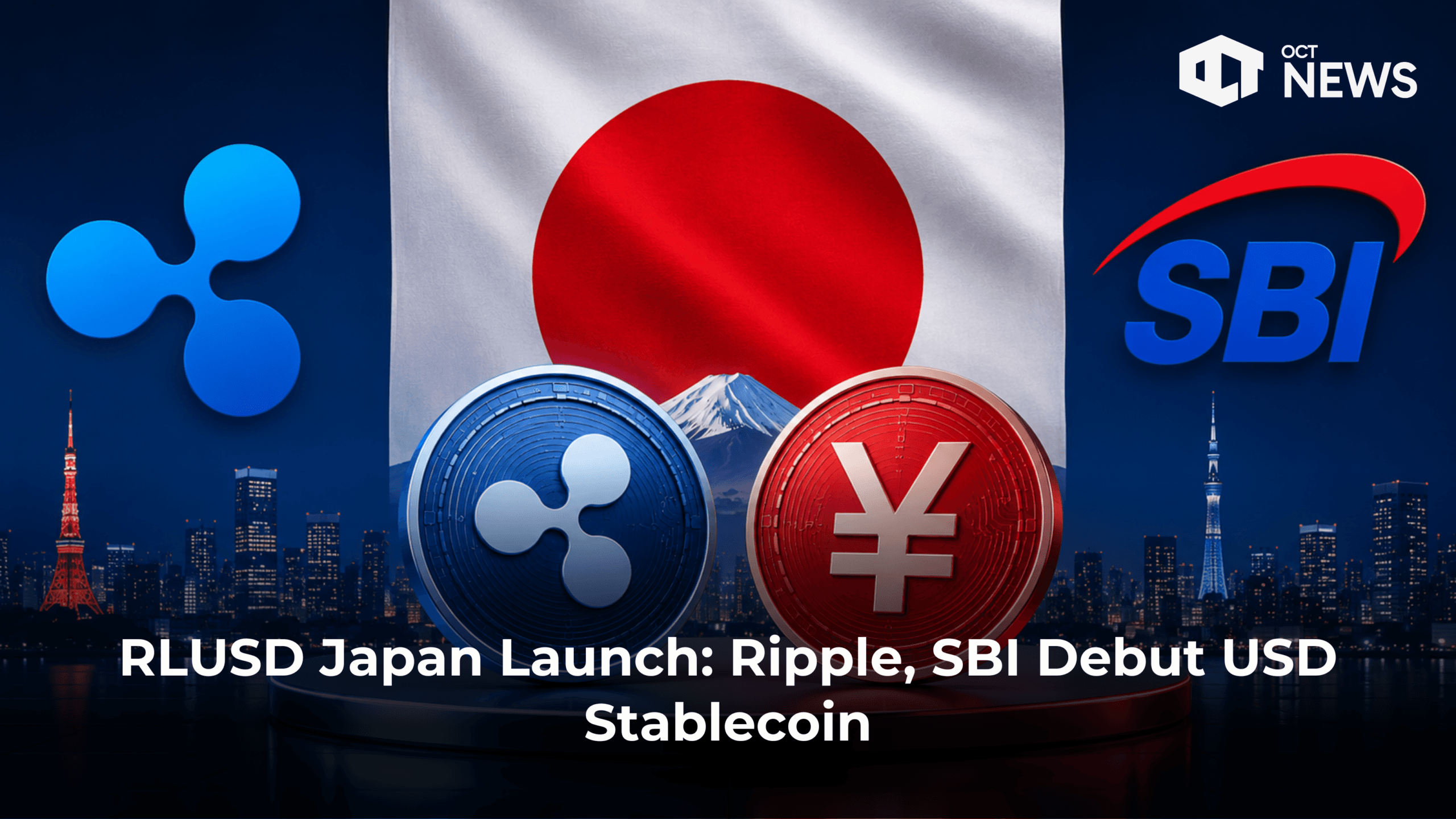
Learn how the RLUSD Japan Launch brings Ripple's regulated USD stablecoin to Japan alongside the new JPYSC yen stablecoin.

Author: Akshay
The RLUSD Japan launch went live on June 24, 2026, as Ripple and SBI Group teamed up through SBI VC Trade. The deal gives the country its first regulated foreign-issued USD stablecoin.
High Signal Summary For A Quick Glance

Neutral View Lab
@NeutralViewLab

@RippleXity Japan greenlighting RLUSD as first foreign USD stablecoin while dropping JPYSC via SBI Trust feels like a quiet power move for real corporate rails.
🚨 JUST IN: Two stablecoin firsts in Japan, same day. 🇯🇵 → $RLUSD: Japan's first regulated foreign stablecoin (Ripple) → JPYSC: Japan's first yen stablecoin (SBI Shinsei) The SBI × #Ripple alliance just opened the floodgates. https://t.co/gv4wo4oPbz
07:45 AM·Jun 25, 2026
High attention and emotional sentiment detected.
The RLUSD Japan launch did not arrive alone. On the same day, SBI Group and Startale Group rolled out JPYSC, a new yen-denominated stablecoin. Together, the two tokens open Japan’s regulated market on both sides of the dollar-yen pair.
The RLUSD Japan Launch became official after approval from the Financial Services Agency (FSA). The regulator cleared the token under the Payment Services Act (PSA), allowing RLUSD to trade in Japan.
The FSA treats RLUSD as a new electronic payment instrument for qualifying foreign stablecoins. So it counts as Japan’s first regulated foreign USD stablecoin under that framework. SBI VC Trade now offers it to both retail and institutional users on its VCTRADE platform.
Ripple backs RLUSD one-to-one with US dollar reserves and publishes regular attestations. According to Ripple, the token’s global market cap sat near $1.7 billion at the time of the announcement.
Jack McDonald, Ripple’s senior vice president of stablecoins, framed the move as an Asia milestone. He said the launch expands access to transparent, regulated USD-backed stablecoins for institutions, consumers, and businesses in Japan. Japan has long led on digital asset adoption, he added, citing its regulatory clarity.
SBI Shinsei Trust Bank issues JPYSC, while SBI VC Trade distributes it first. Startale Group provides the technology behind the token.
JPYSC stands out because a trust bank backs it. So reporting calls it Japan’s first trust-type yen stablecoin, a Type 3 electronic payment instrument under the PSA.
That label matters. JPYC, an earlier yen stablecoin, launched in late 2025 as a funds-transfer type with per-user limits. JPYSC, by contrast, carries no ¥1 million transfer or holding cap.
As a result, JPYSC can support larger institutional transfers, settlement, and real-world asset use. Some coverage reported first-day issuance near ¥3.8 billion, or roughly $23 to $25 million. SBI has not yet published a single English release confirming that figure.
Relative positioning between Ripple’s RLUSD stablecoin and SBI Shinsei’s JPYSC stablecoin in Japan
RLUSD lives natively on two networks, the XRP Ledger and Ethereum. That dual-chain design lets users move the token across both ecosystems with ease.
On the XRP Ledger, Ripple issues RLUSD from the address rMxCKbEDwqr76QuheSUMdEGf4B9xJ8m5De. On Ethereum, the token uses the contract 0x8292Bb45bf1Ee4d140127049757C2E0fF06317eD.
Anyone can verify the supply through public explorers such as XRPSCAN and Etherscan. Dashboards like RWA.xyz also track RLUSD across chains, so the reserves claim stays checkable.
JPYSC offers far less public detail for now. SBI has not confirmed its chain or contract, so independent on-chain tracking still remains limited.
Japan started reshaping its stablecoin rules through PSA amendments back in 2023. Those changes let banks, trust companies, and fund-transfer firms issue redemption-backed tokens.
The framework also lets licensed intermediaries distribute foreign stablecoins, provided they hold reserves domestically. SBI VC Trade fills that role here.
SBI VC Trade became Japan’s first licensed Electronic Payment Instruments Exchange Service Provider. It also handled USDC first in the country, so the firm already knows the compliance path.
Key refinements to the regime clustered around mid-June 2026. Both launches then landed right as those updates took effect.
Timeline: The evolution of the SBI–Ripple partnership alongside Japan’s stablecoin regulatory framework, culminating in the dual launch of RLUSD and JPYSC
SBI Holdings and Ripple form SBI Ripple Asia Co., Ltd., creating the foundation for Ripple’s expansion across Japan and the broader Asian payments market through RippleNet and later XRP Ledger infrastructure.
Amendments to Japan’s Payment Services Act become effective, establishing one of the world’s first comprehensive regulatory frameworks for digital money-type stablecoins while limiting issuance to licensed financial institutions.
Ripple USD (RLUSD) receives final NYDFS approval and launches on the XRP Ledger and Ethereum as a fully reserved U.S. dollar stablecoin with monthly reserve attestations.
Ripple and SBI Group announce a memorandum of understanding to distribute RLUSD in Japan through SBI VC Trade, positioning the exchange as the country’s regulated foreign stablecoin gateway.
JPYC becomes Japan’s first regulated yen-pegged stablecoin under the funds-transfer framework, demonstrating the country’s early regulated stablecoin adoption while retaining per-user limits.
SBI Holdings and Startale unveil plans for JPYSC, Japan’s first trust bank-backed yen stablecoin, to be issued by SBI Shinsei Trust Bank and distributed through SBI VC Trade.
Japan’s 2025 Payment Services Act amendments become fully effective, clarifying the regulatory pathway for foreign-issued stablecoins and trust-type yen stablecoins under the Electronic Payment Instrument framework.
Ripple and SBI Group announce RLUSD availability following regulatory approval, making it Japan’s first regulated foreign-issued stablecoin available to institutional and retail users through SBI VC Trade.
SBI Group and Startale launch JPYSC, Japan’s first trust bank-backed yen stablecoin. Issued by SBI Shinsei Trust Bank, it removes the traditional ¥1 million cap for broader institutional use cases.
Industry coverage highlights the simultaneous launch of RLUSD as Japan’s first regulated foreign stablecoin and JPYSC as the country’s first trust-type yen stablecoin under the refined regulatory framework.
SBI VC Trade is expected to broaden exchange support, institutional adoption, lending services, cross-border payments, and real-world asset integrations while expanding its regulated stablecoin offerings.
The RLUSD Japan launch gives Ripple a regulated foothold in a major Asian market. It also deepens a partnership that dates back to the 2016 SBI Ripple Asia venture. The timing stands out too, since both tokens went live under fresh rules on the same day.
On X, the early response leaned bullish. Many traders framed the dual launch as validation for regulated stablecoins and the broader XRP ecosystem.
Tomohiko Kondo, chief executive of SBI VC Trade, called the listing a major milestone in that collaboration. He said the two firms share a long vision for on-chain finance.
Analysts have not reported a clear XRP price reaction to the news yet. The story is fresh, so market data still remains thin for now.
Competition is coming, though. A megabank group tied to MUFG and Progmat is exploring its own yen stablecoin for the FY2026 to 2027 window.
For now, both tokens trade mainly through SBI VC Trade accounts. The companies also expect wider distribution over time.
Institutions across Japan may now weigh both tokens for payments and treasury use. A regulated USD option and a yen option, side by side, lowers the friction for on-chain settlement.
Several details still remain open. SBI has not published JPYSC’s contract address or chain, and Ripple has not shared Japan-specific RLUSD supply figures.
Readers should watch Ripple and SBI Group channels for the next updates. The pace of this rollout could set a template for stablecoin adoption across Asia.
This article is news and analysis, not financial advice. Always do your own research before making any investment decision.
Our Crypto Talk is committed to unbiased, transparent, and true reporting to the best of our knowledge. This news article aims to provide accurate information in a timely manner. However, we advise the readers to verify facts independently and consult a professional before making any decisions based on the content since our sources could be wrong too. Check our Terms and conditions for more info.


Securitize Stocks Launches Tokenized Equities on Solana
Stellar Settles First Institutional Repo Using Tokenized Treasury Collateral
Uniswap Aggregator Hooks Go Live & Route Fees to UNI Burn
Drift Protocol Exploit Sends $122M to Tornado Cash
Securitize Stocks Launches Tokenized Equities on Solana
Stellar Settles First Institutional Repo Using Tokenized Treasury Collateral
Uniswap Aggregator Hooks Go Live & Route Fees to UNI Burn
Drift Protocol Exploit Sends $122M to Tornado Cash

XRP