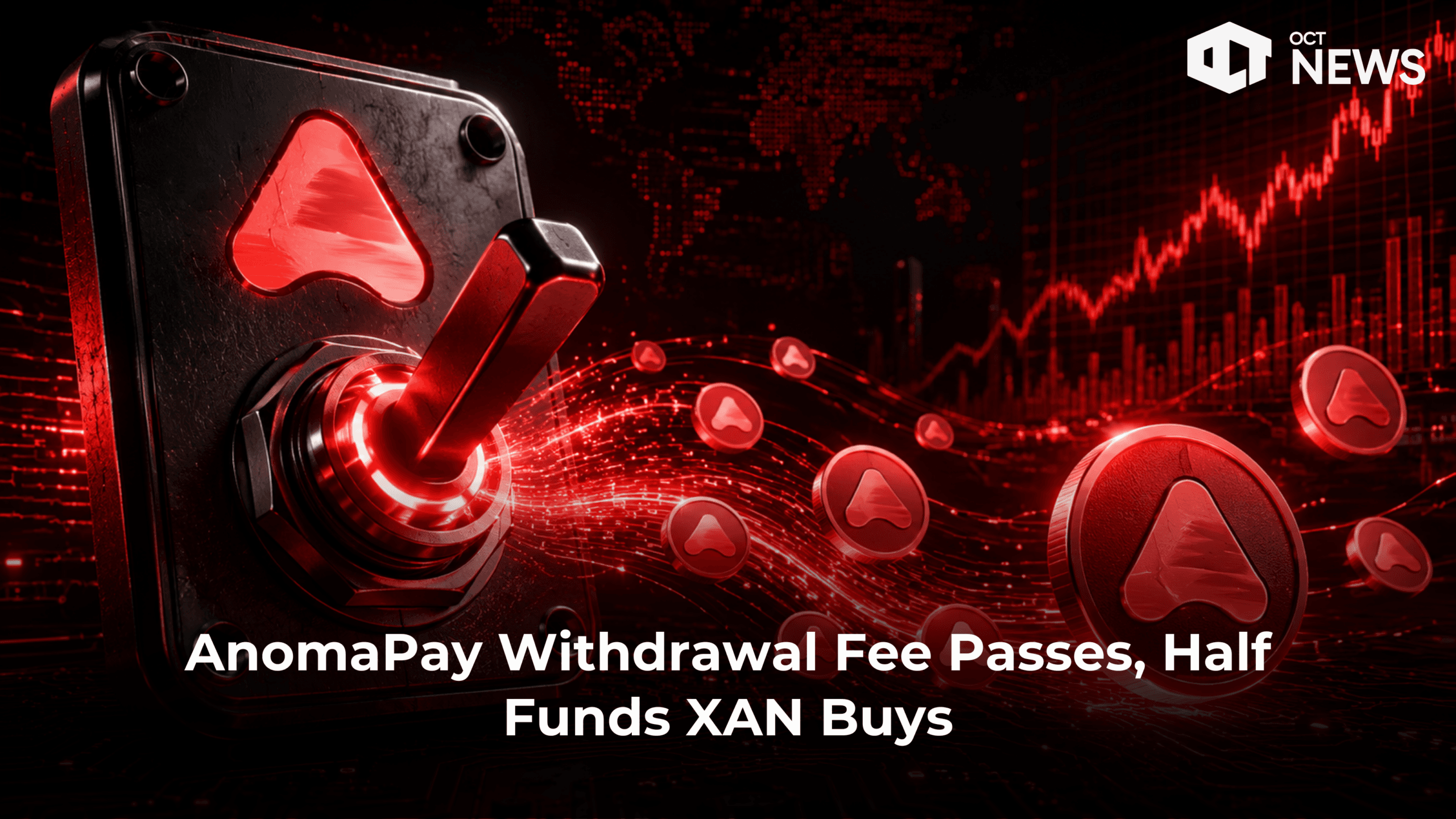
AnomaPay Withdrawal Fee is approved. Learn how the 0.25% fee works, where the revenue goes, and what it means for XAN holders.

Author: Akshay
3 August 2026 – Anoma confirmed that its governance vote to turn on an AnomaPay withdrawal fee had passed. The 0.25% charge will soon be enacted.
High Signal Summary For A Quick Glance

ALBert
@Kwt04A

@anoma @AnomaPay This creates a sustainable value loop real protocol revenue fuels 50% open-market $XAN buybacks while 50% strengthens the treasury. Free deposits and transfers keep adoption frictionless, making $XAN's value increasingly backed by real usage, not hype.
The governance proposal to activate a 0.25% protocol fee for @AnomaPay withdrawals has passed and will soon be enacted. Fees will be distributed 50% to open market purchases of $XAN and 50% to the Anoma Treasury. AnomaPay deposits and transfers will remain free. Learn more: https://t.co/qLmmqy0T48
12:39 PM·Aug 3, 2026

TheNinjaShax 🥷
@theninjashax
@anoma @AnomaPay this is a good step toward making the protocol more sustainable
The governance proposal to activate a 0.25% protocol fee for @AnomaPay withdrawals has passed and will soon be enacted. Fees will be distributed 50% to open market purchases of $XAN and 50% to the Anoma Treasury. AnomaPay deposits and transfers will remain free. Learn more: https://t.co/qLmmqy0T48
12:28 PM·Aug 3, 2026

gardy | gardenia ☘️
@blackgardenian
@anoma @AnomaPay great to hear that deposits and transfers will remain free
The governance proposal to activate a 0.25% protocol fee for @AnomaPay withdrawals has passed and will soon be enacted. Fees will be distributed 50% to open market purchases of $XAN and 50% to the Anoma Treasury. AnomaPay deposits and transfers will remain free. Learn more: https://t.co/qLmmqy0T48
12:06 PM·Aug 3, 2026
High attention and emotional sentiment detected.
The result flips on Anoma’s first real revenue switch. From now on, moving funds out of the AnomaPay shielded pool to a transparent wallet will cost 25 basis points. Deposits and private transfers, however, stay free.
The fee lands on one action only. Specifically, it applies when a user withdraws, or burns, tokens from the shielded pool back to a transparent EVM wallet.
Anoma collects the 0.25% in the same asset being withdrawn. So a user pulling out USDC pays the fee in USDC, and a user pulling out ETH pays it in ETH.
Deposits into AnomaPay remain free. Likewise, private shielded-to-shielded transfers stay free, and users only cover the underlying chain’s gas. As a result, the everyday privacy flow inside the app does not change.
For context, AnomaPay lets people deposit ordinary ERC-20 tokens into a shielded pool. Inside that pool, zero-knowledge proofs verify balances and transfers without revealing amounts, senders, or receivers. A withdrawal then moves value back into the open, and that exit is now the taxed step.
The proposal splits every fee down the middle. Half of the revenue goes to open-market purchases of XAN, Anoma’s governance and utility token. The other half flows to the Anoma Treasury.
According to the Snapshot proposal, the Treasury share funds protocol development, infrastructure, security, audits, grants, and ecosystem growth. In short, one half rewards the token while the other half pays the bills.
The official proposal text lays out the split plainly. “50% will be used to purchase XAN on the open market. 50% will be allocated to the Anoma Treasury to fund protocol development, infrastructure, security, and ecosystem growth,” it reads.
Notably, the proposal does not say what happens to the XAN it buys. It does not state whether those tokens get burned, locked, held, or redistributed. Therefore readers should treat the buyback as demand, not as a confirmed supply cut.
The path here was quick and lopsided. First, a temp-check landed on the Anoma governance forum on 9 July 2026. Then Anoma tweeted the formal proposal on 13 July.
Voting opened on Snapshot on 28 July at 14:09 UTC. Anoma announced that voting was live on 29 July, and the window closed on 31 July at the same time.
The tally left little doubt. For won with about 216 million votes, or 100%, while Against drew roughly 10 thousand, or 0%. No one abstained. That count reflects XAN voting power, including locked tokens, rather than a simple headcount.
The forum reaction was supportive throughout. Commenters compared the plan favorably to Railgun, which already charges a similar 0.25% shield and unshield fee. Several noted that starting with withdrawal fees only was a sensible first step.
This is Anoma’s fee switch moment. Like Uniswap’s long-debated switch and Aave’s buyback program, it ties protocol usage to token demand. Every taxed withdrawal now sends buy pressure toward XAN on the open market.
Still, the effect depends on volume that no one has published. AnomaPay withdrawal volume does not appear on DefiLlama, Dune, or any official dashboard yet. Consequently, projected fee revenue cannot be calculated from primary data.
The token itself trades quietly for now. Around 3 August, XAN changed hands near $0.011, for a market cap of roughly $28 million on about 2.5 billion circulating tokens. Its supply is fixed at 10 billion, and its price sits well below the September 2025 high near $0.25.
No sharp price spike followed the 12:05 UTC announcement in sampled data. In other words, the market has not yet repriced the news, even though the value-accrual link is now real.
How Anoma’s proposed fee switch compares with revenue models used by Uniswap and Aave.
Plenty remains open despite the clear vote. Above all, Anoma has not published an exact enactment date or block. The team only says the fee “will soon be enacted.”
The buyback mechanics are also vague. It is unclear who executes the purchases, how often, on which venues, and with what slippage controls. Meanwhile, no dedicated fee-collector or buyback contract address has appeared on-chain.
The Treasury wallet is not published in the proposal materials either. For that reason, on-chain observers cannot yet track the flows the vote just authorized.
Enactment is the next milestone to watch. Once the AnomaPay withdrawal fee goes live, on-chain sleuths can finally measure real withdrawal volume and the pace of XAN buys.
Until then, the confirmed facts are simple. The fee is 0.25% on withdrawals only, the split is 50/50 between XAN buys and the Treasury, and deposits and private transfers stay free. Timing and execution details are the pieces the team still owes the community.
This article is informational and is not financial advice. Always do your own research before making any investment decision.
Our Crypto Talk is committed to unbiased, transparent, and true reporting to the best of our knowledge. This news article aims to provide accurate information in a timely manner. However, we advise the readers to verify facts independently and consult a professional before making any decisions based on the content since our sources could be wrong too. Check our Terms and conditions for more info.



Anoma