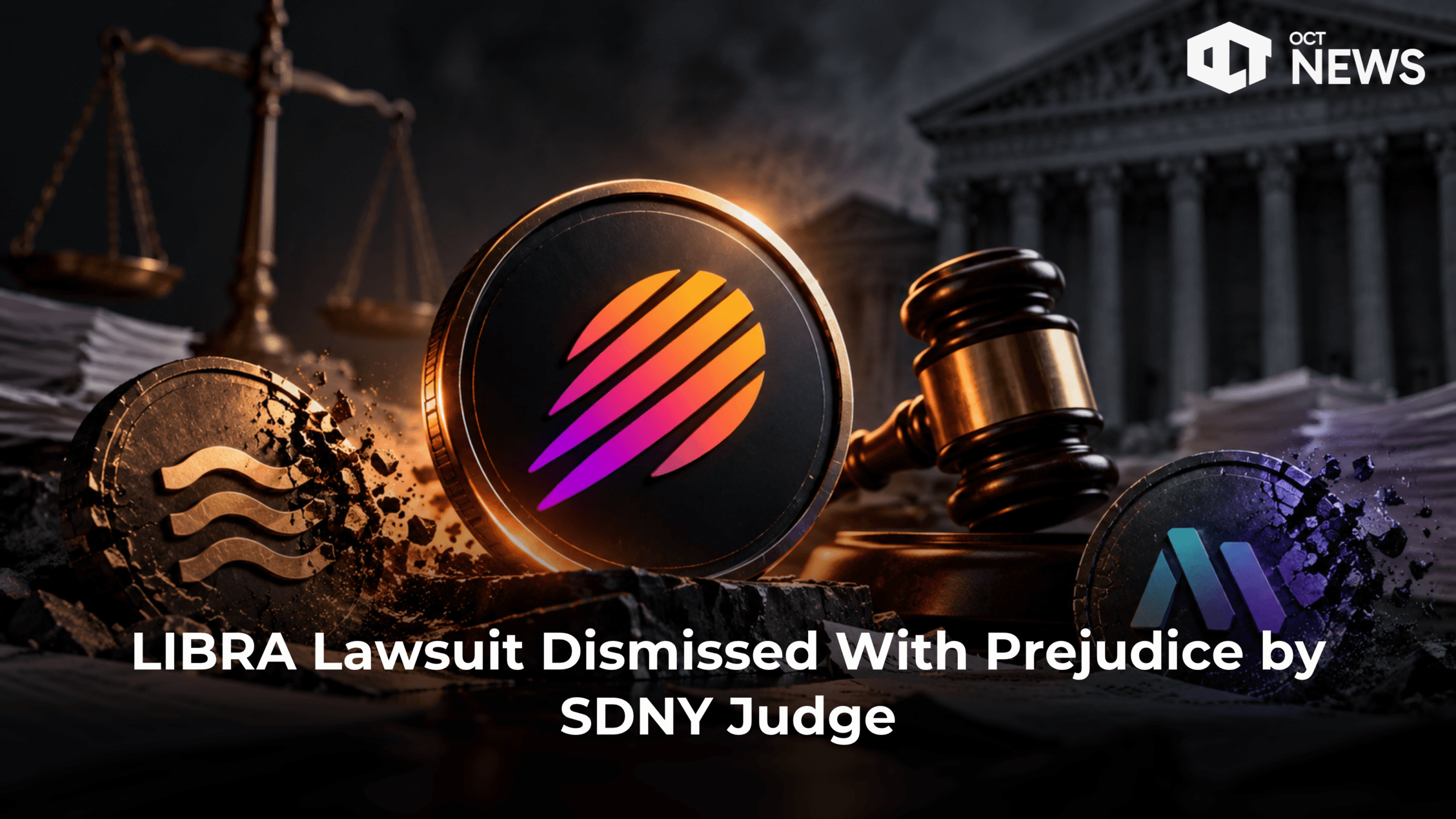
LIBRA Lawsuit Dismissed with prejudice as Judge Rochon rejects RICO claims and denies the proposed MELANIA amendment in the civil case.

Author: Akshay
1st October 2026 – A federal judge dismissed the LIBRA lawsuit with prejudice on September 29, 2026. U.S. District Judge Jennifer L. Rochon tossed every claim in the marquee memecoin class action and ordered the case closed.
High Signal Summary For A Quick Glance

Omega
@omega_netw0rk

@SolanaFloor @MeteoraAG Not just the lawsuit, but also the drama surrounding it seems to have been dismissed with prejudice.
🚨BREAKING: 🇺🇸A U.S. court has dismissed the $LIBRA/$M3M3 lawsuit against @MeteoraAG, former CEO Ben Chow, Kelsier Ventures, and Hayden Davis, rejecting an attempt to expand it to include $MELANIA and other tokens. The dismissed civil claims included RICO racketeering, RICO https://t.co/SgTKv6Qd1h
10:01 AM·Oct 1, 2026
High attention and emotional sentiment detected.
The ruling lands in the Southern District of New York. It covers Kelsier Labs, Hayden Davis, his brothers Gideon and Charles Davis, Meteora co-developer Benjamin Chow, and the Meteora protocol itself. Importantly, the 81-page opinion is a pleading-stage decision, not a verdict on whether the launches were clean.
Judge Rochon dismissed the Hurlock v. Kelsier Ventures complaint in full. The order is Document 274 on the docket, filed the same day.
Plaintiffs Omar Hurlock and Anuj Mehta had brought civil RICO, fraud, and state-law claims. According to the opinion, none of them cleared the pleading bar. So the judge denied leave to amend and closed the case.
The defense framed the result as a clean sweep. In a note published September 30, 2026, Cahill Gordon & Reindel said the court dismissed all claims against Chow with prejudice and ordered the case closed.
The M3M3 and LIBRA saga runs from the December 2024 token launch through the LIBRA collapse and into a civil case dismissed with prejudice in September 2026.
$M3M3 launches on Meteora. Later allegations claimed insider wallets acquired most of the supply before public trading.
Kelsier creates $LIBRA and Javier Milei promotes it. The token surges before collapsing within hours.
Davis describes his role in LIBRA and confirms involvement in MELANIA, including admitting to sniping tokens.
Meteora co-founder Ben Chow leaves the project amid insider-trading allegations. An independent review is announced.
Omar Hurlock files a civil lawsuit alleging RICO, fraud, conspiracy and related state-law violations.
Plaintiffs obtain temporary restraints over alleged LIBRA proceeds before parts of the freeze are later vacated.
The case expands with additional allegations and defendants, including claims involving Kelsier, Davis, Chow and Meteora.
Plaintiffs seek to add MELANIA, ENRON and TRUST to the case and expand the alleged enterprise.
Judge Jennifer L. Rochon dismisses the amended complaint with prejudice and denies further amendment as futile. The court does not decide whether the token launches were manipulated.
The court ruling draws renewed crypto-media attention. Potential appeals and other investigations remain open.
The core of the LIBRA lawsuit was civil RICO. Plaintiffs argued the defendants ran a racketeering enterprise built on wire fraud. However, RICO requires a “pattern,” and a pattern requires continuity.
Here is where the theory broke. The alleged scheme ran from roughly October 2024 to March 2025, about six months. The proposed amendment would have stretched it to about seven.
Courts usually want a substantial period for closed-ended continuity, often more than about two years. As a result, a six-month run of token launches fell short. The judge also rejected open-ended continuity, because Meteora and Kelsier were alleged as mostly legitimate businesses rather than criminal enterprises.
The RICO conspiracy count failed for the same reason. Once the core pattern claim collapsed, the derivative conspiracy claim collapsed with it.
RICO also served as the plaintiffs’ hook for nationwide service of process. Once that hook fell, so did the court’s reach over the Kelsier defendants on the remaining state-law claims.
Consequently, the court dismissed the state-law claims against the Kelsier group for lack of personal jurisdiction under Rule 12(b)(2). That is a procedural exit, not a defense win on the facts.
Meteora faced a different problem. Plaintiffs named the protocol as an unincorporated association. Yet the court treated Meteora as software, not a voluntary group of people with identified members and officers. Therefore the court dismissed every claim against Meteora, following a motion by intervenor Dynamic Labs Limited.
Chow drew the most detailed analysis. The fraud counts against him needed strong evidence of intent, known as scienter, under Rule 9(b).
The plaintiffs pointed to instructions Chow gave Hayden Davis on how to launch a token. But the judge found that detail cut both ways. As she wrote, that conduct “is equally consistent with Chow’s technical management of Meteora and therefore does not allege a compelling inference of fraudulent intent.”
The court also set aside a later Chow statement about enabling Davis. It treated the remark as hindsight, not day-one intent. Likewise, a generic fee or profit motive was not enough. So the fraud, conspiracy, New York GBL, and unjust enrichment counts against Chow all fell.
Plaintiffs tried to widen the case late in the process. Their proposed second amended complaint sought to add $MELANIA, $ENRON, $TRUST, and related theories.
The judge denied that motion as futile. Because she denied leave to amend, the dismissal became final with prejudice rather than leaving room to refile. In plain terms, the LIBRA lawsuit dismissed on September 29 is over at the district-court level.
This is the part some headlines get wrong. The court made no factual finding that manipulation or fraud did or did not occur. It ruled on the pleadings, not the merits.
The complaint had alleged insider pre-positioning and liquidity extraction. It claimed insiders took more than 95% of M3M3 supply, and that roughly $80 million to $110 million was pulled from LIBRA. Those remain allegations, and the judge did not test them.
Crypto lawyer Ariel Givner summed up the takeaway in a widely shared thread. Her point was blunt: you cannot RICO a six-month memecoin launch, and you cannot sue a protocol as a partnership. That is a procedural verdict, not an acquittal on the facts.
For context, the launches themselves were loud. Kelsier launched $LIBRA on February 14, 2025, and CoinDesk reported that Davis admitted to sniping tokens. Chow resigned from Meteora on February 18, 2025, according to The Block.
Several threads stay open. Plaintiffs could appeal to the Second Circuit, though no notice of appeal has surfaced yet. Their counsel at Burwick Law had not posted a response to the dismissal at the time of writing.
Other questions also remain unsettled. The status of any U.S. or Argentine criminal probe is unclear. The outcome of the Fenwick review announced in February 2025 is still unknown. Meanwhile, markets showed no verified reaction, since both tokens have traded as illiquid shells for months.
For now, the headline is simple and the fine print matters more. A federal judge closed this civil case with prejudice, yet no court has ruled on what really happened during the launches. You can read the full opinion and order for the detailed reasoning. This article is informational reporting, not legal or financial advice.
Our Crypto Talk is committed to unbiased, transparent, and true reporting to the best of our knowledge. This news article aims to provide accurate information in a timely manner. However, we advise the readers to verify facts independently and consult a professional before making any decisions based on the content since our sources could be wrong too. Check our Terms and conditions for more info.


Harmony to ShutDown Block Explorer Wiping Pre-2025 Data
Solana Alpenglow Goes Live Cutting Finality to 150ms
IoTeX Zanzibar Upgrade Moves Staking Rewards On-Chain
Altitude Demos X9.150 QR Payment Standard With USDC
Harmony to ShutDown Block Explorer Wiping Pre-2025 Data
Solana Alpenglow Goes Live Cutting Finality to 150ms
IoTeX Zanzibar Upgrade Moves Staking Rewards On-Chain
Altitude Demos X9.150 QR Payment Standard With USDC