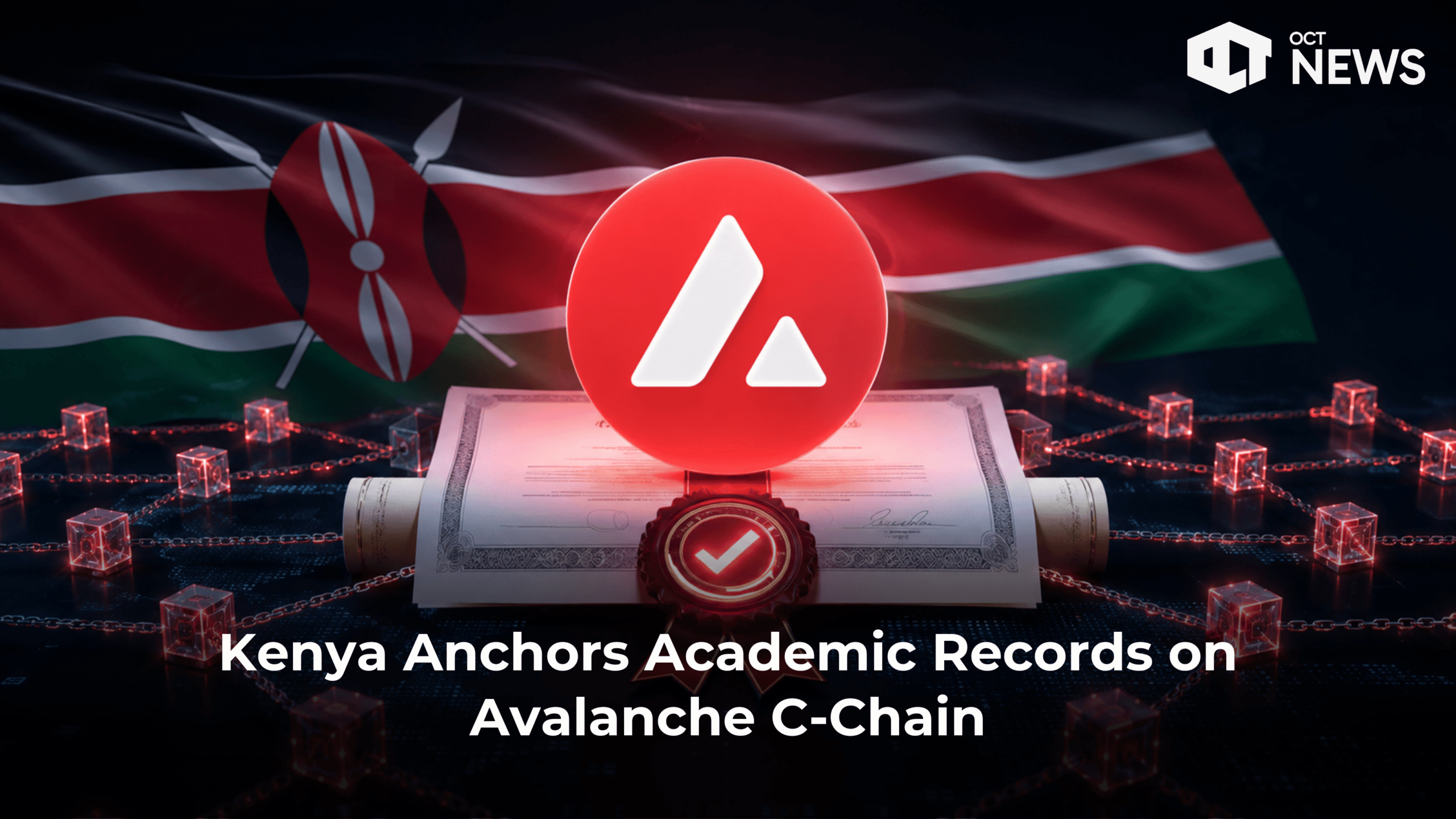
Kenya anchors academic records on Avalanche, enabling secure certificate verification and helping prevent forgery nationwide.

Author: Akshay
3rd August 2026 – Kenya Anchors Academic Records on Avalanche as the Kenya National Examinations Council moves millions of exam records onto a public blockchain. The move makes the country’s certificates verifiable and far harder to forge.
High Signal Summary For A Quick Glance

MindWaveDAO
@nilatoken

@avax @KNECKenya Forgery resistant records at a national scale is a strong example of where blockchain creates real value beyond finance.
BREAKING: Kenya Government brings 30M+ academic credentials on chain with Avalanche Through @KNECKenya, academic records are now verifiable and forgery-resistant, with Avalanche powering the national verification layer. https://t.co/WKcKaFmbhl
01:37 PM·Aug 3, 2026
High attention and emotional sentiment detected.
According to the Ava Labs blog, more than 15 million records dating back to 1989 now sit on the Avalanche C-Chain. Nearly 1 million students from the 2025 KCSE cohort can already access their certificates online.
Kenya Anchors Academic Records through the Kenya National Examinations Council (KNEC), which oversees national exams from primary school through advanced diplomas. The council anchored these records through an unnamed local technology provider. That provider used LegitDoc, the same platform behind India’s blockchain land records.
The coverage is broad. It includes KCPE and KCSE results, advanced diplomas, and Government Teaching Faculty programs. For now, KCSE 2025 certificates are available exclusively through the KNEC e-certificate platform.
The system is projected to reach roughly 35 million verifiable records over time. So the current 15 million marks a starting point, not the finish line.
Timeline: Kenya’s multi-year effort to combat academic certificate fraud, culminating in the public announcement on 3 August 2026 that the Kenya National Examinations Council (KNEC) is anchoring national academic records on Avalanche.
Kenya faces widespread academic credential fraud involving forged KCSE certificates, fake university degrees, altered grades, and fabricated examination records. Public Service Commission (PSC) audits and Ethics and Anti-Corruption Commission (EACC) investigations uncover thousands of suspected and confirmed fraudulent certificates across ministries, hospitals, universities, county governments, and other public institutions, resulting in dismissals, prosecutions, and recovery of public funds.
KNEC gradually introduces stronger digital verification tools. QR codes are added to certificates beginning with the 2023 examination cohort, while initiatives such as TrueCert and direct PSC–KNEC verification links enable employers and government agencies to authenticate certificates more efficiently. Despite these improvements, verification still depends largely on centralized databases and physical documentation.
KNEC launches its official e-certificate portal, allowing candidates who sat examinations from 1989 onward to download tamper-evident digital certificates after identity verification. The platform introduces blockchain-backed verification hashes and Merkle-proof authentication while giving employers and institutions instant verification tools. Initial rollout focuses on KCSE certificates, with additional examination categories planned.
Avalanche and Ava Labs announce that KNEC has anchored Kenya’s academic records on the Avalanche C-Chain. According to the announcement, more than 15 million historical records dating back to 1989 have already been anchored, nearly 1 million 2025 KCSE e-certificates are available digitally, and the system is designed to scale toward approximately 35 million verifiable records. The implementation uses the LegitDoc platform through a Kenyan technology partner, with Avalanche serving as the verification layer rather than replacing KNEC’s e-certificate system.
KNEC plans to extend digital certificate coverage beyond KCSE to additional examinations such as KCPE, TVET, and teacher certification. Historical record anchoring is expected to continue toward the projected 35 million-record target, while employers, universities, and government agencies increasingly adopt instant blockchain-backed verification. Future updates may include additional technical transparency, public verification tools, and independent audits of the on-chain infrastructure.
The design is simpler than full on-chain storage. KNEC keeps each student’s personal data off-chain in its own systems. Only a cryptographic hash, or proof, of each certificate goes onto the Avalanche C-Chain.
That hash acts like a tamper-proof fingerprint. If someone alters a certificate, its hash changes and no longer matches the on-chain record. As a result, forged documents fail verification instantly.
The check itself is fast. An employer or university obtains the e-certificate from a candidate. Then they verify it through the KNEC portal against the Avalanche-anchored proof.
Institutions can also run these checks in bulk. That matters for universities and large employers screening many applicants at once. Each certificate still maps to its own on-chain proof.
Avalanche calls this the “national verification layer.” In practice, anchoring academic records on Avalanche lets institutions confirm authenticity in seconds rather than through slow manual checks.
Kenya Anchors Academic Records to address a problem that has persisted for years. The country has struggled with certificate forgery, especially in public-sector hiring, where fake papers have repeatedly slipped through recruitment checks. As a result, verification remained slow and easy to game.
The problem is not new. Kenyan employers have long relied on manual confirmation letters from KNEC, a process that could drag on for weeks. Earlier verification pilots reportedly drew in outside partners, yet none reached this scale.
KNEC had already been modernizing before this announcement. The council rolled out QR codes on certificates and launched its e-certificate portal earlier in 2026. The Avalanche layer now sits beneath that portal.
KNEC CEO Dr David Njengere framed the shift around access, not just security.
“Candidates no longer have to rely solely on physical certificates. Instead, they can securely access, download and verify their KCSE certificates online, providing a faster, more reliable and more convenient way of managing academic credentials in the digital age.”
This is not Avalanche’s first public-sector deployment. The network has already handled vehicle titles for the California DMV and property deeds in Bergen County, New Jersey. LegitDoc, meanwhile, powered land records in India.
Kenya’s project stands out for its scale. Anchoring academic records on Avalanche at a national level puts millions of documents under one verifiable system. For a public Layer 1, that is a notable real-world test.
Notably, the records sit on the public C-Chain, not a private subnet. So anyone can, in principle, check the anchoring proofs on-chain.
The headline figures do not all line up. Avalanche’s own tweet cited “30M+” records, while the company blog reported 15 million anchored now and 35 million projected. That gap likely reflects current totals versus future scale.
Several details also remain unconfirmed. The local technology provider is still unnamed. Avalanche has not published contract addresses or transaction hashes, so independent on-chain verification stays limited for now.
Questions about cost and privacy are open too. It is unclear who pays the gas fees for ongoing anchoring. According to primary sources, only hashes go on-chain, yet nobody has detailed the full privacy model.
The rollout is still expanding. KNEC plans to bring primary results, diplomas, and teaching programs fully onto the platform over time. The system could eventually process millions of new certificates each year.
Major outlets like CoinDesk and Reuters had not published dedicated coverage as of the announcement. So the story so far rests mainly on Avalanche’s primary sources and the live KNEC portal.
AVAX traded near $6.43 around the announcement, with no clear spike tied to the news. For now, the real signal is adoption, not price. This is not financial advice.
If Kenya reaches its 35 million target, the project could rank among the largest government uses of a public blockchain yet. Either way, Kenyan employers and universities now get a faster way to catch fake certificates.
Our Crypto Talk is committed to unbiased, transparent, and true reporting to the best of our knowledge. This news article aims to provide accurate information in a timely manner. However, we advise the readers to verify facts independently and consult a professional before making any decisions based on the content since our sources could be wrong too. Check our Terms and conditions for more info.


Securitize Stocks Launches Tokenized Equities on Solana
Stellar Settles First Institutional Repo Using Tokenized Treasury Collateral
Uniswap Aggregator Hooks Go Live & Route Fees to UNI Burn
Drift Protocol Exploit Sends $122M to Tornado Cash
Securitize Stocks Launches Tokenized Equities on Solana
Stellar Settles First Institutional Repo Using Tokenized Treasury Collateral
Uniswap Aggregator Hooks Go Live & Route Fees to UNI Burn
Drift Protocol Exploit Sends $122M to Tornado Cash

Avalanche