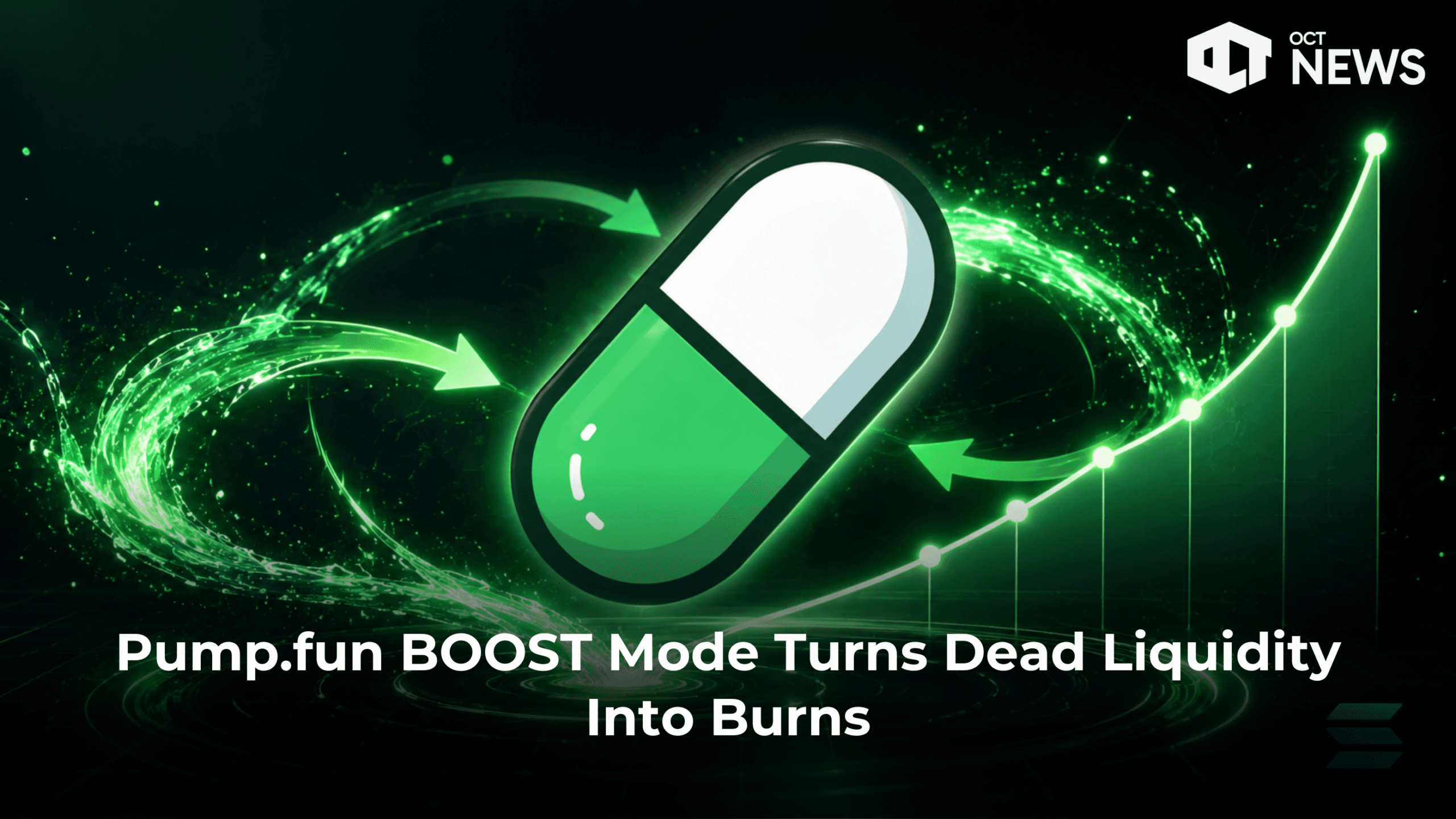
Pump.fun launches BOOST mode, recycling dead liquidity into automatic buybacks and burns for every newly graduated token on PumpSwap.

Author: Akshat Thakur
21st July 2026 – Pump.fun launched BOOST mode on Tuesday. The new default feature recycles dead liquidity from every graduating coin into automatic buybacks and burns.
High Signal Summary For A Quick Glance

GW IS NOT REAL
@5fakb48

@Pumpfun I guess.. At least you're trying to innovate I can't even criticize that
Introducing BOOST mode - the new standard launch mechanism for EVERY new pump fun coin Over $100M in dead liquidity is lost every year when tokens migrate. Now, we’re reinjecting future liquidity into EVERY BONDED COIN. Learn more 👇 https://t.co/FJEE0rSXiB
05:17 PM·Jul 21, 2026

Senius
@CryptoSenius
@Pumpfun @blknoiz06 Try making some features, that Benefits old pumpfun tokens, instead of just trying to make people create new coins all the time, thats the reason no coin survives in the Long run.
Introducing BOOST mode - the new standard launch mechanism for EVERY new pump fun coin Over $100M in dead liquidity is lost every year when tokens migrate. Now, we’re reinjecting future liquidity into EVERY BONDED COIN. Learn more 👇 https://t.co/FJEE0rSXiB
03:25 PM·Jul 21, 2026

The Wheeler Dealer 🌍
@WheelerrDealerr
@Pumpfun retroactively allow the liquidity from old coins to be reinjected into the coin as well? or is that impossible within the contract design?
Introducing BOOST mode - the new standard launch mechanism for EVERY new pump fun coin Over $100M in dead liquidity is lost every year when tokens migrate. Now, we’re reinjecting future liquidity into EVERY BONDED COIN. Learn more 👇 https://t.co/FJEE0rSXiB
02:58 PM·Jul 21, 2026
Steady attention without excessive speculation.
The team announced Pump.fun BOOST mode at 14:52 UTC through its official X account. It went live at 15:23 UTC, so every coin that migrates after that time now carries the configuration.
BOOST activates the moment a coin completes its bonding curve and migrates to PumpSwap. At that point, the protocol takes the dead portion of migration liquidity and puts it back to work.
According to Pump.fun, the system reinjects 17.6 SOL for SOL pairs, or $2,516 for USDC pairs. It then spends that capital over a five-minute window right after migration.
The buybacks run through a TWAP, or time-weighted average price. So instead of one large market buy, the protocol spreads purchases across the window. After each TWAP execution, BOOST immediately burns the tokens it bought.
The Pump program already handles creation, the bonding curve, and migration. So BOOST appears to ride on that existing logic rather than a brand-new contract.
As a result, the coin gets fresh buy pressure and a smaller supply within minutes of graduating. Meanwhile, the trading experience on the curve stays the same.
Before BOOST, every graduation followed a fixed path. First, the bonding curve filled up. Then Pump.fun moved the reserves into a PumpSwap pool and burned the LP tokens.
That burn locked the liquidity for good, which shielded traders from a sudden rug pull. Yet it also froze the dead share, since nobody could ever pull it back out.
Pump.fun spelled out this flow in its bonding-curve docs. BOOST keeps the same safety model, but now it recycles the stuck portion instead of leaving it idle.
Every Pump.fun coin starts on a virtual bonding curve. Because no real pool exists yet, buys simply move the price along a constant-product formula.
Once a coin hits roughly $69,000 in market cap, the curve closes. Then its reserves seed a PumpSwap pool, and the protocol burns the LP tokens.
Around 20% of that migration liquidity has historically sat unusable. Even if every holder sells, the pool cannot fully drain, so that value stays locked. Pump.fun calls this the dead liquidity, and BOOST now redirects it.
Graduations have also grown rare lately. Some mid-2026 reports put the rate near 0.26% of launched coins, so each graduating coin now matters more.
Key milestones in Pump.fun’s Evolution & BOOST Mode Launch
No-code memecoin launchpad launches with a bonding-curve model enabling instant trading. Tokens graduate to a DEX once they hit a market-cap threshold.
Pump.fun replaces Raydium with its own in-house AMM for graduated token migrations, reducing external dependencies while keeping the bonding-curve-to-DEX flow intact.
Public sale and launch of the native $PUMP token, with fee revenue directed toward buybacks and burns, tying platform success to long-term ecosystem value accrual.
Hundreds of millions in SOL become effectively locked in inactive graduated liquidity pools after full sell-offs, emerging as a persistent structural pain point despite the PumpSwap migration.
Pump.fun officially announces BOOST as the new default post-migration mechanism, targeting the dead-liquidity problem via automatic timed buybacks and burns from migration capital.
BOOST rolls out automatically for every new token migrating from the bonding curve. Earlier migrations and Mayhem-mode launches remain unaffected — BOOST becomes the new standard going forward.
Pump.fun says roughly $100 million in dead liquidity vanishes every year. The company derives that figure from cumulative graduation volume and the 20% dead share per migration.
Still, the number remains Pump.fun’s own estimate. No independent audit of the exact $100 million figure was available at launch, so readers should treat it with some caution.
Earlier reporting does support the broader problem. Analysts have previously flagged hundreds of millions of dollars in SOL sitting inside inactive graduated pools, with some estimates above $287 million.
BOOST does not require any toggle. According to Pump.fun, every coin that migrates after 10:23 EST on July 21 automatically gets the configuration.
Two groups miss out, though. Coins that migrated before the cutoff do not qualify, and tokens from Mayhem mode stay excluded as well.
Pump.fun rolled out the change as a setting on new migrations. So no fresh program deployment showed up in early on-chain searches.
Co-founder Alon, known on X as @a1lon9, replied “wow!” minutes after the announcement. His reaction matched the upbeat mood across the thread.
The PUMP token traded roughly between $0.0014 and $0.002 around the announcement. So far, no clear spike or dump has tracked directly to BOOST, and the market cap sat between $590 million and $790 million recently.
PumpSwap remains the main venue for graduated coins. Its total value locked recently held near $217 million to $235 million, according to DefiLlama, with daily volume in the hundreds of millions.
On X, most early reactions leaned bullish. Traders called BOOST “rocket fuel” and a “win-win,” while some floated memes like adding a boost after every 10x.
Not everyone cheered, though. One user compared the feature to DEX Screener boosts, a paid promotion tool, and questioned the framing.
Several technical details also remain open. Pump.fun has not confirmed whether a keeper bot or a modified migration instruction drives the buybacks on-chain.
The audit status of the change also stays unclear. Likewise, Pump.fun has not said whether the 17.6 SOL and $2,516 amounts hold fixed or adjust over time.
None of this is financial advice. Anyone weighing PUMP or a freshly graduated coin should do their own research first.
For now, the first wave of BOOST migrations will show whether the buy-and-burn actually strengthens post-graduation floors. Dashboards on Dune and DefiLlama should surface that data within days.
If the mechanic works as described, Pump.fun BOOST mode could turn a long-standing complaint into a selling point. Traders will watch the next graduations closely to see whether the burns hold up.
Our Crypto Talk is committed to unbiased, transparent, and true reporting to the best of our knowledge. This news article aims to provide accurate information in a timely manner. However, we advise the readers to verify facts independently and consult a professional before making any decisions based on the content since our sources could be wrong too. Check our Terms and conditions for more info.