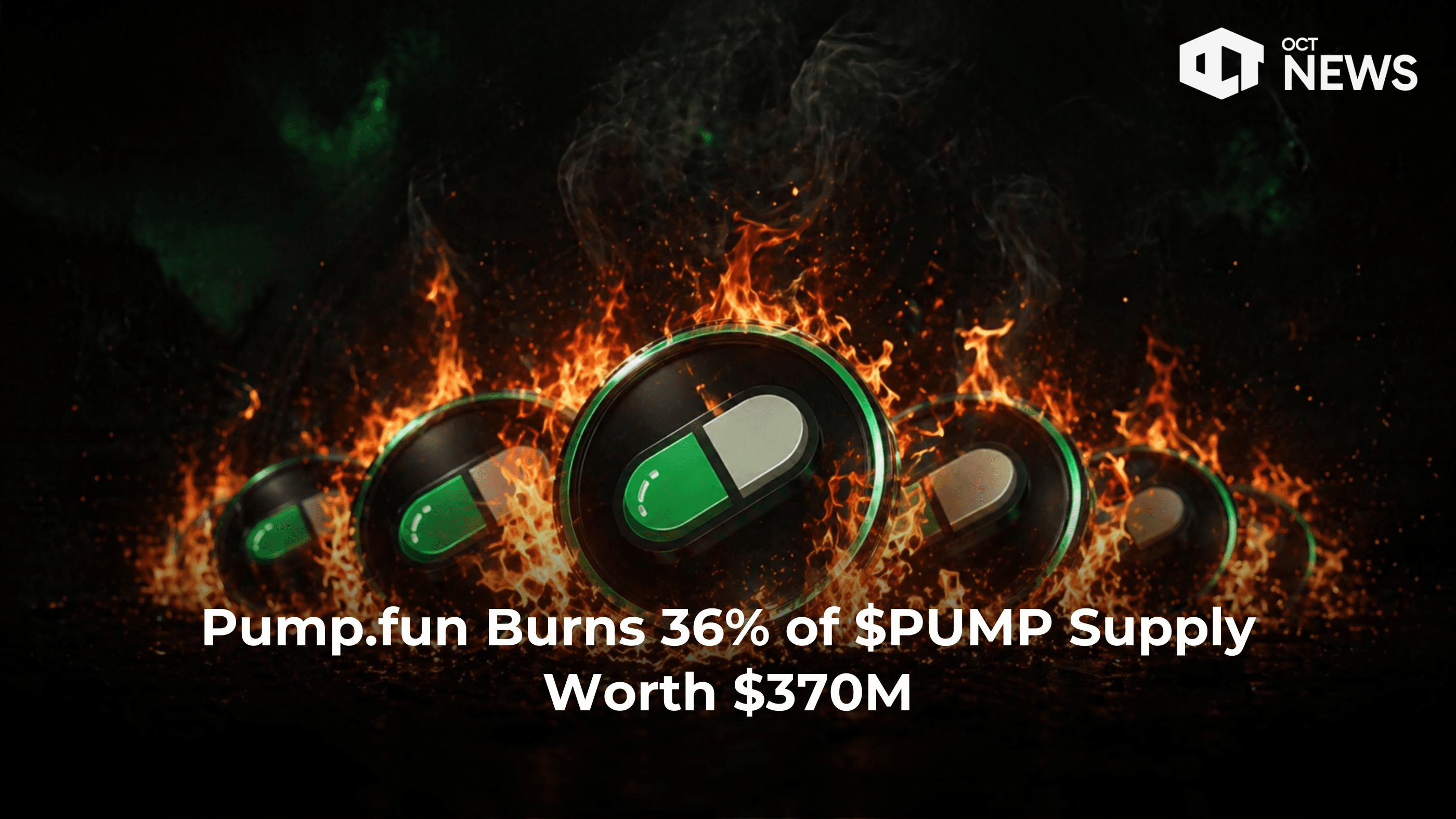
Pump.fun permanently burned $370 million worth of $PUMP tokens, removing roughly 36% of the token's circulating supply in one move.

Author: Sahil Thakur
29th April 2026 – Pump.fun permanently burned approximately $370 million worth of $PUMP tokens, removing roughly 36% of the token’s circulating supply in one move.
High Signal Summary For A Quick Glance

Beanie
@beaniemaxi

Pumpfun bought back $370 Million worth of its tokens over the past year and the chart still looks like a ski hill. It's not surprising however because the token has no utility, doesn't represent ownership, isn't tied to revenue or even governance. Why should it be worth anything? https://t.co/G5KxTweZBy

11:44 PM·Apr 28, 2026

Kantian
@kantianum
Pump Fun just announced burning 36% of the $PUMP supply 🚨 >They also implemented programmatic buybacks using 50% of revenues for one year. But there’s a big issue. Pump Fun team hinted at an airdrop in 2025, and traders were expecting it. There are a lot of negative https://t.co/mIKilHiPyF https://t.co/Q4TDtZrXda

The future of $PUMP We have burned ALL bought back $PUMP tokens, around $370M worth of purchases (~36% of circulating supply), to gain trust with our community. On top of that, we have initiated a programmatic buyback *and burn* scheme at 50% of revenue for the next year to
10:41 PM·Apr 28, 2026

Clive
@Clive_99
Pump fun’s massive announcement today https://t.co/KZNSGcgmAc

09:34 PM·Apr 28, 2026
High attention and emotional sentiment detected.
The burn destroyed around 128 billion tokens that the platform had accumulated through nine months of open-market buybacks. Pump.fun also launched a new buyback-and-burn scheme. The program commits 50% of net revenue for the next year to continued supply reduction.
Since the $PUMP token launched in July 2025, pump.fun directed 100% of platform revenue toward buying $PUMP on the open market. That aggressive buyback strategy ran for roughly nine months before this week’s announcement.
On Monday, the team executed the burn across two on-chain transactions, both verifiable on Solscan. Every previously bought-back token was sent to a burn address permanently.
According to the official announcement, the rationale centers on trust. The team wanted to eliminate uncertainty about what would happen to the bought-back tokens. By burning them, pump.fun made the supply reduction irreversible.
Alongside the burn, pump.fun introduced a structured ongoing program. Starting now, 50% of net revenue from three sources feeds directly into automated buybacks. Those sources are the bonding curve, PumpSwap, and Terminal.
The purchased tokens are immediately burned through a locked smart-contract mechanism. The lock runs for one full year, and the process is fully automated. Nobody can intervene manually or stop the process.
The remaining 50% of revenue goes toward operations, hiring, marketing, acquisitions, and ecosystem investments. Co-founder Alon Cohen framed the split as a move toward sustainability. The previous 100% allocation left no room for reinvestment in the platform itself.
$PUMP is the native utility token of pump.fun, the Solana-based memecoin launchpad that launched in January 2024. The platform lets anyone create and trade tokens via bonding curves with minimal fees. Successful tokens “graduate” to decentralized exchanges like PumpSwap.
The $PUMP token launched through a public ICO on July 12, 2025. The team sold 33% of the total 1 trillion supply, with 15% available to the public at $0.004 per token. According to CoinDesk, the public sale sold out in roughly 12 minutes, raising approximately $500 million.
Total supply stands at 1 trillion PUMP. Before the burn, circulating supply sat at roughly 350 billion tokens. The 128 billion token burn reduced that figure significantly, creating what some analysts call a meaningful supply shock.
The burn also reignited a sore point for the pump.fun community. Many users and token creators expected an airdrop for driving the platform’s revenue. DefiLlama data shows that pump.fun has exceeded $800 million in lifetime fees.
Co-founder Alon Cohen had previously confirmed no airdrop was coming. Instead of distributing value directly to users, the team chose to burn the accumulated buyback tokens. The decision drew sharp criticism from a vocal segment of the community.
Comments on X ranged from “burned our airdrop” to accusations that the team prioritized token value over the people who built the platform. Some users argued that they generated the revenue funding the buybacks, yet saw no direct benefit from the burn.
The pump.fun burns $PUMP announcement drew a polarized reaction. On the bullish side, supporters called it one of the largest single burns in crypto history. They highlighted the supply shock, the guaranteed future burns, and the transparency of on-chain execution.
On the bearish side, critics accused pump.fun of being tone-deaf. They argued that the platform owed its success to creators and traders who received nothing in return. Memes and frustrated posts spread quickly, with the burn announcement thread attracting hundreds of thousands of views.
$PUMP initially surged 10-15% on the news before partially retracing. At press time, the token was trading around $0.0018 with notable volume. The short-term price action reflected positive supply dynamics, while the retrace suggested lingering uncertainty about the broader strategy.
Several key questions remain open. The exact long-term impact on price and adoption depends on pump.fun’s ability to sustain revenue. If platform activity declines, the 50% allocation produces smaller burns over time.
The team has not disclosed specific plans for after the one-year lock expires on the buyback program. They have committed to communicating plans transparently, but no binding commitment exists beyond the initial period.
Precise circulating supply figures also vary slightly across data sources due to ongoing unlocks and vesting schedules. The 36% figure is approximate, and some trackers report slightly different numbers.
Pump.fun remains one of the highest-revenue applications on Solana. PumpSwap, the platform’s native DEX, hit $2.03 billion in daily volume earlier this year, according to Crypto Briefing. It now handles over 50% of all Solana DEX transactions.
Whether the burn shifts community sentiment from frustration to acceptance likely depends on execution. If the ongoing burns produce visible supply reduction and the platform continues growing, holders could benefit over time. If revenue drops or the team changes course after the one-year lock, the trust-building narrative may collapse.
This is not financial advice. Token burns do not guarantee price appreciation, and past buyback performance does not predict future results. Always do your own research before making investment decisions.
Our Crypto Talk is committed to unbiased, transparent, and true reporting to the best of our knowledge. This news article aims to provide accurate information in a timely manner. However, we advise the readers to verify facts independently and consult a professional before making any decisions based on the content since our sources could be wrong too. Check our Terms and conditions for more info.