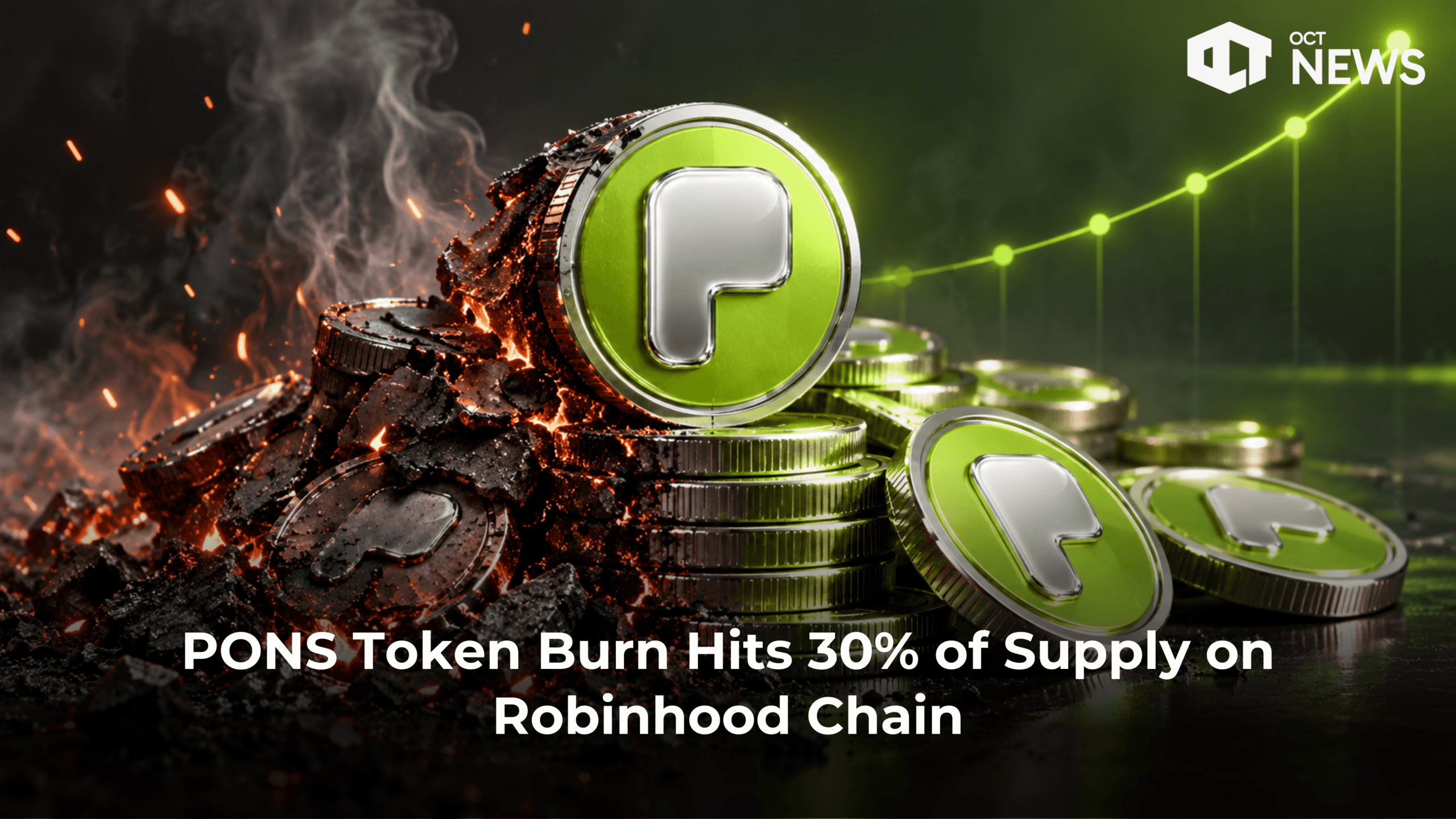
Pons has burned 30% of the $PONS supply, with 300 million tokens sent to a dead address as buybacks continue on Robinhood Chain.

Author: Akshat Thakur
8th September 2026 – The PONS token burn reached 30% of total supply on Monday, and on-chain data confirms it.
High Signal Summary For A Quick Glance

jussy
@jussy_world

@ponsdotfamily wtf, shit is happening so fast
30% of the total $PONS supply has now been burned. https://t.co/z9qdg66Pve
10:29 AM·Sep 8, 2026

Leon
@Leon_Defi
@ponsdotfamily 30 percent gone is mental. supply shock incoming?
30% of the total $PONS supply has now been burned. https://t.co/z9qdg66Pve
04:09 AM·Sep 8, 2026

Minaa
@minstrell_
@ponsdotfamily @0xAltKing More reason to build on pons.
30% of the total $PONS supply has now been burned. https://t.co/z9qdg66Pve
04:00 AM·Sep 8, 2026
High attention and emotional sentiment detected.
Pons posted the milestone at 03:43 UTC on September 8, 2026. Shortly after, the Robinhood Chain explorer showed 300,004,071 PONS sitting at the burn address, or exactly 30.00% of the 1 billion supply.
Pons is a non-custodial token launchpad on Robinhood Chain. Anyone can deploy a fixed-supply token there, and then trade it from their own wallet. Traders often call it the pump.fun of Robinhood.
The $PONS token is the launchpad’s own token, and not one of the tokens launched through it. So the 30% burn applies to $PONS itself. According to the official Pons account, 30% of the total $PONS supply has now been burned.
The claim is easy to check. The Blockscout token page shows a hard cap of 1,000,000,000 PONS. Meanwhile, the dead address 0x000000000000000000000000000000000000dEaD holds 300,004,071 tokens. That balance is the live proof behind the headline.
Burns are also still running. A community bot printed 300,672,657 PONS, or 30.1%, just hours later. As a result, the figure keeps climbing while fees keep flowing.
The PONS token burn is a buyback, and not a one-off manual event. Every trade on a Pons-launched token pays a 1% fee. Then part of that fee funds the burn.
According to the official Pons docs, current launches split the fee 70% to the creator and 30% to the protocol. Of the protocol’s cut, policy sends 80% to a time-weighted buyback of $PONS. Those bought tokens then go straight to the dead address.
Because the address cannot spend, the tokens leave circulation for good. So the effective float now sits near 700 million, down from 1 billion. Still, the docs are blunt about the limits. They state plainly that burning does not guarantee a higher price.
Pons went live around July 13, 2026, just days after Robinhood Chain mainnet on July 1. The founder, who posts as Ozzy on X, took control of the deployer fees that same day. He then said he would use WETH fees to buy back and burn $PONS.
The burn moved fast after that. By July 15, the team said 17.79% was already gone. Next came 22% on July 27, then 27% by August 11, and 29% by August 29.
From July 13 to September 8 is 57 days, or roughly eight weeks. So the run to 30% took about two months. During that stretch, launchpad fees turned Pons into one of crypto’s top fee generators.
Key milestones in Pons ($PONS) Launch & Burn Progress
Arbitrum Orbit L2 goes live with tokenized stocks and DeFi shipping the same day — establishing the ecosystem Pons will launch into.
Noxa halts new issuances; displaced flow begins migrating toward Pons.
Pons launchpad goes live on Robinhood Chain. Founder Ozzy (@MEADGod) takes fee control and commits WETH fees to buyback $PONS for burn.
First burn milestone confirmed: 17.79% of the 1B supply already gone within days of launch.
Price bottoms at $0.003317 on CoinGecko while buybacks continue in the background.
Official update confirms 22% of supply burned as buyback pressure continues post-ATL.
V2 upgrades the bonding curve to locked Uniswap v4 pools, improving liquidity structure for newly launched tokens.
Over 26% of supply burned; platform not yet a month old.
Treasury continues open-market buying; ~27% of supply confirmed burned.
“Nearly 30%” burned confirmed in month-one recap; 80% of protocol revenue has been directed to buybacks and burns.
Official update pins burn rate at 28.52% of total supply.
Burn continues its steady climb; official update confirms 29% of supply destroyed.
Official print at 29.34%; CoinDesk on-chain count confirms ~293M burned. Uniswap Labs publicly purchases $PONS.
Official account confirms 30% of total supply burned. Blockscout verifies 300,004,071 PONS at the dead address — exactly 30.00% of 1B, ~8 weeks after launch.
Despite the name, Pons is independent of Robinhood Markets. The launchpad simply uses Robinhood Chain as infrastructure. CoinDesk stated this point directly.
Robinhood Chain itself launched on July 1, 2026, as an Arbitrum Orbit Ethereum layer 2. It was built for tokenized stocks, USDG, and DeFi. Yet memecoin launchpads arrived almost immediately, and Pons captured most of that flow.
The interface is run by Pons Labs, LLC, and the founder stays pseudonymous. Robinhood CEO Vlad Tenev followed the founder’s account on July 21. That move is social attention, and not an official partnership.
The milestone did not spark a rally. Instead, $PONS fell roughly 16% to 19% on the day of the 30% post. So the burn itself was not a clean pump event.
The token still had a wild run overall. It hit an all-time low of $0.003317 on July 17, and then an all-time high of $0.971 on September 5. By September 8, it traded near $0.69, with a market cap around $490 million.
The late-August melt-up lined up with several catalysts at once. Those included Binance Wallet Alpha attention, a purchase by Uniswap Labs, and record fees on DefiLlama. Therefore the price move was never about the burn alone.
The 300 million at the dead address is real, and no serious analyst disputes it. Still, the harder questions are about durability, not the balance.
Because the burn depends on trading fees, it depends on launchpad volume. That volume runs on a two-month-old chain, and on a gas subsidy that tapers toward late September. So the burn rate could slow if activity cools.
Critics also flag two other points. First, some argue that a share of launch volume is wash traded, which inflates the fees that fuel the burn. Second, the 80% buyback split was a disclosed policy at first, and not immutable code. According to The Defiant, Uniswap Labs later bought $PONS for long-term alignment, though it did not disclose the size.
The next test is simple. If fees hold up, then the burn keeps grinding past 30%. If launchpad activity fades, then the buyback bid fades with it.
No official long-term target burn has been published. So the community treats the burn as an open-ended program that runs while volume lasts. For now, the on-chain record is clear, even as the debate over sustainability continues.
This article is for information only, and not financial advice. Always do your own research before trading any token.
Our Crypto Talk is committed to unbiased, transparent, and true reporting to the best of our knowledge. This news article aims to provide accurate information in a timely manner. However, we advise the readers to verify facts independently and consult a professional before making any decisions based on the content since our sources could be wrong too. Check our Terms and conditions for more info.