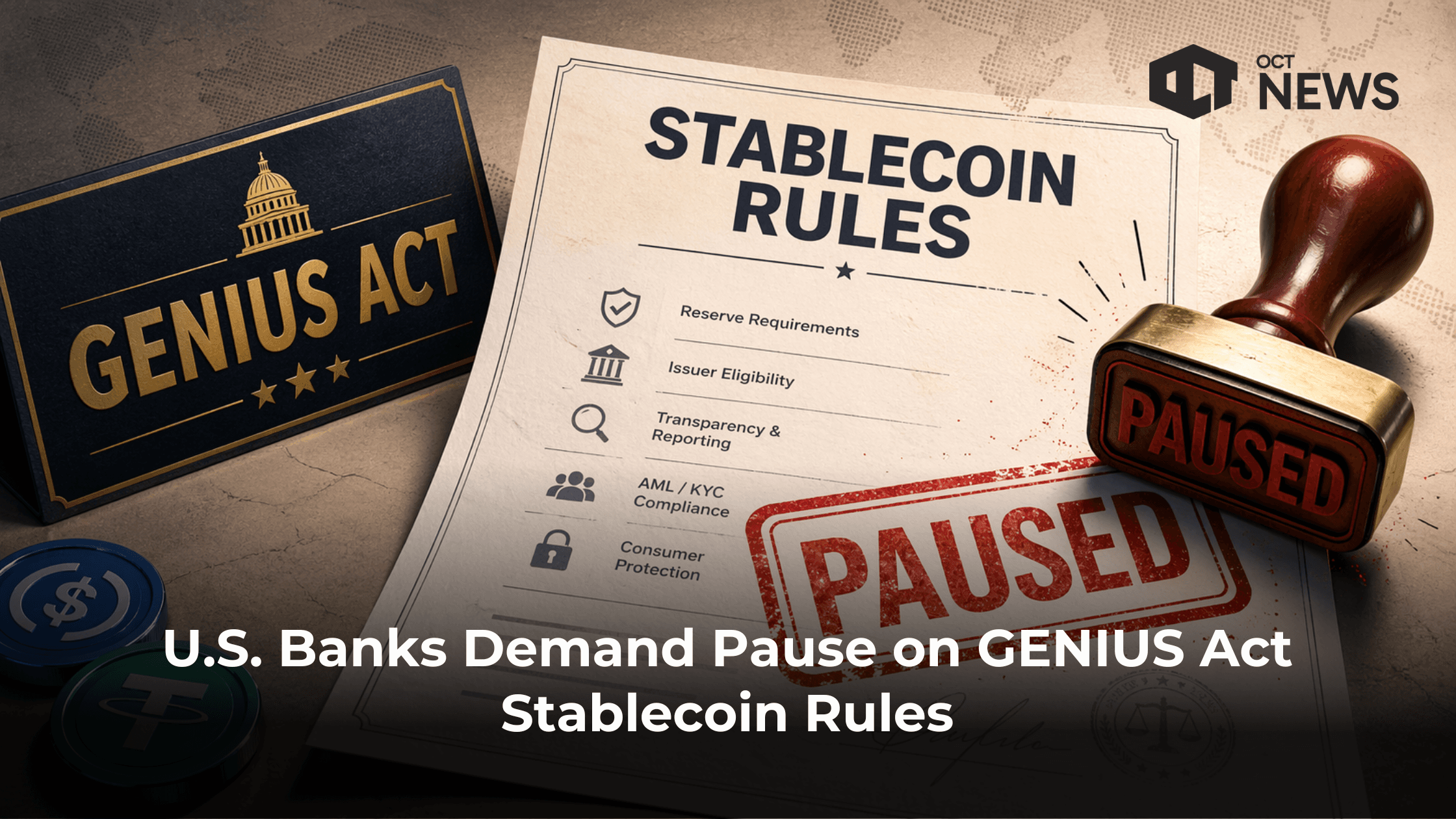
U.S. banks urge a pause on GENIUS Act stablecoin rules until OCC finalizes framework, citing overlapping regulations.

Author: Kritika Gupta
Steady attention without excessive speculation.
23rd April 2026- U.S. banks are pushing regulators to slow down the rollout of the GENIUS Act stablecoin rules, arguing that the current process is moving too quickly for meaningful review. A coalition of major banking groups has formally requested a pause on ongoing public comment periods until the Office of the Comptroller of the Currency finalizes its core framework for stablecoin issuers.
This request puts the implementation of the GENIUS Act stablecoin rules under scrutiny. While regulators aim to establish a comprehensive framework at speed, banks argue that overlapping proposals from multiple agencies create confusion and increase compliance risk. As a result, the industry is calling for a more coordinated regulatory timeline.
High Signal Summary For A Quick Glance

科技立委葛如鈞 Ko Ju-Chun
@dAAAb

U.S. banks are asking Treasury to hit the brakes on GENIUS Act stablecoin rules — demanding extended comment periods until the OCC finalizes its framework. 4 agencies, overlapping rules, tight 2027 deadline. When Taiwan passed the AI Basic Act, we learned: rushed regulation https://t.co/oijS2H0WOF

12:02 AM·Apr 23, 2026

Solix Trading
@Solix_Trade
Wall Street banks are suddenly “confused” about stablecoin rules. Now they want to slow down the GENIUS Act because regulators are moving too fast. Let’s be honest. When crypto moves fast, they call it reckless. When regulators move fast, they call it complicated. This isn’t
06:13 PM·Apr 22, 2026
This issue stems from how regulators rolled out the GENIUS Act framework. The law, passed on July 18, 2025, established the first comprehensive federal regime for payment stablecoins. It defined who can issue stablecoins, required 100% reserve backing in high-quality liquid assets, and imposed strict AML and sanctions compliance. In addition, it introduced redemption standards and consumer protections designed to align stablecoins more closely with traditional financial safeguards.
However, the rulemaking process has unfolded in parallel rather than sequentially. The OCC published its proposed rule in late February 2026, positioning it as the foundational blueprint. Shortly after, the FDIC released its own proposal on April 7, followed by AML-focused rules from FinCEN and OFAC on April 8. Banks now argue that these later proposals depend directly on OCC definitions, including what qualifies as permissible activity and how reserves must be structured. Therefore, they claim meaningful feedback is not possible without clarity from the OCC first.
This type of request is not unusual in U.S. financial regulation. Agencies often extend or pause comment periods when multiple frameworks overlap. For example, regulators extended the 2023 large-bank capital proposal after industry groups requested more time for analysis. Similarly, in early 2025, banking associations pushed for a pause on pending regulatory actions during an administrative transition. These precedents show that extensions typically improve rule quality rather than disrupt timelines.
Banking trade groups, including the American Bankers Association and the Bank Policy Institute, have described the current timelines as unworkable. They argue that banks play a central role in stablecoin infrastructure, particularly as custodians of reserves. Therefore, they need sufficient time to evaluate compliance costs, operational risks, and competitive dynamics with nonbank issuers.
At the same time, crypto industry participants have taken a more measured stance. They broadly support the GENIUS Act’s objective of expanding regulated, dollar-backed stablecoins. However, they warn that rushed implementation could create compliance gaps or unintended constraints. As a result, many prefer a coordinated approach that ensures consistency across agencies.
If regulators grant the extension, the final rulemaking timeline could shift closer to the GENIUS Act’s statutory deadline of January 18, 2027, or 120 days after final rules are issued. In the short term, this would delay clarity. However, it would also allow for more comprehensive industry input, which could strengthen the final framework.
From a market perspective, such pauses have historically had limited negative impact. In fact, previous delays in crypto-related regulation often supported sentiment by signaling a more deliberate and structured approach. Therefore, a coordinated timeline could ultimately boost confidence in U.S.-regulated stablecoins.
At the same time, prolonged uncertainty carries risks. Nonbank issuers may delay applications, and innovation pipelines could slow as companies wait for clearer guidelines. Consequently, regulators face a trade-off between speed and precision.
Our Crypto Talk is committed to unbiased, transparent, and true reporting to the best of our knowledge. This news article aims to provide accurate information in a timely manner. However, we advise the readers to verify facts independently and consult a professional before making any decisions based on the content since our sources could be wrong too. Check our Terms and conditions for more info.