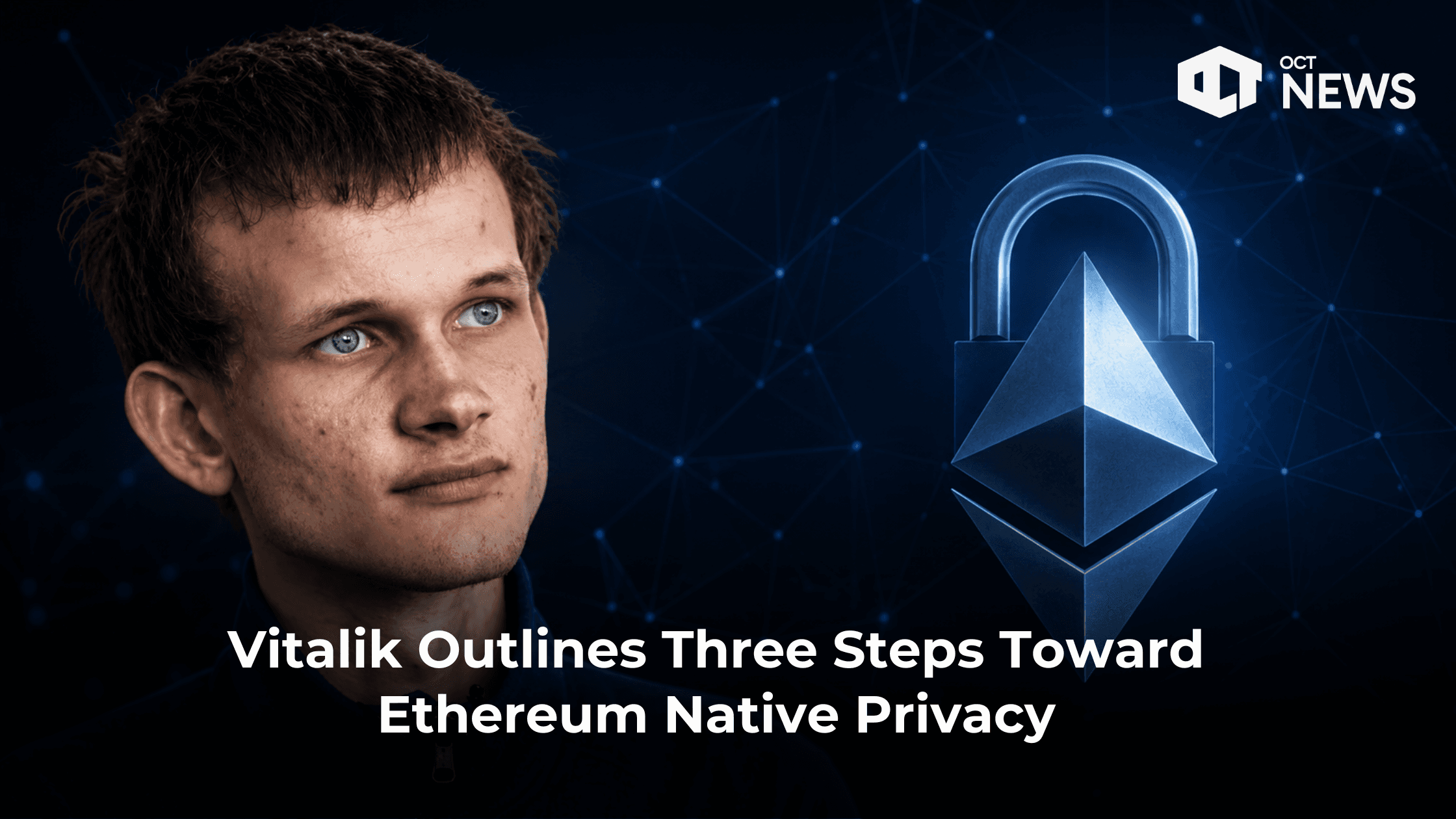
Ethereum privacy upgrades gain focus as Vitalik Buterin highlights AA, FOCIL, keyed nonces, Kohaku and private reads for native privacy.

Author: Kritika Gupta
20th May 2026- Vitalik Buterin on May 20, 2026 outlined three upgrades aimed at making Ethereum native privacy practical. None require a major protocol overhaul. The Ethereum co-founder posted the update on X. He listed three pillars: Account Abstraction paired with FOCIL, keyed nonces via EIP-8250, and access-layer work through the Kohaku SDK. Two of the three target the Hegota upgrade, expected in late 2026.
High Signal Summary For A Quick Glance

Pxsone
@pxsone

@VitalikButerin Day 30. Privacy on Ethereum is a big deal, and without it many use cases (payments, DeFi) are less viable for regular people. Native privacy could unlock real adoption. Thanks for the summary even if Vitalik's technical threads are still above my level, but I'm following along.
Short-term things being done to shift Ethereum toward native privacy: * AA + FOCIL (makes privacy protocol txs, among many other things, first-class with strong inclusion guarantees) * Keyed nonces: https://t.co/BeTJvFhxiV * Access-layer work (Kohaku, private reads...) https://t.co/MImWVYXBQv
07:58 AM·May 20, 2026

Tsubasa
@tsubasaxx86
@VitalikButerin Bonding curves on ETH just got more interesting. When private txs become first-class: curve buys become unlinkable, wallet identity detaches from launch activity, MEV on entries gets harder. https://t.co/2ohoCxRUlU is already sitting on Uniswap V4 hooks. The architecture is
Short-term things being done to shift Ethereum toward native privacy: * AA + FOCIL (makes privacy protocol txs, among many other things, first-class with strong inclusion guarantees) * Keyed nonces: https://t.co/BeTJvFhxiV * Access-layer work (Kohaku, private reads...) https://t.co/MImWVYXBQv
07:12 AM·May 20, 2026

Gor
@soltokenizer
@VitalikButerin AA + FOCIL finally making privacy txs first-class is the cleanest path to strong inclusion without full mempool encryption. Keyed nonces + access-layer work (Kohaku/private reads) close the remaining side-channel gaps elegantly. Do you see this stack naturally converging toward
Short-term things being done to shift Ethereum toward native privacy: * AA + FOCIL (makes privacy protocol txs, among many other things, first-class with strong inclusion guarantees) * Keyed nonces: https://t.co/BeTJvFhxiV * Access-layer work (Kohaku, private reads...) https://t.co/MImWVYXBQv
07:01 AM·May 20, 2026
Steady attention without excessive speculation.
The first pillar combines Account Abstraction with Fork-Choice Enforced Inclusion Lists. Account Abstraction, via EIP-8141 (Frame Transactions), makes smart-contract wallets first-class citizens. As a result, privacy transactions no longer need fragile relay infrastructure.
FOCIL (EIP-7805) adds censorship resistance. A rotating committee of roughly 16 validators per slot publishes inclusion lists. Attesters then reject any block that ignores valid listed transactions. Together, these two proposals guarantee rapid inclusion in one to two slots, even under active censorship.
Vitalik highlighted the synergy in a February 2026 post. “With FOCIL and 8141 together, anything can be included onchain through one of 17 different actors,” he wrote. That includes smart wallet, gas-sponsored, and privacy protocol transactions. “This gives us guaranteed rapid inclusion.”
The context matters. After the 2022 Tornado Cash sanctions, over 70% of Ethereum blocks briefly censored sanctioned transactions, according to MEV Watch data. FOCIL directly addresses that vulnerability by distributing inclusion power across a committee rather than trusting a single block builder.
The second pillar is EIP-8250, proposed on May 5, 2026. Its authors include Thomas Thiery, Toni Wahrstätter, lightclient, and Vitalik Buterin. The proposal replaces the single linear nonce with a pair: a nonce key and a nonce sequence.
This change targets a specific problem in privacy protocols. Protocols like Railgun route many users through a shared contract address. With a single nonce, one delayed transaction blocks every subsequent one from the same sender. In contrast, keyed nonces create independent lanes, so each withdrawal or transfer proceeds without waiting.
Ethereum’s Privacy Stack: Before vs. After
The third pillar operates at the access layer. Kohaku is an Ethereum Foundation-backed open-source SDK for privacy-first wallet infrastructure. The Foundation publicly unveiled it at Devcon in November 2025.
Kohaku bundles several privacy features into one framework. It supports private sends and receives through Railgun and Privacy Pools. It also includes stealth addresses and social recovery.
The most novel feature is private reads. Right now, every balance check or contract query leaks metadata to the RPC provider. Kohaku uses Oblivious RAM, Trusted Execution Environments, and Private Information Retrieval to fix this. As a result, the RPC never learns what data the user requested.
Unlike FOCIL and keyed nonces, Kohaku does not require a hard fork. Production-ready packages are already available as of May 2026, and wallet developers can integrate the SDK today.
The protocol-level changes all target the Hegota hard fork. It is currently expected in the second half of 2026. However, no exact activation date has been set, and Ethereum upgrades have historically faced delays.
If the upgrade ships on schedule, Ethereum gains three things at once: censorship-resistant inclusion, concurrent privacy transactions, and wallet-level tooling. That would mark the most significant Ethereum native privacy improvement since launch.
The approach differs sharply from privacy chains like Aztec. Those projects offer full default privacy but require users to move to a separate network. Ethereum’s strategy is incremental. It layers privacy into existing infrastructure and bets on network effects over starting from scratch.
Key milestones related to Ethereum’s privacy evolution
The U.S. sanctions on Tornado Cash put Ethereum privacy tools under regulatory pressure and forced the ecosystem to rethink privacy, compliance, and censorship resistance.
Vitalik Buterin outlined stealth addresses as a way for users to receive assets privately without exposing their main wallet activity on-chain.
Vitalik published a broader privacy roadmap, framing privacy as a core Ethereum usability and security requirement rather than a niche feature.
EIP-7702 and the Pectra upgrade improved wallet flexibility, helping lay the groundwork for more advanced and private transaction flows.
Fork-Choice Enforced Inclusion Lists advanced as a mechanism to reduce the ability of block builders or validators to exclude transactions.
The keyed nonces EIP introduced another account-abstraction building block for parallel transaction flows and more advanced wallet behavior.
Work on Kohaku and private read infrastructure targeted safer wallet queries, app interactions, and user data access across Ethereum applications.
Vitalik’s latest comments tied together stealth addresses, private reads, censorship resistance, and account-abstraction progress into a clearer privacy endgame.
Not everyone is convinced. Privacy maximalists argue that Ethereum’s incremental approach will never match dedicated privacy chains, where all transactions are shielded by default. On Ethereum, privacy remains opt-in, which limits its effectiveness because the anonymity set is smaller.
Regulatory concerns persist as well. Stronger privacy tools could reignite scrutiny from regulators who targeted Tornado Cash in 2022. Privacy Pools let users prove their funds are not from sanctioned sources. However, that compliance approach has not been tested in court.
Some researchers have also raised concerns about FOCIL’s attack surface. A well-funded actor could theoretically bribe committee members to exclude rather than include transactions. While the committee’s rotating composition makes sustained attacks difficult, the risk is an open research question.
Vitalik’s tweet serves as a progress report on a strategy first outlined over a year ago. The three pillars target different layers of the stack. FOCIL handles inclusion, keyed nonces handle concurrency, and Kohaku handles metadata protection.
Wallet developers can start building with Kohaku today. Protocol developers are refining FOCIL and EIP-8250 for Hegota. The community reaction on X has been overwhelmingly positive, with developers praising the “privacy as first-class citizen” framing.
The real test comes when Hegota ships. Until then, Ethereum native privacy remains a work in progress, with the most critical pieces still months from mainnet deployment.
Our Crypto Talk is committed to unbiased, transparent, and true reporting to the best of our knowledge. This news article aims to provide accurate information in a timely manner. However, we advise the readers to verify facts independently and consult a professional before making any decisions based on the content since our sources could be wrong too. Check our Terms and conditions for more info.



Ethereum