EDGE, the native token of decentralized perpetuals exchange edgeX, crashed 46.8% in a single 4-hour candle on June 1.

Author: Sahil Thakur
High attention and emotional sentiment detected.
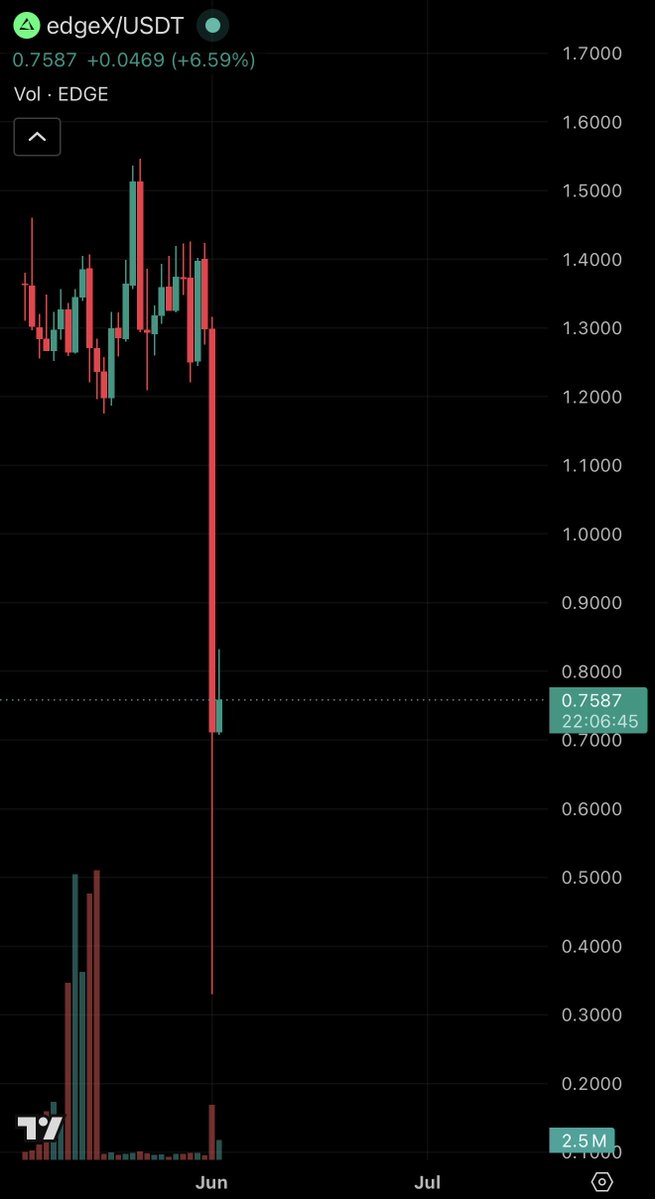
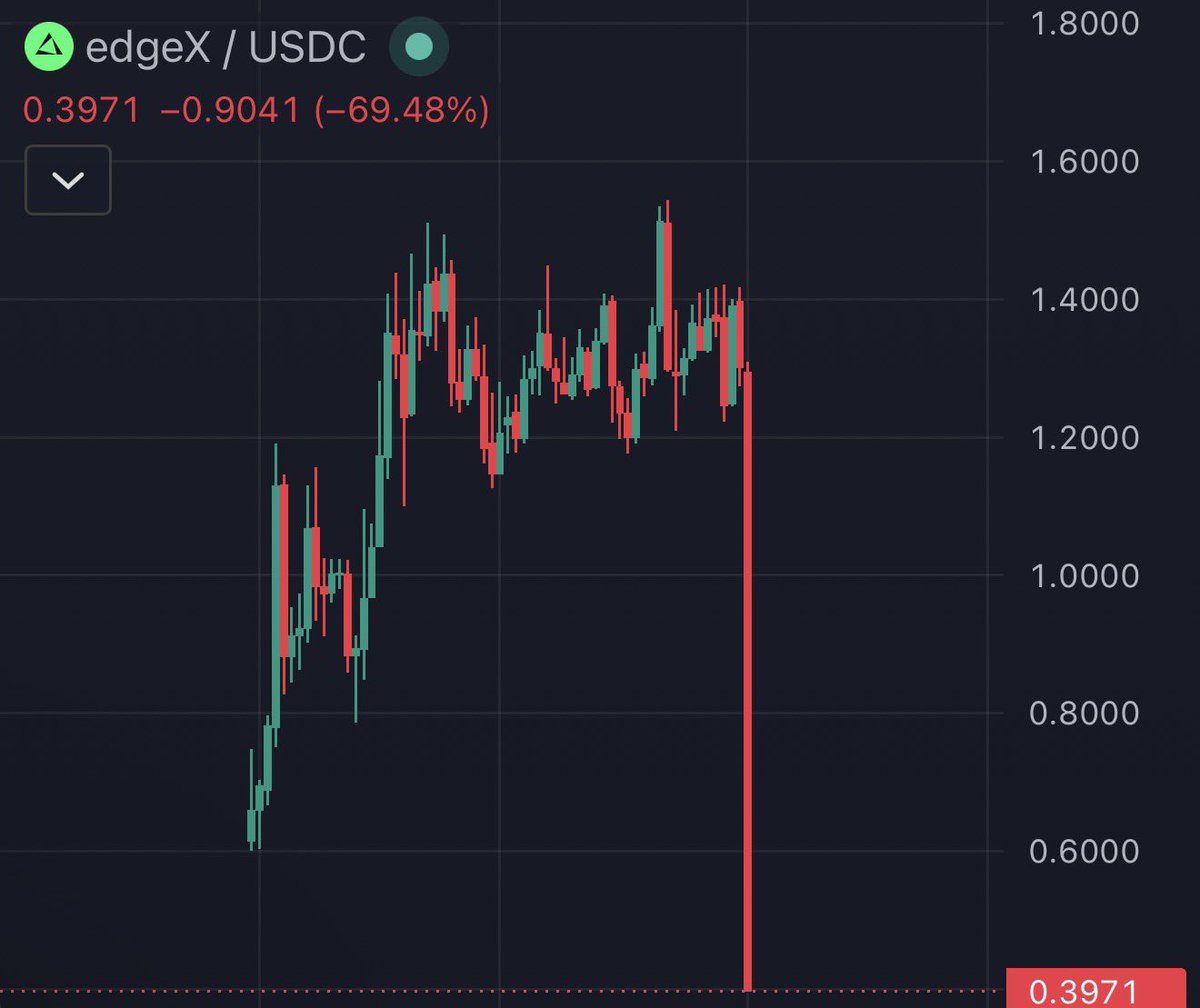
2nd June 2026 – EDGE, the native token of decentralized perpetuals exchange edgeX, crashed 46.8% in a single 4-hour candle on June 1. As a result, the token dropped from $1.14 to $0.61, with a wick low near $0.32, before rebounding to roughly $0.80.
High Signal Summary For A Quick Glance
The move triggered approximately $2.81 million in liquidations during the peak hour alone, according to Coinglass. Specifically, long positions accounted for $1.96 million of that total. Meanwhile, some sources reported up to $5 million in total liquidations across the four-hour window.
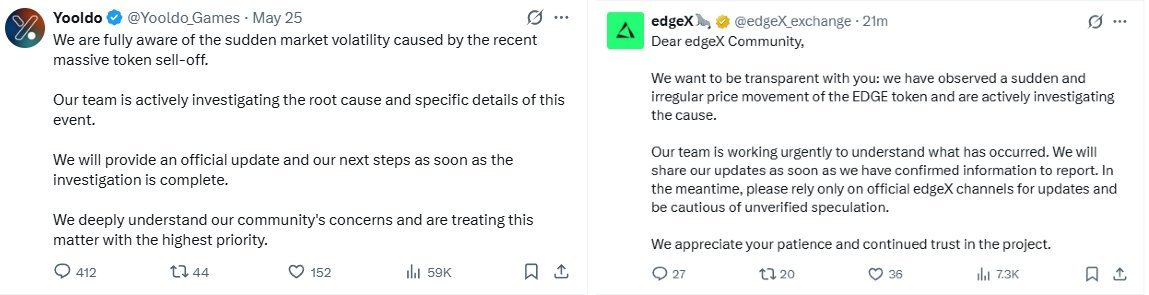
The edgeX team responded within hours. In a statement posted on X, the team said it observed “sudden and irregular price movement” and launched an active investigation.
According to Binance market data cited by Wu Blockchain, the EDGE flash crash began around 21:00 UTC on June 1. The 4-hour candle closed at $0.6115, consequently marking a 46.8% decline from the open at $1.1424.
The wick reached as low as $0.32 before buy pressure returned. By early June 2, the price had recovered to the $0.75-$0.84 range. Even so, the 24-hour change still sat between -41% and -45%.
In addition, trading volume spiked sharply. Sources reported 24-hour volume between $14 million and $88 million depending on exchange aggregation. In turn, market capitalization fell from over $450 million to roughly $249 million based on a circulating supply of 350 million tokens.
EDGE had thin order-book depth and high open interest relative to its market cap. Because of this, a large sell order on centralized exchanges removed bids and triggered a cascade of long liquidations.
Liquidation engines then automatically sold collateral into an already-thin book. That pushed the price lower and forced more liquidations. As a result, a feedback loop drove the token from $1.14 to $0.32 in under two hours.
Meanwhile, market makers appear to have pulled bids during the sell-off, creating what traders call a “liquidity vacuum.” Once forced selling ran out, short liquidations added minor upward pressure on the rebound. Importantly, no oracle failure or smart-contract exploit caused the move. Instead, this was a market-mechanics event amplified by leverage on thin liquidity.
The edgeX team posted its only public statement at 22:42 GMT on June 1. The full text read: “We want to be transparent with you: we have observed a sudden and irregular price movement of the EDGE token and are actively investigating the cause.”
The team also said: “We will share our updates as soon as we have confirmed information to report. In the meantime, please rely only on official edgeX channels for updates and be cautious of unverified speculation.”
So far, the team has not published a post-mortem or follow-up. The investigation remains ongoing as of June 2.
Community analysts using Arkham-tagged data noted coordinated outflows from wallets linked to Bybit, OKX, Bitget, and Gate.io around the time of the crash. Separately, roughly $1.6 million reportedly moved from a SpotVault-related address to multiple new wallets tagged as exchange accounts.
In response, the edgeX team addressed one flagged address, calling it their official spot contract. Still, no analyst has publicly identified a large single-wallet dump or exploit signature on Etherscan.
Additionally, DEX liquidity for EDGE on Uniswap was thin relative to the CEX-driven price action. Because of that, the crash played out primarily on centralized venues, with Binance as the key exchange.
edgeX is a high-performance perp DEX incubated by Amber Group. It launched V1 in late 2024 and subsequently grew into a top-three perp DEX by trading volume. The platform recently upgraded to V2, which now runs on EDGE Chain, a proprietary layer built on Arbitrum Orbit.
The EDGE token launched via TGE and airdrop on March 31, 2026. That launch faced early criticism after the team temporarily closed comments on X. Also, community members alleged whale-favoring allocations. In response, edgeX locked 140 million EDGE, roughly 14% of the total supply, for one year.
Before the crash, EDGE traded between $1.20 and $1.40. It reached an all-time high of $1.54 on May 21, 2026. Notably, no token unlocks, governance votes, or delistings preceded the June 1 event.
The dominant sentiment on X was shock and frustration. For instance, many traders described the EDGE flash crash as a “textbook liquidity hunt.” One trader wrote: “We saw it in the order flow. $EDGE was a textbook cabal coin: pump the price, build a wall of trapped longs, then nuke it to harvest the liquidations.”
Similarly, another trader posted: “The team tried to Crime it up with their centralized supply but ran out of fuel.” Of course, these claims remain unverified speculation.
On top of that, retail holders expressed frustration at losing money on a token promoted through edgeX’s “Trade to Own” campaign. The prior TGE backlash and the absence of a submitted audit on the token contract also added to the distrust.
Adding more spice to the event was ZachXBT who mentioned that edgeX supply was being controlled by a few insiders with a low float.
Several key questions are still unanswered. First, no one has identified the precise trigger wallet or wallets behind the initial sell pressure. Whether the move was a whale dump, market-maker rebalancing, coordinated sell, or insider activity also remains unknown.
Furthermore, the team has neither confirmed nor denied whether team-linked wallets participated in the selling, beyond the single spot-contract clarification. The full root cause still remains pending.
Likewise, no major exchange has issued a statement about the crash. No tier-1 media outlet has published coverage at the time of writing, either.
The edgeX team now faces a critical trust test. Specifically, the community expects a detailed post-mortem that identifies what triggered the crash and whether insiders played a role. A transparent report could therefore help rebuild credibility after the TGE backlash.
Currently, EDGE trades near $0.80, down more than 40% from pre-crash levels. The token’s 100% fee-buyback mechanism and V2 upgrade narrative remain intact. Still, neither will matter much if holder confidence continues to erode.
This is not financial advice. Traders should exercise caution and conduct their own research before making any decisions related to EDGE or edgeX.
Our Crypto Talk is committed to unbiased, transparent, and true reporting to the best of our knowledge. This news article aims to provide accurate information in a timely manner. However, we advise the readers to verify facts independently and consult a professional before making any decisions based on the content since our sources could be wrong too. Check our Terms and conditions for more info.


ZachXBT
@zachxbt

@edgeX_exchange We all know edgeX supply was being controlled by a few insiders with a low float. If you care about transparency at all you will name the counterparties / MM agreements which lead to these events. https://t.co/qn2LvNPg2H
Dear edgeX Community, We want to be transparent with you: we have observed a sudden and irregular price movement of the EDGE token and are actively investigating the cause. Our team is working urgently to understand what has occurred. We will share our updates as soon as we
01:55 AM·Jun 2, 2026

giveno
@givenoxbt
tl;dr; < $EDGE> $EGDE just got the market maker farewell treatment down 70% in under an hour. no hack. no exploit. just vibes what onchain data shows: - coordinated outflows from Bybit, OKX, Bitget and Gate simultaneously - $1.6M liquidity pulled from the SpotVault - tokens https://t.co/C1CyzyPji2 https://t.co/kwiAVPy1BT
Dear edgeX Community, We want to be transparent with you: we have observed a sudden and irregular price movement of the EDGE token and are actively investigating the cause. Our team is working urgently to understand what has occurred. We will share our updates as soon as we
11:53 PM·Jun 1, 2026

Ethan
@0xEthan
$EDGE Just got rugged Over $1B of value lost in hours as the exchange seems to have been hacked https://t.co/ZjeBxWgm48
09:59 PM·Jun 1, 2026