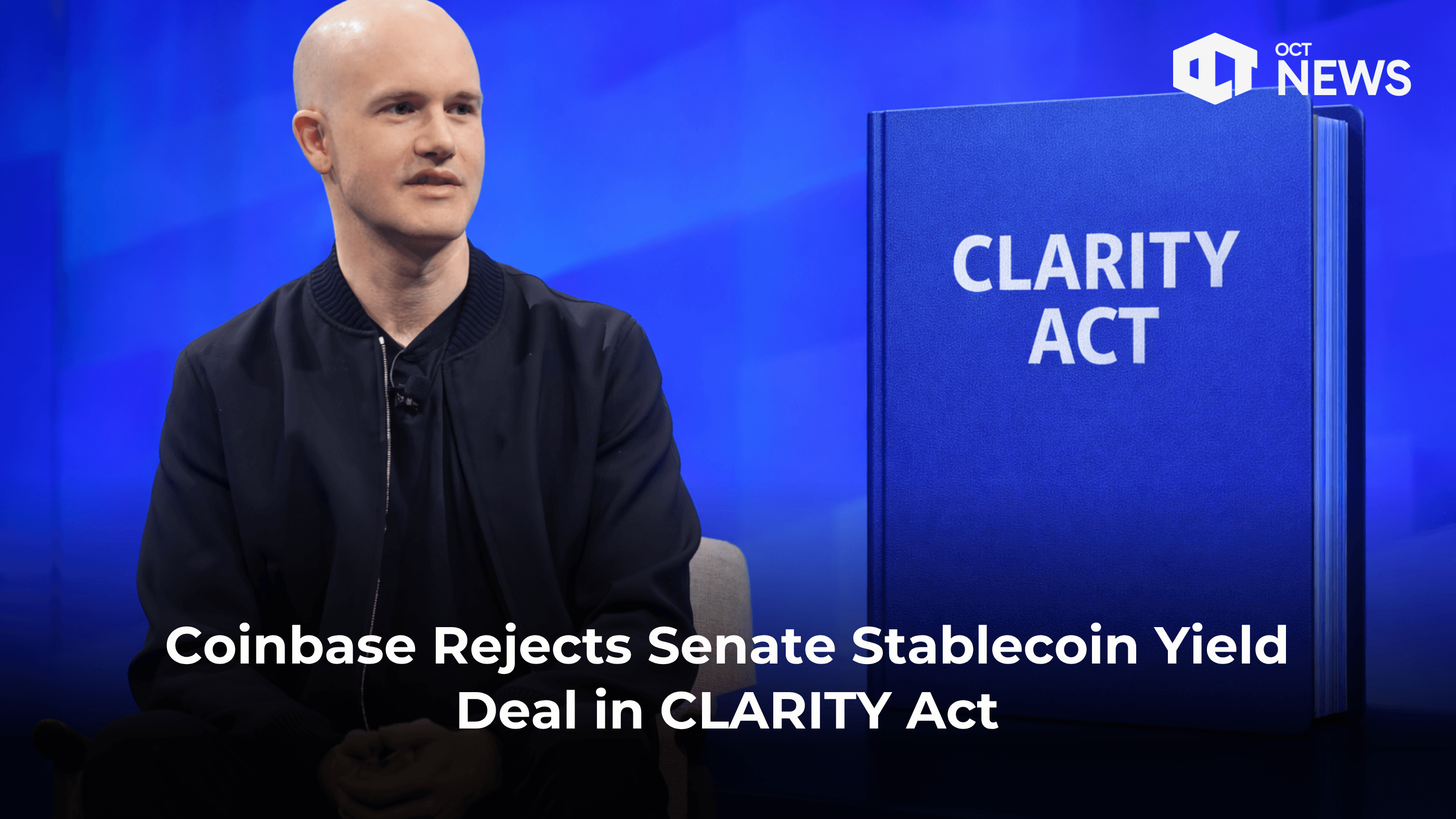
Coinbase has rejected the latest Senate compromise on stablecoin yields in the CLARITY Act for the second time in three months.

Author: Sahil Thakur
26th March 2026 – Coinbase has rejected the latest Senate compromise on stablecoin yields in the CLARITY Act, stalling the most important U.S. crypto market-structure bill for the second time in three months.
High Signal Summary For A Quick Glance

🇬🇧 ChartNerd 📊
@ChartNerdTA

🏛 #CLARITY UPDATE: Coinbase told Senate officials this week that it "COULD NOT" support the latest version of a Stablecoin Yield Compromise. https://t.co/5iudzlvJEC https://t.co/rHA97xroO6
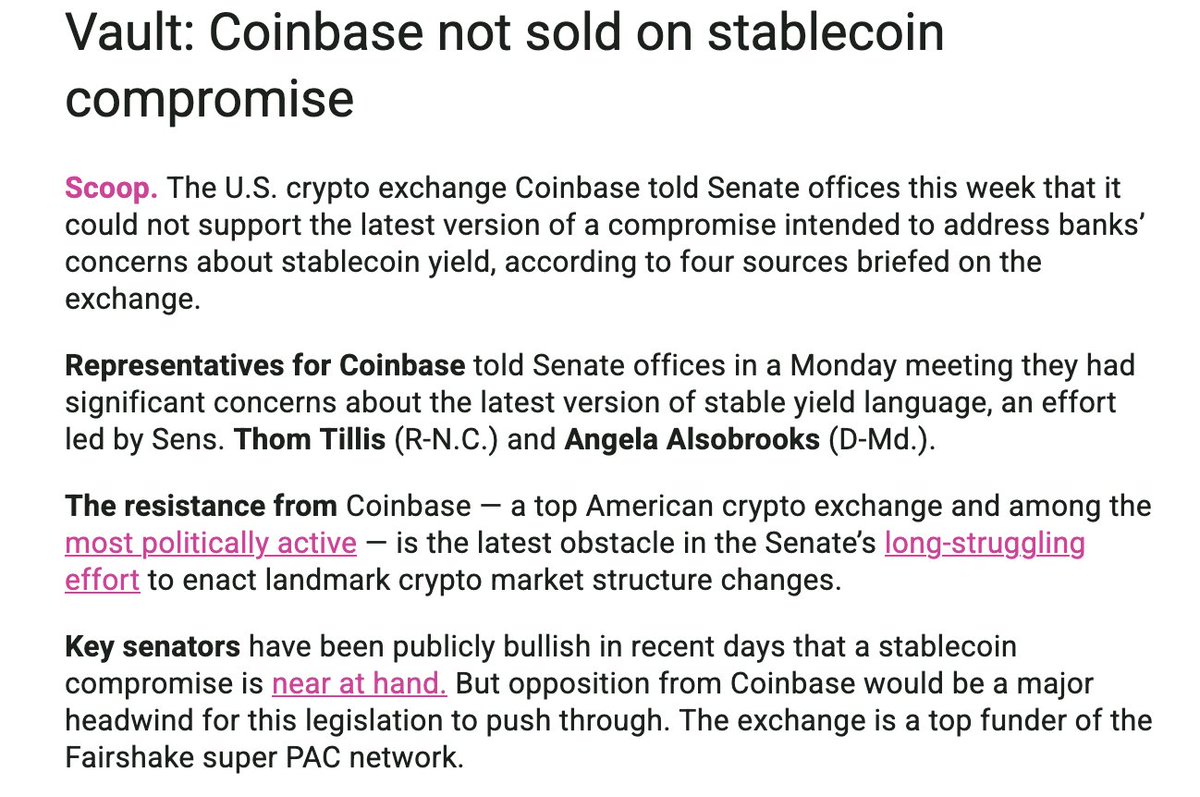
Coinbase still isn't onboard... 👀 https://t.co/OhXfoFeLvP https://t.co/F8sqpEo2rN
07:55 PM·Mar 25, 2026

Diana
@InvestWithD
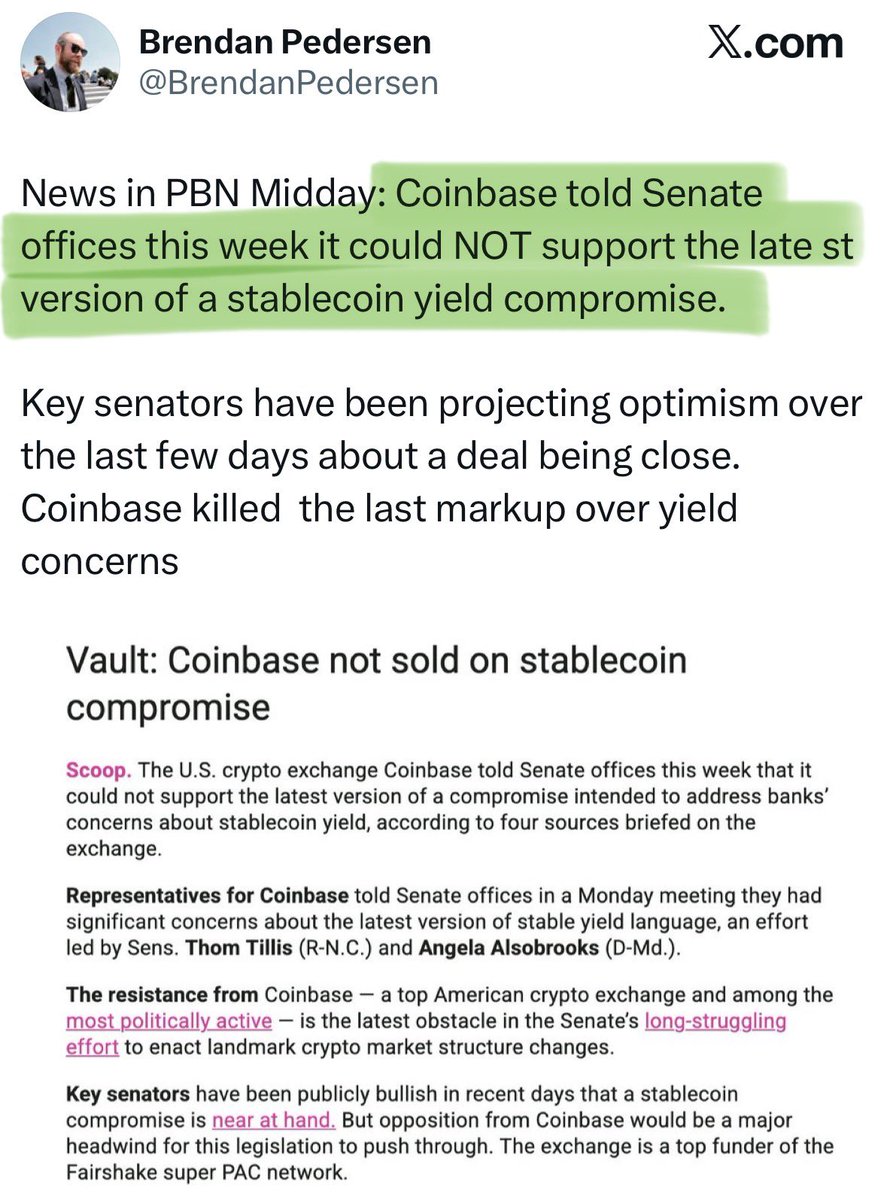
🚨UPDATE: COINBASE TOLD SENATE OFFICES IT COULD NOT SUPPORT THE LATEST CLARITY ACT COMPROMISE 🤯🇺🇸 New reporting says @Coinbase told Senate offices this week it could NOT SUPPORT the latest version of the stablecoin yield compromise inside the CLARITY Act. 👀 According to the https://t.co/kIEsyjcnFB https://t.co/4x5NwhG4Hb
🚨UPDATE: CLARITY Act Draft Text Is Expected TO BE RELEASED TODAY 🤯🇺🇸 A select group of CRYPTO industry leaders as well as BANKING representatives REVIEWED the latest CLARITY Act compromise text after being invited to Capitol Hill for 30-minute meetings to read the draft and https://t.co/RlIG2MlEax https://t.co/Y7IvsagqxP
07:52 PM·Mar 25, 2026

Chad Steingraber
@ChadSteingraber
Coinbase still isn't onboard... 👀 https://t.co/OhXfoFeLvP https://t.co/F8sqpEo2rN
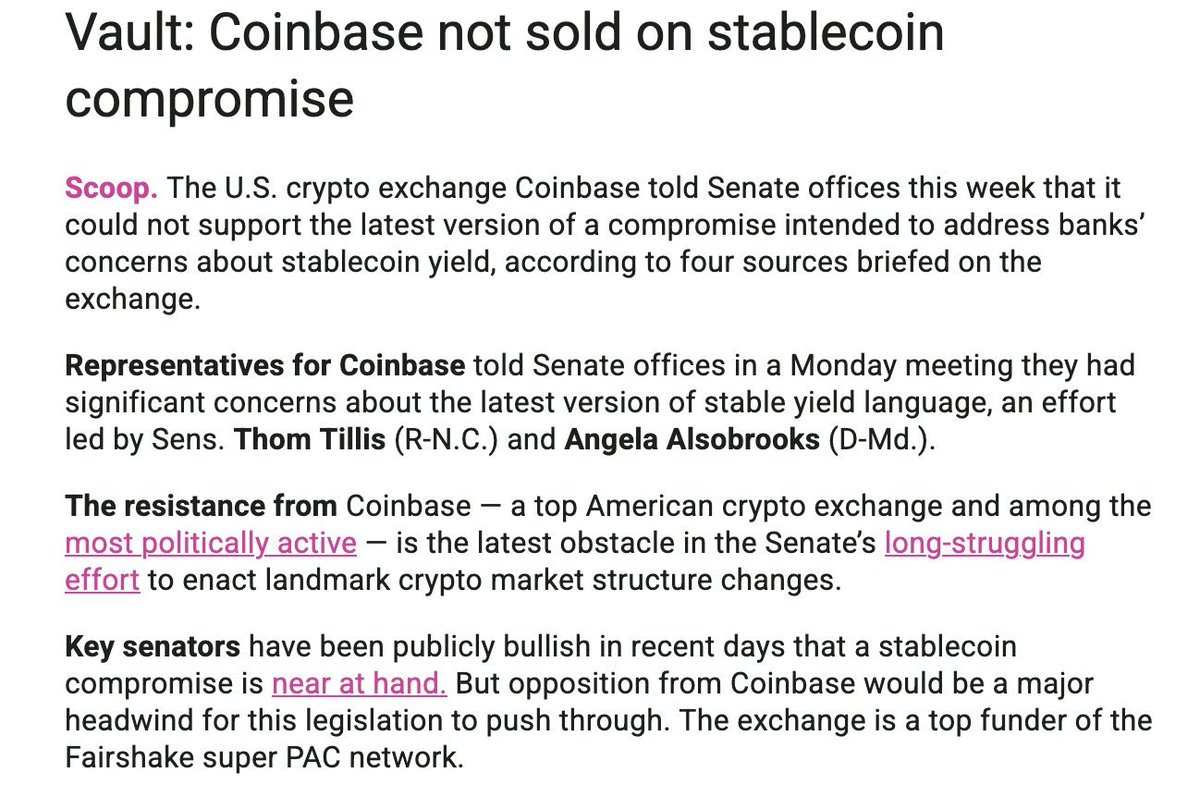
News in PBN Midday: Coinbase told Senate offices this week it could NOT support the late st version of a stablecoin yield compromise. Key senators have been projecting optimism over the last few days about a deal being close. Coinbase killed the last markup over yield concerns https://t.co/OopFDJ2K2x
07:07 PM·Mar 25, 2026
High attention and emotional sentiment detected.
The exchange told Senate offices it cannot support the revised provisions. According to reports from CryptoRank, Coinbase considers the new language overly restrictive. The company argues it tightens constraints on yield and reward programs while leaving unclear how activity-based or transaction-linked rewards would be classified.
This follows CEO Brian Armstrong’s January 2026 decision to withdraw support from an earlier version. That move forced the Senate Banking Committee to cancel a scheduled markup entirely.
The Digital Asset Market Clarity Act is the Senate’s comprehensive crypto market-structure bill. It covers CFTC and SEC jurisdiction over digital assets, intermediary rules, DeFi protocols, tokenized assets, and stablecoins.
A companion House bill, the Clarity for Payment Stablecoins Act, already passed. But the Senate version remains the bottleneck. The bill cleared the Senate Agriculture Committee yet still needs a Senate Banking Committee markup to advance.
Of all the provisions in the CLARITY Act, stablecoin yield has been the single biggest sticking point since early 2026.
Coinbase co-issues USDC with Circle. The exchange offers holders roughly 4% APY-style rewards on USDC balances. That yield comes from revenue-sharing with Circle, which earns interest on the USD reserves backing USDC.
This is not a small revenue line. Stablecoin-related income accounted for nearly 20% of Coinbase’s total revenue in Q3 2025, according to the company’s earnings reports. Any legislation restricting yield programs directly threatens that stream.
Coinbase has taken a clear position: “no bill is better than a bad bill.” The company argues stablecoin rewards drive adoption, innovation, and financial inclusion. In its view, banks should compete rather than lobby to block competition.
The banking lobby sees stablecoin yield as an existential threat. The American Bankers Association, JPMorgan, and Bank of America have pushed aggressively against any form of passive yield on stablecoins.
Their argument is straightforward. If platforms like Coinbase offer 4% returns on dollar-pegged stablecoins without FDIC insurance or banking regulation, depositors could flee traditional banks. One Treasury-related study reportedly estimated potential deposit losses of up to $6.6 trillion.
Banks have lobbied to ban not just direct yield but also any structure that is “economically or functionally equivalent” to bank interest. That includes indirect, activity-based, or transaction-linked rewards.
The earlier GENIUS Act banned stablecoin issuers from paying yield directly. But it left a loophole. Platforms and exchanges like Coinbase could still offer rewards or incentives on stablecoin holdings without violating the issuer ban.
Banks fought to close that gap. Negotiations involved multiple rounds of White House-brokered attempts at compromise. One proposal allowed limited yield tied to peer-to-peer payments or transaction activity while banning passive, idle-balance yield.
The latest amendment, linked to Sens. Tillis and Alsobrooks, went further. It tightened language to ban anything “economically or functionally equivalent” to bank interest. That sweeping definition could capture nearly all of Coinbase’s USDC reward programs.
Some crypto industry groups reportedly view this draft as “the best possible result.” But Coinbase disagrees. Its rejection, combined with the company’s January walkout, has stalled progress again.
Markets responded quickly. Coinbase stock (COIN) fell roughly 5% to 12% across recent sessions on the news. Circle’s stock (CRCL) dropped approximately 19% to 20% before a partial recovery.
Cathie Wood’s ARK Invest bought the Circle dip, adding shares during the sell-off. Meanwhile, prediction-market odds for the CLARITY Act passing in 2026 fell to around 61%, down roughly 10 points from recent highs.
Closed-door negotiations continue. Industry and bank representatives have held briefings, and more sessions are expected. No Senate Banking Committee markup date is currently set.
The Senate faces time pressure. Midterm elections later in 2026 compress the legislative calendar. Competing priorities also limit available floor time.
Several outcomes are possible. Senators could tweak the yield language to create clearer carve-outs for activity-based rewards, bringing Coinbase back on board. The bill could also advance with the current restrictive language, handing banks a win but risking continued industry pushback. A prolonged stall remains the most likely near-term scenario.
The yield fight ultimately comes down to one question. Will stablecoins stay simple payment tools, or will they evolve into competitive yield-bearing dollar alternatives? Coinbase’s rejection makes clear the company will not accept legislation that answers that question in the banks’ favor.
Our Crypto Talk is committed to unbiased, transparent, and true reporting to the best of our knowledge. This news article aims to provide accurate information in a timely manner. However, we advise the readers to verify facts independently and consult a professional before making any decisions based on the content since our sources could be wrong too. Check our Terms and conditions for more info.