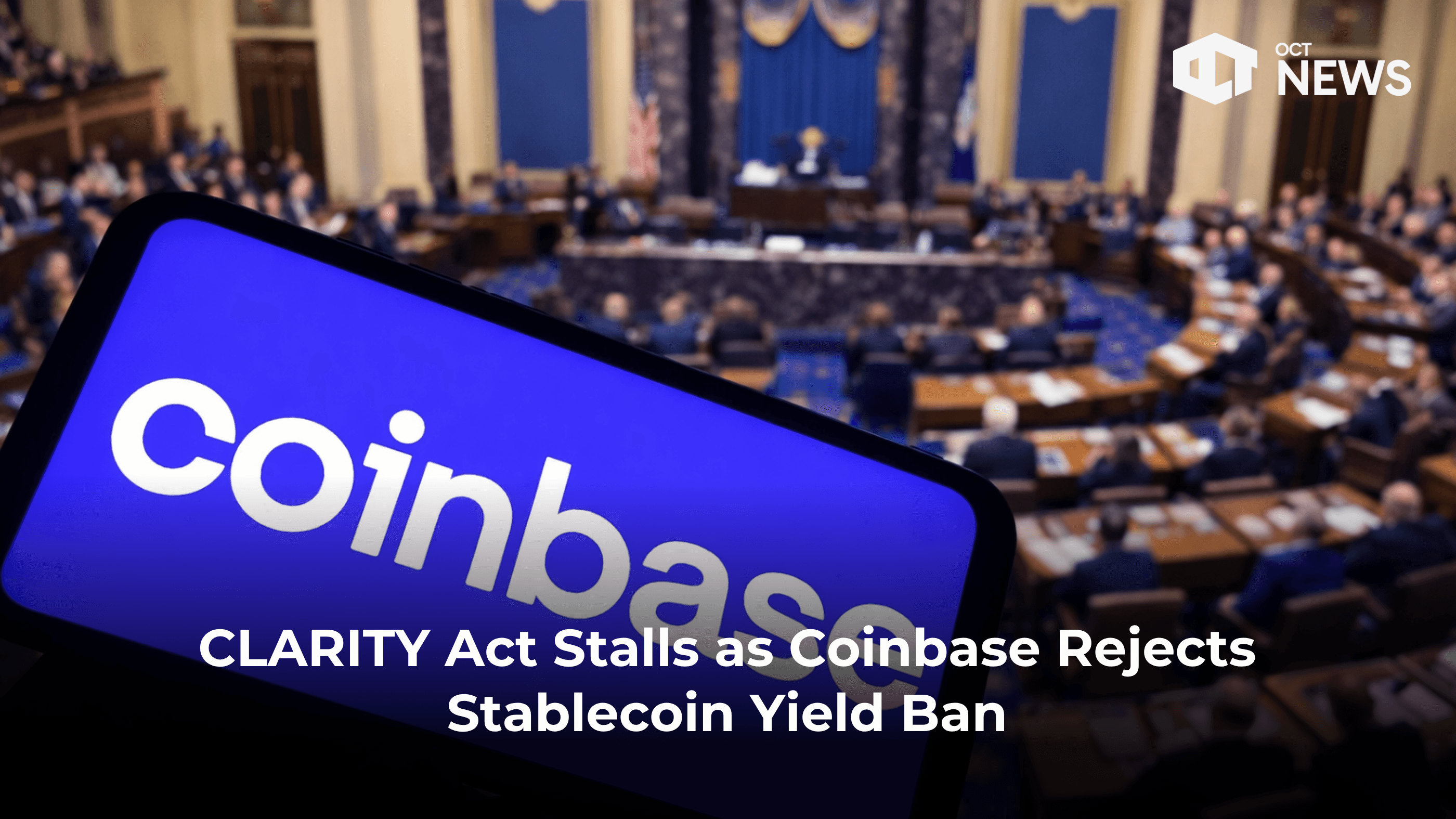
The CLARITY Act hit a major roadblock after Coinbase rejected the latest Senate draft over its yield restrictions for a second time.

Author: Sahil Thakur
30th March 2026 – The CLARITY Act hit a major roadblock after Coinbase rejected the latest Senate draft over its stablecoin yield restrictions for a second time.
High Signal Summary For A Quick Glance

Leader Alpha
@LeaderAlphaNews

🚨 HOLY SHIT CHARLES HOSKINSON JUST LOST HIS DAMN MIND OVER THE CLARITY ACT!! He’s SLAMMING the table, laughing like a madman, and ABSOLUTELY ROASTING Brad Garlinghouse to his face while the whole crypto world watches in shock! “THIS IS A HORRIFIC TRASH BILL, A DEATH TRAP FOR https://t.co/o4bNi5fH0v https://t.co/aHORYYOmKR

🚨 Charles Calls out #Ripple CEO Brad Garlinghouse "FUCK ALL OF US" This is NOT GOOD 🤯🤯🤯 $ADA $XRP https://t.co/VVtogQ4qqK https://t.co/1vQsHVibav
08:52 PM·Mar 29, 2026

Crypto Tice
@CryptoTice_
THE CLARITY ACT IS DONE. 🚨 Lummis just confirmed it. Text dropping NEXT WEEK. DeFi protected. Stablecoin yield unlocked. Institutional barriers gone. One bill. Every problem solved. Years of regulatory uncertainty. Ended. Next week. The text drops next week. https://t.co/2grVMOG0vV

11:04 AM·Mar 29, 2026
Steady attention without excessive speculation.
The Digital Asset Market Clarity Act of 2025 (H.R. 3633) passed the House in July 2025. It received strong bipartisan support at 294-134. The bill aims to replace years of “regulation-by-enforcement” with a clear statutory framework for crypto.
Yet its path through the Senate has stalled over one issue. That issue is whether crypto platforms can pay yield on stablecoin balances.
On March 20, Senators Thom Tillis (R-NC) and Angela Alsobrooks (D-MD) announced a deal. They reached an “agreement in principle” with White House backing on the stablecoin yield language. The compromise bans passive yield on holdings while allowing activity-based rewards.
Within days, however, the compromise collapsed. According to CoinDesk, Coinbase told Senate offices it could not support the latest text. It was the second time the exchange withdrew backing, after a similar move in January 2026.
Stablecoin yield is central to Coinbase’s business. The exchange earned roughly $1.35 billion from stablecoin-related revenue in 2025, according to CoinDesk. That represented about 19% of total revenue in Q3 2025.
The latest draft would ban passive yield on USDC, USDT, and other dollar-pegged tokens. It would also restrict any structure “economically equivalent to interest.” As a result, analysts estimate the provision could strip Coinbase of roughly $800 million per year.
Coinbase CEO Brian Armstrong previously called earlier drafts “clearly worse than the status quo.” On an industry call this week, Coinbase clashed with other firms over how to respond, CoinDesk reported.
The fallout hit Circle even harder. On March 24, Circle (CRCL) stock fell 20% in its worst session on record, according to CNBC. That single drop wiped $5.6 billion in market value.
Circle had rallied 170% since early February. Still, the crash came swiftly after the CLARITY Act stablecoin yield ban language leaked publicly. USDC is the second-largest stablecoin by market cap, and the yield restrictions threaten a key driver of its adoption.
Some analysts believe the selloff is overdone, though. Bitwise CIO projected Circle could still reach a $75 billion valuation by 2030. He argued that stablecoin demand runs more on payments and settlement than yield alone.
The CLARITY Act stablecoin yield debate comes down to a clash between traditional banks and crypto platforms.
JPMorgan, Bank of America, and Wells Fargo lobbied hard for the ban. Their fear is deposit flight. If crypto platforms pay yield on stablecoin balances, depositors could pull money out of bank accounts. Standard Chartered analysts estimate that could redirect up to $500 billion by 2028.
On the other side, Coinbase, Circle, a16z, and Ripple argue the opposite. They say stablecoin yield is a core product feature. Banning passive returns would cripple utility and hurt U.S. competitiveness, they argue. In response, crypto firms are preparing a counter-proposal on reserve-yield sharing.
Senator Alsobrooks told reporters the compromise was designed to “protect innovation” while preventing deposit flight. Nevertheless, the crypto industry views the language as too bank-friendly.
Coinbase vs banks in context of the CLARITY Act
Not everyone in crypto agrees with Coinbase’s position. According to CoinPedia, the industry has split into two camps.
One group wants to accept the deal and push the bill forward. They argue that passing comprehensive legislation matters more than any single provision. In their view, the risk of losing the entire bill outweighs the yield-ban cost.
The other camp, led by Coinbase, calls the restrictions unacceptable. They believe the current language lets banks dictate crypto product design through law.
This divide reflects business models more than ideology, CoinDesk noted. Companies with heavy yield revenue have the most to lose. Those focused on trading or custody have less at stake here.
Beyond the yield fight, the CLARITY Act would reshape U.S. crypto regulation entirely.
The bill draws a clear line between the SEC and CFTC. Digital commodities are decentralized assets linked to a mature blockchain. They would fall under the CFTC for spot-market oversight. Meanwhile, securities and investment contracts stay with the SEC, but with limited exemptions.
Stablecoins are carved out and handled separately under the GENIUS Act. The CLARITY Act also defines “mature blockchains,” provides DeFi safe harbors, adds anti-CBDC provisions, and strengthens illicit-finance controls.
For the first time, exchanges and dealers in digital commodities would have a clear registration path under the CFTC. That alone could transform how crypto businesses operate in the U.S.
The Senate Banking Committee markup is next. Senator Cynthia Lummis (R-WY) confirmed it targets the second half of April. Easter recess ends April 13, so the likely windows are April 13 or April 20.
After that, the bill faces several more steps. It needs a Banking Committee vote, then a full Senate floor vote. That requires 60 filibuster-proof votes. Then it must be reconciled with the Agriculture Committee’s version and merged with the House-passed CLARITY Act. Finally, it needs a presidential signature.
Senator Bernie Moreno (R-OH) has warned of a tight deadline. If the bill does not reach the floor by May, it probably will not pass before the 2026 midterms, according to Yahoo Finance. Failure now could push crypto legislation into 2027.
After the March 21 bipartisan compromise on stablecoin yield language was described as “99% resolved.” Senator Cynthia Lummis, the bill’s lead champion, declared at the DC Blockchain Summit, “We really are going to get it out of the Banking Committee in April,” adding that changes to Title 3 deliver “the strongest protection for DeFi and developers ever enacted” and urging, “Let’s get it done, once and for all” to fulfill the goal of making America the digital-asset capital of the world.
Ripple CEO Brad Garlinghouse, who had earlier pegged April passage odds at 80-90%, revised his outlook in late-March remarks at the FII Priority Miami Summit, acknowledging “negotiations have not been pretty” but predicting, “Compromise is reached when they are most tired and frustrated… By the end of May, we’ll get something,” while noting on Fox Business that “we’re going to get there, it’s just taking a little longer than we thought.” With a hard May deadline looming before midterms shift congressional dynamics, the April markup is now the pivotal next step toward full Senate consideration and eventual presidential signing.
Meetings between Senate staff, crypto leaders, and bank representatives continued through late March. The Tillis-Alsobrooks compromise was a genuine breakthrough. But it may not survive Coinbase’s opposition.
President Trump has pushed hard for crypto-friendly legislation. The White House convened industry and banking representatives earlier in 2026, according to Reuters. That pressure, however, has not resolved the stablecoin yield dispute.
Europe and Asia are moving ahead with clearer rules in the meantime. The longer the U.S. debates, the more crypto activity may shift offshore. The April markup will determine whether the CLARITY Act stablecoin yield fight ends in compromise or collapse.
This article is for informational purposes only and does not constitute financial advice. Cryptocurrency investments carry significant risk. Always do your own research before making any investment decisions.
Our Crypto Talk is committed to unbiased, transparent, and true reporting to the best of our knowledge. This news article aims to provide accurate information in a timely manner. However, we advise the readers to verify facts independently and consult a professional before making any decisions based on the content since our sources could be wrong too. Check our Terms and conditions for more info.