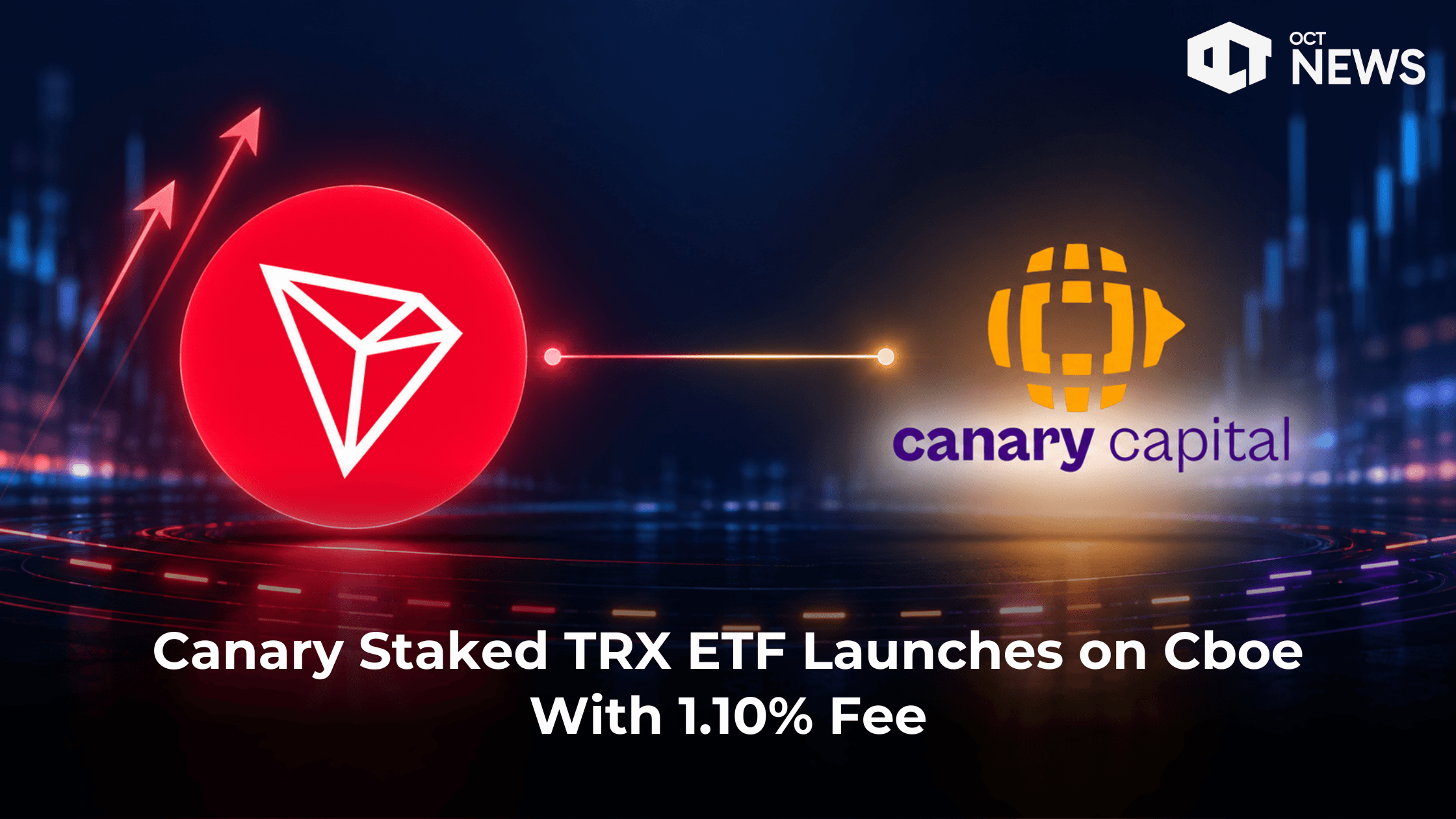
The Canary Staked TRX ETF launches on Cboe with spot TRX exposure, staking rewards in NAV, a 1.10% fee and $50.25M in assets.

Author: Kritika Gupta
9th September 2026- Canary Capital launched the Canary Staked TRX ETF this week. The fund began trading on the Cboe BZX Exchange under the ticker TRXS. It is the first US spot ETF that holds TRON’s TRX token and also stakes it for extra yield.
High Signal Summary For A Quick Glance

Xora_pussy🌊RIVER
@SangPham200598

@trondao @CanaryFunds 25% is only half the pain. The real boss fight is proving the cost basis for every swap, bridge and airdrop before 2027 hitsThe 0.13% spread is the part that deserves more attention. The edge came from giving buys and sells separate jobs, then recycling inventory between them.
. @CanaryFunds announced the launch of the Canary Staked TRX ETF. The Fund seeks to provide exposure to the spot price of TRX, the native token of the TRON network. In addition, the Fund also seeks to earn additional TRX through participation in the TRON network's delegated https://t.co/z3RIuy3gSa
03:29 PM·Sep 9, 2026

Atlas
@AtlasXBTC
@CanaryFunds @trondao @justinsuntron @stevenmcclurg @Cboe Having a registered market structure could make TRX exposure more accessible to traditional investors.
The Canary Staked TRX ETF ($TRXS) is designed to provide exposure to TRX alongside staking rewards. For investors focused on payment and settlement infrastructure, TRXS offers a transparent access point through a registered structure. Learn More >>> https://t.co/v1Mqr0zrL7 https://t.co/KcaSxSZ7Di
01:53 PM·Sep 9, 2026

Big Prince
@skyprince70
@CanaryFunds @trondao @justinsuntron @stevenmcclurg @Cboe The launch of TRXS is a significant step in making TRX more accessible through traditional investment channels. On-chain utility + regulated market access = a powerful combination for broader TRON adoption.
The Canary Staked TRX ETF ($TRXS) is designed to provide exposure to TRX alongside staking rewards. For investors focused on payment and settlement infrastructure, TRXS offers a transparent access point through a registered structure. Learn More >>> https://t.co/v1Mqr0zrL7 https://t.co/KcaSxSZ7Di
01:52 PM·Sep 9, 2026
Steady attention without excessive speculation.
The launch landed on September 9, 2026, according to CoinDesk. Canary’s own product page lists an inception date of September 8. Either way, the fund now gives brokerage investors a wrapped, stakeable route into TRON.
The fund has two jobs. First, it tracks the spot price of the TRX that the Trust holds. Second, it earns additional TRX through TRON’s delegated proof-of-stake system.
Those staking rewards do not arrive as a cash dividend. Instead, the extra TRX flows straight into the fund’s net asset value. As a result, any yield compounds inside the share price rather than landing in your account as income.
Canary seeded the product with real size. The issuer page shows net assets of about $50.25 million and roughly 148.4 million TRX as of the launch window. That stake still barely registers against TRX’s market cap of around $32.2 billion.
TRON matters mainly because of stablecoins. The launch release cited more than $94 billion in circulating USDT on the network, plus over 15 billion lifetime transactions. So the fund effectively packages exposure to one of crypto’s busiest settlement rails.
Here is the catch. The Canary Staked TRX ETF charges a 1.10% annual sponsor fee, accrued daily and payable monthly. On top of that, the sponsor keeps 20% of the staking rewards, so the Trust retains only 80%.
That pricing sits well above the market for spot Bitcoin funds. Those products charge roughly 0.19% to 0.25%, according to Crypto Briefing. In short, investors pay a premium for the convenience of staking they never have to manage.
Whether that premium pays off depends on the yield. For now, the answer stays hidden. The product page still shows net and gross staking yield as “–“, so the actual return is not yet disclosed.
Key milestones in the Canary Staked TRX ETF’s path to launch
Capital files to launch a spot TRX ETF with staking capabilities.
Cboe BZX files a 19b-4 application to list TRXS as a commodity-based trust share.
The proposed exchange listing moves through the SEC’s public review process.
An amended S-1 moves the fund’s registration process forward.
Canary updates the proposed fund structure and regulatory disclosures.
Amendment No. 4 reveals the 1.10% sponsor fee, 90% staking target and staking-fee structure.
Launch reporting indicates the registration cleared its final stage, although the exact effectiveness timestamp remains unconfirmed.
It says TRXS is coming the next day as its product page records approximately $50.25 million in net assets.
TRXS begins trading on Cboe BZX, offering spot TRX exposure with staking rewards reflected in its NAV.
TRON runs on delegated proof-of-stake, or DPoS. Holders freeze TRX to gain network resources and to vote for Super Representatives, and those validators produce blocks and share rewards in TRX. The unfreeze step takes time, though, so staked TRX is not instantly liquid.
The fund itself does not run a validator. Instead, the sponsor directs staking through outside providers, and the product page names Luganodes. Under normal conditions, Canary expects to stake about 90% of the TRX.
The remaining slice stays unstaked on purpose. That buffer helps the fund handle cash creations and redemptions, which move in 10,000-share baskets. Notably, those baskets settle in cash rather than in TRX itself.
How TRXS compares with non-staked spot ETFs and staked ETH proposals
Canary built the fund as a Delaware statutory trust that issues commodity-based trust shares. Importantly, it is not registered under the Investment Company Act of 1940, and it is not a commodity pool. Valuation runs off the CoinDesk Tron Benchmark Rate, a 60-minute New York reference price.
BitGo Trust Company holds the digital assets, while U.S. Bank handles the cash. The regulatory paper trail runs deep, too. Canary first filed its S-1 in April 2025, and Amendment No. 4 in August 2026 spelled out the 1.10% fee and the staking terms.
Steven McClurg, Canary’s CEO, framed the launch around TRON’s payments role. He said investors increasingly look “toward the networks driving real-world blockchain adoption,” in a press release commissioned by TRON. TRON founder Justin Sun echoed the infrastructure pitch.
Staking inside a wrapper adds real risk. TRON’s unfreeze delay means the fund cannot unstake instantly, so redemptions could face friction during stress. DailyCoin flagged exactly this liquidity concern at launch.
The structure carries other caveats, too. Staked assets are not covered by FDIC or SIPC protection, and validators can face slashing or downtime penalties. Because the Trust sits outside the 1940 Act, investors also give up some of the safeguards that traditional funds provide.
Despite the first-of-kind billing, the token reaction stayed muted. TRX traded near $0.338 on launch day, and it moved less than 1% over 24 hours. DailyCoin noted the price “barely moved.”
The math explains the calm. The roughly $50 million seed is tiny next to a $32 billion market cap, so it adds no meaningful buy pressure. TRX still sits up about 19% year to date, per CoinDesk.
Social reaction leaned on TRON’s own ambassadors rather than broad retail demand. One skeptic on X put it bluntly, arguing that “TradFi” now farms yields “while pretending they invented the network.” The tone split between milestone and expensive wrapper, yet no one disputed the basic facts.
The open questions now shift to performance and disclosure. Traders will watch for day-one share volume, any premium or discount to NAV, and the first real staking yield figure once Canary posts it.
The launch also extends Canary’s growing altcoin lineup, which already includes XRP, Litecoin, HBAR, Solana, and SUI products. If TRXS draws steady inflows, more staked single-asset ETFs could follow. This article is informational and not financial advice, so treat any yield or price expectation with caution.
Our Crypto Talk is committed to unbiased, transparent, and true reporting to the best of our knowledge. This news article aims to provide accurate information in a timely manner. However, we advise the readers to verify facts independently and consult a professional before making any decisions based on the content since our sources could be wrong too. Check our Terms and conditions for more info.


TRON