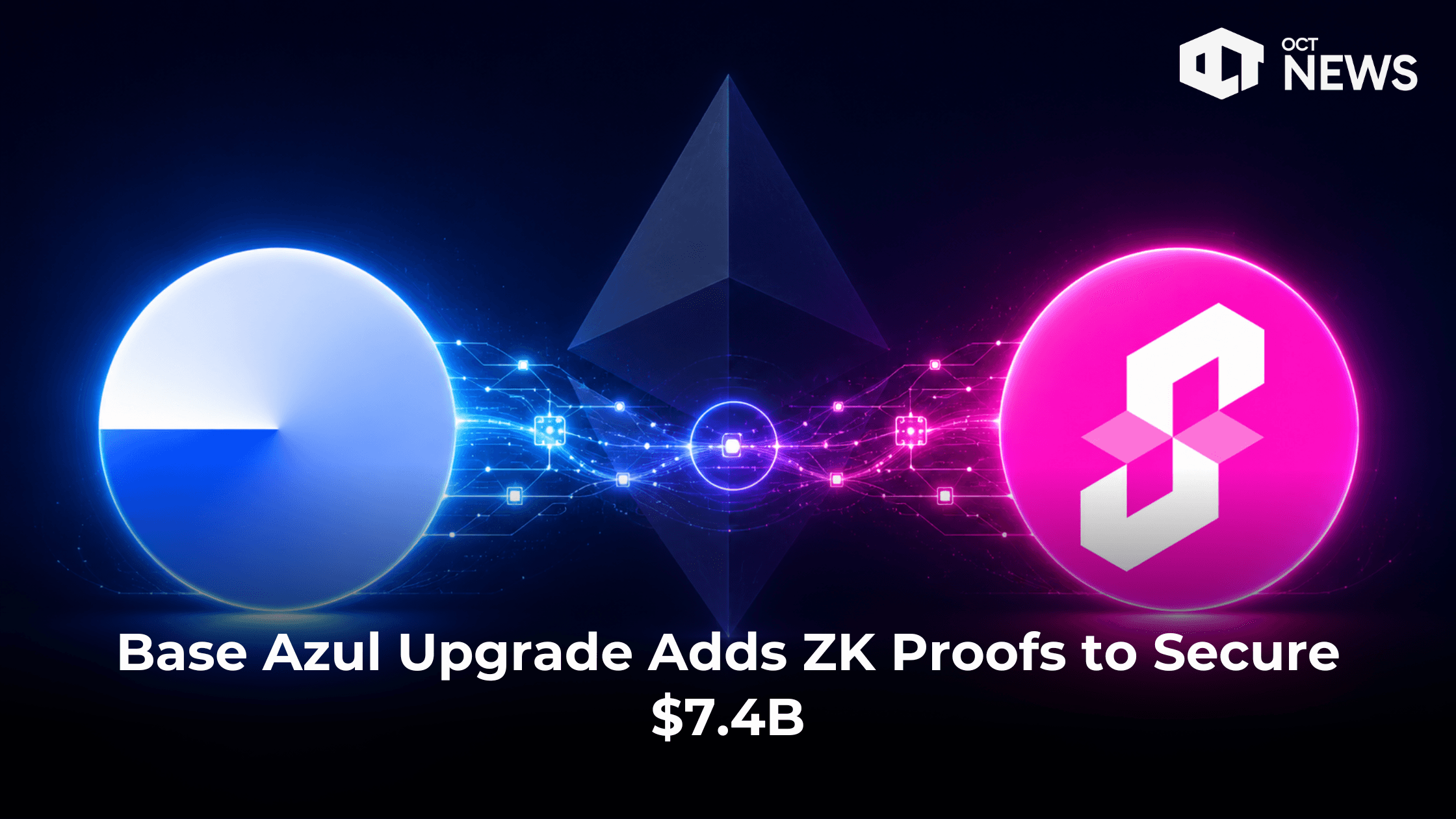
Base Azul upgrade brings Succinct SP1 ZK proofs to Base, aiming for withdrawals, stronger security, and a path toward decentralization.

Author: Kritika Gupta
22nd May 2026 – Base is preparing to launch its Azul upgrade, which will use Succinct’s SP1 zkVM to generate zero-knowledge proofs for every transaction on the network.
High Signal Summary For A Quick Glance

Brian Trunzo
@NTBro

Succinct is critical Ethereum infrastructure. https://t.co/YI9dq6EnsG
Succinct is bringing zero-knowledge proofs to @base. The upcoming Azul upgrade will use SP1 to prove every transaction on the network. Succinct will soon secure over $10 billion across major rollups, making SP1 the most widely deployed zkVM in production. https://t.co/rXCK90pwin https://t.co/8U3BVWVUFc
03:50 PM·May 22, 2026
Succinct Labs confirmed the partnership in a blog post on May 4. According to the announcement, the Base Azul upgrade will use SP1 to prove $7.4 billion in deposits on the chain.
The upgrade introduces a multiproof system that pairs ZK proofs with Trusted Execution Environment (TEE) proofs. When both proof types agree on a state proposal, withdrawals can finalize in roughly one day instead of the current seven-day challenge period.
Azul is Base’s first fully independent network upgrade. Until now, Base relied on shared OP Stack updates for its infrastructure changes. This time, the upgrade runs on Base’s own consolidated client stack, which includes base-reth-node for execution and base-consensus for consensus.
The core change is a shift from purely optimistic rollup security to a hybrid model. Optimistic rollups assume transactions are valid and use a seven-day window for fraud proof submissions. That delay has long frustrated users who need to wait a full week to withdraw funds to Ethereum.
With Azul, SP1 generates a ZK proof that mathematically verifies each batch of transactions. A TEE proof runs alongside it. If both proofs confirm the same result, the system treats the batch as final much sooner. According to Base’s announcement, the target is roughly one day for withdrawal finality.
ZK proofs also carry an important override function. Anyone can post a ZK proof permissionlessly. If a ZK proof contradicts a TEE proof, the ZK proof takes precedence. That design adds a trust-minimized fallback layer to the system.
SP1 is an open-source zkVM built by Succinct Labs. It allows developers to write standard Rust programs and compile them into provable programs that run on a RISC-V instruction set. From there, SP1 generates a compact ZK proof that anyone can verify quickly.
In simple terms, a zkVM acts like a trustless computer. It proves that a program ran correctly and produced a specific output. The verifier does not need to re-execute the computation. For Base, this means SP1 can prove that a batch of transactions produced the correct state transition.
This approach differs from older ZK systems that required custom cryptographic circuits for each application. SP1’s general-purpose design makes it easier to integrate with existing rollup infrastructure. Succinct’s GitHub repository hosts the full open-source codebase.
Base is not the only major chain using SP1. According to Succinct’s May 22 tweet, SP1 will soon secure over $10 billion in digital assets across multiple rollup ecosystems.
Other major rollups that use or have announced SP1 integrations include Optimism through OP Succinct, Mantle, Arbitrum, Polygon, and Celo. That breadth of deployment makes SP1 the most widely adopted zkVM in production, according to Succinct.
Base accounts for the largest single share of that figure. The $7.4 billion in deposits cited by Succinct represents roughly 74% of the total. According to DefiLlama data, Base’s DeFi TVL has fluctuated in the multi-billion dollar range, with one recent snapshot at approximately $4.5 billion.
The difference between the $7.4 billion deposits figure and DeFi TVL likely reflects different measurement methods. Succinct’s figure appears to include all bridged assets, while DefiLlama tracks only assets deployed in DeFi protocols.
Base before vs. after the Azul upgrade
The multiproof system directly supports Base’s push toward Stage 2 status on L2Beat. Stage 2 is the highest maturity classification for rollups. It requires that the security model does not depend on any single trusted party.
By combining TEE and ZK proofs from independent sources, Azul creates a security-in-depth model. An attacker would need to compromise both proof systems simultaneously. That is a significant improvement over single-proof models where one compromised component can threaten the entire system.
Ethereum co-founder Vitalik Buterin has repeatedly advocated for multiproof architectures as the preferred path to rollup security. Base’s implementation of this concept puts it ahead of several competitors that have only published roadmaps so far.
Key milestones in the Succinct SP1 and Base Azul trajectory
Succinct Labs begins building zero-knowledge infrastructure aimed at making proof generation easier for developers and production systems.
Succinct releases SP1, a general-purpose zkVM designed to prove standard Rust programs without requiring teams to build custom circuits.
Rollups and infrastructure teams start using SP1 for execution proofs, bridges, and scaling systems, moving the technology closer to production use.
Base announces the Azul upgrade and confirms that Succinct’s SP1 will support its zero-knowledge proof system.
The Base Azul upgrade is expected to move from testnet toward mainnet activation, bringing SP1-backed proving closer to live deployment.
With Base added to SP1’s production footprint, Succinct moves toward securing nearly $10 billion across major rollup deployments.
Several important details remain unclear. The exact mainnet activation date has not been confirmed. Base originally targeted May 13, but the May 22 tweet still described the upgrade as “upcoming.”
Real-world proving costs and performance benchmarks have not been published yet. ZK proof generation is computationally intensive. It remains unknown whether these costs will affect user fees on Base.
Some observers have also raised concerns about concentration risk. SP1 now powers ZK proofs across multiple major rollups. If the zkVM contains a critical bug, several chains could face exposure at once. The multiproof design mitigates this at the individual chain level, since the TEE proof provides a redundant check.
Azul is also described as an intermediate step. No public timeline exists for when Base plans to remove the TEE component and rely solely on ZK proofs.
The Base Azul upgrade specs show a roadmap toward full cryptographic proof of every state transition. For now, the hybrid TEE plus ZK approach offers a practical balance between security and production readiness.
Once Azul goes live, the market will see how the multiproof system performs under real load. Proving costs, withdrawal speeds, and verifier contract behavior will all face scrutiny from developers and users.
For Base’s growing user base, the most immediate benefit is clear. Faster withdrawals and stronger security guarantees now come backed by one of the most widely deployed proving systems in crypto.
Our Crypto Talk is committed to unbiased, transparent, and true reporting to the best of our knowledge. This news article aims to provide accurate information in a timely manner. However, we advise the readers to verify facts independently and consult a professional before making any decisions based on the content since our sources could be wrong too. Check our Terms and conditions for more info.