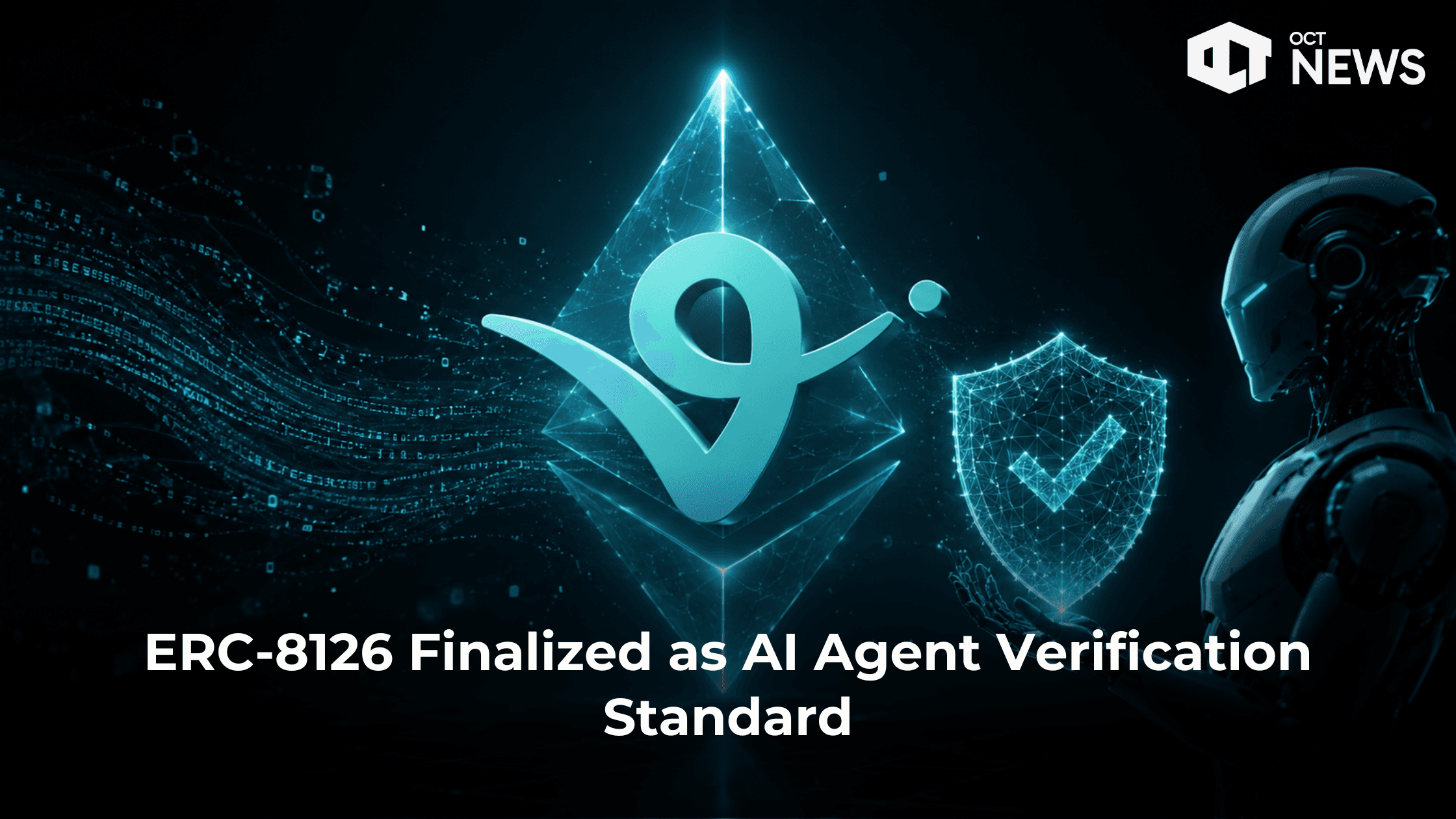
ERC-8126 brings ZK-based AI agent verification to Ethereum, creating portable trust signals without exposing private code or data.

Author: Kritika Gupta
12th June 2026- ERC-8126, a new standard for verifying AI agents on Ethereum, has reached Final status. Virtuals Protocol promoted the standard publicly on June 12, calling it the missing trust layer for autonomous agents.
High Signal Summary For A Quick Glance

Eclipse 🌖
@ECLresearch

@virtuals_io This is the key architectural win — zero-knowledge proof for agent provenance without sacrificing privacy. Token-agnostic verification layer is what scales trust across any agent-to-agent interaction.
ERC-8126 standardizes AI agent verification. Any provider can verify, any application can read the result, and the agent never exposes what it keeps private. An agent can prove its code passed a security review without revealing the code, prove it controls a wallet without https://t.co/UD8ZPwdnxf https://t.co/vK0lha2rRx
07:29 AM·Jun 12, 2026

HashRaX
@Thewarstar0909
@virtuals_io actually holding the keys to identity without giving away the secret sauce is the only way this thing scales. ready to see how fast devs adopt this one
ERC-8126 standardizes AI agent verification. Any provider can verify, any application can read the result, and the agent never exposes what it keeps private. An agent can prove its code passed a security review without revealing the code, prove it controls a wallet without https://t.co/UD8ZPwdnxf https://t.co/vK0lha2rRx
07:23 AM·Jun 12, 2026

cybercentry.base.eth
@cybercentry
@virtuals_io Identity. Verification. Commerce. The agent economy will need all three. Excited to see ERC-8126 move forward as an open verification standard for AI agents.
ERC-8126 standardizes AI agent verification. Any provider can verify, any application can read the result, and the agent never exposes what it keeps private. An agent can prove its code passed a security review without revealing the code, prove it controls a wallet without https://t.co/UD8ZPwdnxf https://t.co/vK0lha2rRx
07:02 AM·Jun 12, 2026
High attention and emotional sentiment detected.
The standard lets an AI agent prove it is trustworthy without exposing its code, its wallet activity, or its private data. Co-authors Leigh Cronian and Chris Johnson built it on top of ERC-8004, the agent identity standard. You can read the full ERC-8126 specification on the Ethereum site.
ERC-8126 defines a single interface that any verification provider can implement. So independent providers can run specialized checks and return one portable result.
The standard sets out five core verification layers. Each one targets a different way an agent can go wrong.
Ethereum Token Verification checks that an agent’s smart contract is legitimate and secure. Solidity Code Verification looks for issues like reentrancy and unsafe calls. Meanwhile, Wallet Verification confirms wallet control and screens the history against threat databases. These checks lean on established patterns, such as the OWASP smart contract standards.
Two more layers cover the public surface. Web Application Verification checks HTTPS access, SSL validity, and common web flaws. Media Content Verification screens images for tampering, synthetic media, and C2PA provenance data.
An optional sixth layer, Quantum Cryptography Verification, adds quantum-resistant encryption for future-proofing. For now, providers can choose whether to apply it.
The privacy mechanism is the core idea. In short, a provider inspects sensitive data but never publishes it.
Each provider uses Private Data Verification, or PDV, to generate a Zero-Knowledge Proof. As a result, the proof attests to an outcome without revealing the underlying material.
Co-author Chris Johnson explained the point directly. “An agent can prove it passed a security review without exposing confidential infrastructure or proprietary information,” he wrote in a detailed thread on X.
So the practical effect is simple. An agent can prove it controls a wallet without exposing every transaction. It can prove its code passed review without publishing the code.
How ERC-8126 fits beside agent identity, reputation, and credential standards
Every verified agent receives one unified risk score. The score runs from 0 to 100 and is the mean of the applicable layer scores.
The standard defines five tiers for that number. Low Risk covers 0 to 20, while Moderate runs 21 to 40. Elevated sits at 41 to 60, High Risk at 61 to 80, and Critical at 81 to 100.
Detailed results stay private to the agent’s wallet holder. By contrast, the headline score travels with the agent so any application can read it.
Providers can also post attestations to ERC-8004’s Validation Registry. In that case, the score and proof references become discoverable across the ecosystem. That step stays optional, so the verification work itself runs off-chain and avoids heavy gas costs.
ERC-8126 does not stand alone. Instead, it depends on ERC-8004, the “Trustless Agents” standard proposed around August 2025.
ERC-8004 gives each agent an on-chain identity through an ERC-721 passport. So ERC-8126 resolves that identity’s metadata and adds the verification it was missing.
Together with ERC-8183, a commerce standard for agent-to-agent jobs, the three form a clear stack. Supporters frame it as identity, verification, and commerce for the agent economy.
Johnson put the framing plainly. “No single company owns these layers. They belong to the ecosystem,” he wrote. Virtuals Protocol echoed the message in its own June 12 post.
Not everyone is fully convinced. Developers in the Ethereum Magicians discussion raised pointed concerns alongside the praise.
The main worry is incentives. Because anyone can stand up a provider with no minimum bar, some fear verifiers could compete on leniency. One critic compared that risk to the credit ratings that failed before 2008.
Others flagged the limits of static checks. Web Application Verification confirms that an endpoint is reachable. Still, it does not prove what code actually runs behind the URL.
A third concern is freshness. Attestations are snapshots, and the base standard includes no built-in revocation. So an agent could change after it passes verification.
Adoption is now the open question. As of the June announcement, tier-1 outlets had not covered the standard, and the discussion stayed mostly within crypto-native circles.
The market reaction was muted too. VIRTUAL held a market cap near $370 million to $390 million, with no measurable spike tied to the news, according to CoinGecko data.
The real test is whether wallets, marketplaces, and other agents start reading ERC-8126 scores at scale. Cybercentry is described as an early provider, though the full list of live verifiers remains unconfirmed.
For now, ERC-8126 gives the agent economy a privacy-preserving trust signal it lacked before. Watch for the first apps that consume these proofs in production. None of this is financial advice, and crypto markets can move fast in either direction.
Our Crypto Talk is committed to unbiased, transparent, and true reporting to the best of our knowledge. This news article aims to provide accurate information in a timely manner. However, we advise the readers to verify facts independently and consult a professional before making any decisions based on the content since our sources could be wrong too. Check our Terms and conditions for more info.



Virtuals Protocol