Pendle ($PENDLE) Review: DeFi’s Answer to TradFi Yields
Pendle Review: A yield-trading protocol enabling fixed yield, long yield, and advanced strategies through tokenized yield markets.


Author: Akshat Thakur
Introduction
Pendle is a permissionless yield-trading protocol that aims to redefine how decentralized finance (DeFi) users interact with yield-bearing assets. By tokenizing and splitting these assets into principal and yield components, Pendle introduces a liquid marketplace for yield allowing users to buy, sell, and speculate on future yield streams. This mirrors sophisticated strategies in traditional finance, such as bond stripping and interest rate derivatives, but brings them into the permissionless, composable environment of DeFi.
The protocol’s core innovation lies in its Standardized Yield (SY) token format, its custom Automated Market Maker (AMM), and the vePENDLE governance model. These features together provide users with a toolkit for fixed yield, variable yield speculation, structured financial products, and liquidity provision strategies. Pendle’s design positions it as the foundational layer for DeFi yield markets, aiming to unlock a $400 trillion opportunity by bridging traditional derivatives markets with decentralized systems.
The Issues Pendle Aims to Solve
- Inefficient Yield Management in DeFi
Most yield-bearing tokens like stETH or aUSDC generate rewards over time, but users can only passively earn without any flexibility to adjust exposure. This creates inefficiency because yield is locked and cannot be actively managed or traded. - Absence of Fixed Yield Products
DeFi primarily offers variable yield, which fluctuates based on supply-demand dynamics. This lack of fixed-yield products prevents users especially risk-averse investors and institutions from securing predictable returns or hedging yield volatility. - Liquidity Fragmentation in Yield Markets
Yield-bearing assets exist across various protocols and ecosystems, but without a standardized system, liquidity is fragmented. This fragmentation makes it difficult to aggregate liquidity and hampers capital efficiency. - Limited Composability Across Yield Tokens
Different yield-bearing tokens have unique mechanics such as rebasing, reward accrual, or lockups. This lack of standardization complicates integration across protocols, restricting developers from building composable yield strategies. - Lack of Yield Derivatives
Interest rate derivatives are a cornerstone of traditional finance, with trillions in daily volume. DeFi, until Pendle, lacked instruments that allowed speculation or hedging on interest rates and future yields. - Capital Inefficiency for Liquidity Providers
AMMs traditionally expose LPs to impermanent loss, especially in pools with assets of unequal risk-return profiles. Yield-bearing pools compound this problem because the yield accrues in a way that AMMs cannot efficiently account for, discouraging LP participation.
How Pendle Tackles These Problems
- Yield Tokenization with SY, PT, and YT
Pendle standardizes yield-bearing tokens through its Standardized Yield wrapper. Once wrapped, these tokens can be split into PT (Principal Tokens) and YT (Yield Tokens). PT secures the underlying asset redeemable at maturity, while YT entitles the holder to yield streams until maturity. This separation allows users to sell future yield upfront, speculate on yield, or gain exposure to principal without yield risk. - Fixed Yield Instruments
By purchasing PT, users effectively lock in a fixed yield. The price paid for PT reflects a discount to its redemption value at maturity. This mirrors zero-coupon bonds in traditional finance, offering a predictable return stream and appealing to users seeking stable income. - Custom AMM for Yield Trading
Pendle’s AMM is designed specifically for yield trading. Unlike standard AMMs, it accounts for time decay and provides concentrated liquidity. This minimizes impermanent loss and maximizes capital efficiency, ensuring that trading PT and YT remains liquid and fair. - Composability via SY Standard
SY creates a universal format for yield-bearing tokens, regardless of whether they are rebasing, staked, or lending tokens. This increases composability across DeFi, enabling protocols to easily integrate Pendle’s yield instruments without building specialized integrations for each asset. - Introduction of Yield Derivatives
Through YT, users can go long on yield, betting on increases in staking rewards or lending rates. Conversely, PT offers fixed income-like exposure. This transforms DeFi into a yield derivatives marketplace, enabling speculation, hedging, and structured product creation. - Efficient and Incentivized Liquidity Provision
LPs in Pendle pools earn from multiple revenue sources: swap fees, underlying SY yield, PT yield, and boosted incentives via vePENDLE. This diversified reward structure improves LP capital efficiency, while Pendle’s AMM design mitigates risks traditionally associated with yield-bearing pools.
Problem–Solution Overview
Inside Pendle’s Technology and Architecture
Pendle’s design integrates multiple components into a cohesive yield trading ecosystem:
- Standardized Yield Tokens: SY wraps yield-bearing assets into a common format, eliminating differences in rebase mechanics or reward accrual.
- PT (Principal Tokens): Represent ownership of the underlying asset and are redeemable at maturity.
- YT (Yield Tokens): Represent entitlement to the future yield stream of an asset until maturity.
- Pendle AMM V2: Specially designed for PT/SY pairs with flash swap mechanics, impermanent loss mitigation, and concentrated liquidity to optimize trading and capital efficiency.
- Order Book Functionality: Complements the AMM by enabling limit orders for PT and YT at implied APY targets.
- Governance (vePENDLE): Vote-escrowed PENDLE tokens direct emissions to chosen pools, grant governance rights, provide fee revenue, and boost LP rewards by up to 250%.
This modular approach ensures Pendle can support any yield-bearing asset, from staking derivatives like stETH to lending assets like aUSDC, while enabling composability with other DeFi protocols.
Technology & Architecture
PENDLE Tokenomics: Supply, Utility & Incentives
- Total Supply: 258,446,028 PENDLE
- Emission Schedule: Weekly emissions of 216,076 PENDLE, decreasing by 1.1% per week until April 2026, then stabilizing with 2% annual inflation.
- Circulating Supply: Distributed across vePENDLE lockers, LP rewards, ecosystem incentives, and reserves.
- Utility:
- Governance through vePENDLE
- Directing liquidity incentives
- Boosting LP rewards by up to 2.5x
- Fee distribution from swap and yield fees
- Revenue Sources:
- 5% fee on YT yield
- Swap fees from Pendle AMM
- All revenue distributed to vePENDLE holders
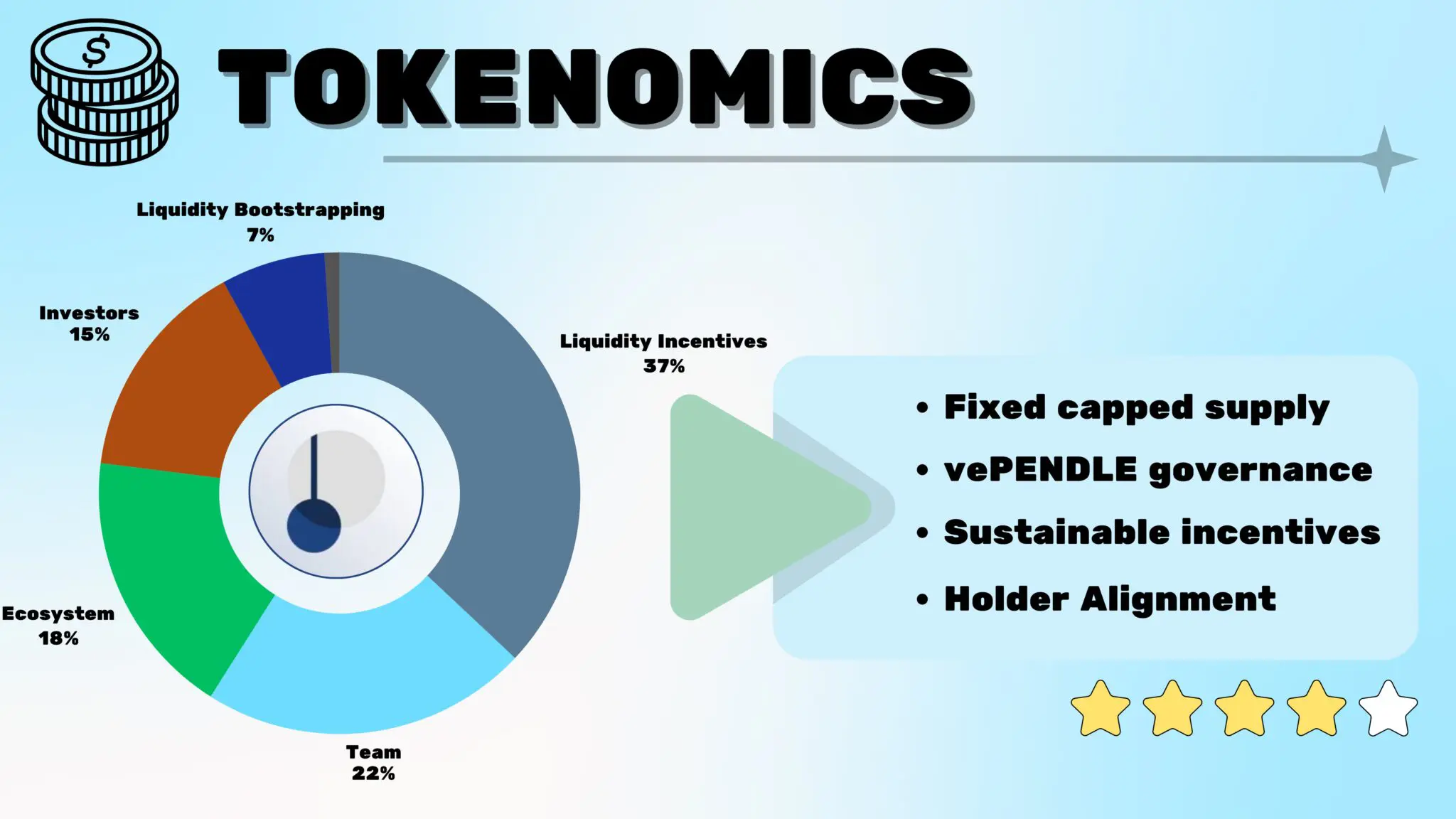
Pendle’s veTokenomics ensures long-term alignment, with emissions tied to vePENDLE governance and incentives designed to reward long-term commitment.
Allocation:
- 37% – Liquidity Incentives
- 22% – Team
- 18% – Ecosystem Funds
- 15% – Investors
- 7% – Liquidity Bootstrapping
- 1% – Advisors
Market Performance
📊 Market Performance
Team
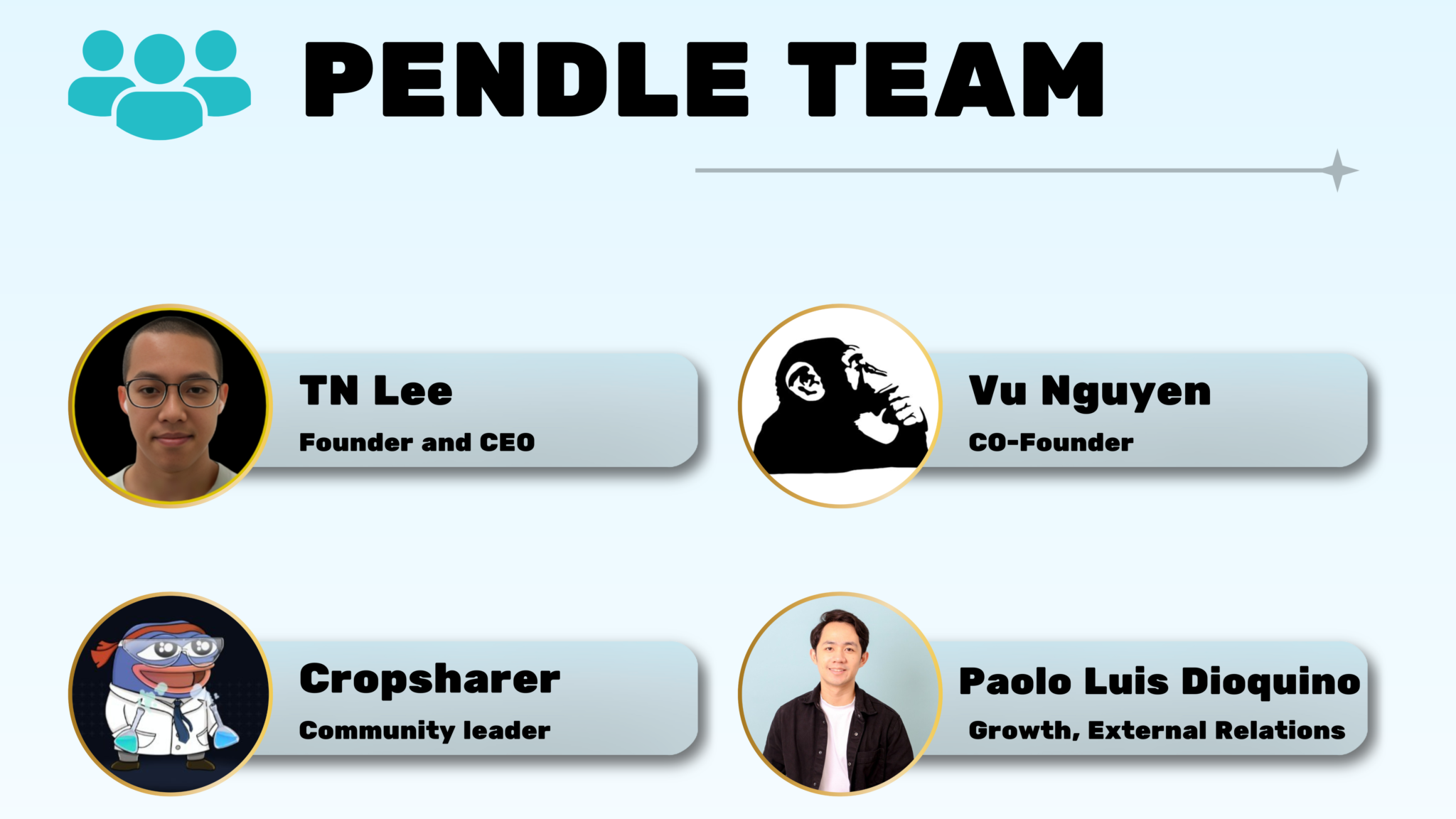
Pendle’s founding team comprises experienced DeFi builders and engineers. Although much of the team operates pseudonymously, the project’s credibility is demonstrated through secure deployments, open-source code, extensive audits, and ecosystem partnerships. The team has delivered consistently since its launch, iterating from Pendle V1 to V2.
- TN Lee: Founder & CEO.
- Vu Nguyen: Co-founder.
- Cropsharer: Community leader.
- Paolo Luis Dioquino: Growth & External Relations.
Project Analysis
Comparative Overview
- Vs. Notional Finance: While both tokenize yield, Notional focuses on fixed lending markets, whereas Pendle’s AMM supports broader yield strategies.
- Vs. Element Finance: Element specializes in fixed yield; Pendle extends beyond this by offering long yield exposure and boosted LP incentives.
- Vs. Yield Protocol: Yield pioneered fixed lending rates; Pendle scales the concept across multiple yield-bearing tokens with better AMM mechanics.
Strengths
- First-mover advantage in yield tokenization and derivatives
- Broad support for yield-bearing assets through SY standard
- vePENDLE aligns governance, incentives, and revenue distribution
- Efficient AMM tailored for yield trading with reduced impermanent loss
- Expanding ecosystem integrations with Lido, Aave, Compound, and others
Challenges
- User complexity: splitting and trading PT and YT can be intimidating for casual DeFi users
- Dependency on underlying protocols introduces systemic risk if base assets fail
- Competition from emerging protocols offering yield strategies may fragment liquidity
- Sustainability of emissions as primary growth driver remains a concern
Pendle vs Competing Yield Tokenization Protocols
| Project | Core Focus & Innovation | Compliance / Identity | Performance & Notes |
|---|---|---|---|
|
| Yield tokenization via PT/YT, time-decay AMM, SY standard, vePENDLE governance | Permissionless; no KYC; vePENDLE | High capital efficiency, broad asset support, institutional-ready in 2025 |
|
| Fixed & variable yield tokenization with recursive compounding strategies | Permissionless; no KYC | Capital-efficient; actively evolving; leverages yield for compounding mechanics |
|
| Formerly APWine; future-yield tokenization with PT/YT, deployed on Base, MetaVaults | Permissionless | Active with yield tools; advanced yield aggregation via MetaVaults |
|
| Standardizing yield primitives to enable fixed or variable yield markets | Permissionless | Still early; growing product lines; active in fixed-yield space |
|
| Yield derivatives via order books for fixed-yield trading | Permissionless | Thin liquidity; slowed development but still live |
|
| Fixed-income focused, predecessor of Element Finance | Permissionless | Lower TVL but active in the yield-tokenization niche |
Roadmap and the Future
- 2025 H2: Expansion of Pendle AMM across additional chains, broadening access to multi-chain liquidity.
- 2026: Development of cross-margin trading for PT and YT to support more advanced derivatives strategies.
- 2026–2027: Integration with institutional platforms to provide tokenized yield products for structured funds and asset managers.
- Long-Term Vision: Position Pendle as the yield layer of DeFi, offering fixed income, variable yield, structured products, and interest rate derivatives for both retail and institutional markets.
Conclusion
Pendle has emerged as the leading yield-trading protocol in DeFi, pioneering the tokenization of principal and yield components for any yield-bearing asset. By creating PT and YT markets, Pendle enables advanced strategies that mirror traditional finance while remaining fully permissionless and composable. Its vePENDLE governance model aligns incentives for long-term growth, while the AMM design improves liquidity efficiency for traders and LPs alike.
Compared to competitors, Pendle provides broader asset support, superior capital efficiency, and a more sustainable tokenomics design. While challenges such as user education and reliance on external protocols remain, Pendle’s innovation and traction suggest it could become the backbone of DeFi’s fixed income and derivatives market. As DeFi matures, Pendle is well-positioned to capture the demand for yield products from both crypto-native and institutional users.
Explore More Reviews to Level Up Your DYOR Game.
Frequently Asked Questions
What is Pendle?
What problem does Pendle solve?
– Lack of fixed-yield products
– Inefficient yield trading and management
– Liquidity fragmentation across protocols
– Limited composability of yield-bearing tokens
– Absence of yield derivatives (common in traditional finance)
– Capital inefficiency for liquidity providers in AMMs
How does Pendle tokenize yield?
PT (Principal Tokens): Redeemable for the underlying asset at maturity
YT (Yield Tokens): Represent future yield until maturity
This separation enables fixed-yield investing, yield speculation, and greater flexibility in yield strategies.
What makes Pendle’s AMM different?
Can Pendle provide fixed yield?
What are yield derivatives in Pendle?
– Going long on yield: Buy YT to benefit if future yields increase.
– Fixed yield exposure: Buy PT for guaranteed returns.
This introduces interest rate derivatives to DeFi, enabling speculation and hedging.
How does Pendle ensure composability across DeFi?
What incentives do liquidity providers (LPs) get?
– Swap fees
– Underlying SY yield
– PT yield
– Boosted rewards via vePENDLE governance
This diversified model improves LP capital efficiency compared to traditional AMMs.
What is vePENDLE and why is it important?
– Direct emissions toward chosen liquidity pools
– Boost LP rewards (up to 2.5x)
– Earn protocol fees
This aligns incentives between governance, liquidity, and protocol growth.
In this article
Technology & Architecture 📊 Market PerformancePendle vs Competing Yield Tokenization Protocols