The Zcash price rally took ZEC from $16 to $1,200 in 14 months. See how the halving, shielded supply, Ironwood upgrade, ETF, and a short squeeze fueled it.

Author: Kritika Gupta
The Zcash price rally has become one of the most dramatic comeback stories in crypto. After trading near $16 in July 2024, ZEC surged past $1,200 within fourteen months and reached a market capitalization of nearly $20 billion. However, no single event caused this rise. A halving, growing shielded adoption, the Ironwood upgrade, institutional demand through the Grayscale ETF, and a major short squeeze combined to drive ZEC higher.
In July 2024, Zcash traded at $16. Fourteen months later, it crossed $1,200, representing a gain of roughly 7,400%. Meanwhile, its market capitalization approached $20 billion, while ZEC surged about 2,300% year over year. That return exceeded anything Bitcoin, Ethereum, or Solana delivered over the same period. Although most of the crypto market had written off the original privacy coin, it staged one of the industry’s largest single-asset rallies.
However, ZEC did not climb in a straight line. First, it recovered from its 2024 lows and rallied toward $700 in October 2025. Then, a protocol-driven correction pushed the price sharply lower in early 2026. Nevertheless, buyers had regained control by mid-August. Within weeks, ZEC broke through $850, $1,000, and eventually $1,200 as daily trading volume surpassed $1 billion.
So, how did Zcash make such a dramatic comeback? Ultimately, five catalysts stacked on top of one another, compressing supply while unlocking new demand. This article explains each one.
Key events behind the Zcash price rally
Zooko Wilcox founded ZCash in 2016. The network uses Bitcoin’s codebase but adds zero-knowledge proofs, allowing users to verify transactions without exposing sensitive information. As a result, shielded transactions can conceal the sender, recipient, and amount. However, privacy remains optional. Users can choose between transparent transactions and shielded transfers. Moreover, Edward Snowden has praised the project’s cryptographic approach.
ZCash follows the same basic supply model as Bitcoin, including a 21 million coin cap, scheduled halvings, and no premine. However, its privacy usage has grown significantly, providing important context for the Zcash price rally. Around 30% of all ZEC now sits in shielded addresses, up from 8% in 2024. In February 2026, 59.3% of transactions used the shielded pool. ZCash copies Bitcoin’s monetary skeleton and changes almost nothing about it, except that your transactions can remain completely private.
Five catalysts behind the Zcash price rally
In November 2024, ZCash completed its second halving, cutting the block reward from 3.125 ZEC to 1.5625 ZEC. As a result, daily issuance fell by 50%. Although the event produced the same mechanical effect as a Bitcoin halving, it affected an asset with a much smaller market capitalization and thinner liquidity. Moreover, ZCash’s post-halving inflation rate fell below Bitcoin’s. By that point, the network had already issued roughly 16.8 million of its 21 million coins, meaning more than 80% of the total supply was circulating.
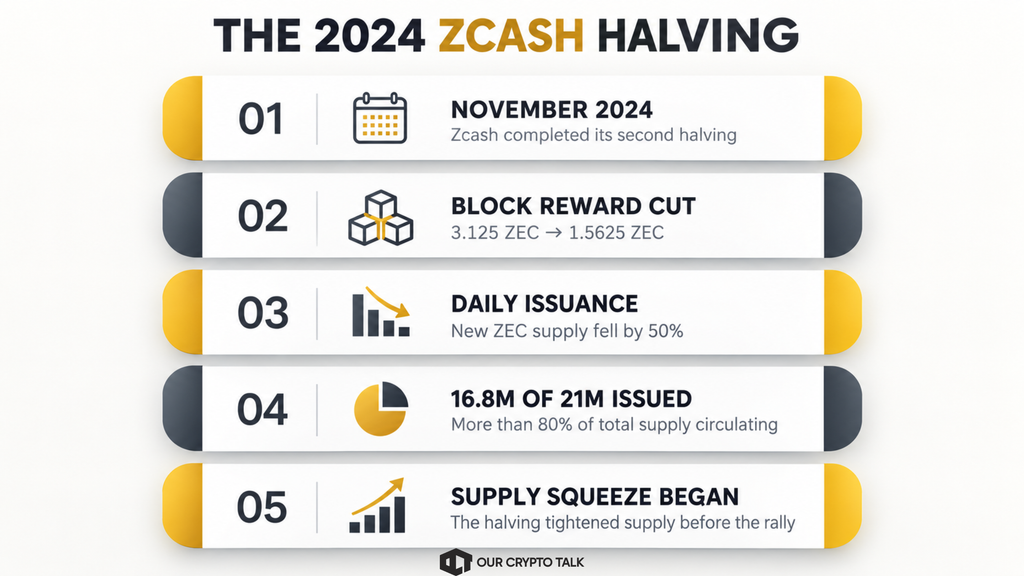
However, the halving did not immediately trigger the Zcash price rally. Instead, it created the structural conditions for the surge that followed. The halving did not start the rally. It tightened supply. Consequently, every later catalyst hit a market with less new ZEC entering circulation.
The share of ZEC held in shielded addresses rose from 8% in early 2024 to around 30% in 2026, nearly quadrupling in two years. Shielded ZEC still exists, but the public blockchain cannot track it as visible, readily tradable supply. As more coins entered privacy pools, the amount of ZEC available on transparent markets became harder to measure.
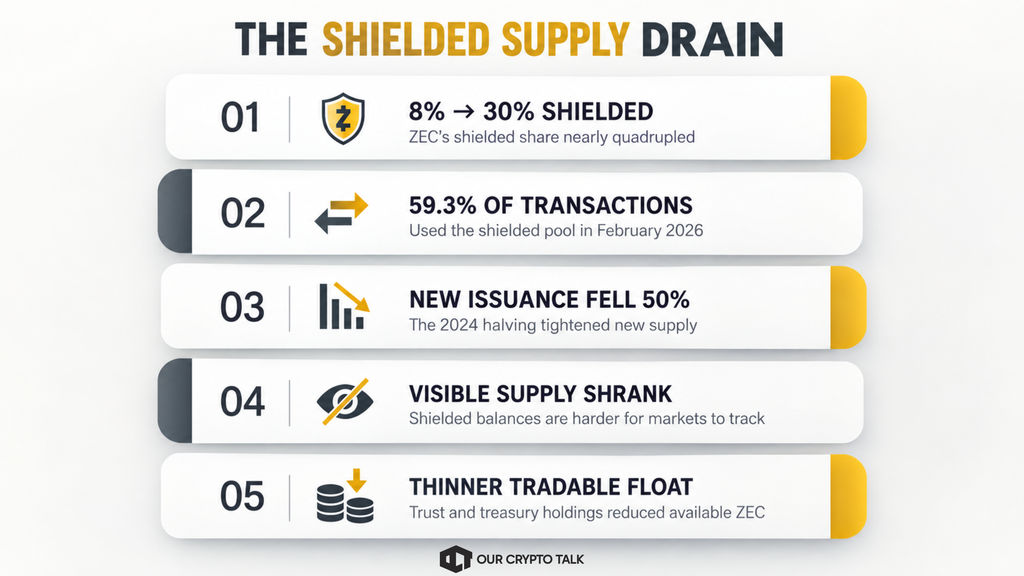
Moreover, this shift reflects real network activity rather than passive holding alone. In February 2026, 59.3% of Zcash transactions used the shielded pool. At the same time, the 2024 halving tightened supply from another direction. New issuance fell by 50%, while users moved around 30% of the existing supply into privacy pools.
Together, these developments dramatically reduced ZEC’s visible liquid float and helped fuel the Zcash price rally. Around a third of the supply now sits in shielded addresses. Meanwhile, the Grayscale trust and corporate treasuries such as Cypherpunk Technologies hold another portion. As a result, the tradable float is far smaller than the market capitalization suggests. In a market this tight, even modest inflows can move the price sharply.
In June 2026, developers disclosed a critical vulnerability in Orchard, ZCash’s primary shielded pool. Specifically, the bug could have allowed an attacker to mint counterfeit ZEC without detection. Because shielded transactions conceal their details, developers could not conclusively prove that nobody had exploited the flaw. As a result, the uncertainty weakened confidence in ZCash’s supply integrity and pushed ZEC into the $270 to $300 range.
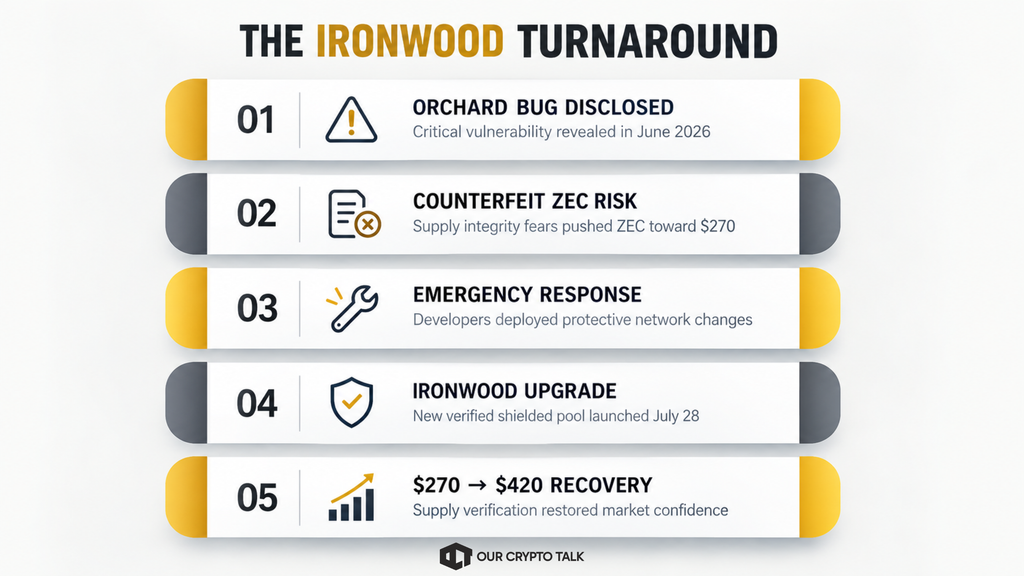
Developers quickly responded by deploying emergency network changes in June to contain the threat and protect new transactions. However, those measures only addressed the immediate danger. Therefore, the network still needed a permanent solution to restore confidence in both its privacy system and total supply.
That solution arrived on July 28 with Ironwood. The full network upgrade replaced the vulnerable Orchard pool with a new, formally verified shielded pool. Furthermore, it introduced independent supply verification, allowing the network to confirm that the total ZEC supply remains accurate without exposing individual balances or transaction details.
Once the supply question had an answer, the fear trade ended. Consequently, ZEC recovered from around $270 to $420 within weeks of the Ironwood upgrade, reviving the Zcash price rally. Ultimately, Ironwood became the most consequential upgrade in ZCash’s history because it turned the coin’s largest vulnerability into its strongest technical argument. The network can now prove that its supply is honest without sacrificing user privacy.
In late November 2025, Grayscale filed to convert its $137 million Zcash Trust into a spot ETF. After months of regulatory filings, ZCSH began trading on NYSE Arca on August 25, 2026. The launch gave the United States its first spot ETF for a privacy coin and opened ZEC exposure to investors who preferred regulated brokerage products over direct token custody.
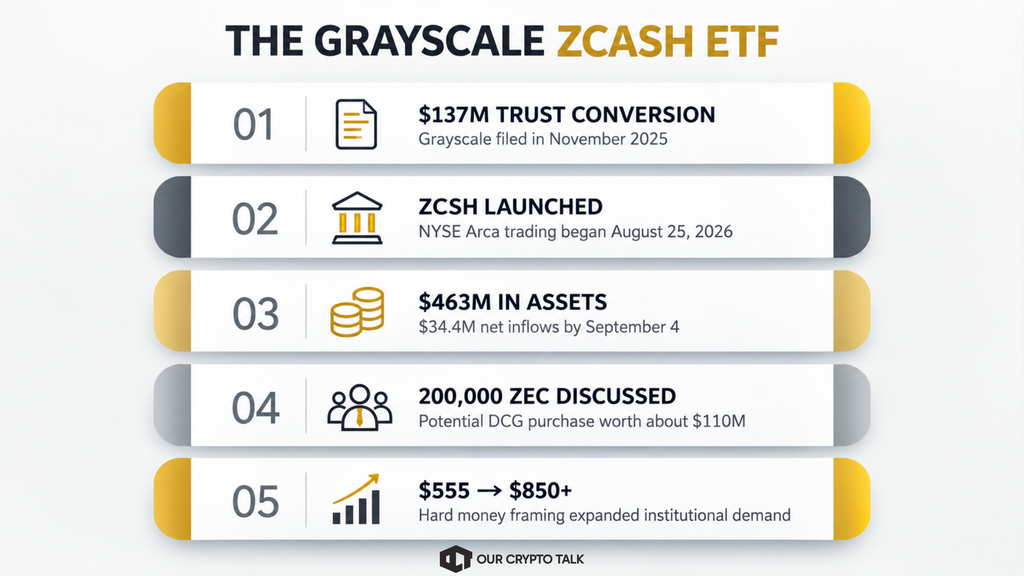
Institutional demand followed quickly. By September 4, ZCSH had accumulated $463 million in assets and recorded $34.4 million in net inflows since launch. Meanwhile, DCG International Investments, part of Grayscale’s parent company, discussed purchasing shares representing roughly 200,000 ZEC, worth around $110 million.
However, Grayscale did not focus its pitch on privacy. Instead, it presented ZEC as hard money. Like Bitcoin, ZCash has a fixed supply cap of 21 million coins and follows a predictable halving schedule. Unlike Bitcoin, it also offers optional transaction encryption. As a result, this framing expanded ZEC’s appeal beyond traditional privacy-coin users.
Consequently, the market responded immediately. ZEC surged from roughly $555 to more than $850 around the ETF launch. Ultimately, Grayscale did not market ZCSH as a privacy product. It marketed ZCSH as hard money, and that reframing changed who was buying.
By late August, open interest in ZEC perpetual futures had reached $2.4 billion. Many traders believed the rally had become overextended and opened short positions in anticipation of a correction. However, this heavy short positioning created the conditions for an explosive squeeze if ZEC continued rising.
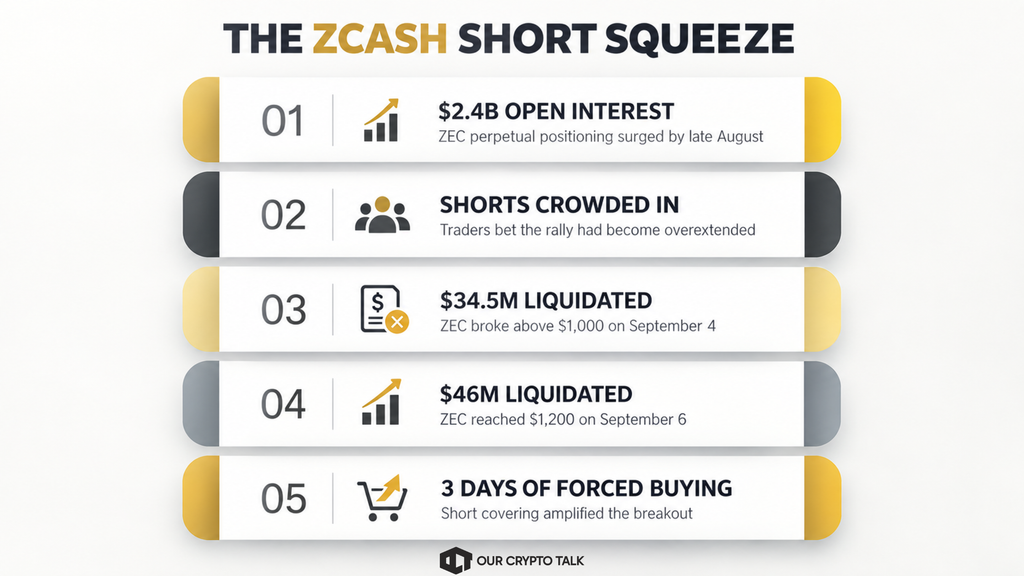
That squeeze began on September 4, when ZEC broke above $1,000 and triggered $34.5 million in short liquidations within a single day. Two days later, another $46 million in short positions disappeared over 24 hours as ZEC reached $1,200. Three consecutive days of forced position closures required short sellers to buy ZEC at rising prices, which amplified the move.
The broader catalysts drove the rally, but forced liquidations powered the breakout above $1,000. Shorts bet against momentum and got crushed. That is the difference between a rally and a squeeze.
The rally can be real, and a correction can still be coming. First, regulation remains one of the largest risks. Upcoming EU rules could force exchanges to restrict or delist privacy coins in 2027, potentially removing access for European investors. Meanwhile, privacy-focused assets continue to face political scrutiny and exchange delistings worldwide. Therefore, the approval of a U.S. spot ETF does not eliminate those risks.
Second, ZEC’s thin liquid float amplifies moves in both directions. Shielded pools hold around 30% of the supply, while Grayscale and corporate treasuries control another portion. Consequently, this structure can fuel sharp rallies when demand rises. However, it can also accelerate selloffs when buyers disappear. After such a vertical move, a 30% to 50% correction would not be unusual.
Furthermore, concentration and migration create additional pressure points. Cypherpunk Technologies controls roughly 2% of ZEC’s supply and reportedly operates around 18% of the network’s hashrate. As a result, one corporate group now holds significant influence over both supply and mining. At the same time, millions of ZEC remain in the sealed Orchard pool. Therefore, the market must consider how quickly holders could migrate or sell those coins.
Finally, the ETF cannot guarantee sustained demand. Bitcoin ETFs have recorded net outflows during market corrections, and ZCSH could experience the same reversal. Moreover, technical conditions look stretched after ZEC gained roughly 370% in three months and pushed its RSI to extreme levels. Overall, these risks do not invalidate the bullish catalysts, but they widen the possible outcomes and leave ZEC vulnerable to a severe correction.
This article is for informational purposes only and does not constitute financial advice. Always do your own research.