US military confirms running a Bitcoin node for operational tests, exploring network security, resilience, & decentralized infrastructure.
 Akshat Thakur
Apr 23, 2026, 11:54 AM UTC

Author: Akshat Thakur
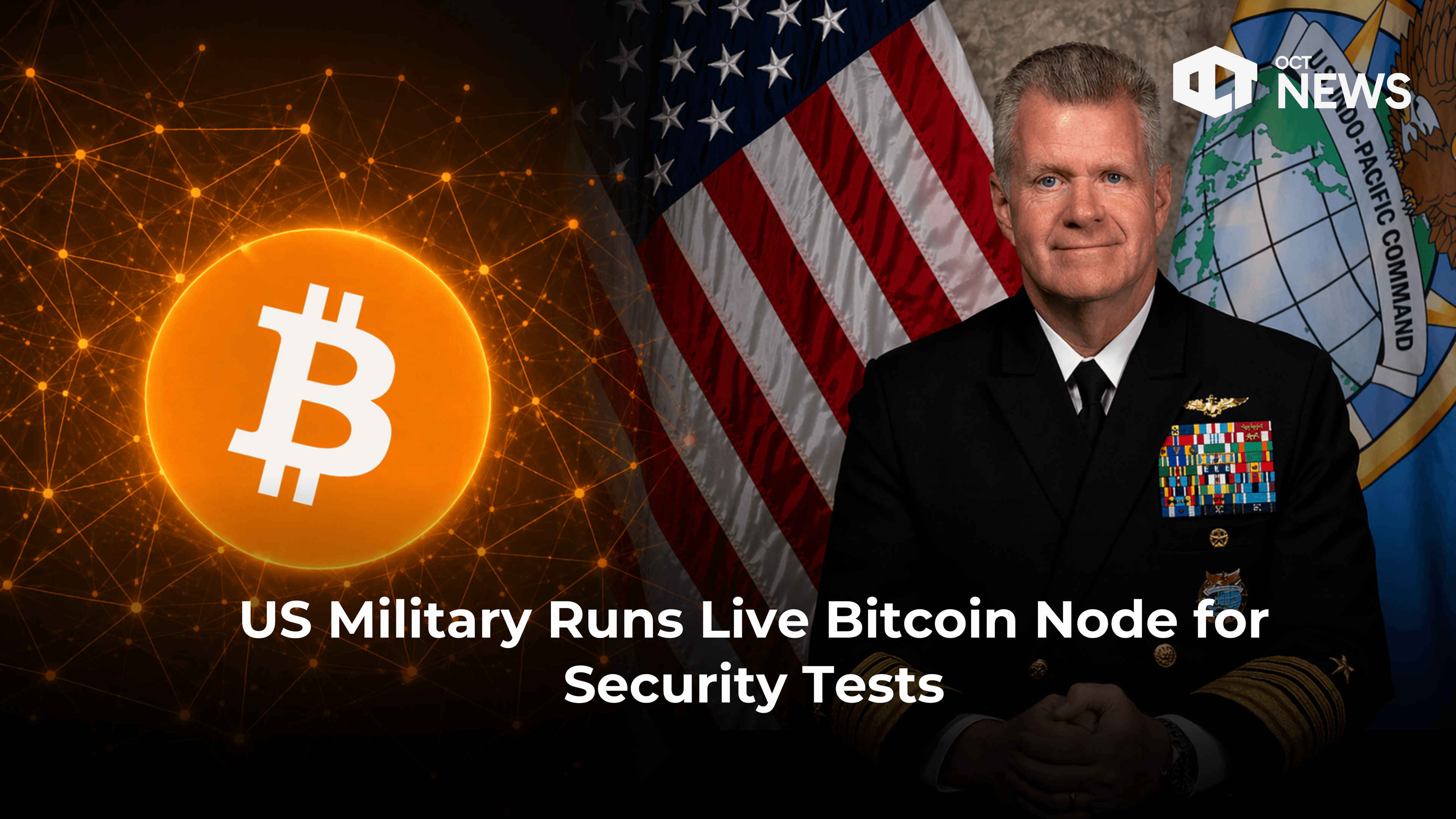
23rd April 2026 – The United States military is running a live node on the Bitcoin network. Admiral Samuel Paparo, commander of U.S. Indo-Pacific Command, confirmed the operation during a House Armed Services Committee hearing on April 22.
High Signal Summary For A Quick Glance
Paparo told Congress the military is not mining Bitcoin. Instead, the focus is on monitoring and operational testing. “We have a node on the Bitcoin network right now,” Paparo said. “We’re doing a number of operational tests to secure and protect networks using the Bitcoin protocol.”
The confirmation came in response to a question from Congressman Lance Gooden. Specifically, Gooden asked about Bitcoin’s potential role in military operations during a session focused on Indo-Pacific security.
This is the first time a senior U.S. military official has publicly confirmed running a live Bitcoin node. Until now, statements from the Pentagon and combatant commands focused on general blockchain research. None confirmed direct participation in the Bitcoin network.
Paparo leads USINDOPACOM, one of the largest and most strategic combatant commands. As a result, his confirmation carries significant institutional weight. The command oversees 36 nations and more than 380,000 personnel across the Indo-Pacific region.
Because the disclosure came under oath in congressional testimony, it also represents a formal, on-the-record acknowledgment. This shifts the conversation from theoretical exploration to real-time engagement with Bitcoin’s core infrastructure.
Bitcoin runs on a decentralized, permissionless network of roughly 17,000 to 20,000 reachable nodes worldwide. Each node maintains a full copy of the blockchain and independently verifies every transaction. Because of this design, no central server or trusted third party is required.
For the military, those properties align with operational needs in contested environments. The Indo-Pacific theater faces threats from communications jamming, cyber attacks, and supply-chain disruption. In particular, traditional communications infrastructure could be degraded or denied during conflict. Bitcoin’s distributed architecture resists all three of those threats.
The protocol’s proof-of-work mechanism also creates a tamper-resistant data layer. Records on the blockchain cannot be changed without controlling a majority of the network’s computing power. As a result, it offers a potential tool for secure, zero-trust communications.
Paparo described the work as operational tests focused on network security. Specifically, the military is using Bitcoin’s cryptographic architecture to explore ways to protect networks.
According to reports from Bitcoin Magazine and News.Bitcoin.com, the tests could involve several use cases. These may include stress-testing the protocol’s resilience to adversarial attacks. They could also involve evaluating how the network performs when traditional internet infrastructure degrades.
In addition, the military may be exploring Bitcoin’s potential for secure messaging or immutable record-keeping. Cryptographic signing and peer-to-peer resilience are among the key features under examination. Financial applications, on the other hand, are not the focus.
This approach echoes earlier Department of Defense interest in distributed systems. DARPA funded research into distributed ledger technology as early as 2016. Those projects studied secure communications and resilient data sharing, though none involved running a live node on the public Bitcoin network.
Congressman Gooden framed the exchange as historic in a follow-up statement after the hearing. He highlighted Bitcoin’s growing strategic relevance to national security.
Gooden represents Texas’s 5th congressional district. He has been an outspoken advocate for Bitcoin-friendly policy and pushed for more transparency on government engagement with the protocol.
The broader defense community has similarly shown rising interest in Bitcoin’s underlying technology. Earlier research papers and wargames explored blockchain for secure data sharing and resilient command-and-control systems. Paparo’s testimony, therefore, is the most senior public acknowledgment to date.
Because the hearing focused on Indo-Pacific security posture, the context also matters. Geopolitical tensions in the region are high, with concerns over supply-chain vulnerabilities, cyber threats, and contested electromagnetic environments. Bitcoin’s design, which requires no trusted intermediary, offers a potential hedge against exactly those risks.
The military is expected to continue monitoring and testing its Bitcoin node in controlled environments. No policy shift or large-scale deployment has been announced so far.
Still, the disclosure opens the door for further congressional oversight and public debate. Lawmakers may push for more transparency on the scope of testing and the results.
For the Bitcoin ecosystem, the news has already generated strong bullish sentiment. Community commentary frames it as validation of the protocol’s robustness at the highest levels of national power. Exchanges and market participants will watch for follow-on statements from the Pentagon or other combatant commands.
The scope remains narrow for now, with the military monitoring and testing rather than speculating or mining. Yet running a live node on the public Bitcoin network marks a clear milestone in institutional adoption. The tests are underway, and the results could shape how both the military and the broader market view Bitcoin’s role as infrastructure going forward.



Bitcoin