VeChain MiCA compliance puts VET and VTHO among early ESMA register entries, strengthening EU regulatory positioning.

Author: Kritika Gupta
15th June, 2026– VeChain told its followers that it moved early to align its native tokens with the EU’s crypto rulebook. The VeChain MiCA push placed VET and VTHO among the first crypto-assets listed on the EU’s ESMA register. The team framed the step as proof that compliance sits at the core of its growth strategy.
High Signal Summary For A Quick Glance

Wu Blockchain
@WuBlockchain

MiCA Transition Ends on July 1: Approximately 75% of EU Crypto Companies May Lose License The EU’s MiCA transition period will end on July 1, after which crypto exchanges, brokers and wallet service providers without a MiCA license will no longer be able to serve EU users. As https://t.co/WLR9qozwZ2

03:05 AM·Jun 15, 2026
Steady attention without excessive speculation.
The post recapped an action VeChain actually took back in March 2025. Still, the timing matters now, because the EU’s transitional regime for crypto firms ends on July 1, 2026.
VeChain Foundation San Marino S.r.l. notified the white papers for VET and VTHO to regulators on 13 March 2025. It filed through Ireland’s Central Bank of Ireland, the national competent authority that handled the submission. The entry now sits in ESMA’s public register under the legal entity identifier 5299001UWKNB61VZCT67.
The filing covers Title II crypto-assets, the MiCA category for utility and governance tokens. As a result, neither token counts as a stablecoin or a security under the framework. VeChain then announced the achievement publicly around 18 March 2025, and crypto.news covered it the same week.
Both assets are native protocol tokens on the VeChainThor blockchain. VET serves as the value-transfer and staking token, while VTHO acts as the gas token for transactions. Because of this dual-token design, the two filings cover the chain’s core economic engine.
The ESMA register is the EU’s central database for crypto-asset disclosures. It lists notified white papers, authorised stablecoin issuers, and licensed service providers. Anyone can verify the VeChain MiCA entry directly in the public OTHER.csv file.
A white paper notification is a disclosure step, not a business license. So the listing does not approve VeChain’s token economics or grant a service-provider permit. Instead, it confirms the documents meet MiCA’s transparency rules.
That distinction still carries weight. Once regulators publish a notified white paper, the issuer can offer the asset across all 27 member states. This passporting right lowers legal friction for EU exchanges that list VET or VTHO.
The listing applies only to the white papers, so it leaves several things untouched. It does not authorise VeChain as a crypto-asset service provider, the separate license that trading and custody platforms need. It also does not approve a stablecoin, because VET and VTHO fall outside the asset-referenced and e-money token rules.
This matters for how readers should read the headline. According to the framework, a Title II notice signals transparency rather than a merit review of the project. The regulator checks that the disclosure is complete, yet it does not vouch for token performance or investor returns.
Key milestones related to this development
The EU’s main crypto-asset provisions begin applying, setting clearer disclosure rules for non-stablecoin tokens.
ESMA’s MiCA register begins recording notified crypto-asset white papers across the EU framework.
VeChain moves early to align VET and VTHO with MiCA’s Title II white-paper notification regime.
The VET and VTHO white papers are notified through Ireland’s Central Bank and recorded on ESMA’s register.
EU exchanges, custodians, and institutions now have clearer regulatory footing when assessing VET and VTHO.
MiCA entered into force in 2023, and most of its provisions applied from 30 December 2024. Meanwhile, existing service providers received a transitional window that closes on 1 July 2026. After that date, many firms must hold full authorisation to operate in the bloc.
VeChain points to its early filing as a clear head start. According to the team, moving first reduces regulatory risk as the deadline approaches. ESMA itself last updated the register around 12 June 2026, just days before the reminder post. You can track those updates on the official ESMA MiCA page.
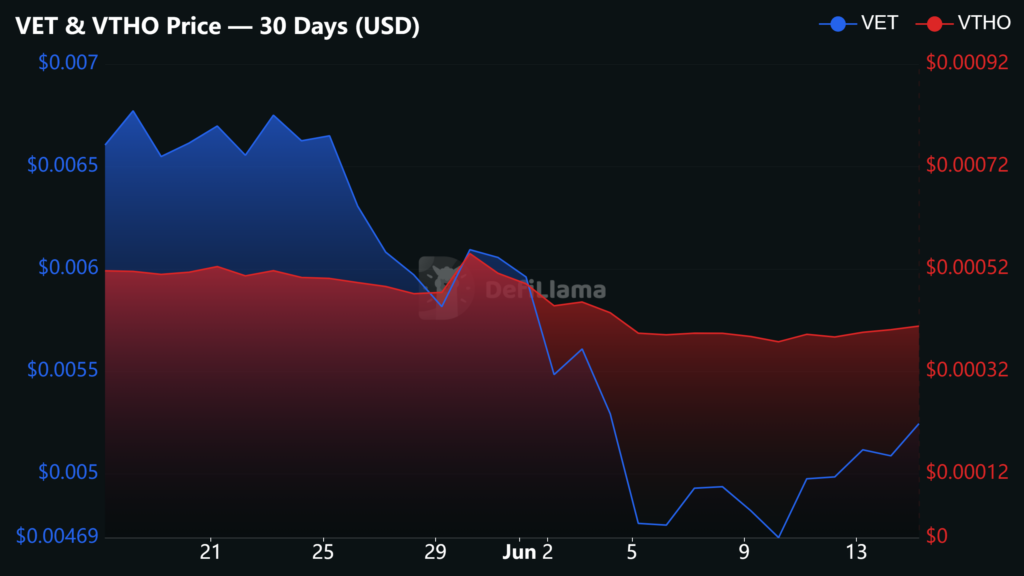
VET traded near $0.005098 on the day of the post, up roughly 1.6% over 24 hours. Its market cap sat around $438 million on a circulating supply of about 86 billion tokens. Daily volume hovered near $11 million, according to CoinGecko and CoinMarketCap data.
VTHO, the gas token, traded near $0.0004 with a market cap around $39 million. Its circulating supply runs near 100 billion tokens, since the network mints VTHO continuously as holders keep VET. Notably, the June reminder produced no clear price or volume spike, since it simply recapped older news. Sentiment in the replies stayed positive, though engagement remained modest at a few thousand views.
VeChain has long pitched itself as an enterprise-grade chain for supply chain, sustainability, and real-world asset use cases. So a regulatory milestone fits its pitch to institutions more than its retail trading volume. The 2026 Manifesto, published on 5 January, again called VET and VTHO two of the first tokens on the register.
VeChain continues to lean on compliance as a selling point for enterprise adoption. The team has tied its regulatory work to the Hayabusa upgrade and MiCA-aligned custody through BitGo. A separate notification for the B3TR token also followed later in 2025.
Whether the VeChain MiCA head start converts into new EU listings or institutional flows remains unconfirmed. Still, the public register now gives exchanges a clear reference point before the July deadline. This article is not financial advice, and readers should research any token carefully before investing.
Our Crypto Talk is committed to unbiased, transparent, and true reporting to the best of our knowledge. This news article aims to provide accurate information in a timely manner. However, we advise the readers to verify facts independently and consult a professional before making any decisions based on the content since our sources could be wrong too. Check our Terms and conditions for more info.


VeChain