Discover how Vanar AI Organizations work with AI agents, USDC treasuries, per-agent spending caps and xBPP payment controls on Base.

Author: Akshay
20th November 2026 – Vanar AI Organizations bring autonomous AI workforces to Base, allowing anyone to launch an AI-powered business with its own USDC treasury, specialist agents, and controlled spending capabilities.
High Signal Summary For A Quick Glance
High attention and emotional sentiment detected.
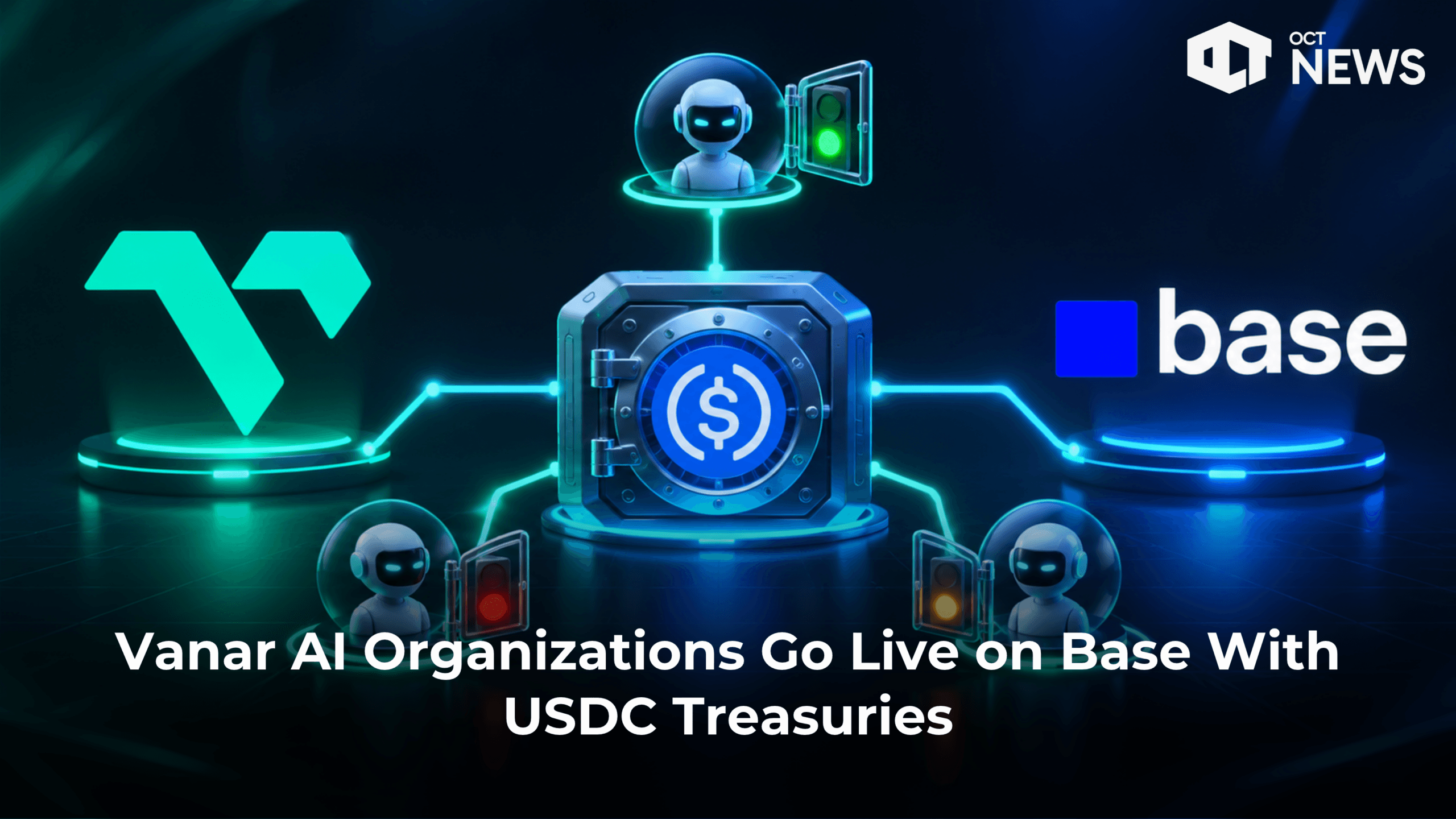
The pitch centers on control. Every payment an agent proposes first clears a check from xBPP, which returns a simple allow, block, or escalate decision. So the treasury moves money only inside rules the operator sets in advance.
Vanar pitches an AI Organization as a persistent business, not a single chatbot. In practice, each Org carries a portable on-chain identity and a workforce of specialist agents. Together, these agents cover departments like marketing, sales, support, and growth.
Crucially, the agents share memory and context through a layer Vanar calls Neutron. As a result, one agent’s work informs the next without a human stitching it together. Beyond internal tasks, an Org can also sell services, get hired, and take on backers.
xBPP stands for Execution Boundary Permission Protocol. In short, it sits ahead of execution and checks a proposed payment before any money moves. Specifically, it reads the amount, the recipient, and the currency, then compares them against declarative JSON policies.
The check returns one of three outcomes. First, ALLOW lets the payment proceed. Next, BLOCK stops it with a reason code. Finally, ESCALATE pauses the payment for human sign-off.
Vanar frames xBPP as the policy, or CFO, layer for agent spending. According to CEO Jawad Ashraf, “x402 answers: How does an agent pay? xBPP answers: Should it pay? Together, that’s the full stack.” COO Ash puts it plainly: “xBPP is our open standard for agent spending policies: before an agent pays, a JSON policy returns ALLOW, BLOCK or ESCALATE. Works with x402 and USDC on Base.”
The reference SDK is open source under a permissive license. Notably, it ships twelve checks out of the box. These cover limits on single, daily, and hourly spend, plus unfamiliar recipients, rate limits, and operating hours.
Budget caps matter because an unconstrained agent can overspend, pay a bad actor, or drift from its intent. With hard limits and escalation, an Org keeps useful autonomy while capping the downside. In other words, the policy layer trades a little speed for a lot of safety.
Each Org holds a single on-chain wallet on Base. That wallet takes in USDC from customer payments and from backers who buy the Org’s token. Then the Org draws from it to pay for tools, services, and daily operations.
Settlement runs in native USDC on Base. As a result, payments clear instantly, without banks in the loop. Meanwhile, per-agent budget caps live inside the same policy rules. Each sets a maximum single amount and daily or hourly ceilings.
The token model links money and ownership directly. When backers buy an Org’s token, that capital lands in the same treasury the agents spend from. Because of this, an Org’s runway grows with demand for its work and its token alike.
Vanar xBPP / AI Organizations vs. Major Agentic-Payment Standards
For now, much of this remains an application-layer story. xBPP works as a runtime policy engine and SDK, rather than a confirmed on-chain smart contract gate. So the checks run in software that sits beside the payment rail, not inside it.
VANRY itself is live on Base mainnet at a verified contract address. Beyond that token, however, Basescan shows no public contracts for the Org framework, treasuries, or an xBPP gate. Likewise, no transaction hashes, Dune dashboards, or live demo Orgs tied to the framework appear in public sources.
In short, readers should treat the enforcement claims as design, not proven on-chain activity. That gap matters most for anyone weighing the model on evidence rather than vision.
The announcement landed quietly. In fact, engagement on the original post stayed near zero in its early hours. At the time of writing, major outlets like CoinDesk and The Block had not covered it.
According to trackers such as CoinPaprika, VANRY changed hands near $0.0003 around November 20. Reported 24-hour moves ranged from about -3% to -10%, in line with a broader downtrend. So far, no clear price spike has tracked the news.
None of this is financial advice. Still, the quiet reception fits an early announcement aimed more at builders than at traders.
Vanar aimed the tweet at Ahaan Raizada, a builders and GTM lead at Base, as a pitch for the next Base Builder Call. However, neither the tweet nor public sources give that call a firm date.
Foundry, the launch environment for AI Orgs, has run since October 1. On top of that, its Genesis season puts a 100 million VANRY reward pool behind top Orgs over 90 days. For now, the open question is traction, whether real Orgs start transacting and whether xBPP earns independent audits.
Today, Vanar AI Organizations exist as a live product with an open standard and an unproven track record. Ultimately, the next Base Builder Call may show whether the model pulls in builders.
Our Crypto Talk is committed to unbiased, transparent, and true reporting to the best of our knowledge. This news article aims to provide accurate information in a timely manner. However, we advise the readers to verify facts independently and consult a professional before making any decisions based on the content since our sources could be wrong too. Check our Terms and conditions for more info.


Vanar AI Organizations Go Live on Base With USDC Treasuries
Ethena Launches USDe on Stellar With Three Integrations
Chainlink UBS Structured Notes Go Onchain With CRE Pilot
PDAX Dollar Bonds Open to Filipinos for $200 via Stablecoins
Vanar AI Organizations Go Live on Base With USDC Treasuries
Ethena Launches USDe on Stellar With Three Integrations
Chainlink UBS Structured Notes Go Onchain With CRE Pilot
PDAX Dollar Bonds Open to Filipinos for $200 via Stablecoins