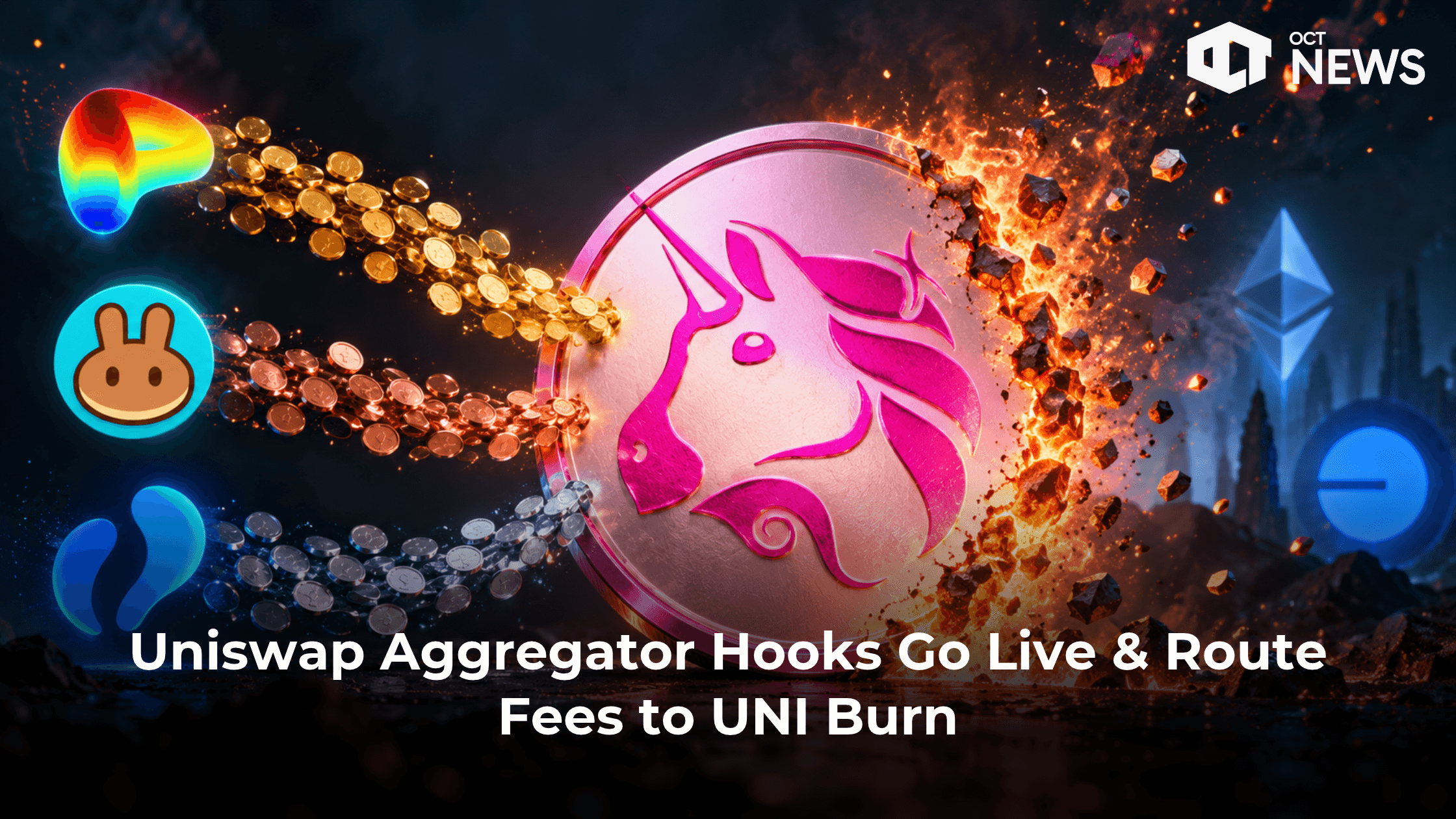
Uniswap Aggregator Hooks connect external DEX liquidity to v4, with protocol fees from routed swaps contributing to UNI burns.

Author: Kritika Gupta
23rd October 2026- Uniswap Labs turned its v4 protocol into an aggregator. The new Uniswap Aggregator Hooks wrap outside liquidity sources so they behave like native v4 pools. They are live now in the Uniswap Web App and API on Ethereum, Base, and Robinhood Chain.
High Signal Summary For A Quick Glance

𝗪𝗵𝗮𝘁𝗜𝘀𝗕𝗿𝗲𝘄𝗶𝗻𝗴.𝗰𝗿𝗼 📈
@WhatIsBrewing_

@Uniswap The competitive shift is from hosting all the liquidity to owning the route. External venues can keep the pools while Uniswap captures a protocol fee on swaps routed through these hooks. Execution quality after fees is what makes that stick.
https://t.co/Intu2d6Dg2
04:31 AM·Oct 23, 2026

Crypto Board
@cryptobtoday
@Uniswap Turning outside liquidity into v4 pools through hooks is a smart way to get depth without fragmenting it. Who bears the risk if one of the wrapped sources misprices or goes dry mid swap?
https://t.co/Intu2d6Dg2
11:45 PM·Oct 22, 2026

Kyle Salzar
@KyleSalzar
@Uniswap Aggregation makes total cost per swap the scoreboard. robinhood:0x2d8d6f4a93acd7a916a5a654ec8b690ba3b3eadd hook pools on Robinhood Chain add a 0.05% hook fee on each side, and it isn't leakage: it funds staker rewards (and locked liquidity, in pools that activate it). Does the
https://t.co/Intu2d6Dg2
09:37 PM·Oct 22, 2026

Simon
@simonc11
@Uniswap Outside of official hooks, hooks are mostly used by scammers. Thanks for that Uniswap.
https://t.co/Intu2d6Dg2
09:04 PM·Oct 22, 2026
High attention and emotional sentiment detected.
The idea is simple on the surface. Instead of sending you to a rival venue, Uniswap pulls that venue into its own router. As a result, a single swap can mix Uniswap pools and external pools in one transaction.
A v4 hook is a smart contract attached to a pool. It can run custom logic at set points, such as before or after a swap. So developers can extend behavior without changing the core protocol.
An aggregator hook holds no liquidity of its own. Instead, it forwards each trade to an external venue like a Curve or Fluid pool, then settles the result back through Uniswap. To the router and the user, it looks like a normal v4 pool.
The router then queries these hooks every block for fresh quotes. Next, it builds the most efficient route across native pools and the wrapped sources. Finally, it settles everything in one transaction, and no new token approvals are required.
Uniswap published the implementation as open-source code. You can read it in the v4-hooks-public repository on GitHub.
Uniswap says seven external sources are available at launch. Together, it claims they cover more than 90% of decentralized exchange activity on the three chains. The company also reports more than $4.5 trillion swapped across its protocol to date.
The official announcement did not name the exact seven, however. The developer docs and the public GitHub list instead point to source types. Those include Curve, Fluid, PancakeSwap V3, Slipstream, Uniswap V2 and V3 forks, LitePSM, and Tempo.
So the headline coverage figure is hard to verify directly. Uniswap also did not detail the measurement period or method behind the 90% claim.
Uniswap v4 Aggregator Hooks vs. standalone aggregators
The launch ties directly into the UNIfication proposal from November 2025. That framework first described aggregator hooks alongside a wider fee switch and UNI burn plan.
Here is the key mechanic. Swaps routed through the wrapped external sources pay a protocol fee. That fee then feeds the burn mechanism and reduces UNI supply over time.
Founder Hayden Adams framed the move plainly. “We took the logic of an aggregator and smushed it into a Uniswap v4 hook,” he wrote on X. He added that native Uniswap liquidity carries no added margin. External routes, meanwhile, pay just a couple basis points of UNI protocol fees.
Not everyone reads this as a brand-new launch. According to on-chain analysis by Chord, the hooks have existed since at least February 2026, and first swaps appeared in April 2026.
Chord also measured the early volume. It reports roughly $2.85 billion routed through the hooks across about 88,000 swaps by late on October 22. Most of that flow came from Sky’s LitePSM, which often paid no protocol fee at all.
Fee collection looked small as well. Chord counted around $2,059 of fees gathered into the burn-linked TokenJar contract at the time of its review. Its coverage estimates also ran lower than the official figure. It put the figure near 74% on Ethereum, 88% on Base, and 81% on Robinhood Chain.
These numbers are independent research, not official data. Still, they suggest the near-term burn impact stays modest for now.
Uniswap Aggregator Hooks: liquidity sources and UNI burn
The design raises a pointed question. Uniswap now earns protocol fees on volume that ultimately settles on rivals like Curve, Fluid, and PancakeSwap. Critics therefore frame this as free-riding on competitor liquidity.
Supporters counter that users simply get the best route in one click. Meanwhile, external venues still receive the trade flow and their own swap fees. So far, no major pushback from Curve, Fluid, or PancakeSwap teams has surfaced publicly.
Analysts also flag the usual aggregator risks. For example, quotes can drift between the moment of pricing and execution. In addition, routing power could concentrate if most traders default to Uniswap’s app and API.
For now, Uniswap Aggregator Hooks face one real test: routed volume after fees and gas. Only sustained flow through fee-paying sources will drive meaningful UNI burn. Early data, as noted, points to a slow start rather than a sudden surge.
UNI price action stayed muted around the news. The token traded near $7.40 to $7.62 on October 21, slipped toward $7.00 on October 22, then recovered into the low $7 range on October 23. The concurrent CME UNI futures launch on October 19 adds noise to that picture.
Watch three things next: which chains and sources get added, whether fee rates rise above a few basis points, and how much volume keeps flowing once the launch buzz fades. This article is informational and not financial advice.
Our Crypto Talk is committed to unbiased, transparent, and true reporting to the best of our knowledge. This news article aims to provide accurate information in a timely manner. However, we advise the readers to verify facts independently and consult a professional before making any decisions based on the content since our sources could be wrong too. Check our Terms and conditions for more info.


Uniswap Aggregator Hooks Go Live & Route Fees to UNI Burn
Drift Protocol Exploit Sends $122M to Tornado Cash
Dusk Domains Goes Live on Mainnet With .dusk Names
Harmony to ShutDown Block Explorer Wiping Pre-2025 Data
Uniswap Aggregator Hooks Go Live & Route Fees to UNI Burn
Drift Protocol Exploit Sends $122M to Tornado Cash
Dusk Domains Goes Live on Mainnet With .dusk Names
Harmony to ShutDown Block Explorer Wiping Pre-2025 Data

Uniswap