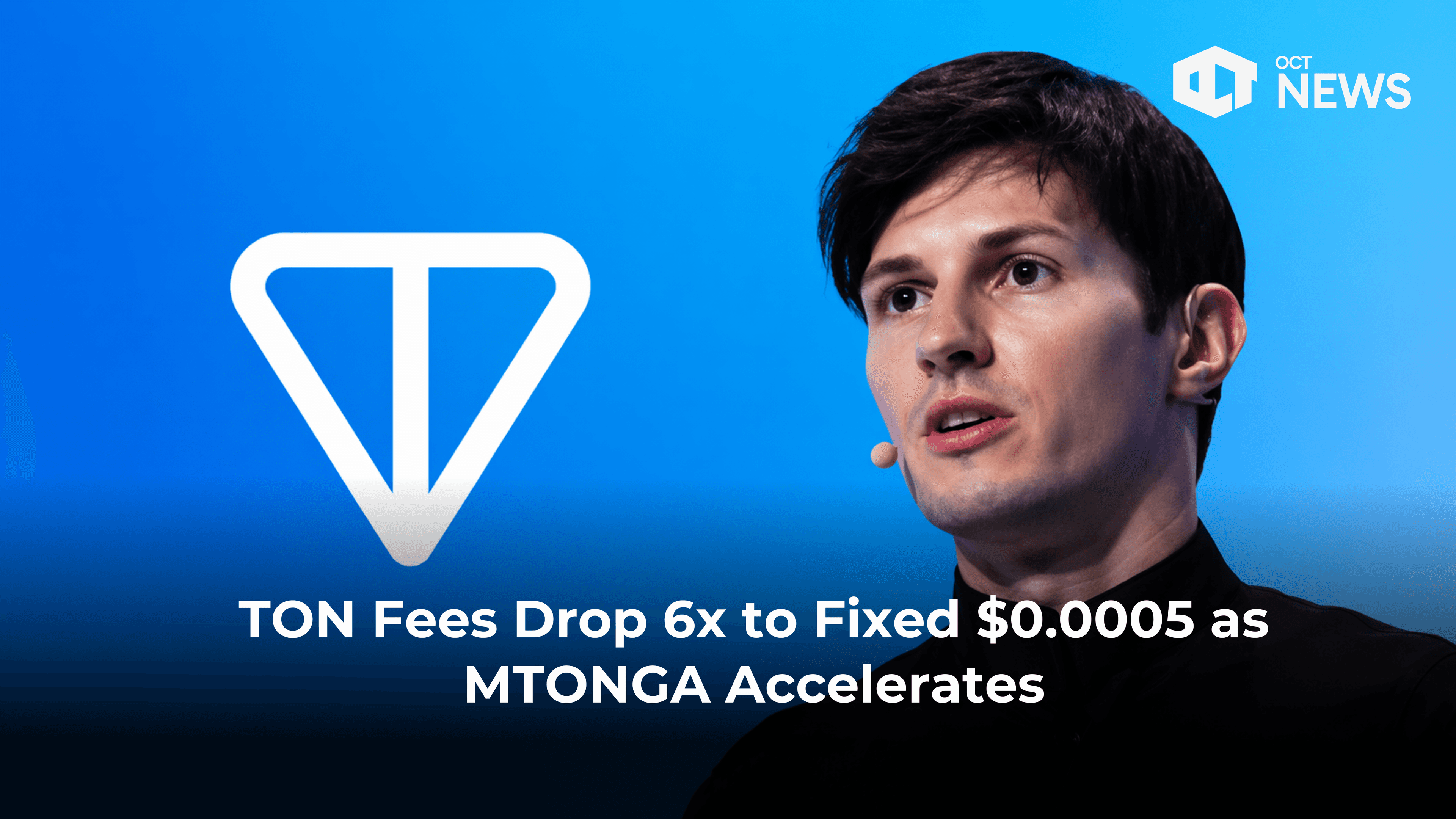
TON fees drop 6x to a fixed rate as Pavel Durov pushes feeless transactions, aiming to make Telegram payments seamless and cost-free.

Author: Akshat Thakur
24th April 2026 – Pavel Durov announced on Wednesday that TON transaction fees will drop sixfold in one week to a fixed rate of 0.00039 TON, roughly $0.0005 at current prices. Most transactions will soon become completely feeless with zero commission.
High Signal Summary For A Quick Glance

Viktor 🧡
@s0meone_u_know

@durov This is massive for Agentic AI, day-to-day transactions, micropayments & gaming 👀🔥 Make TON Great Again 🗽💎 https://t.co/jhTHCCuDci

⚡️ In one week, TON fees will drop 6× — to just 0.00039 TON (~$0.0005) per transaction, fixed regardless of network load. 🆓 Soon after most transactions go fully feeless. Zero commission. MTONGA!
06:31 PM·Apr 23, 2026

Anotida Msiiwa
@anomsiiwa
@durov How do you plan to prevent massive bot spam and network congestion once the transactions go completely feeless?
⚡️ In one week, TON fees will drop 6× — to just 0.00039 TON (~$0.0005) per transaction, fixed regardless of network load. 🆓 Soon after most transactions go fully feeless. Zero commission. MTONGA!
05:22 PM·Apr 23, 2026

Mr. Satoshik
@MrSatoshik
@durov $MTONGA is already a whole movement to make $TON great again!
⚡️ In one week, TON fees will drop 6× — to just 0.00039 TON (~$0.0005) per transaction, fixed regardless of network load. 🆓 Soon after most transactions go fully feeless. Zero commission. MTONGA!
05:22 PM·Apr 23, 2026
Steady attention without excessive speculation.
Durov shared the news in a post on X. The new fixed rate applies regardless of network congestion. This eliminates the variable pricing that previously made TON fees unpredictable during peak activity.
The change marks the second concrete step in Durov’s “Make TON Great Again” (MTONGA) initiative. The first was the Catchain 2.0 upgrade, which delivered sub-second block times and sixfold faster overall performance.
The sixfold fee cut sets every transaction at a flat 0.00039 TON. At current prices near $1.28, according to CoinGecko data, that translates to roughly half a cent per transaction.
Catchain 2.0 made this possible. The upgrade improved block production, state management, and validator coordination across the network. Those efficiency gains allow the base gas price to drop without compromising security.
Targeted parameter tweaks handle the rest. By adjusting the protocol’s fee floor, the TON Foundation locks costs at a predictable level for developers and users alike.
For context, Solana averages about $0.00025 per transaction. Ethereum layer-2 networks typically charge $0.01 to $0.10. TON’s new rate lands in competitive territory with the cheapest chains in the market.
Durov said most transactions will go fully feeless soon after the initial cut. He has not shared the exact implementation details yet.
The expected model involves a hybrid approach. High-frequency and low-value operations would be subsidized through ecosystem revenue, staking rewards, or deflationary token dynamics. Only spam-prone transactions would retain minimal fees to protect the network.
Validators currently earn income from transaction fees. Under the new model, compensation could shift toward staking participation and network growth incentives. Durov has signaled confidence that increased activity will more than offset the loss of fee revenue.
That theory remains untested at scale. Whether staking yields and ecosystem revenue can fully replace per-transaction income is the central question for TON validators in the coming weeks.
Key milestones in TON and MTONGA Fee Reductions
TON begins as a Telegram-backed blockchain project aimed at enabling seamless payments and mini-app integrations within messaging.
Following regulatory pressure, TON evolves into an independent network, powering tokens, NFTs, and Telegram’s growing on-chain ecosystem.
Network performance improves significantly with sub-second block times and major throughput gains under the MTONGA initiative.
TON fees are set to drop 6x to a fixed ultra-low rate, with plans for near-feeless transactions to enhance mass adoption and scalability.
TON originated as Telegram’s internal blockchain project in 2018 with a $1.7 billion ICO. Regulatory pressure from the SEC forced it to spin out as an independent layer-1 in 2020. Telegram settled with regulators, paying $18.5 million and returning $1.2 billion to investors.
Since then, the TON Foundation rebuilt the network independently. Telegram deepened its integration starting in 2023, adding native wallet functionality, mini-app support, and in-app token transfers.
Today, TON powers mini-apps, wallets, and payments for a user base that exceeds one billion monthly active users. Sub-second confirmations from Catchain 2.0 already removed the speed barrier. Fixed and eventually zero TON fees remove the cost barrier.
For developers, the economics shift dramatically. A game, payment flow, or tokenized collectible inside Telegram can now run at virtually no marginal cost. That opens the door to micro-payments, real-time social rewards, and frictionless NFT transfers that were previously uneconomical on any chain.
AI agents running inside Telegram mini-apps also stand to benefit. Feeless transactions could enable on-chain interactions for automated services, tokenized communities, and agent-to-agent payments without eating into margins.
The announcement drew immediate attention on X. Replies ranged from celebratory “MTONGA!” memes to practical questions about validator incentives and spam prevention.
Some community members asked how the network will prevent abuse once fees drop to zero. Spam mitigation is a known challenge for feeless chains. Networks like IOTA and Nano have faced sustained spam attacks that exploited their zero-fee designs.
Durov has framed the entire MTONGA sequence as a deliberate push. In previous public comments, he emphasized that TON must match the speed and simplicity of Telegram itself. The network has to serve hundreds of millions of everyday users, not just crypto natives.
No external party has issued a competing statement on this specific announcement.
MTONGA is a seven-part plan. Durov has disclosed two steps so far. Catchain 2.0 handled speed. The fee reduction handles cost. The remaining five steps have not been announced.
The pace is aggressive. Catchain 2.0 rolled out recently, and the fee cut follows within weeks. The rapid timeline signals that Durov intends to move through the full roadmap before momentum fades.
The sixfold fee reduction activates in one week. The fixed 0.00039 TON rate goes live across the network at that point.
Shortly after, most transactions shift to feeless operation. Developers and infrastructure providers have already received advance notice to update indexers, wallets, and dApps for the new parameters.
For validators, the transition tests whether staking yields and ecosystem revenue can fully replace fee income. For users, the goal is simple: on-chain actions should feel as seamless as sending a Telegram message. The fees are falling on schedule, and the next weeks will show whether zero-cost transactions drive the mass adoption Durov has been building toward.
Our Crypto Talk is committed to unbiased, transparent, and true reporting to the best of our knowledge. This news article aims to provide accurate information in a timely manner. However, we advise the readers to verify facts independently and consult a professional before making any decisions based on the content since our sources could be wrong too. Check our Terms and conditions for more info.


Securitize Stocks Launches Tokenized Equities on Solana
Stellar Settles First Institutional Repo Using Tokenized Treasury Collateral
Uniswap Aggregator Hooks Go Live & Route Fees to UNI Burn
Drift Protocol Exploit Sends $122M to Tornado Cash
Securitize Stocks Launches Tokenized Equities on Solana
Stellar Settles First Institutional Repo Using Tokenized Treasury Collateral
Uniswap Aggregator Hooks Go Live & Route Fees to UNI Burn
Drift Protocol Exploit Sends $122M to Tornado Cash