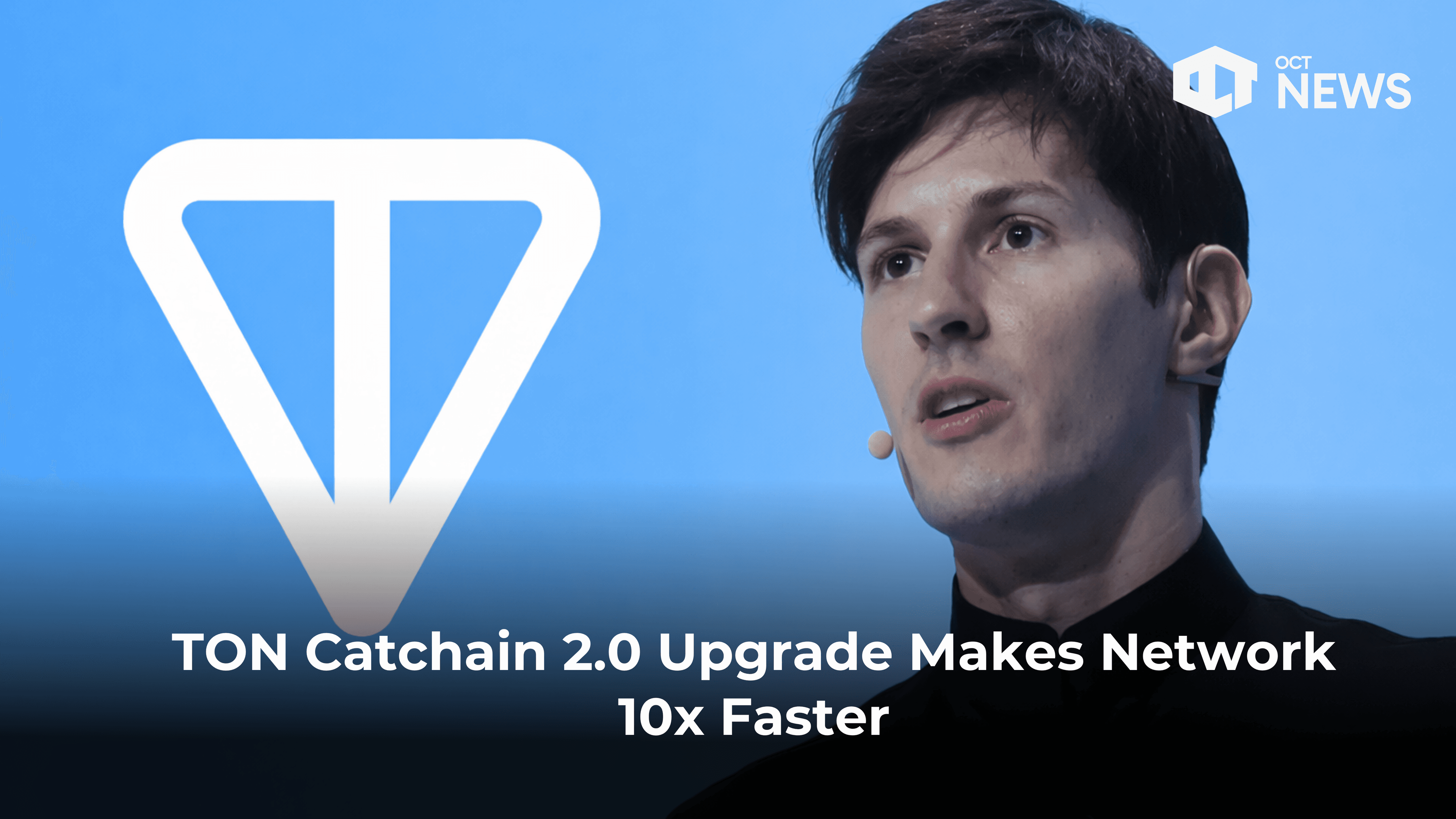
TON Catchain 2.0 upgrade boosts speed 10x with sub-second finality as Pavel Durov outlines MTONGA roadmap for faster and cheaper network.

Author: Akshat Thakur
10th April 2026 – The TON blockchain completed its TON Catchain 2.0 upgrade on April 9, cutting block time sixfold and pushing transaction finality below one second.
High Signal Summary For A Quick Glance

SUPREME
@supremejayx

@durov awesome ! Make TON Great Again
The TON blockchain just got upgraded and is now 10× faster. Block rate increased 6×. Transactions are now instant, subsecond. This was step 1 of 7 to Make TON Great Again (MTONGA). Next step: cut the already low transaction fees by 6×.
03:15 PM·Apr 9, 2026

💎GEM INSIDER💎
@gem_insider
@durov will this pump $TON prices? https://t.co/US6UHowC4k

The TON blockchain just got upgraded and is now 10× faster. Block rate increased 6×. Transactions are now instant, subsecond. This was step 1 of 7 to Make TON Great Again (MTONGA). Next step: cut the already low transaction fees by 6×.
03:13 PM·Apr 9, 2026

defizard
@belizardd
@durov mtonga absolute chad https://t.co/hv5DvKQQD3

The TON blockchain just got upgraded and is now 10× faster. Block rate increased 6×. Transactions are now instant, subsecond. This was step 1 of 7 to Make TON Great Again (MTONGA). Next step: cut the already low transaction fees by 6×.
03:08 PM·Apr 9, 2026
Steady attention without excessive speculation.
Pavel Durov announced the upgrade through a post on X. He called it the first of seven planned improvements under the banner “Make TON Great Again,” or MTONGA. As a result, the next step on the roadmap is a sixfold reduction in transaction fees.
Validators approved the TON Catchain 2.0 upgrade by a supermajority exceeding 85 percent. It went live on mainnet the same day. TON’s official X account echoed the news hours later with a simple “Make TON Great Again” reply.
Before the upgrade, TON produced blocks roughly every 2.5 seconds. Finality took around 10 seconds. Because of that delay, users had to wait before a payment was truly settled on the network.
Catchain 2.0 sliced block time to about 400 milliseconds. Payment settlement now takes roughly one second. According to Durov, the overall network speed improved tenfold as a result of the consensus overhaul.
Catchain is TON’s custom Byzantine-fault-tolerant consensus layer. It coordinates a dynamic set of validators who rotate block production duties. Specifically, the 2.0 version optimizes how those validators stream state updates and finalize blocks without the old multi-second lag.
The core team flagged the change in advance so node operators could prepare. Indexers and RPC providers now handle six times as many blocks per minute. That shift required services across the ecosystem to update their infrastructure ahead of the switchover.
TON sits on top of the largest installed base any blockchain can claim. Telegram has more than one billion monthly active users. Most chains fight for users. In contrast, TON faces the opposite challenge: scaling to match the traffic Telegram could send its way.
Sub-second confirmations shrink the gap between tapping “send” and knowing the money moved. That turns a clunky crypto payment into something closer to Venmo or Cash App for a global audience that never asked for private keys or gas limits.
On top of that, faster finality raises the ceiling for high-frequency use cases. Real-time trading inside mini-apps, instant settlements between friends, and tokenized collectibles all benefit from the speed bump. Decentralized apps on TON can now target response times that feel like ordinary web or mobile software.
Solana currently produces blocks roughly every 400 milliseconds, so TON’s new block time now matches that benchmark. Ethereum’s layer-1 finality still sits around 12 to 15 minutes, although layer-2 rollups like Arbitrum and Optimism offer faster soft confirmations.
The difference for TON is distribution. Neither Solana nor Ethereum L2s have a built-in gateway to one billion chat users. If Telegram’s mini-app ecosystem pushes even a fraction of that audience on-chain, TON could handle throughput that competing networks would struggle to match without the same integration advantage.
Still, raw speed alone does not guarantee adoption. Developer tooling, wallet UX, and reliable bridge infrastructure all play a role. Competing chains have years of ecosystem maturity that TON is still building.
Telegram first proposed a blockchain-based payment system in 2018. The project raised $1.7 billion through a Gram token sale, making it one of the largest ICOs at the time.
The U.S. Securities and Exchange Commission filed an emergency action in October 2019. The agency alleged that Gram tokens were unregistered securities. Telegram settled in June 2020, returned $1.2 billion to investors, and paid an $18.5 million civil penalty.
After the settlement, an independent community of developers picked up the open-source code. They continued building what became TON. The TON Foundation, a Swiss non-profit, now oversees ecosystem development.
Telegram reintegrated TON through in-app wallets, mini-apps, and native payments starting in 2023. Games like Notcoin and Hamster Kombat drove millions of on-chain wallets in 2024 and 2025. That growth gave the network a user base most chains would envy.
Durov did not reveal the full seven-step plan in his post. He confirmed only the second move: slashing transaction fees by another factor of six. That would push costs even lower on a network already known for cheap transfers compared with Ethereum or Solana.
In concrete terms, TON’s current average fee sits well below one cent. A sixfold cut would make transactions nearly free for end users, which could remove the last psychological barrier to everyday payments inside Telegram chats.
The remaining steps are still under wraps. Earlier public comments from Durov have hinted at tokenized stickers, emojis, and revenue sharing for creators who build on the chain. The pattern points toward tighter Telegram integration and more developer tooling.
The immediate technical lift is done. TON is already running at the new speed. Fee compression could roll out within weeks if the same validator consensus process holds.
If the upgrades land cleanly and mini-app developers respond, TON could see a surge of new activity. If friction remains or competing chains match the pace, the momentum may prove temporary.
For now, the TON Catchain 2.0 upgrade has delivered the headline performance jump Durov promised. The next six steps will determine whether MTONGA translates into measurable growth inside the world’s biggest messaging platform.
Our Crypto Talk is committed to unbiased, transparent, and true reporting to the best of our knowledge. This news article aims to provide accurate information in a timely manner. However, we advise the readers to verify facts independently and consult a professional before making any decisions based on the content since our sources could be wrong too. Check our Terms and conditions for more info.