Tether CEO unveils Hypersearch, a DHT-based decentralized search engine built by its engineering team, expanding beyond stablecoins.

Author: Akshat Thakur
Steady attention without excessive speculation.
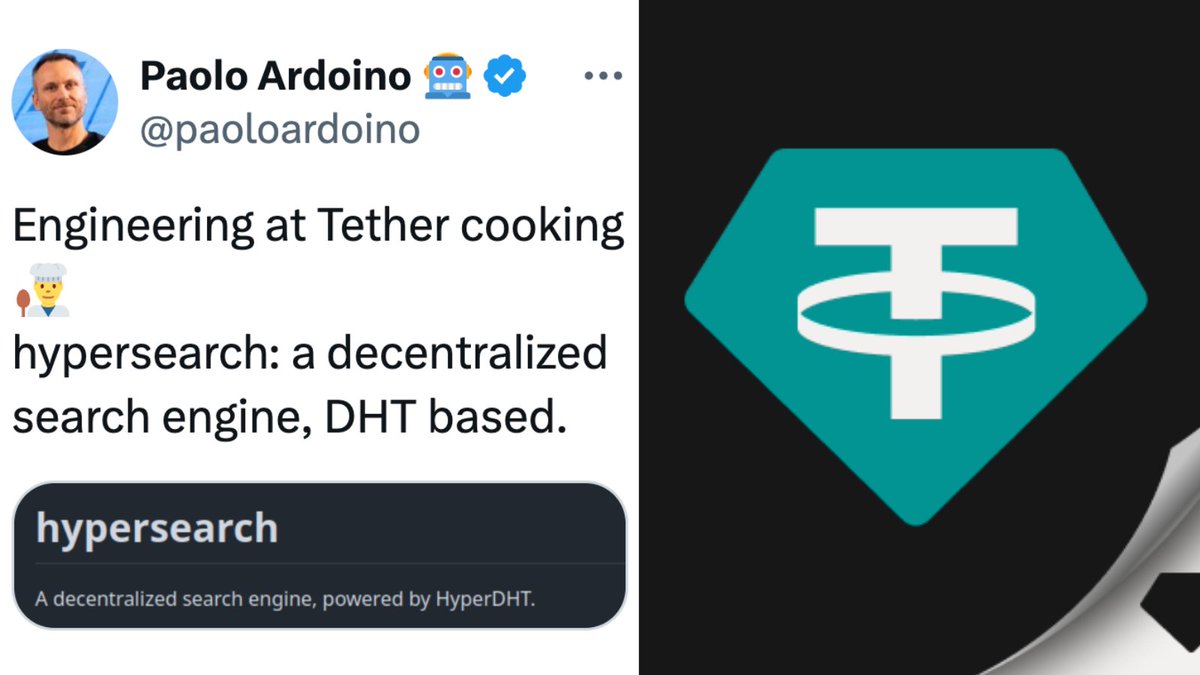
April 8, 2026– Tether CEO Paolo Ardoino revealed that his engineering team is building Hypersearch. The project is a decentralized search engine powered by DHT technology. Ardoino shared the news through a post on X, marking Tether’s latest push beyond stablecoins.
High Signal Summary For A Quick Glance

CoinDesk
@CoinDesk

LATEST: @paoloardoino says @tether engineering is working on "hypersearch," a decentralized search engine built on DHT-based infrastructure. https://t.co/PgnXigEXpD

03:23 PM·Apr 7, 2026

DEGEN NEWS
@DegenerateNews
NEW: @tether CEO @paoloardoino SAYS THE COMPANY IS COOKING A DECENTRALIZED SEARCH ENGINE https://t.co/D9BAtKUIwk
01:57 PM·Apr 7, 2026

Cointelegraph
@Cointelegraph
🔥 JUST IN: Paolo Ardoino reveals Tether is building Hypersearch, a decentralized search engine. https://t.co/KPLSsOD8U1

01:50 PM·Apr 7, 2026
In the post, Ardoino described the project as “Engineering at Tether cooking hypersearch: a decentralized search engine, DHT based.” Shortly after, Cointelegraph amplified the announcement, which included an image of the project’s progress.
Tether has spent the past two years diversifying beyond USDT. Specifically, the company has invested in Bitcoin mining, energy infrastructure, AI initiatives, and data centers. In 2024 alone, Tether reported $13 billion in profit. As a result, it has significant capital for ambitious projects.
Tether Hypersearch fits an existing pattern. The company previously backed Holepunch, a peer-to-peer platform. It also funded Keet, a decentralized communication app built on the Hypercore protocol. Both rely on distributed networking, just like Hypersearch.
Meanwhile, search remains one of the most centralized layers of the internet. Google controls roughly 91% of the global search market. Most blockchain explorers and news aggregators still depend on centralized backends. Because of this, a decentralized alternative could reduce reliance on commercially biased platforms.
DHT technology distributes data across a network of participating nodes. Instead of a central database, lookups happen through key-based routing across many peers. BitTorrent popularized this approach, and its DHT network currently supports over 25 million active nodes daily.
As a result, this design makes the search engine resistant to control by any single entity. No company or government can unilaterally remove content from the index.
Tether has not released a whitepaper yet. However, based on the DHT foundation, Hypersearch likely uses a peer-to-peer model for shared indexing. Tether’s resources could help solve challenges that limited previous decentralized search efforts.
Decentralized search is not a new concept. Projects like Presearch and YaCy attempted it before. Similarly, Brave Search operates with some decentralized elements. Still, none have come close to challenging Google.
The core technical hurdles include relevance ranking, spam resistance, and scalability. In contrast, centralized engines use massive server farms and proprietary algorithms refined over decades. Replicating that quality on a distributed network remains unsolved at scale.
Tether’s advantage, however, is resources. With USDT’s $144 billion market cap and daily volume exceeding $50 billion, the company has both capital and a distribution channel. Whether that translates into a competitive search product remains to be proven.
Paolo Ardoino took over as Tether CEO in December 2023. Since then, he has pushed the company’s infrastructure expansion aggressively. His personal announcement of Tether Hypersearch suggests real internal commitment.
Notably, the phrasing “engineering at Tether cooking” implies active development. This is not a roadmap slide or concept paper. Tether’s own engineers are building it.
That commitment from a company generating billions annually carries weight. Still, no timeline or beta access details have been shared yet.
The project remains in active development. Tether has not announced a launch date, testnet, or beta program. Therefore, more technical details may emerge in the coming weeks.
If successful, Hypersearch could join USDT in a broader Tether ecosystem. Users could then search for on-chain data, dApps, and blockchain information through a censorship-resistant tool. Integration with Keet and Tether’s mining operations also remains possible.
For now, the announcement confirms Tether’s continued investment in decentralized infrastructure. The crypto industry will watch for technical documentation, open-source releases, and progress on the hard problems of decentralized search.
Our Crypto Talk is committed to unbiased, transparent, and true reporting to the best of our knowledge. This news article aims to provide accurate information in a timely manner. However, we advise the readers to verify facts independently and consult a professional before making any decisions based on the content since our sources could be wrong too. Check our Terms and conditions for more info.