A single wallet withdrew removed 11% of STO Token Supply from Binance, leading to a 1500% pump before a huge dump followed.

Author: Sahil Thakur
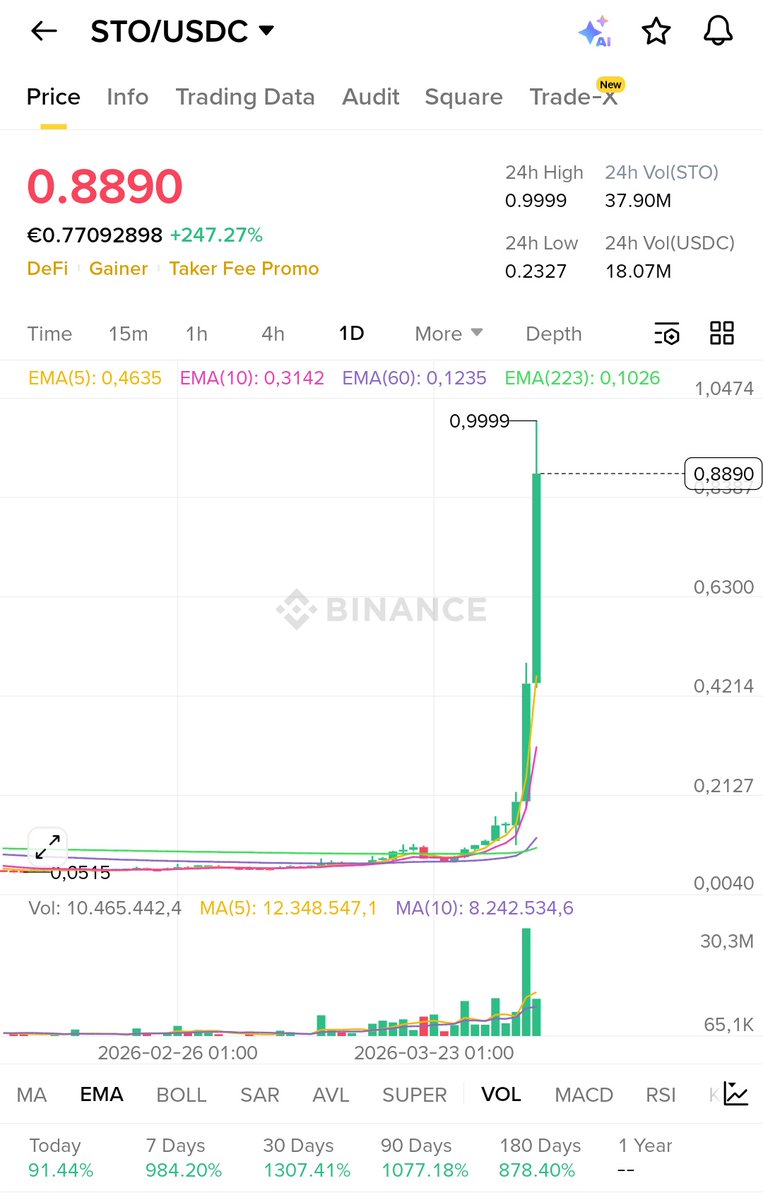
3rd April 2026 – A single wallet withdrew 25.5 million StakeStone STO tokens from Binance in one transaction, removing 11% of circulating supply. The move triggered a 1,500% price surge that peaked at $1.74 before crashing over 60%.
High Signal Summary For A Quick Glance

Evening Trader Group
@Eveningtraders

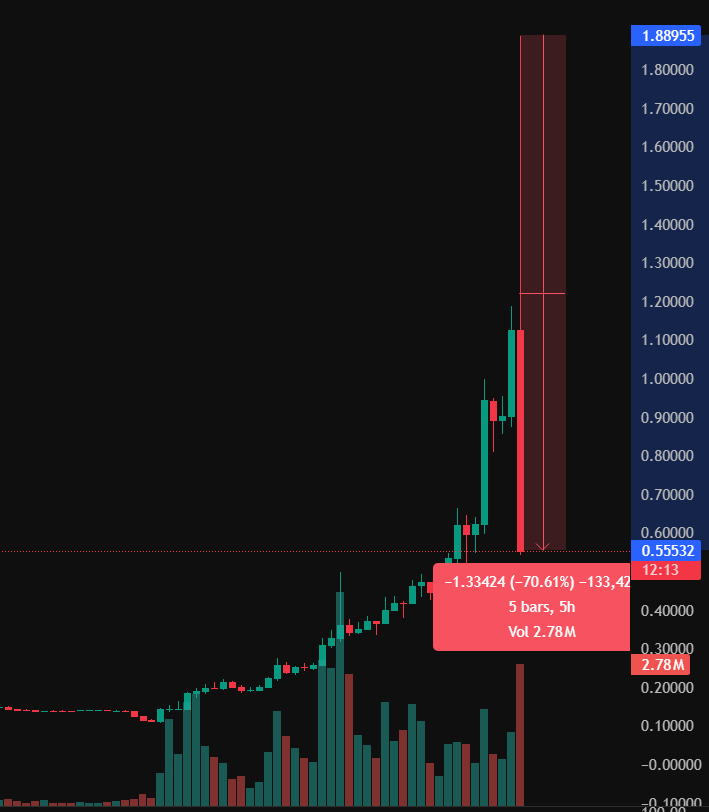
$STO (@Stake_Stone) just nuked over -70% in a single candle 😱 24h volume hit $1.45B, more than 10x its current market cap The team had been depositing tokens to CEX about a week prior Price then exploded +1500% into peak liquidity Now it looks like a textbook distribution https://t.co/YdOX1PY9oW
09:58 AM·Apr 2, 2026

Boku
@BokuNoCrypto
Who pump crimed $STO 😭 From 0.05 to 1$ in few days My airdrop peanuts become stimmy but i already sold 🤣 Idk if you remember stakestone, in past they launched a pre-deposit campaign for Berachain, and gave like 200-300 tokens to all https://t.co/0MOUuI29cL
06:56 AM·Apr 2, 2026

onchainschool.pro
@how2onchain
$STO : TOKEN MOVEMENT A large holder, who has withdrawn tokens worth more than $5M from Binance in the last 3 days, has transferred everything to a new wallet. Profit is 40%+ at the moment We continue to monitor the movement of tokens. Wallet: https://t.co/xMyjAi7YYf

11:34 AM·Apr 1, 2026
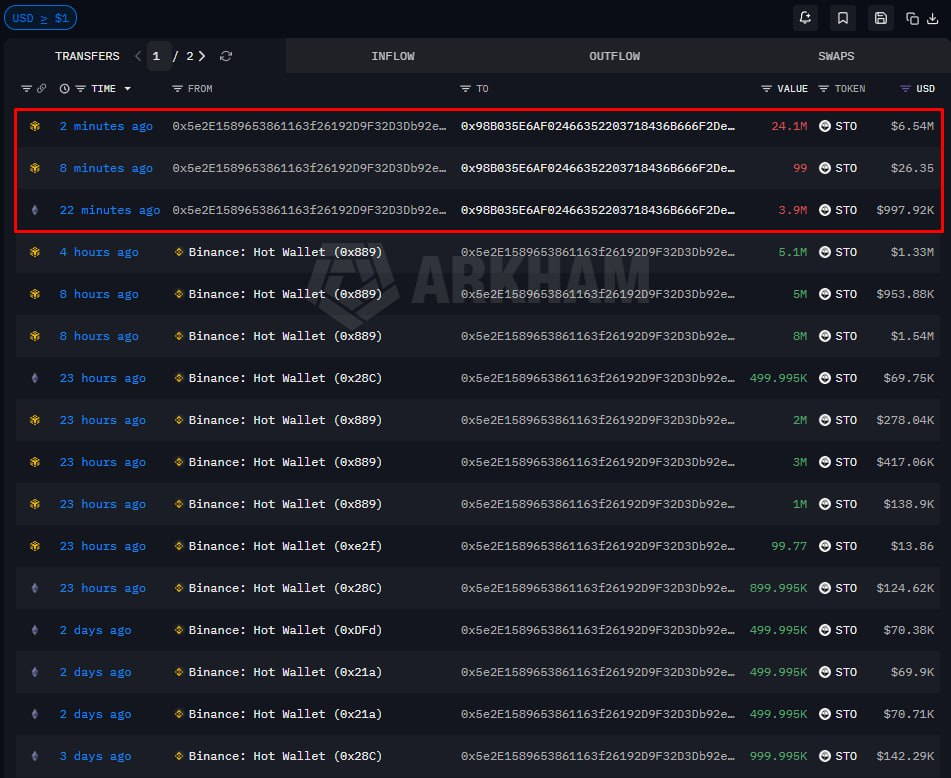
The wallet was created just days before the withdrawal. It had no prior transaction history. On or around April 1, it pulled $4.85 million worth of the StakeStone STO token off Binance in a single move, draining the exchange’s sell-side liquidity.
STO had been trading at $0.05 in early February. By the end of March it had climbed to $0.11. Then the withdrawal happened and the price started moving because there was simply nothing left to sell into.
As a result, the price doubled to $0.26 within hours of the withdrawal. It kept going. $0.50. $0.80. $1.20.
Within 72 hours, STO hit an all-time high of $1.74. At the same time, 24-hour trading volume reached $1.63 billion against a market cap of roughly $125 million. In other words, volume was nearly 13 times the entire market cap in a single day.
Only 22.5% of STO’s total 1 billion supply is currently in circulation. The rest is held by early investors, the team, and locked allocations. So when 11% of an already thin float disappears from an exchange, even modest buying pressure can move the price dramatically.
Shortly after STO hit its peak, a second newly created wallet deposited 28 million tokens onto Gate.io. That represented 12% of circulating supply moving back onto an exchange.
When large amounts of tokens return to exchanges after a pump, it typically signals that someone is preparing to sell. The crash came fast. STO dropped over 60% from its peak within hours.
People who bought at $1.50 were sitting at $0.60 the same afternoon. At the time of writing, the StakeStone STO token is trading around $0.40.
Beyond the immediate price action, the timing of the pump raises additional questions. According to CryptoRank data, the one-year vesting cliff for team tokens (15% of total supply), investor tokens (21.5%), and ecosystem treasury tokens (4%) expires on April 3, 2026.
That means approximately 405 million tokens, or 40.5% of total supply, begin linear unlocking starting today. The pump occurred just two days before this cliff expired.
Whether someone was front-running the unlock or creating exit liquidity ahead of a massive supply increase is unclear. But the timing is difficult to ignore.
StakeStone is a decentralized omnichain liquidity protocol that creates yield-bearing versions of major assets across more than 20 blockchains. According to official documentation, its core products include STONE for ETH and SBTC for BTC.
The project raised $22 million in a strategic round led by Polychain Capital in November 2024, with participation from Binance Labs, OKX Ventures, and HashKey Capital. BingX invested an additional $10 million in February 2025.
StakeStone also announced a partnership with World Liberty Financial, the Trump-associated DeFi project, to provide cross-chain liquidity infrastructure for the USD1 stablecoin. While some outlets cited this partnership as a bullish narrative driver, on-chain evidence points to supply removal as the primary catalyst.
The withdrawal wallet, identified as 0x5e2E, had no transaction history before the event. Similarly, the deposit wallet that moved 28 million tokens onto Gate.io was also newly created. Neither wallet has been attributed to a known entity.
The pattern is consistent with a supply squeeze. Remove enough tokens from an exchange to collapse available liquidity, let FOMO-driven buying push the price higher, then deposit tokens back onto a different exchange to sell into the elevated price.
The 28 million token deposit also exceeds the 25.5 million withdrawal by 2.5 million tokens. This suggests the actor may have acquired additional tokens elsewhere, although it could also be a different entity entirely.
This type of supply manipulation is not new. According to Chainalysis research, over 4,800 suspected pump-and-dump events were identified in a six-month period across crypto markets.
Low-float tokens are especially vulnerable to this kind of activity. When a large percentage of supply is locked or vesting, the circulating float becomes thin enough for a single actor to move the market. STO’s 22.5% circulating supply made it a textbook candidate.
For comparison, the Mango Markets manipulation in 2022 demonstrated a similar principle. Avraham Eisenberg moved $114 million using a different mechanism, but the underlying dynamic was the same: thin liquidity in crypto markets allows outsized manipulation by individual actors.
At the time of writing, StakeStone has not issued a public statement about the price movement or the wallet activity. Binance and Gate.io have also not commented on the transactions.
Without wallet attribution, it is impossible to determine whether the activity involved insiders, early investors, or an unrelated third party. As a result, the identity of the wallet owner remains unknown.
The immediate concern is the vesting unlock. With 405 million tokens beginning to enter circulation, STO holders face sustained sell pressure in the weeks and months ahead.
The broader takeaway is structural. A token with only 22.5% of supply in circulation, concentrated exchange liquidity, and no circuit breakers can be moved 1,500% by a single wallet in a single transaction. That is the reality of trading low-float tokens on centralized exchanges.
This is not investment advice. Anyone holding or considering STO should do their own research and understand the risks associated with low-liquidity tokens facing large upcoming unlocks.
Our Crypto Talk is committed to unbiased, transparent, and true reporting to the best of our knowledge. This news article aims to provide accurate information in a timely manner. However, we advise the readers to verify facts independently and consult a professional before making any decisions based on the content since our sources could be wrong too. Check our Terms and conditions for more info.


Securitize Stocks Launches Tokenized Equities on Solana
Stellar Settles First Institutional Repo Using Tokenized Treasury Collateral
Uniswap Aggregator Hooks Go Live & Route Fees to UNI Burn
Drift Protocol Exploit Sends $122M to Tornado Cash
Securitize Stocks Launches Tokenized Equities on Solana
Stellar Settles First Institutional Repo Using Tokenized Treasury Collateral
Uniswap Aggregator Hooks Go Live & Route Fees to UNI Burn
Drift Protocol Exploit Sends $122M to Tornado Cash