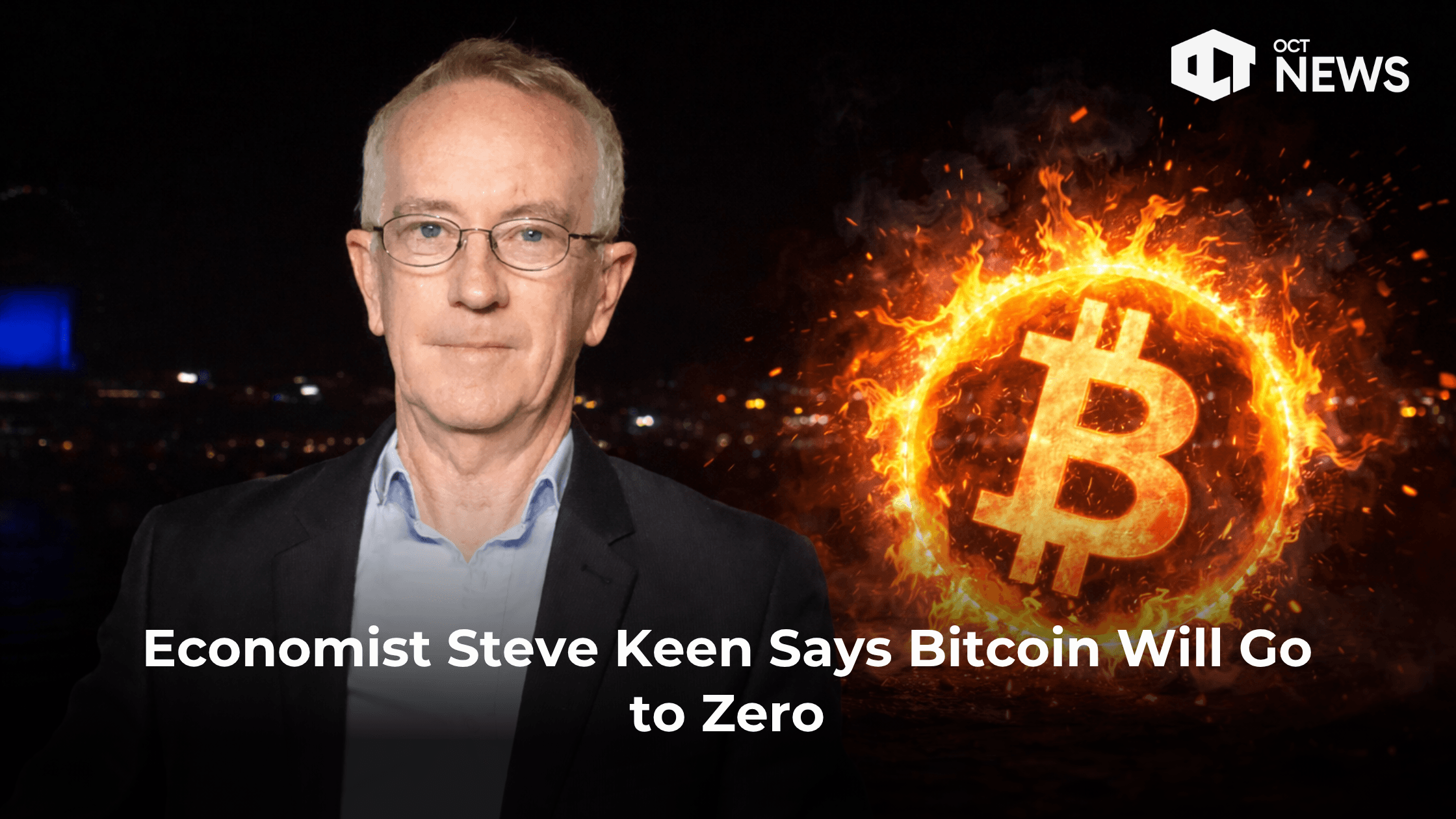
Economist Steve Keen, who predicted the 2008 crash, warns Bitcoin will go to zero, calling it a speculative bubble despite its $2T market cap.

Author: Arushi Garg
Steady attention without excessive speculation.
April 7, 2026: Professor Steve Keen, the economist known for predicting the 2008 Global Financial Crisis, warned in a post on X that “Bitcoin is going to zero.”
The longtime cryptocurrency critic reiterated his view that Bitcoin lacks intrinsic value and depends on speculative demand. He also pointed to its energy consumption, calling it unsustainable and characteristic of a broader financial bubble. The warning comes as Bitcoin trades near record highs, with its market capitalization hovering around the $2 trillion mark. The contrast highlights a persistent divide between academic skepticism and the asset’s continued growth in mainstream financial markets.
High Signal Summary For A Quick Glance

Brian's Beacon
@BriansBeacon

@AltcoinDaily I love this clip because it shows an example of somebody who really hasn't done any deep research on Bitcoin. Bitcoin converts the cheapest, most marginal, and often wasted energy on Earth into the hardest form of money ever invented. A global monetary network that can't be
JUST IN: Professor Steve Keen who predicted the 2008 financial crash now is warning people "Bitcoin is going to zero." https://t.co/P7g6rP0k2m
03:57 AM·Apr 7, 2026

Lord
@LordAkumaaa
@AltcoinDaily If Bitcoin goes to anything less than $10,000, people will grab the rest of the remaining bitcoin.
JUST IN: Professor Steve Keen who predicted the 2008 financial crash now is warning people "Bitcoin is going to zero." https://t.co/P7g6rP0k2m
02:58 AM·Apr 7, 2026

Gary Cardone
@GaryCardone
@AltcoinDaily My boys at @AltcoinDaily; Few of these academia are fuck off rich!!’ May I suggest listening to predictions made by book worms who are not stupid rich should say a whole lot! Just saying, follow players, not slayers.
JUST IN: Professor Steve Keen who predicted the 2008 financial crash now is warning people "Bitcoin is going to zero." https://t.co/P7g6rP0k2m
01:04 AM·Apr 7, 2026
Professor Steve Keen is an Australian economist who rose to prominence for accurately predicting the 2008 Global Financial Crisis. As early as 2005, he warned that dangerously high levels of private debt would trigger a severe collapse once credit growth slowed.
Mainstream economists largely ignored this view at the time. His debt-deflation models, inspired by Hyman Minsky, later proved prescient and established his reputation as a critic of conventional economic thinking.
Keen has been a consistent opponent of Bitcoin since its early years. He argues that the cryptocurrency has no intrinsic value, relies on energy-intensive mining, and behaves like a speculative bubble rather than a true currency or store of value.
Contrasting Steve Keen’s critique with Bitcoin’s observed market and network performance
Professor Steve Keen delivered his latest warning as part of an ongoing public commentary series where he applies his debt-deflation theories directly to cryptocurrency markets. He continues to view Bitcoin as an energy-intensive speculative asset with no productive cash flows, arguing that its value is entirely dependent on perpetual new buyer inflows rather than any intrinsic economic utility.
Although Keen has maintained this position for more than a decade, the latest statement comes during a period of record market capitalization and increasing institutional involvement in Bitcoin. Keen cited no new data in his latest remarks, repeating arguments he has made in prior years.
OCT reached out to Professor Keen for additional comment and had not received a response at the time of publication.
While Keen’s warning reflects a long-standing academic critique of Bitcoin, the market response so far suggests limited immediate impact. The divergence between traditional economic frameworks and crypto market behavior continues to define the debate.
Our Crypto Talk is committed to unbiased, transparent, and true reporting to the best of our knowledge. This news article aims to provide accurate information in a timely manner. However, we advise the readers to verify facts independently and consult a professional before making any decisions based on the content since our sources could be wrong too. Check our Terms and conditions for more info.