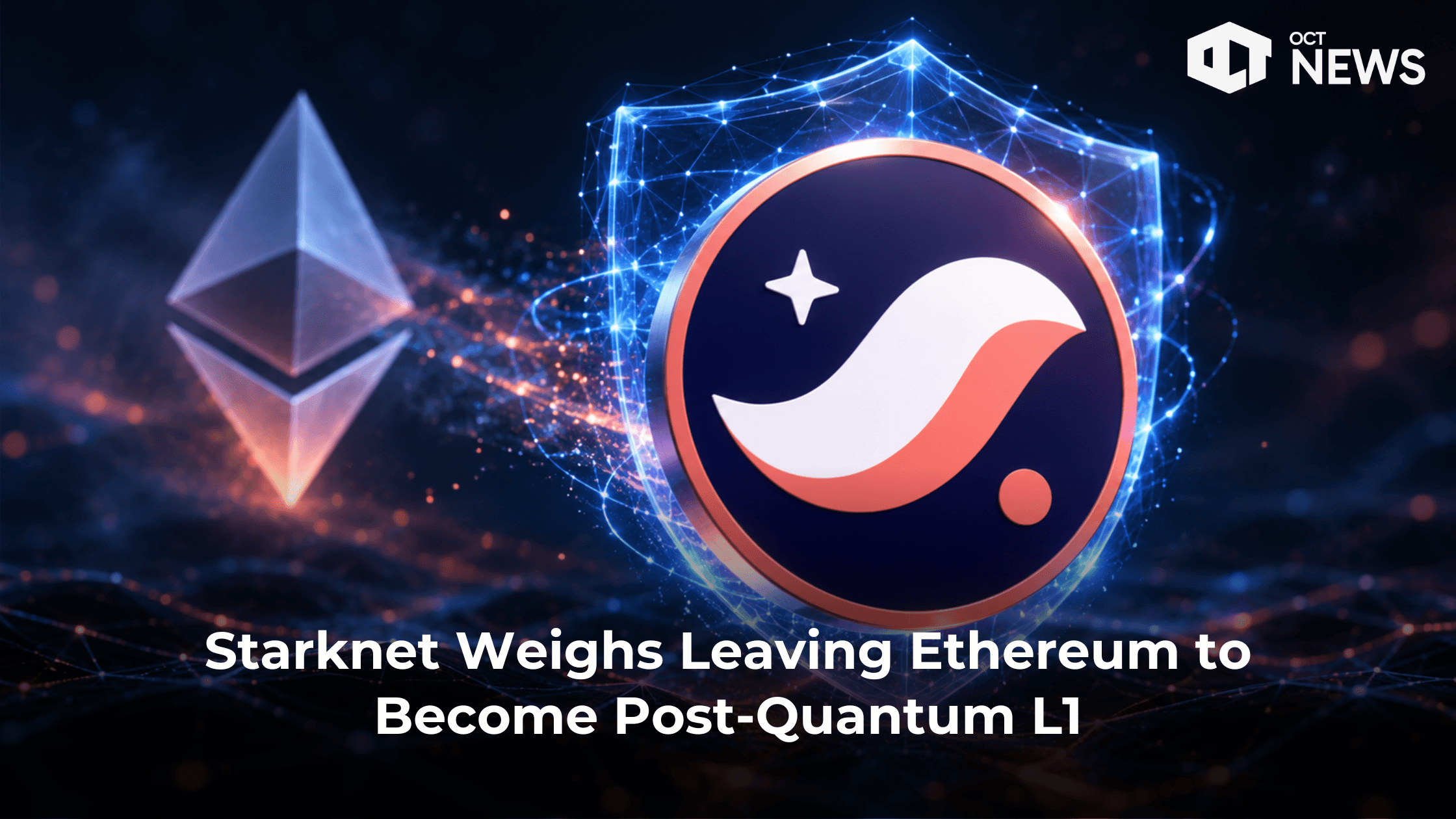
Starknet post-quantum L1 research goes to a non-binding governance poll, exploring independence from Ethereum with STRK remaining the token.

Author: Kritika Gupta
15th October 2026 – Starknet has opened a non-binding governance poll. It asks STRK holders a direct question. Should the network research becoming an independent post-quantum Layer 1? The poll is research-only, so a Yes vote does not approve any move. Instead, it would start a formal research effort and lead to more detailed proposals later. Meanwhile, bridges from Ethereum to Starknet stay open, and STRK remains the token.
High Signal Summary For A Quick Glance

showkat
@Kalid_bin_walid

@Starknet Voting yes. Starknet’s tech is built for a post-quantum future, so it should have its own chain 🐱$starknet$3
Starknet is exploring a path towards becoming an independent post-quantum L1. A governance post is now live with a non-binding poll for STRK holders to share their views. https://t.co/89bUM2zTR2
08:55 AM·Oct 15, 2026

HEISGIFT
@heisgift
@Starknet post-quantum as an l1 path is a big call curious what the community actually votes for tho
Starknet is exploring a path towards becoming an independent post-quantum L1. A governance post is now live with a non-binding poll for STRK holders to share their views. https://t.co/89bUM2zTR2
08:28 AM·Oct 15, 2026
High attention and emotional sentiment detected.
The governance forum post went live around 07:31 UTC on October 15. Shortly after, the official @Starknet account announced the live poll at 07:45 UTC.
Voting runs on Snapshot and closes on October 22. STRK stakers and delegators can take part, and an early snapshot showed zero votes across the options.
There are three choices. First, Yes, this should be researched. Second, No, this shouldn’t be researched. Third, Neutral, I need more information.
Each outcome points somewhere specific. A Yes starts research toward later proposals and polls. A No keeps post-quantum work going while Starknet stays an L2. A Neutral simply keeps the discussion open.
The pitch rests on control over timelines. According to the forum post by author henrli, the parts of Starknet Ethereum under its own control can become quantum-resistant soon.
However, the parts that depend on Ethereum, such as the bridge and data availability, are tied to Ethereum’s schedule. As a result, the team argues that a Starknet independent L1 would remove that dependency.
The urgency traces back to early October. On October 8, StarkWare CEO Eli Ben-Sasson posted a thread framing the quantum threat as possibly much closer than expected. He also pointed to fast-moving AI and called for a defensive “bunker mode.”
Then, on October 10, StarkWare went further. The firm called a Starknet independent L1 its “clearest path forward,” so the poll formalizes a direction the team already favors.
Starknet’s evolution and its proposed post-quantum L1 research
Starknet launches in stages as a ZK validity rollup on Ethereum.
The major STRK airdrop expands token participation in the ecosystem.
StarkWare outlines three phases of quantum-readiness work, with the final phase dependent on Ethereum upgrades.
StarkWare publicly discusses an independent L1 as a path toward greater control over security upgrades.
The community is asked whether to research an independent post-quantum L1. The poll does not approve a transition.
A “Yes” result would initiate research leading to more detailed proposals and polls.
Any actual transition would require later dedicated governance. No binding vote or L1 launch date is confirmed.
Starknet is a ZK validity rollup that settles on Ethereum using STARK proofs. Importantly, STARKs rely on collision-resistant hash functions rather than the elliptic-curve math that quantum computers threaten.
Because of that design, the core proving system is already considered quantum-resistant. In addition, users can adopt post-quantum signatures through account abstraction without a hard protocol upgrade.
The remaining risks are surface-level. A three-phase roadmap published on June 30 addresses them one by one. For example, it swaps Pedersen hashing for BLAKE2, adds signatures like Falcon-512, then tackles bridge messaging and blob data availability.
Starknet: Ethereum L2 today vs. proposed independent post-quantum L1
The team has tried to limit the surprises. According to the forum post, STRK stays the token, and the project will not issue a new one. Furthermore, bridges from Ethereum to Starknet will stay open regardless of the result.
Still, the security model would change in a real way. Today, Starknet inherits Ethereum’s economic security, finality, and data availability. As an independent L1, it would instead provide its own consensus, security, and data availability.
In that scenario, STRK would also carry more weight as a native gas and staking asset. So the token’s role expands even though its supply plan does not.
The upside is speed and agility. By owning its stack, Starknet could push quantum and crypto-agility upgrades on its own timeline rather than Ethereum’s.
The costs are real, though. Leaving Ethereum means giving up a large validator set and inherited economic security. It also introduces bridge and liquidity fragmentation risk.
Skeptics also point to usage. Some observers note thin daily activity and revenue against a market cap near $540 million to $570 million in mid-October. Meanwhile, DefiLlama put Starknet TVL around $162 million over the same period.
The market still reacted quickly. After the October 8 discussion, STRK jumped more than 20% in a day and later topped $0.12 before cooling. Around the October 15 announcement, it traded near $0.07 to $0.08, according to OKX data. None of this is financial advice.
Early sentiment leans positive. On X, many STRK holders and ecosystem builders voiced support. They often frame a Yes as backing research, not a decision.
Several accounts amplified the poll and asked to see a concrete plan. Still, more analytical voices stress the tradeoffs and the gap between the L1 narrative and current on-chain usage.
For now, nothing binds Starknet to a transition. If holders vote Yes, a research effort begins and produces more detailed proposals and later, binding governance.
Several questions stay open. The architecture, the validator set, the consensus model, and any L1 launch date remain undefined. Notably, the often-cited 2027 figure is a full quantum-resistance target, not an L1 launch date.
The vote closes on October 22, so the first real signal arrives then. Readers can watch the live coverage and the Snapshot tally as a Starknet independent L1 moves from idea to formal research.
Our Crypto Talk is committed to unbiased, transparent, and true reporting to the best of our knowledge. This news article aims to provide accurate information in a timely manner. However, we advise the readers to verify facts independently and consult a professional before making any decisions based on the content since our sources could be wrong too. Check our Terms and conditions for more info.


Starknet Weighs Leaving Ethereum to Become Post-Quantum L1
Vitalik Backs ZKsync Airbender Prime & Eyes zkEVM Security
StandX Cancels Token Launch and Winds Down Perps
Creo Engine Unites Gaming AI & $CREO in Website Launch
Starknet Weighs Leaving Ethereum to Become Post-Quantum L1
Vitalik Backs ZKsync Airbender Prime & Eyes zkEVM Security
StandX Cancels Token Launch and Winds Down Perps
Creo Engine Unites Gaming AI & $CREO in Website Launch

Starknet