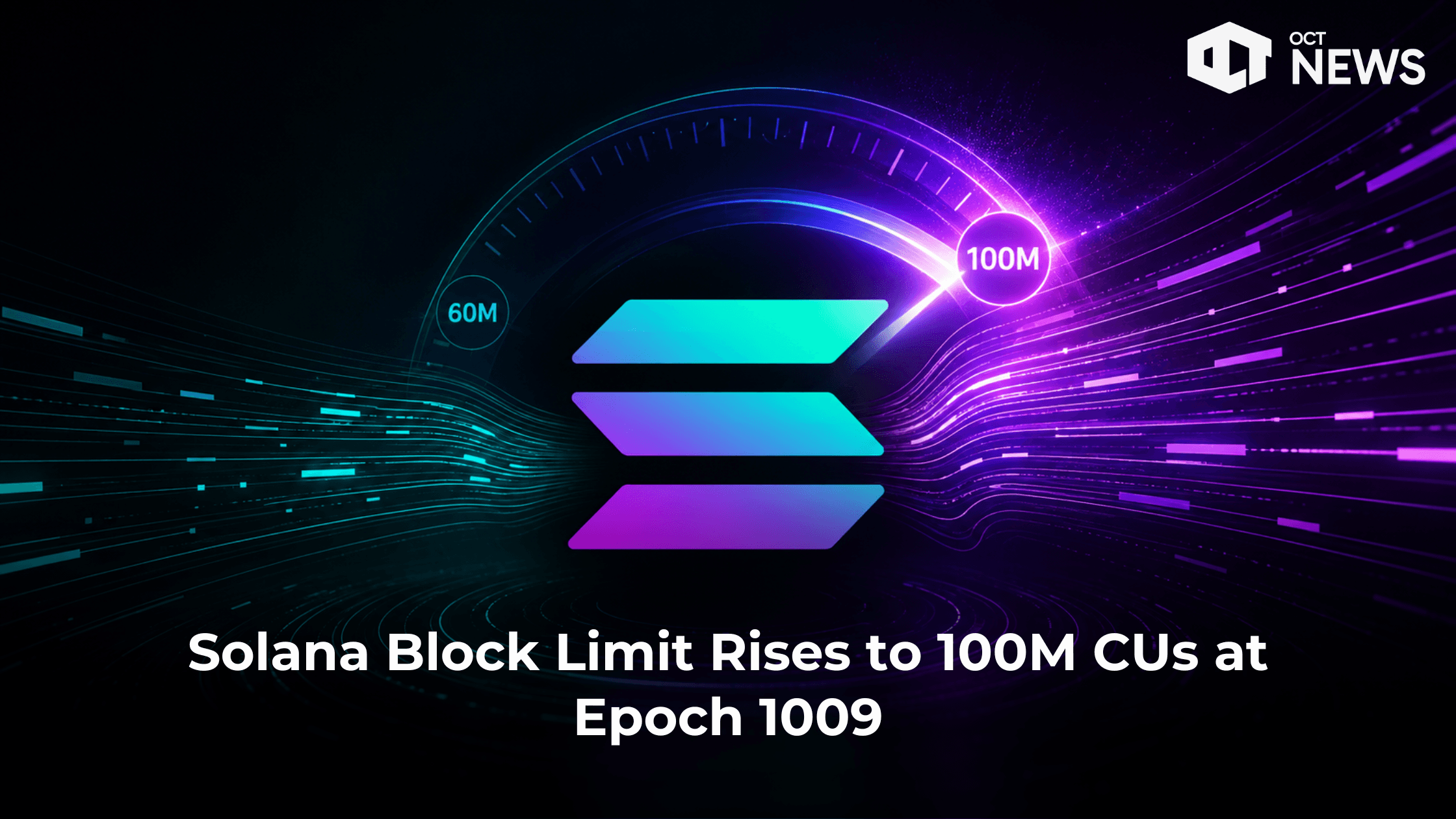
Solana 100M compute units arrive with SIMD-0286, raising block capacity from 60M to 100M and expanding network throughput by nearly 67%.

Author: Kritika Gupta
28th July 2026 – Solana 100M marks the network’s latest major capacity upgrade. Through SIMD-0286, Solana will raise its maximum block compute limit from 60 million to 100 million compute units at the start of Epoch 1009.
The upgrade expands available blockspace by nearly 67%. It aims to support more non-vote transactions, ease congestion during periods of high demand, and improve overall network throughput.
High Signal Summary For A Quick Glance

Yann
@0xYann_

The next @solana upgrade is massive Blocktime: 400ms → 200ms (2x faster) Rent cost: 10x cheaper Transaction size limit: 4x bigger Example: @JupiterExchange swaps are heavy and sometimes need 2 txs. This upgrade turns that into just 1! Faster, cheaper, more data per tx. https://t.co/3gv9S274El
100% faster slots, 90% cheaper rent, 400% transaction size increase Solana v4.2 Activating soon.
12:05 PM·Jul 28, 2026
High attention and emotional sentiment detected.
SIMD-0286 raises only one number. It moves the Max Block Units cap from 60 million to 100 million CUs. As a result, each block can hold about 66% more work.
The other limits stay the same. Max Writable Account Units remains at 12 million. Max Vote Units stays at 36 million. The block accounts data delta holds at 100 MB.
A compute unit measures the work a transaction needs to run. In other words, it is Solana’s version of gas. The block limit then caps the total CUs a leader can pack into one slot.
Lucas Bruder of Jito Labs authored the proposal in May 2025. You can read the full text in the SIMD-0286 document. The pull request merged into the repo on July 23, 2025.
The Solana 100M block limit sets how much execution fits in each 400 millisecond slot. Therefore a higher cap means more room for non-vote transactions. That extra room can ease congestion during demand spikes.
More space can also soften priority fees. If demand does not fill the new capacity, then fee pressure may fall. Still, nothing here is certain.
The change targets non-vote throughput on purpose. Votes already hold their own 36 million CU budget. So the fresh capacity mainly serves apps, traders, and everyday users.
Solana currently processes a few thousand transactions per second, including votes. More block space gives that number room to grow. Yet raw capacity only helps if real demand shows up to use it.
Solana has raised this limit in clear stages. First, SIMD-0207 lifted it to 50 million. Next, SIMD-0256 pushed it to 60 million. Now SIMD-0286 takes it to 100 million.
Brennan Watt of Anza led the 60 million step. Bruder then wrote the 100 million proposal. Each increase followed better client software rather than a sudden leap.
Bruder designed SIMD-0286 to follow the 60 million change, not replace it. In short, the ladder keeps climbing one rung at a time.
Before SIMD-0207, the cap sat near 48 million CUs. Each rung has tracked steady gains in client performance. The pattern shows a network scaling on purpose, not by accident.
Solana’s block compute limit progression
Solana’s block compute limit stood at approximately 48M CUs before the network began its latest capacity expansion cycle.
The first increase in the progression lifted Solana’s maximum block compute limit from roughly 48M to 50M CUs.
Solana expanded block capacity again, increasing the maximum compute budget from 50M to 60M CUs.
The feature-gated upgrade will raise block capacity from 60M to 100M CUs. Activation occurs at the Epoch 1009 boundary, with the exact UTC time dependent on live slot progression.
A 1B CU block limit has been discussed as an aspirational scaling target, but no formal SIMD, activation epoch or implementation date has been announced.
Solana uses a feature gate for the switch. It needs no separate on-chain vote. Once enough stake runs supporting software, the gate flips at an epoch boundary.
Clients already carry the code. Testnet activated the feature near epoch 983. Devnet activated it near epoch 1100. Mainnet is next at Epoch 1009.
Exact timing is hard to pin down. Solana 100M epochs last about two to two and a half days. So the precise UTC moment can shift with real-time slot speeds.
The feature gate lives at a fixed on-chain address. Trackers watch that account to confirm the flip. Explorers such as Solana Beach and Solana Compass show the epoch countdown in real time.
Bigger blocks ask more of validators. Each node must still execute and verify larger blocks inside the same slot. As a result, demands on CPU, memory, and networking rise.
Smaller operators could feel the strain. If marginal nodes drop off, then centralization risk grows. One analyst framed the concern simply: throughput is forgivable, but state is forever.
Higher limits can also speed state growth. More successful transactions mean more data to store over time. So client teams like Anza and Firedancer keep optimizing for the load.
The upgrade does not touch per-account limits. A single hot account still caps at 12 million CUs. So one busy program cannot swallow the whole block on its own.
SOL traded around $73 to $74 near the announcement, per CoinMarketCap and CoinGecko. That marked a drop of roughly 4% on the day. No clear spike tied directly to the upgrade appeared in the data.
The mood on X still leaned bullish. Anza CEO Brennan Watt posted an “epoch 1009 forecast: raining blockspace.” SolanaFloor then amplified the news within minutes.
Secondary outlets picked up the story fast. The Block and CoinDesk covered the 66% lift when Bruder first filed it in 2025. CryptoBriefing confirmed the Epoch 1009 activation this week.
This article is not financial advice. Readers should always do their own research before making any decision.
Anza and Jito have hinted at limits well beyond 100 million. Watt and others have floated targets as high as 1 billion CUs over time. Those goals pair with Firedancer, shorter slots, and Alpenglow.
For now, the network gets its next real test at Epoch 1009. Traders and validators will watch fill rates, fees, and skip rates closely. The true proof arrives in the first days after the Solana block limit climbs to 100 million.
Our Crypto Talk is committed to unbiased, transparent, and true reporting to the best of our knowledge. This news article aims to provide accurate information in a timely manner. However, we advise the readers to verify facts independently and consult a professional before making any decisions based on the content since our sources could be wrong too. Check our Terms and conditions for more info.