Solana 1.0 ends the mainnet beta era as Zelle showcases confidential transfers and ICE outlines its institutional crypto plans.

Author: Kritika Gupta
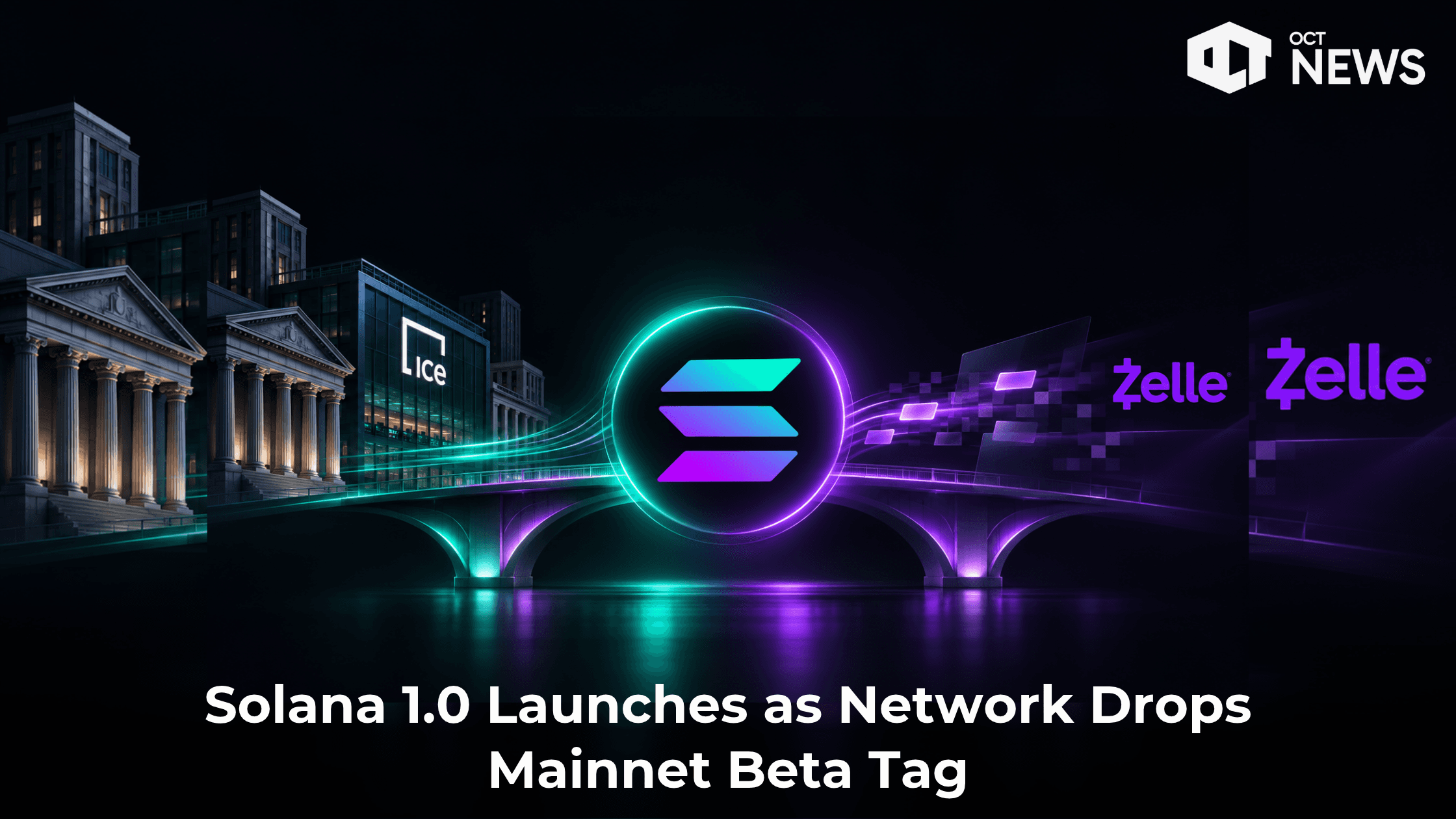
17th November 2026- Solana dropped its “mainnet beta” tag on Monday, rebranding the network as Solana 1.0 at the Breakpoint conference in London.
High Signal Summary For A Quick Glance

Yuna Han
@YunaElira

@solana yeah, six years and eight months in beta — and the graduation day comes with a $1.25M confidential bank transfer live on stage. that's a way to mark it.
Yesterday at Breakpoint, Solana officially left beta. Alongside 1.0, Zelle routed a $1.25M confidential bank transfer live on stage, and ICE announced new onchain lending infrastructure. Announcements: - Solana 1.0 officially marked the network’s graduation from “mainnet beta” https://t.co/kH7UONiIhF
11:10 AM·Nov 17, 2026

Zealynx
@ZealynxSecurity
@solana Leaving beta changes what users and integrators expect when something goes wrong. With 1.0 out, is there now a published process for how upgrades and any network halt get decided and announced, or is that still handled case by case?
Yesterday at Breakpoint, Solana officially left beta. Alongside 1.0, Zelle routed a $1.25M confidential bank transfer live on stage, and ICE announced new onchain lending infrastructure. Announcements: - Solana 1.0 officially marked the network’s graduation from “mainnet beta” https://t.co/kH7UONiIhF
10:41 AM·Nov 17, 2026

CoinW
@CoinWOfficial
@solana Out of beta after all these years 🎓 A live Zelle bank transfer on stage is a pretty great way to graduate. Which Breakpoint announcement caught you most off guard?
Yesterday at Breakpoint, Solana officially left beta. Alongside 1.0, Zelle routed a $1.25M confidential bank transfer live on stage, and ICE announced new onchain lending infrastructure. Announcements: - Solana 1.0 officially marked the network’s graduation from “mainnet beta” https://t.co/kH7UONiIhF
10:37 AM·Nov 17, 2026
High attention and emotional sentiment detected.
The Solana Foundation announced the change on November 16. So after more than five years, the network finally retires the beta label it has carried since launch.
In short, almost nothing changes for users. Your SOL, accounts, assets, apps, and transaction history all stay exactly the same.
According to the Solana Foundation, the move is a naming and versioning milestone. It is not a software update. It also does not activate new consensus rules.
Instead, Solana 1.0 gives the protocol a shared version number. So the two main clients can reference the same rule set independently. Those clients are Agave, built by Anza, and Firedancer, built by Jump Crypto.
The Foundation put it plainly. “For users, this is the same network, nothing changes,” the blog post said. As a result, there are no migrations and no new fees. No action is required either.
The Foundation also coordinated the change with Anza and the Firedancer team. So both client teams now align on a single, shared protocol version. That coordination is the real point of the 1.0 label.
Solana launched its mainnet beta back in March 2020. Yet the beta label stuck around for years. Meanwhile, billions of dollars kept flowing through the network.
Part of the reason was reliability. Between 2022 and early 2024, Solana suffered several outages. One halt in 2023 lasted nearly 19 hours. Another stoppage followed in February 2024.
Since then, the picture has improved sharply. Uptime has held steady since February 2024. Firedancer also reached mainnet in December 2025, which added valuable client diversity.
Then came Alpenglow in October 2026. That upgrade cut finality from roughly 12.8 seconds to about 150 milliseconds. So the Solana 1.0 rename formalizes a production status the network had arguably already earned.
Solana’s journey from mainnet beta to institutional adoption
Solana launches its mainnet beta, beginning the network’s production journey.
An extended network halt raises concerns about Solana’s stability and resilience.
A major outage renews scrutiny of network reliability while the beta designation remains.
At Breakpoint, Solana introduces shared protocol versioning. Existing balances, accounts and applications remain unchanged.
Zelle demonstrates a $1.25 million confidential transfer using test tokens on devnet. ICE and Abra announce institutional lending backed by qualified custody.
The rename grabbed headlines, but two institutional moments did the heavier lifting. First, Zelle took the stage.
Zelle, operated by bank-owned Early Warning Services, demonstrated a $1.25 million confidential transfer of its ZelleUSD stablecoin. The demo used Solana’s Token-2022 confidential transfer extension. That feature keeps the transferred amount encrypted on-chain, while the transfer itself stays verifiable.
Still, one caveat matters a lot. Multiple outlets confirmed the demo ran on Solana devnet. Devnet is a test network, so the showcase used test tokens rather than real money.
The privacy here is also partial, not total. The extension hides only the amount. Sender and receiver addresses stay public, and the network can still verify the transfer. Only authorized parties can decrypt the figure.
Denise Leonhard, Zelle’s general manager, explained the choice of chain. “That piece around trust, security, proven infrastructure is the reason why we chose Solana,” she said on stage.
Zelle also said ZelleUSD will expand to international peer-to-peer payments. According to the company, it is targeting an India corridor by the end of 2026. Anchorage Digital Bank will issue the stablecoin.
Three key announcements from Solana Breakpoint 2026
Next came Intercontinental Exchange, the parent company of the New York Stock Exchange. Hester Serafini, president of ICE Clear Europe, spoke about the firm’s Solana plans.
Serafini said the NYSE’s alternative trading system is already set up to accept tokens minted on Solana. She added that ICE Digital Trust already supports Solana too.
“We’re looking at whether we can become a validator for Solana,” Serafini said. For now, that remains an exploration rather than a firm commitment.
Separately, ICE and Abra announced a custody partnership the same day. Under the deal, ICE Digital Trust will hold segregated, non-rehypothecated collateral for Abra Credit’s institutional loans. The collateral starts with BTC, ETH, and SOL.
Importantly, this is off-chain qualified custody that backs lending. ICE has not built a new on-chain lending protocol on Solana. So the “onchain lending” framing deserves a careful read.
The announcements landed during a weak stretch for crypto. SOL traded near $71 to $73 around November 16 and 17. Over the weekend, it had dipped to about $67.55.
That weekend low was SOL’s weakest level since June. Over the prior week, the token fell roughly 17% amid broad market softness, according to data cited from CoinMarketCap.
So there was no clear announcement-driven rally. Meanwhile, Solana DeFi total value locked sat near $4.75 billion on November 17, according to DefiLlama.
The Solana 1.0 milestone is symbolic more than technical. Yet the timing still matters. Pairing the rename with Zelle and ICE on one stage points to growing institutional attention.
Several key questions also stay open. A mainnet launch date for ZelleUSD is unconfirmed. So is the official token mint. Whether ICE actually runs a validator remains unknown too.
For now, the takeaway is simple. Solana 1.0 closes the beta chapter. The real test is whether these institutional pilots move from devnet demos to live production. This is not financial advice.
Our Crypto Talk is committed to unbiased, transparent, and true reporting to the best of our knowledge. This news article aims to provide accurate information in a timely manner. However, we advise the readers to verify facts independently and consult a professional before making any decisions based on the content since our sources could be wrong too. Check our Terms and conditions for more info.



Solana