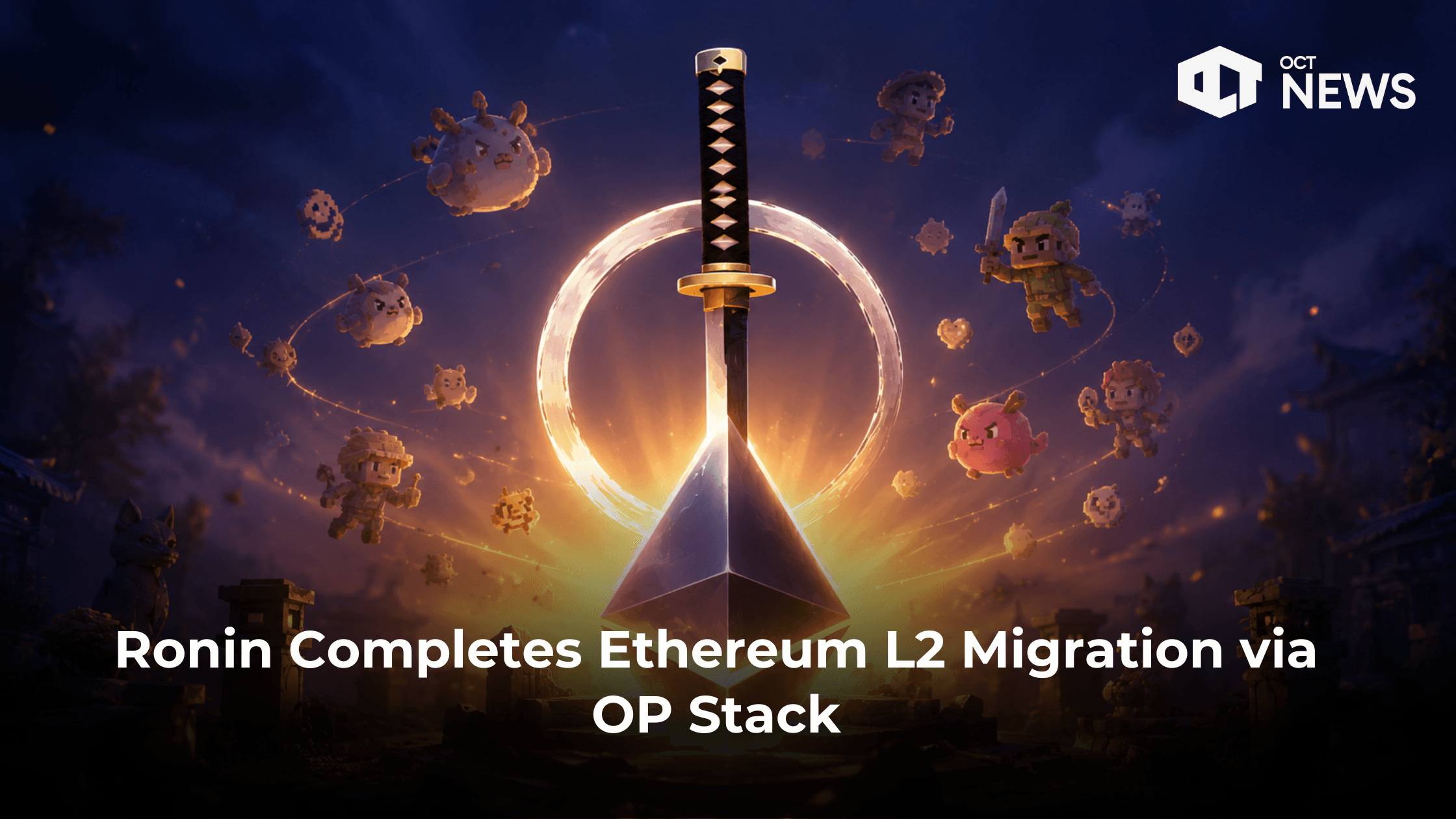
Ronin completed its Ethereum Layer-2 migration via the OP Stack, boosting scalability, interoperability, and Web3 gaming expansion.

Author: Arushi Garg
13th May 2026 – Ronin Network has completed its migration from an independent Ethereum sidechain to a full Layer 2 built on the OP Stack. The transition marks the largest state migration from an L1 to an Ethereum L2 ever conducted.
High Signal Summary For A Quick Glance

TSUBASA 🥷🎮
@tsubasaP2E

@Ronin_Network congrats Ronin
Ronin. Is. Home. Migration to Ethereum complete ⚔ Five years ago, Ronin was a new Ethereum sidechain with a single game aboard: Axie Infinity. Over the years, Ronin emerged as THE gaming chain, onboarding millions of players through more games like Pixels, Cambria, Angry https://t.co/0zjUhPkoAp
08:27 AM·May 13, 2026

Kusakabe
@Nftloser3
@Ronin_Network Congrats! Looking forward to more new games
Ronin. Is. Home. Migration to Ethereum complete ⚔ Five years ago, Ronin was a new Ethereum sidechain with a single game aboard: Axie Infinity. Over the years, Ronin emerged as THE gaming chain, onboarding millions of players through more games like Pixels, Cambria, Angry https://t.co/0zjUhPkoAp
08:26 AM·May 13, 2026

jayveeaxie.ron
@jayveeaxie
@Ronin_Network How to celebrate? There's no airdrop, no Ron price pump to the moon. We are clearly $RON is hopeless
Ronin. Is. Home. Migration to Ethereum complete ⚔ Five years ago, Ronin was a new Ethereum sidechain with a single game aboard: Axie Infinity. Over the years, Ronin emerged as THE gaming chain, onboarding millions of players through more games like Pixels, Cambria, Angry https://t.co/0zjUhPkoAp
08:23 AM·May 13, 2026
The hard fork took place on May 12, 2026 at block 55,577,490. It involved roughly 10 hours of scheduled downtime starting at 15:16 UTC. All prior Ronin state, including balances, smart contracts, and NFTs, carried over to the new L2 chain.
Ronin co-founder Jihoz (Jeff Zirlin) confirmed the completion on X. “Today’s a day we’ve been building towards for years,” he wrote. “Ronin is officially an Ethereum Layer 2.”
Before this migration, Ronin operated as a sovereign sidechain. Nine validators handled all security and consensus. That model carried significant risk, as the 2022 bridge hack demonstrated when attackers stole $625 million.
Now, Ronin functions as an optimistic rollup. Transactions still execute on the Ronin chain, optimized for gaming. But settlement and data availability happen on Ethereum mainnet, with additional support from EigenDA.
According to the team, this shift delivers 50% faster transactions. It also eliminates the need to fund an independent validator set through token inflation.
One of the most significant changes involves RON tokenomics. Annual inflation drops from 45 million RON to 5 million RON, an 89% reduction.
Under the old model, high inflation subsidized validator security costs. With Ethereum now handling settlement, those costs disappear. New treasury streams replace them: 90 million RON from staking reserves, sequencer profits, and a 1.25% marketplace fee.
RON remains the gas token on the network. No new token emerged during the migration. According to DefiLlama, Ronin’s pre-migration TVL sat at roughly $64 million, down 95% from its 2022 peak.
Timeline: Ronin’s journey from Axie Infinity sidechain to full Ethereum Layer 2
Sky Mavis launches Ronin as a dedicated Ethereum sidechain for Axie Infinity, offering low fees and high throughput for blockchain gaming.
The Ronin Bridge suffers a $625 million exploit linked to the Lazarus Group, forcing the network into emergency recovery mode.
Sky Mavis and investors fund full recovery while Ronin upgrades to DPoS, expands validator decentralization, and strengthens bridge security.
Ronin expands beyond Axie Infinity as Pixels, Cambria, Angry Dynomites, and other games onboard millions of new users.
Ronin unveils “Homecoming,” confirming its migration from an independent sidechain to a full Ethereum Layer 2 built on the OP Stack.
The network completes its Ethereum L2 state migration at block 55,577,490 following roughly 10 hours of scheduled downtime.
Ronin officially confirms its Ethereum migration is complete, slashes RON inflation roughly 9x, and activates Proof of Distribution rewards.
For users, the migration required no action. Wallets, balances, and game assets transferred automatically at the fork block. Games like Axie Infinity, Pixels, Cambria, and Angry Dynomites resumed normal operations after the downtime window.
The network auto-unstaked RON for users who had not withdrawn beforehand. The team advised stakers to re-stake after the migration completed.
For developers, the chain retains full EVM compatibility. Node operators now run a reth + op-node setup guided by Conduit, which powered the migration infrastructure. The team also launched Proof of Distribution, a new builder rewards program. It distributes incentives based on on-chain metrics like gas usage, active users, and transaction volume.
The Ronin Ethereum L2 migration carries symbolic weight beyond its technical significance. Ronin launched in 2021 as an Ethereum sidechain built by Sky Mavis specifically for Axie Infinity. High gas fees on Ethereum mainnet made the move necessary at the time.
Then came the March 2022 bridge hack. North Korea’s Lazarus Group exploited the small validator set to drain $625 million. It remains one of the largest DeFi exploits in history. Sky Mavis and its investors funded the recovery.
In the years that followed, the team rebuilt. They launched DPoS staking, expanded to new games, and onboarded millions of users across Southeast Asia and South Korea. The decision to migrate back to Ethereum grew directly from the security lessons of the hack.
“By using Ethereum for security, we no longer have to pay for our own security costs via inflation while inheriting the security of the largest smart contract platform ever created,” Jihoz wrote on X.
How Ronin’s OP Stack migration changes security, costs, inflation, and ecosystem positioning
Despite the milestone, RON’s price action has remained flat. The token trades in the $0.08 to $0.12 range, with a market cap between $64 million and $91 million. Daily trading volume sits around $9 to $10 million.
Post-migration TVL data has not yet shifted materially, according to DefiLlama. The migration completed too recently for large capital flows to register.
Skeptics note that the upgrade must now deliver real liquidity and DeFi inflows to justify its significance. The chain’s TVL remains a fraction of its historical peak.
Several open questions remain. Exact sequencer profit projections and EigenDA usage metrics have not surfaced yet. The timeline for deeper DeFi integrations, such as Uniswap v3 deployment, is also unclear.
The Ronin team framed the migration as the beginning of a new chapter. “We are Ethereum’s gamification engine,” the official account wrote on X. Whether that vision translates into renewed growth depends on what builders and users do next with the upgraded infrastructure.
Community sentiment on X trends positive so far. Conduit, which led the technical execution, called it the largest L1-to-L2 data migration ever completed. No major technical issues have emerged since games resumed post-downtime.
Our Crypto Talk is committed to unbiased, transparent, and true reporting to the best of our knowledge. This news article aims to provide accurate information in a timely manner. However, we advise the readers to verify facts independently and consult a professional before making any decisions based on the content since our sources could be wrong too. Check our Terms and conditions for more info.