
Loading Search...


Author: Tanishq Bodh
The same AI-powered mining network that took over 51% of Monero’s hashrate last year is now targeting Dogecoin. Qubic Dogecoin mining is set to go live on mainnet April 1, 2026, and the infrastructure is already being tested. This is not a whitepaper promise. The dispatcher is live, the first test share has been pushed through the full pipeline, and computors are already picking up tasks.
Here’s what’s actually happening, why it matters, and what it means for Dogecoin miners, $QUBIC holders, and the broader crypto mining landscape.
Qubic is a decentralized blockchain network built around Useful Proof of Work (UPoW). Most proof-of-work blockchains burn massive amounts of energy solving cryptographic puzzles that serve no purpose beyond securing the chain. Qubic takes a different approach. Its mining network directs computational resources toward training Aigarth, its bioinspired AI system built on the Neuraxon architecture.
Instead of miners wasting electricity on meaningless math, Qubic miners get paid to train artificial intelligence. The network operates on a 676-Computor quorum consensus model with zero-fee transactions and a deflationary token emission schedule.
But Qubic didn’t stop at AI training. Over the past year, it proved that its infrastructure could mine other proof-of-work cryptocurrencies simultaneously without sacrificing its core AI mission. That proof came through Monero.
Before Dogecoin, there was Monero.
In August 2025, Qubic crossed a threshold that made headlines across crypto media. The network claimed to have captured over 51% of Monero’s total hashrate, causing a blockchain reorganization over several blocks. This wasn’t a theoretical exercise. Qubic’s distributed compute network generated more than $3.5 million in mining revenue and mined over 26,000 XMR blocks during the process.
The reaction was mixed. Ledger’s CTO called it an “ongoing 51% attack.” Qubic framed it as a technical demonstration of its UPoW model. Regardless of perspective, the takeaway was clear – Qubic possesses real, significant computing power and its outsourced computation model works at scale.
The economic loop was straightforward. Mined XMR rewards were converted into USDT, then used to buy back and burn $QUBIC tokens on the open market. This created deflationary pressure tied directly to real mining revenue, not speculative demand.
But the Monero integration had a limitation. Monero uses the RandomX algorithm, which runs on CPUs. Since Qubic’s AI training (Aigarth) also runs on CPUs and GPUs, the two workloads had to alternate rather than run simultaneously. Mining Monero meant temporarily pausing AI work, and vice versa.
This is exactly what Qubic Dogecoin mining solves.
Dogecoin isn’t just a meme coin. It’s one of the largest proof-of-work networks in crypto with a massive economic footprint. Each Dogecoin block produces 10,000 DOGE, with approximately 14.4 million DOGE mined every single day. At current prices, that translates to roughly $3.4 million in daily emissions.
That’s $3.4 million in fresh value being created every day, distributed to miners. Qubic wants a piece of that flow.
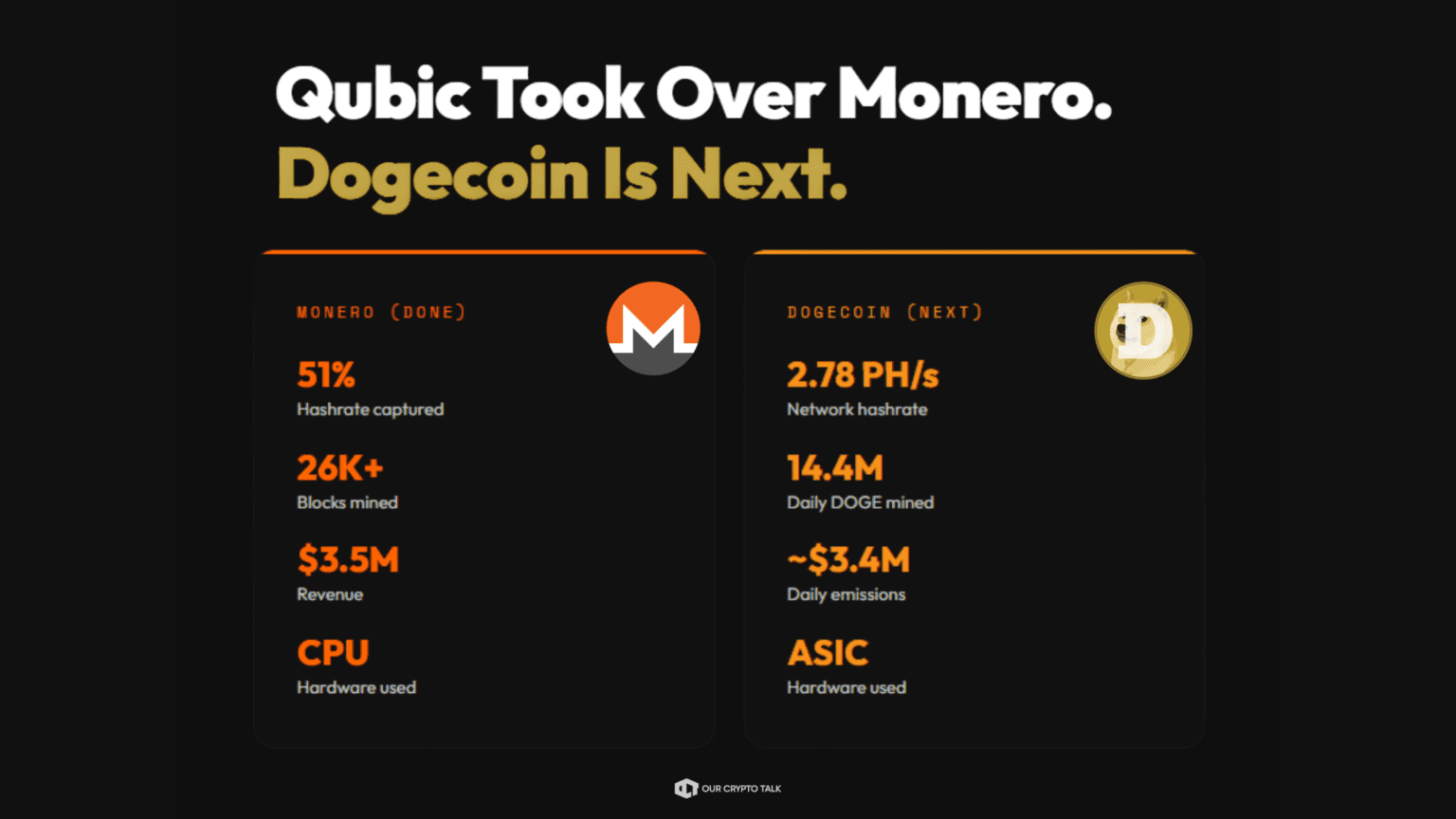
But the technical reason Dogecoin was chosen over other PoW chains is equally important. Dogecoin uses the Scrypt hashing algorithm, which requires ASIC hardware (Application-Specific Integrated Circuits). Qubic’s AI training runs on CPUs and GPUs. These are entirely different hardware categories.
This means DOGE mining and AI training can run at the same time on the same Qubic network without competing for resources. ASICs handle Dogecoin. CPUs and GPUs handle Aigarth. The alternating model that limited the Monero integration is completely eliminated. Both workloads run in parallel, 24/7.
This is the architectural breakthrough that makes Dogecoin a fundamentally better fit than Monero for Qubic’s long-term strategy.
During the February 19, 2026 All Hands AMA, Qubic’s core tech lead Joetom walked through the full technical architecture for the first time. The system consists of four main components working together.
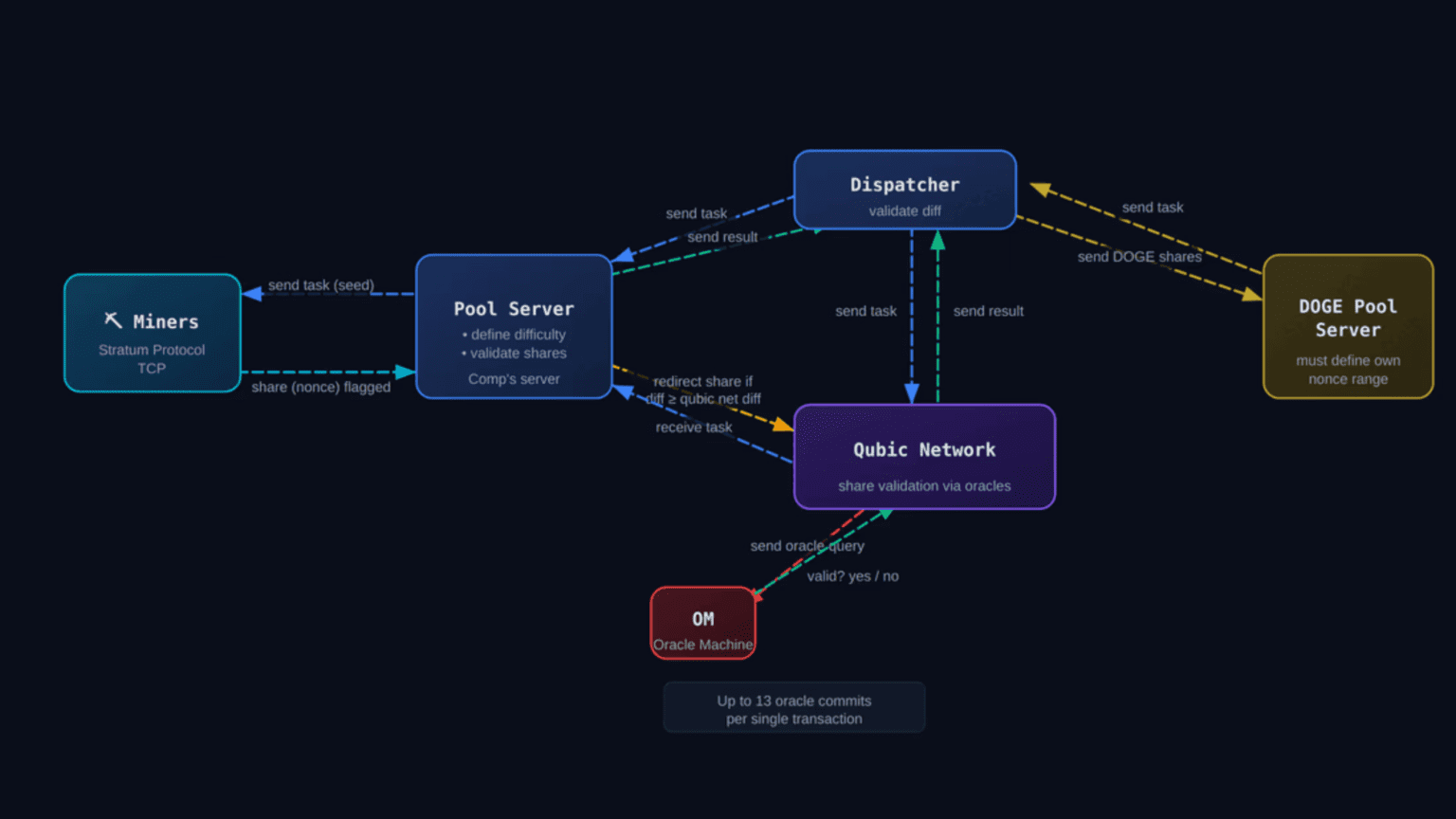
Miners connect through the Stratum protocol (TCP) to a Pool Server. These are ASIC miners running the Scrypt algorithm, the same hardware used for standard Dogecoin mining.
The Pool Server acts as the coordination layer. It distributes work assignments, sets the difficulty threshold for what counts as a valid share, and checks incoming submissions from miners.
The Dispatcher is a custom bridge between the Qubic network and a Dogecoin Pool Server. It translates Doge pool tasks into a format that Qubic miners can process, and routes completed work back to the Doge pool.
Oracle Machines are the critical innovation. Instead of trusting a single pool operator to validate shares (the standard model in traditional mining pools), Qubic submits each share to decentralized verification through its Oracle Machines. Up to 13 oracle commits per transaction ensure that share validation is trustless and transparent.
Think of the entire system like a postal service with built-in fraud detection. The Pool Server is the local post office handing out work and checking stamps. The Dispatcher is the translator between two different postal systems. And Oracle Machines are the independent auditors making sure nobody is forging stamps or skimming packages.
This is the first real-world external use case for Qubic’s Oracle Machines, which went live on mainnet on February 11, 2026. As of the last reported update, over 11,000 successful oracle queries had been processed with zero unresolvable requests. Starting in late March, Oracle participation will also directly affect Computor revenue, adding an economic incentive layer to what was previously a voluntary role.
As of the March 19, 2026 All Hands recap, the integration is on track.
The dispatcher is live this epoch. Computors can already pick up test tasks. A software-based test miner has already produced the first DOGE share through the full pipeline – from the Doge pool, through the dispatcher, to the miner, and back. This milestone validates the entire flow architecture.
The mainnet launch target remains April 1, 2026, with full production targeted for April 30. The team has been clear that network stability takes priority over hitting dates. If testing reveals issues, the timeline will be extended.
Two open items remain. The community needs to decide which existing Doge pool to start with via a Discord poll, and the core team is asking community members with ASIC hardware to help test end-to-end.
The economic model mirrors what worked with Monero, but at potentially much larger scale.
DOGE mined through the Qubic network flows through the dispatcher. Mining rewards get converted and used to buy back and burn $QUBIC tokens. Every DOGE block mined through Qubic is effectively a $QUBIC buy-and-burn event.
With 14.4 million DOGE in daily emissions (roughly $3.4M at current prices), even capturing a small percentage of Dogecoin’s mining output could create meaningful deflationary pressure on $QUBIC supply. The ASIC mining layer is entirely additive. It generates new revenue that didn’t exist before without cutting into existing CPU/GPU miner rewards from AI training.
This is the key difference from most token burn mechanisms in crypto. Most burns are funded by transaction fees or treasury allocations. Qubic’s burns are funded by external mining revenue from other blockchains. The value isn’t recycled from within the ecosystem – it’s imported from outside.
One practical benefit for hardware owners: older Scrypt ASICs like the Antminer L3+ have been collecting dust for years because they can’t turn a profit on standard Doge pools. Through Qubic Dogecoin mining, these machines get a second life. They can contribute hashrate to the network, with all mined DOGE flowing through the dispatcher. For miners sitting on depreciated hardware, this is free revenue from equipment that was otherwise worthless.
The April 1 mainnet launch coincides with a significant moment for Qubic’s visibility. The project is set to present at Paris Blockchain Week 2026 on April 15-16 at the Carrousel du Louvre. If the launch schedule holds, the team will be presenting a system in production, not a proof of concept, to an audience of over 10,000 participants including institutional players.

Qubic is also arriving at PBW with additional credibility markers. The network recently hit a certified record of 15.52 million transactions per second, verified by CertiK. Network tick speed has nearly doubled to 0.6 seconds after the latest core optimization. And on the research front, two Neuraxon papers have been accepted at peer-reviewed scientific conferences under IEEE and Scopus indexing, with additional submissions in progress for ALife and AGI conferences. Very few crypto protocols can point to independent scientific validation at this level.
The next Qubic halving is targeted for August 2026, which adds another deflationary catalyst to the timeline. Between the Dogecoin mining revenue feeding buy-and-burns and a halving reducing new emissions, the supply-side pressure on $QUBIC could compound significantly in the second half of the year.
Short answer – almost certainly not through brute force.
Dogecoin’s hashrate is currently at an all-time high of approximately 2.78 PH/s (petahashes per second). That’s orders of magnitude larger than Monero’s gigahash-scale hashrate. Without existing ASIC mining power, Qubic would need to match the entire 2.78 PH/s and surpass it. That would require roughly $2.85 billion in hardware plus approximately $2.5 million per day in electricity.
Beyond the hardware costs, Dogecoin has several structural defenses that Monero lacked. Its mining ecosystem is ASIC-driven, meaning miners have significant hardware investments that can’t be repurposed. It has diverse mining pools, institutional backing, and a massive grassroots community that has enjoyed over $1 billion in block rewards over the last year.
Qubic’s strategy here isn’t to overpower Dogecoin. It’s vampire mining – making mining through Qubic’s system more profitable than mining alone, and letting economic incentives do the work. If they can offer better returns, miners switch voluntarily. The network grows organically rather than through force.
Dogecoin mining is a milestone, but the significance extends beyond adding another coin to mine.
It proves that Qubic’s infrastructure – Oracle Machines, smart contracts, and the computor network – can support external use cases at scale. DOGE mining is the first application built on top of Oracle Machines, but the same validation framework can serve price feeds, cross-chain data, and any external information that smart contracts need to act on.

It also demonstrates that Useful Proof of Work can expand horizontally. CPU/GPU resources train AI. ASIC resources mine Dogecoin. Future hardware categories could plug into additional workstreams.
Monero proved the engine works. Qubic Dogecoin mining proves it scales. And if April 1 goes as planned, Qubic will have a live, revenue-generating mining operation feeding directly into its token economy – built on decentralized infrastructure that no single operator controls.
The machine doesn’t stop. It just picks a bigger target.


Qubic Dogecoin Mining Explained: What It Is and Why It Matters
Bitcoin Miner Crisis: Trigger for the Next BTC Move
Meta Metaverse Failure Explained: How $80 Billion Burned on a Future That Never Arrived
Biggest Crypto Hacks of All Time : $6B+ Stolen and Counting
Qubic Dogecoin Mining Explained: What It Is and Why It Matters
Bitcoin Miner Crisis: Trigger for the Next BTC Move
Meta Metaverse Failure Explained: How $80 Billion Burned on a Future That Never Arrived
Biggest Crypto Hacks of All Time : $6B+ Stolen and Counting


