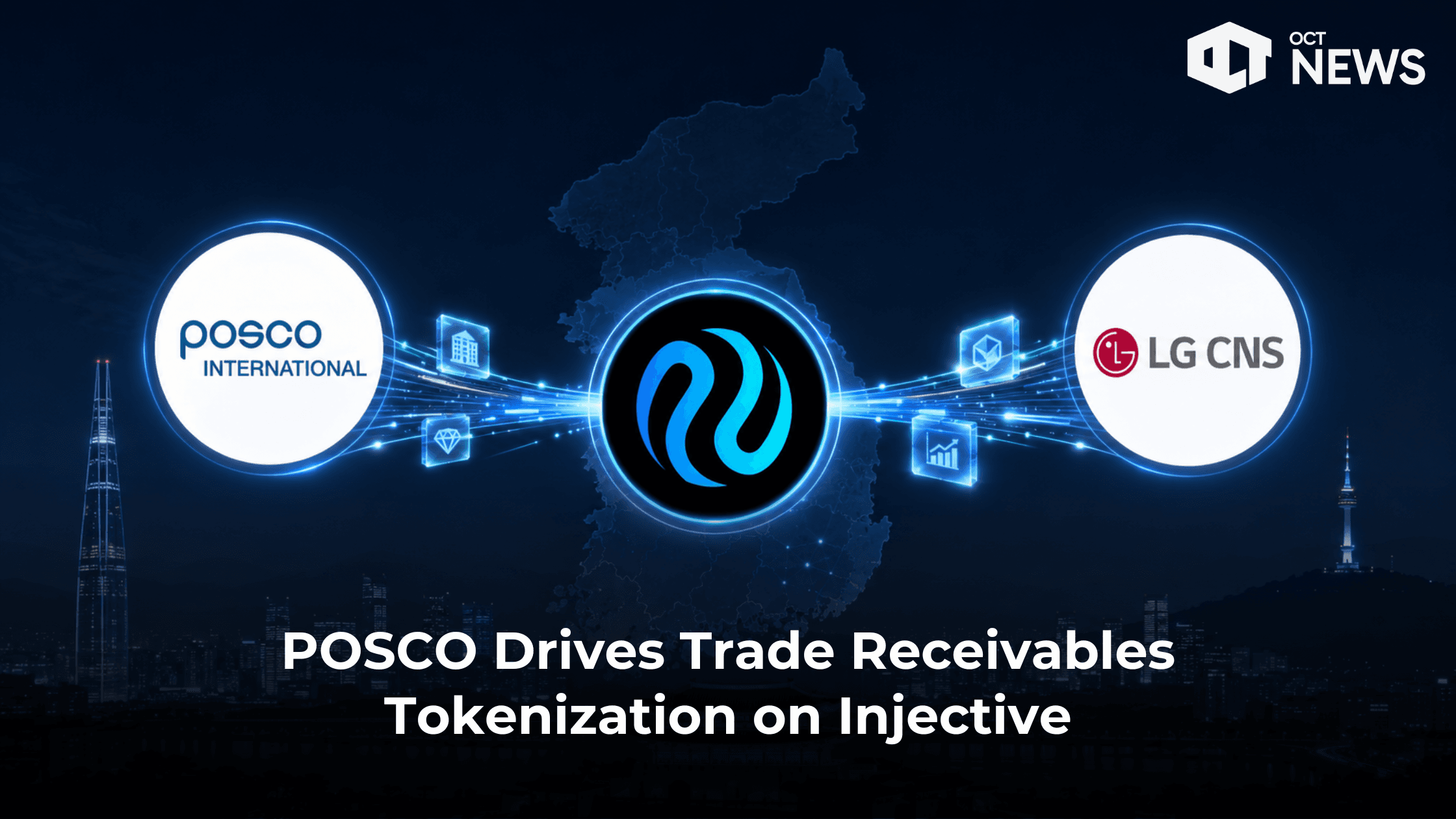
POSCO LG CNS Injective RWA Pilot tokenizes live trade receivables, combining blockchain, compliant infrastructure for global trade finance.

Author: Kritika Gupta
21st August 2026- POSCO International, South Korea’s largest trading company, has put real trade invoices on-chain with Injective tokenization. Working with LG CNS, it completed a proof-of-concept and launched a live pilot on Injective. The two firms announced the milestone in late July 2026.
The pilot stands out because it uses live data, not test data. According to CoinDesk, POSCO tokenized actual accounts receivable from trade between its overseas subsidiaries and their counterparties. In short, real invoices became permissioned digital assets.
High Signal Summary For A Quick Glance

Chrisncreation.inj 🥷
@NwudeChris1

POSCO International + LG CNS tokenized actual commercial receivables using live data. AI agents reviewed the Letters of Credit and docs. Compliance controls were baked straight into the onchain assets. And now Injective is now an SEC-registered transfer agent. This week https://t.co/B57Njppwp5 https://t.co/V7yEaiA7GD

ICYMI: Injective is breaking new ground in tokenization by combining purpose-built RWA infrastructure, AI-powered finance, and regulatory rails into one unified network for the first time. South Korea’s largest trading company, POSCO International, and LG CNS recently launched a https://t.co/xuLuHdkl8G
03:08 PM·Aug 21, 2026
High attention and emotional sentiment detected.
POSCO International handled the trade side, while LG CNS, the IT arm of LG Group, served as the technology partner. The POSCO Injective pilot tested whether blockchain and AI could support core trade finance tasks.
The setup has three parts. First, receivables were issued as permissioned real-world assets on Injective. Second, a shared ledger gave headquarters, subsidiaries, and partners one synchronized view. Third, AI agents reviewed trade documents for errors.
LG CNS also brings a strong institutional track record. It helped build the Bank of Korea’s Project Hangang CBDC pilots and operates tokenization platforms for KOSCOM and Mirae Asset Securities.
Injective co-founder Eric Chen framed the POSCO Injective collaboration as a proof point. “When South Korea’s largest trading company and LG CNS choose Injective for live trade receivables, it demonstrates Injective’s ability to move real capital markets onchain,” he said.
A trade receivable is a claim for payment after goods ship. In this pilot, each claim becomes a permissioned token on Injective. The token carries its own compliance rules.
This is where trade receivables tokenization differs from a simple database entry. Injective’s native RWA module sets the rules at the protocol level. So only approved holders can receive the asset, and transfers follow set restrictions.
Compliance also travels with the token. KYC, AML, and eligibility checks stay attached as it moves. Because the pilot is permissioned, these tokens are not open to retail traders.
The shared ledger then cuts reconciliation work. Counterparties see the same record at the same moment. As a result, multi-day paper checks can shrink to near real time.
Injective is a Layer 1 built for finance, based on the Cosmos SDK. It added a native RWA module with its Volan upgrade in early 2024. That module supports permissioned assets and protocol-level controls.
The chain has leaned harder into institutions this year. It launched Injective Mint, an issuance platform, around July 2026. Separately, Injective Institutional Services gained SEC transfer-agent registration, effective around 19 August 2026.
That registration matters for regulated finance. A transfer agent can keep official records of securities ownership. According to Injective, those records can sit on a distributed ledger.
POSCO is not new to blockchain either. In April 2026 it issued a roughly $100 million digital bond on HSBC Orion. That made it the first non-financial Korean company to do so.
The pilot also tested AI agents for paperwork. Letters of credit and supporting documents are dense and error-prone. So the AI agents scan them and flag discrepancies before settlement.
This is the AI half of the blockchain-and-AI pitch. In theory, faster document checks reduce disputes and delays. POSCO said the pilot confirmed real efficiency gains in these areas.
A POSCO International spokesperson called the results meaningful. “This PoC is significant in that it validated the applicability of AI and blockchain technology based on real trade data and processes,” the company said in its press release.
Plenty still remains undisclosed. POSCO released no figures for the value of receivables tokenized, the transaction count, or any pilot TVL. For context, the company reported roughly $22.2 billion in revenue last year. That figure describes its business, not the pilot.
There are also no public contract or token addresses. The assets are permissioned, so they mostly stay off public explorers. That limits independent on-chain verification for now.
Some analysts urge caution too. Ledger Insights noted that a purely intra-group shared ledger may not require a public chain at all. It also assumed that sensitive commercial details stay off-chain.
POSCO plans to finalize a pilot operation framework in the second half of 2026. It will focus on the areas where efficiency gains were confirmed. Then it aims to apply the system to real operations in phases.
Full production is still ahead, not done. The firms describe this as a first-of-its-kind pilot, though tokenized trade finance has earlier precedents. So the “first” framing is best read as Injective’s marketing.
Market watchers will track whether trade receivables tokenization scales beyond POSCO. INJ traded near $5 around both the July pilot news and the August transfer-agent update. Its moves tracked the broader market more than any single headline.
This article is informational and not financial advice. Always do your own research before acting on any token or project. For now, POSCO’s live pilot stands as a real test of on-chain trade finance.
Our Crypto Talk is committed to unbiased, transparent, and true reporting to the best of our knowledge. This news article aims to provide accurate information in a timely manner. However, we advise the readers to verify facts independently and consult a professional before making any decisions based on the content since our sources could be wrong too. Check our Terms and conditions for more info.


Walrus Console Goes Live as Managed Layer for AI Data
Solana Goes Live With x402 Batch Payments for AI Agents
WLFI App Ready to Release, Folkman Says at Token2049
ether.fi to Launch USD Stablecoin on $300M Deposits via Ethena
Walrus Console Goes Live as Managed Layer for AI Data
Solana Goes Live With x402 Batch Payments for AI Agents
WLFI App Ready to Release, Folkman Says at Token2049
ether.fi to Launch USD Stablecoin on $300M Deposits via Ethena

Injective